
Flower Delivery to Saki from Abroad: Zones, Timing and What to Know
People call us from Germany, Israel, the UAE and a dozen other countries every week asking the same opening question: can you actually get fresh flowers to Saki today? The answer is yes, but the details matter more than the yes. Saki is a small city in western Crimea, about 45 kilometres north of Sevastopol, and the logistics of reaching it from abroad involve payment routing, address specifics and variety choices that catch most senders off guard. This article covers everything a sender outside Russia needs to know before placing the order — not in general terms, but with the actual numbers, flower names and timing windows that make the difference between a delivery that lands and one that doesn't.
Why Saki Is Different from Ordering to Moscow or Saint Petersburg
Most international senders picture Russian flower delivery as a single system, but geography splits it sharply. Moscow and Saint Petersburg have flower warehouses restocked daily from Dutch and Ecuadorian auctions. Saki, sitting on the Crimean steppe near the salt lakes, is supplied through a different chain entirely, and the assortment available on any given day reflects that. Roses from Krasnodar greenhouses, local spray chrysanthemums, alstroemeria and seasonal Crimean peonies in May and June are the reliable backbone. Exotic stems — protea, anthurium, bird of paradise — exist but require advance confirmation, usually 24 hours, because they travel to Saki rather than sitting in a local cooler ready to cut. The city itself is compact, which is actually an advantage: once the courier is on the road, most addresses inside Saki are reachable within 20 to 30 minutes. What slows things down is not the last mile but the sourcing window upstream. Senders abroad often assume same-day means within two hours of clicking the button at midnight their time. In practice, orders placed before 10:00 Moscow time reliably hit same-day delivery; orders placed in the afternoon Moscow time may push to the following morning depending on what stems are already conditioned and ready. The second thing that surprises people is that Saki has a significant older population and a strong local tradition of giving flowers on name days and Soviet-era holidays — February 23, March 8, May 9 — so lead times tighten sharply around those dates and booking two to three days ahead is not excessive, it is simply practical.
Bouquets we can deliver



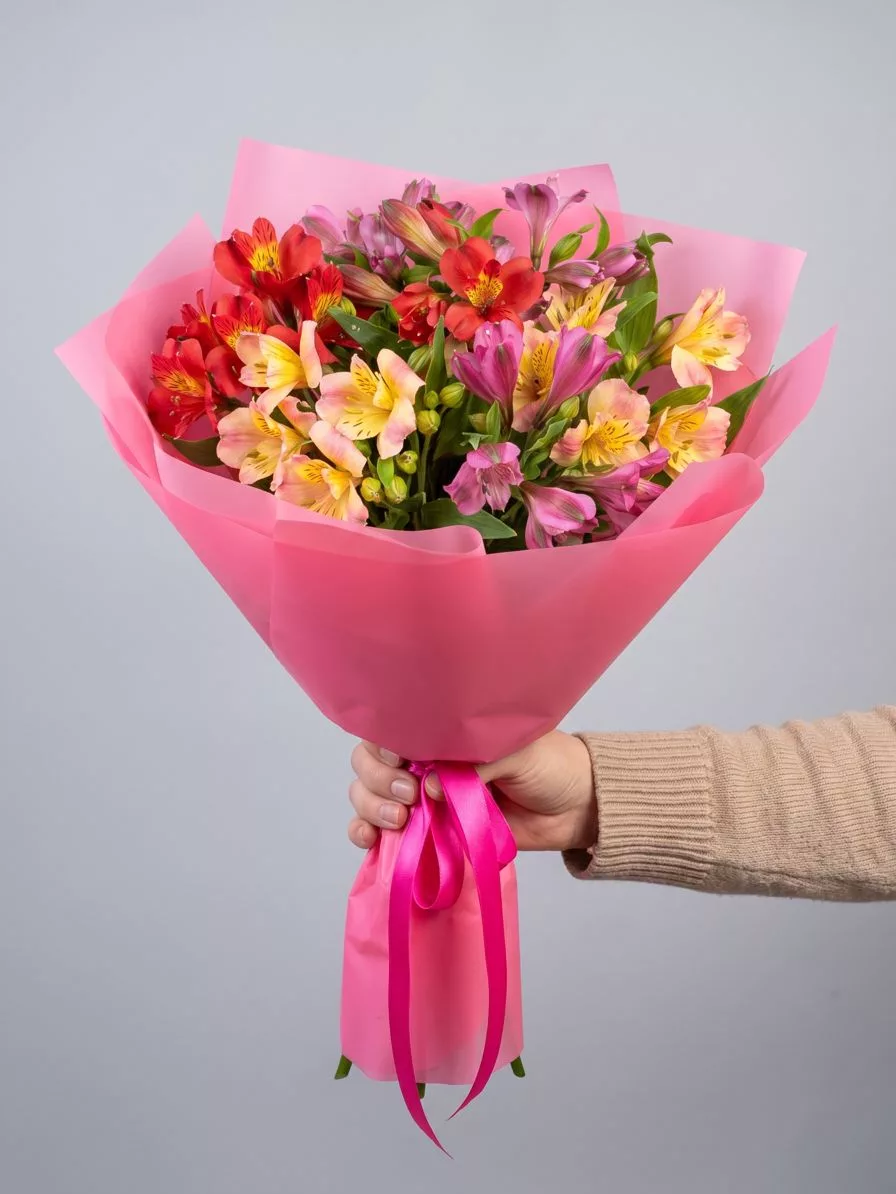
Payment from Abroad: What Actually Works
This is the question that derails more orders than any flower variety issue. Standard Visa and Mastercard issued outside Russia have not processed payments to Russian merchants reliably since 2022, and Saki is no exception to that reality. What does work: cards issued by banks in countries that maintain correspondent relationships with Russian payment processors — some Armenian, Kazakh and Azerbaijani cards go through cleanly. Mir cards work if the sender has one, which is rare for people living in Western Europe or North America. The most friction-free route for most international senders is a bank transfer in roubles using the shop's account details, or payment through services like Wise routed to a rouble account where the recipient bank accepts it. WeChat Pay and Alipay work for senders based in China. The practical advice: contact the shop directly before trying to push a card through three times and triggering a block. A manager can tell you within a few minutes which payment route will clear for your specific country and bank. Keep the time zone difference in mind — Moscow is UTC+3, so a sender in Los Angeles is nine hours behind and a sender in Tokyo is six hours ahead. If you are placing an order in the evening your local time, there may be nobody to confirm payment routing until the Moscow morning, which affects whether the order counts as same-day. Stating your country and preferred payment method in the first message saves everyone 40 minutes of back-and-forth.
Which Flowers Hold Up Best for Delivery in Saki's Climate
Saki has a semi-arid continental climate — hot and dry in summer, cold and windy in winter. That temperature range matters for flower choice. In July and August, when midday temperatures regularly exceed 30 degrees Celsius, delicate open-faced flowers like garden roses, ranunculus and anemones are risky for outdoor transport unless the courier vehicle is refrigerated, which ours is. For summer orders, stems with tougher cell walls perform best: spray roses, alstroemeria, lisianthus in bud stage, solidago and statice. Chrysanthemums are the summer workhorse — they tolerate heat better than almost any other cut flower, and the large-headed varieties like Anastasia and Reagan look substantial in a bouquet without being fragile. In winter, the concern flips: frost damage during the walk from vehicle to door. Gerberas blacken at the tips if left in sub-zero air for even a few minutes, so winter orders should lean toward roses, carnations and hypericum berries, which handle brief cold exposure without visible damage. Spring — April through early June — is the easiest season. Tulips from Crimean growers are genuinely local and fresh, irises open beautifully, and the first peonies arrive in late May. Peonies from Crimean farms are a real seasonal advantage: they are cut closer to the source than anything shipped from Holland, so they arrive tighter and last longer in the vase. If the recipient's birthday or anniversary falls in late May or early June, requesting peonies is the single best flower decision you can make from abroad.
Giving the Right Address: What Russian Address Format Requires
International senders regularly underestimate how precisely a Russian address needs to be written, and Saki has address patterns that confuse people unfamiliar with post-Soviet urban layout. A complete delivery address in Saki includes: the street name and house number, the apartment or office number if applicable, the building or corpus number if the property has multiple blocks, and the entrance number for multi-storey apartment buildings. That last detail — the entrance, called podezd in Russian — is genuinely important. A building with six entrances and 120 apartments will have the courier standing outside guessing without it, and in summer heat that is a problem for both the flowers and the schedule. If the recipient lives in a private house rather than an apartment block, note that house numbers in some Saki streets follow old Soviet numbering that does not run consecutively — odd numbers on one side, even on the other, but sometimes with large gaps. Confirming the address with the recipient before placing the order is not being overcautious, it is just good logistics. Also useful: the recipient's phone number is mandatory, not optional. The courier calls ahead to confirm the person is home or to arrange a handoff. If the recipient is at work, the work address is perfectly fine — just specify it is an office delivery so the courier knows to ask at reception. For surprise deliveries, many senders give a neighbour's number as the contact and arrange for the neighbour to receive the bouquet. This works, but tell us explicitly so the courier is briefed and does not ring the recipient's bell directly.
Timing Windows and How to Use the Moscow Time Reference
Every delivery promise we make is anchored to Moscow time, and international senders need to convert consciously rather than assume. If you are in Berlin, Moscow is two hours ahead of you in winter and one hour ahead in summer. If you are in Dubai, Moscow is one hour behind you. If you are in New York, Moscow is eight hours ahead in winter. The practical consequence: an order placed at 9:00 AM in New York during winter lands at 17:00 Moscow time, which is still within same-day range if the recipient can receive until 20:00. An order placed at 9:00 PM in New York arrives at 05:00 Moscow time, which means it will be processed when the shop opens and delivered that Moscow day — but that Moscow day may already be the date after the occasion you intended. The delivery window in Saki runs from 08:00 to 22:00 Moscow time. Within that window, we offer morning delivery (08:00 to 12:00), daytime (12:00 to 17:00) and evening (17:00 to 22:00). Selecting a window rather than an exact hour is standard practice for fresh flower delivery everywhere, and Saki is no different. For occasions where timing is ceremonial — a birthday dinner at 19:00, for example — request the evening window and specify the earliest acceptable arrival time in the order comments. Flowers cut that morning and delivered by 18:30 will be at their best for the table. One common mistake from abroad: ordering for a date and not specifying a window at all, then being surprised when the delivery happens at 09:00 and the recipient is already at work. The window field exists for a reason — fill it in.
Bouquet Sizes, Stem Counts and What the Numbers Mean in Russia
Russian flower-giving has a specific and widely observed rule about stem count: even numbers of flowers are for funerals, odd numbers are for celebrations. This is not a vague cultural preference — it is something recipients notice immediately and something that will be mentioned if you get it wrong. Standard celebratory bouquets in Russia run to 7, 9, 11, 15, 19, 25 or 51 stems. The jump to 51 is not a typo; a bouquet of 51 roses is a recognised grand gesture for significant anniversaries and milestone birthdays, and in Saki as elsewhere in Russia it reads as serious intent. For a first-time or casual gift, 9 or 11 stems is entirely appropriate and not stingy — the Russian norm is not the same as the Western European habit of buying a dozen. If you are ordering a mixed bouquet rather than a single variety, the total stem count across all flowers still follows the odd-number rule. A bouquet of 5 roses, 4 alstroemeria and 2 eucalyptus branches contains 11 stems total and is correct. Packaging matters too: Russian recipients expect flowers to arrive wrapped, typically in kraft paper or a decorative sleeve with a ribbon, not in a bare hand-tied bunch. Our bouquets are packaged for hand delivery by default. If the recipient is someone who will display the bouquet in a vase immediately, you can request that the stems be cut at an angle and wrapped in damp paper for transit, which extends vase life by a day or more. Mention this in the order comments and it will be done.
What to Include in the Card and How Cyrillic Works for Senders Who Don't Read It
A card or note is standard with any delivered bouquet in Russia, and the absence of one is noticed — it can make a recipient wonder if the delivery was meant for someone else. If you write in English, we will include the message exactly as written, which is fine for recipients who read English. If you want the message in Russian but cannot write Cyrillic yourself, the cleanest approach is to write the text in English in the order comments and add a note asking for it to be transliterated or translated into Russian. Transliteration means rendering your words phonetically in Cyrillic so a Russian reader can sound them out — this works well for names and short phrases. Translation means converting the meaning, which is better for full sentences. Specify which you want. Common phrases that translate well: happy birthday (s dnyom rozhdeniya), congratulations (pozdravlyayu), with love (s lyubovyu), thinking of you (dumayu o tebe). For longer messages, keep the tone warm and direct — flowery metaphors sometimes lose their meaning in translation and land as awkward. One thing that surprises senders from more formal cultures: it is entirely normal in Russia to include a personal and even sentimental message on a card from a flower shop. The florist is not reading it critically; the card is sealed or folded before delivery. If the occasion is a reconciliation or an apology, say so plainly in the message — Russian recipients appreciate directness in personal notes more than elaborate circumlocution. The card is included at no extra charge and is part of every standard order.
Sending flowers to Saki from abroad is not complicated once you know the three things that actually matter: confirming your payment method before the order rather than after, placing the order before 10:00 Moscow time for same-day delivery, and giving a complete address including apartment number and entrance. Everything else — variety choice, stem count, card wording — we can guide you through in a few messages. The flowers reach Saki fresh because we handle the sourcing and the courier route ourselves, and because we have been doing exactly this for customers in dozens of countries long enough to know where the friction points are. If you are unsure about anything, contact us before you order rather than after: it takes less time to answer a question than to redirect a delivery. We deliver bouquets across Russia in 1–2 hours.
Frequently asked questions
Can I order flowers to Saki on the same day from a different country?
Yes, if you place the order before 10:00 Moscow time. That cutoff gives enough time to source, condition and dispatch the bouquet within the same delivery day. Orders placed in the afternoon Moscow time are assessed case by case depending on what is already prepared — contact us directly and we will tell you honestly what is possible.
What if the recipient is not home when the courier arrives in Saki?
The courier calls the recipient's number before arriving. If there is no answer, the courier attempts the delivery and then contacts you, the sender, for instructions. We can reroute to a workplace, leave with a neighbour if pre-arranged, or reschedule for later the same day. Providing a reliable recipient phone number when ordering prevents almost all missed-delivery situations.
Do I need to know Russian to place an order for Saki delivery?
No. Our managers handle orders in English. The address and card message are the only elements that need to be in Russian for the recipient's benefit, and we can transliterate or translate both from your English text. Write everything in English in the order form and add a note specifying whether you want the card translated or left in English.
Which flowers are actually available in Saki, not just in Moscow?
Reliably available year-round: roses, spray roses, alstroemeria, chrysanthemums and carnations. Seasonal additions include tulips and irises in spring, Crimean peonies from late May through June, and sunflowers in summer. Exotic varieties like protea or tropical flowers require 24-hour advance notice to source. When in doubt, ask us to confirm availability for your delivery date before finalising.
Is it appropriate to send flowers to a man in Russia?
Yes, and it is more common than many Western senders expect. February 23 — Defender of the Fatherland Day — is the standard occasion for gifting men, and flowers are a normal part of that. Bouquets for men in Russia typically lean toward structured compositions with roses, irises or chrysanthemums rather than soft mixed arrangements, and the packaging is often simpler. Tell us the recipient is male and we will compose accordingly.
Ready to send a bouquet?
Pick a city, choose the flowers, and we will hand them over with a photo confirmation.
Choose a city →