
Flower Delivery to Sukhinichi from Abroad: Zones, Timing and Varieties
Sukhinichi is a small town in Kaluga Oblast, and every week we receive orders for it from people calling or writing from Germany, the United States, Israel, Kazakhstan and a dozen other countries. The questions are always the same: will it actually arrive, how long does it take, and what flowers survive the journey in good condition? This article answers all of that plainly, based on what we see every day on the shop floor.
Where Sukhinichi Is and Why That Matters for Delivery
Sukhinichi sits roughly 270 kilometres south-west of Moscow in Kaluga Oblast. It is not a large city — the population is under ten thousand — but it is a proper administrative centre with residential streets, a railway station and addresses that courier services can reach. When you order from abroad, the distance that matters is not from your country to Russia but from our Saint Petersburg warehouse to the recipient's door in Sukhinichi. That route runs through Moscow and then south-west along the M3 highway corridor, and it determines the delivery window we quote you. We work on a 1–2 hour delivery promise for major Russian cities, and for Sukhinichi we plan the route carefully so the flowers are cut and packed as close to dispatch as possible, not the day before. The town's relatively low traffic density compared to Moscow or Kaluga city actually helps: once a courier is in Sukhinichi, finding the address and completing the handover is usually straightforward. What complicates things is not geography but timing: orders placed late in the evening for same-day delivery to a regional town require confirmation, so placing your order before noon Moscow time gives us the most room to work. If you are in New York, that means before 5 a.m. Eastern — realistically, ordering the evening before your intended delivery date is the sensible approach from a North American time zone.
Bouquets we can deliver



How to Place an Order When You Are Outside Russia
The most common mistake international senders make is assuming they need a Russian phone number or a Russian bank card. You do not. Our website accepts international cards, and you can reach us by WhatsApp or email in English. When you fill in the recipient's details, write the address in Russian if you have it, or write it in Latin letters and we will transliterate it — our operators do this dozens of times a week. The recipient's mobile number is essential: the courier calls ahead, and in a town like Sukhinichi where buildings can be spread out, that call saves time. If you do not have the recipient's number, tell us, and we will arrange a surprise delivery with a door knock, though this adds a small risk of a missed handover if no one is home. Payment goes through a secure gateway; you will see the charge in your local currency converted at the current rate. After payment, you receive an order confirmation by email with an order number and an estimated delivery window in Moscow time, so you can convert it to your local time zone and know when to expect a photo confirmation from us. We send a photo of the bouquet at the door as standard — this matters especially for international senders who cannot check in person.
Which Flowers Travel Well to Sukhinichi
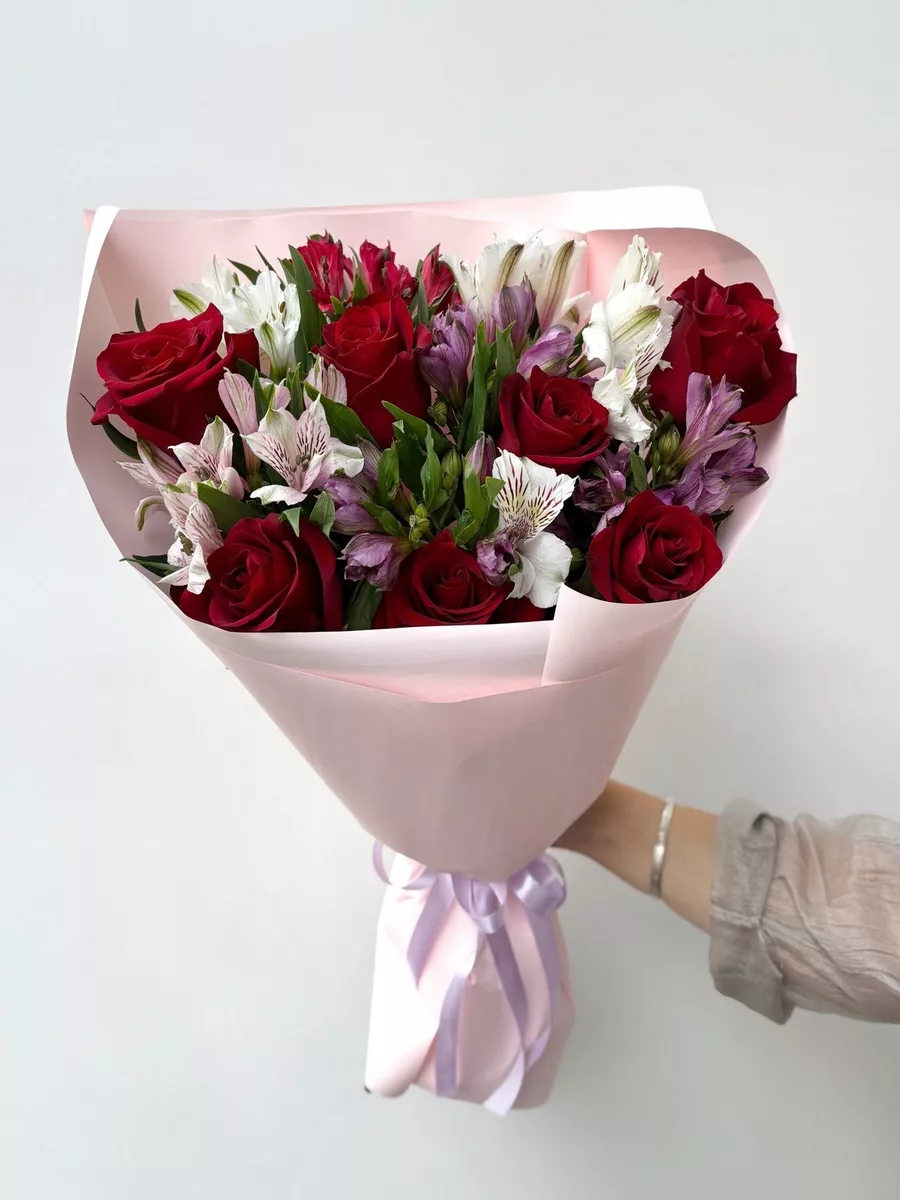
Not every flower is equally suited to a delivery that involves distance and potentially a few hours in transit. Roses are the most reliable: Dutch spray roses and large-headed garden roses both hold their form well when properly hydrated before packing. We use aqua-pack sleeves — a water-filled collar around the stems — for all deliveries beyond 150 kilometres, and Sukhinichi qualifies. Chrysanthemums, both single-stem and pompon varieties, are exceptionally robust and arrive looking exactly as they left the shop. Alstroemeria is another strong choice: the buds are partially closed when packed and open beautifully over the following two to three days at the recipient's home, which means the flowers effectively have a longer visible lifespan. Tulips are seasonal and more delicate; in spring they are fine, but in summer heat they droop quickly in transit, so we advise against them for warm-weather deliveries unless the recipient is home to receive them immediately. Gerberas are popular but their stems are hollow and bend under their own weight if the bouquet is held at an angle for long — we reinforce them with thin wire supports for long-distance orders. Orchid stems in a vase box travel very well and make a striking gift. Avoid requesting open peonies in summer for a distant delivery: they are magnificent but fragile once fully open, and a two-hour transit can bruise the petals.
Seasonal Timing and Temperature Considerations
Russia has genuine seasons, and they affect flower delivery in ways that matter. In January and February, Sukhinichi temperatures regularly drop below minus fifteen Celsius. Flowers cannot sit in an unheated vehicle or on a doorstep for more than a few minutes at those temperatures without cell damage: petals blacken, stems turn soft. We pack winter orders in insulated thermal sleeves and coordinate with the recipient to ensure someone is home during the delivery window. If you are ordering from abroad in winter, confirm with your recipient that they will be available; a missed delivery in deep frost means the bouquet cannot simply be left outside. Summer brings the opposite problem: July and August temperatures in Kaluga Oblast can reach thirty-two to thirty-five Celsius, and roses in particular wilt rapidly in a hot car. We schedule summer deliveries for morning slots where possible and keep vehicles climate-controlled. Spring is the easiest season: tulips, ranunculus and hyacinths are all in good supply from Dutch auctions, travel well in mild temperatures and are reasonably priced. Autumn is excellent for dahlias, lisianthus and seasonal spray roses. When you order from abroad and are not sure what is in season, tell us the occasion and the recipient's taste, and we will recommend what is genuinely fresh that week rather than what merely looks good in a photo. Seasonal flowers are always fresher than out-of-season varieties forced through extra cold-chain steps.
Writing the Card Message from Abroad
A card message is often the most personal part of the order, and for international senders it raises a specific question: should it be in Russian or in the sender's language? The answer depends entirely on the recipient. If your recipient reads English, French, Hebrew or German, we print the card exactly as you write it. If they read only Russian, write your message in your language and ask us to translate it — we do this for English, and for other languages we can transliterate or use a simple translation you provide. The card is printed on a small kraft card and attached to the bouquet; it is not read aloud by the courier, so there is no awkwardness about the courier knowing the content. Keep the message under 150 characters if you want it on one side of the card without shrinking the font. Dates in Russia are written day-month-year, so if your card references a date, write it out in words to avoid confusion — 03/04 means the third of April in Russia, not the fourth of March as it would in the United States. Russian naming customs use a first name and a patronymic in formal contexts, but for a flower card a first name alone is entirely appropriate and warm. If you want to address the card formally — for a colleague or a professional contact — ask us and we will format it correctly. Signed cards from abroad often simply say the city the sender is writing from, which recipients find touching.
Common Mistakes International Senders Make
The most frequent error is underestimating the time difference. Moscow is UTC+3, and there is no daylight saving adjustment in Russia — Russia abolished clock changes in 2014. Someone in Los Angeles ordering at 9 p.m. on a Tuesday is placing an order at 7 a.m. Wednesday Moscow time, which is fine for same-day delivery. Someone in Sydney ordering at 9 p.m. is placing an order at 2 p.m. Moscow time the same calendar day, which is also workable. Confusion arises when senders assume the delivery date they type is interpreted in their local calendar day rather than Moscow's. Always state the intended delivery date as a Moscow-calendar date to avoid a bouquet arriving a day early or late. The second common mistake is providing an incomplete address. Russian addresses follow the format: oblast, city, street, building number, apartment number. Sukhinichi is in Kaluga Oblast, so the address should start there. If you only have a street name and building number, the courier will call the recipient, but having the apartment number saves time in a multi-unit building. The third mistake is ordering flowers the recipient is allergic to — lilies are the main culprit, as their pollen is potent and some people react strongly. If you are not certain, choose roses or chrysanthemums, which are almost universally tolerated. Finally, do not assume the recipient will be home: confirm with them, or choose a delivery window when they are likely to be in.
What Happens After You Place the Order
Once your payment clears, the order enters our production queue. For Sukhinichi, we cut and arrange the bouquet on the morning of the delivery date, not the night before, so the flowers are as fresh as possible when they leave the shop. The stems are cut at an angle, conditioned in clean water with a flower preservative, then packed in the aqua-pack sleeve, wrapped in kraft paper or a decorative sleeve depending on your selection, and placed in a rigid box for transport. The courier collects the order and calls the recipient approximately thirty minutes before arrival. If the recipient does not answer, the courier tries again and, if still unreachable, follows the instructions you provided at checkout — leave with a neighbour, leave at the door, or return and reschedule. You receive a photo of the completed delivery by email or WhatsApp, whichever you used to contact us. If there is any issue — wrong address, recipient not home, flower substitution due to stock — we contact you before making any change, not after. Substitutions happen occasionally when a specific variety is unavailable from the auction that morning; we always replace with something of equal or higher value and similar character. You are never charged more than the original order amount for a substitution. The whole process from your order confirmation to delivery photo typically takes three to six hours for a Sukhinichi order placed before noon Moscow time.
Ordering flowers for someone in Sukhinichi from abroad is genuinely manageable once you know the time zone arithmetic, have the recipient's mobile number and have chosen varieties suited to the season. The town is reachable, the addresses are findable, and the courier system works the same way it does for any Russian city we serve. What makes the difference between a smooth delivery and a frustrating one is almost always the quality of the information you provide at checkout — address, phone number, preferred delivery window and any allergy or preference notes. Get those right, place the order the evening before in your time zone, and the flowers will arrive fresh. We deliver bouquets across Russia in 1–2 hours.
Frequently asked questions
Which rose varieties actually survive the trip to Sukhinichi without arriving half-open?
Dutch spray roses and large-headed varieties like Explorer or Avalanche hold best. We hydrate stems for four hours before packing and use aqua-pack sleeves for any delivery beyond 150 kilometres, which Sukhinichi always triggers. Garden roses with looser petals are riskier in summer heat or January cold. Stick to spray roses if you want the safest result.
How long does delivery from your Saint Petersburg warehouse to Sukhinichi actually take?
The route runs roughly 900 kilometres by road. Standard delivery takes two days from dispatch. If you order before noon Moscow time, we can usually dispatch same day, meaning the flowers arrive the following evening. Express options cut that by one day but cost more and require the recipient to be reachable by phone for courier coordination.
What is the minimum bouquet value that makes sense for a Sukhinichi delivery given the courier cost?
Courier fees to Sukhinichi sit between 800 and 1200 roubles depending on the season and route load. Ordering a bouquet under 2000 roubles means delivery costs more than half the gift value, which most senders find uncomfortable. Bouquets in the 3500 to 6000 rouble range are the most common choice from international customers ordering to this address.
Can I order chrysanthemums to Sukhinichi in winter or does the cold damage them in transit?
Chrysanthemums are actually more cold-tolerant than roses and travel well in winter if packed correctly. The problem is not the flowers but unheated vehicle sections on provincial routes. We insulate packaging for sub-zero conditions, but if temperatures drop below minus fifteen, which happens in Sukhinichi in January and February, we recommend confirming dispatch timing before placing the order.
Do I need to provide a Russian-format address or will Latin letters work for the Sukhinichi delivery form?
Latin letters work. Write the street name and building number as you have them and add the postcode if you know it — Sukhinichi district postcodes start with 249. Our logistics team converts the address before dispatch. If you have the address in Russian Cyrillic from the recipient, paste that directly into the form and it will process without any changes needed.
Ready to send a bouquet?
Pick a city, choose the flowers, and we will hand them over with a photo confirmation.
Choose a city →