
Flower Delivery to Terek from Abroad: Zones, Timing and What to Prepare
Every week we take orders from people calling or messaging from Germany, the UAE, Israel, the United States — someone's mother has a birthday in Terek, a colleague is retiring, a sister just had a baby. The questions are always the same: can you actually reach Terek, how fresh will the flowers be by the time they arrive, and what do I need to tell you to make it work? This article answers all of that plainly, based on what we handle daily at Five Flowers.
Where Terek Is and Why It Matters for Delivery
Terek is a city in the Kabardino-Balkarian Republic in southern Russia, sitting in the North Caucasus region roughly 50 kilometres east of Nalchik. Its position matters practically: the city is not a major transport hub, which means delivery logistics require more precise coordination than sending flowers to Moscow or Saint Petersburg. Roads into the area are generally reliable, but weather in the Caucasus foothills can shift quickly, particularly from November through March when fog and ice occasionally slow ground transport. When you place an order from abroad, you are not just buying flowers — you are buying a timed logistics operation across a large country, and understanding the geography helps you set realistic expectations. Five Flowers coordinates delivery from Saint Petersburg, which means your order enters a national dispatch chain rather than a local one. The distance from Saint Petersburg to Terek is approximately 2,800 kilometres by road. We work with temperature-controlled transport to keep stems viable across that distance, and we plan routes around known bottlenecks. What this means for you as a sender abroad is simple: place your order at least 24 hours before the desired delivery time, and if the occasion is fixed — a birthday, an anniversary — build in an extra half-day buffer. Terek's city centre and main residential districts are within our standard delivery zone, but if the recipient lives in a rural address on the outskirts, confirm the exact street with them before ordering, because incomplete addresses in this region are the single most common reason a delivery is delayed.
Bouquets we can deliver



Timing Your Order Across Time Zones
This is where international senders make the most mistakes, and it is entirely understandable. If you are in London, you are two hours behind Moscow time. If you are in Dubai, you are one hour ahead. New York is seven or eight hours behind depending on the season. Terek follows Moscow Standard Time, which is UTC plus three, and there is no daylight saving adjustment in Russia. When you decide you want flowers delivered at noon on a Tuesday in Terek, work backwards from that Moscow-time noon: if you are in Los Angeles, that is 2 a.m. your Monday night. Most people do not think about this until they are already a day late. We recommend that international customers place orders during our working hours, which run from early morning to late evening Moscow time, so that any questions about the address, the recipient's availability, or variety substitutions can be resolved in real time rather than by message chain. If you place an order outside those hours, it enters the queue and is confirmed at opening — which can push a same-day request into next-day territory. For fixed occasions, the safest approach is to order two days ahead. This gives the dispatch team time to source specific varieties if they are not in current stock, prepare the arrangement, and schedule the Terek leg of the route without rushing. Rush orders are possible, but they narrow your variety options significantly, because what can be delivered quickly depends on what is already prepared and en route to the region.
Which Flowers Survive the Journey to Terek
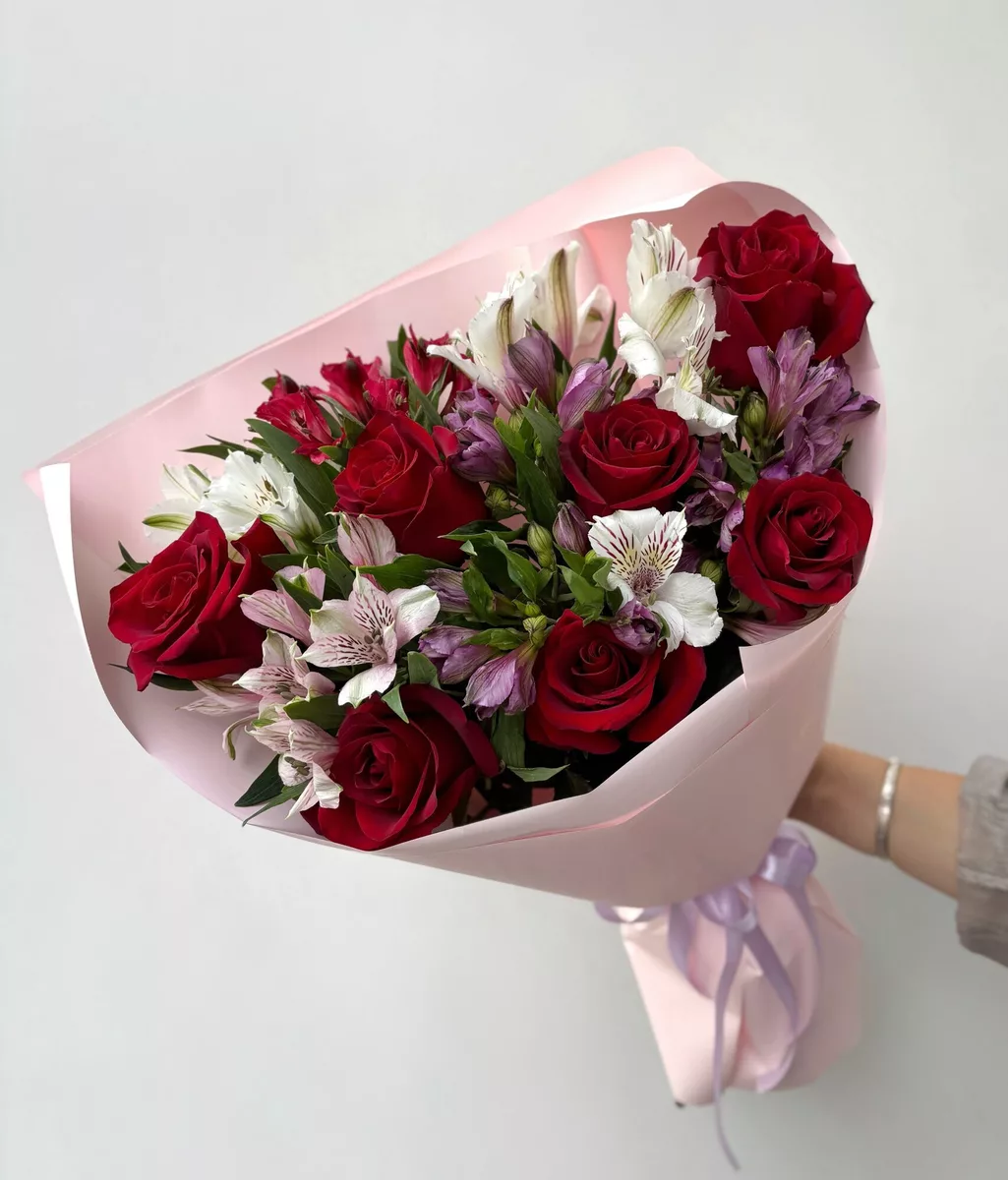
Not every flower that looks beautiful in a Saint Petersburg shop window will arrive in Terek looking the same. Distance and transit time select for hardier varieties, and knowing which ones to choose is part of what a working florist brings to the conversation. Roses are the most reliable long-distance flower when handled correctly: varieties like Explorer, Avalanche, and Red Naomi have tight, firm petals and strong stems that hold up well in temperature-controlled transit of 24 to 36 hours. Chrysanthemums — both spray and single-headed — are exceptionally durable and arrive looking nearly as fresh as they left. Alstroemeria travels well and offers good colour range. Carnations, which many people dismiss as old-fashioned, are genuinely one of the best choices for long-distance delivery: they are robust, long-lasting, and available in a wide range of colours year-round. What tends to suffer on longer routes includes open garden roses with loose outer petals, ranunculus in warm months, and fully open peonies — all of which are beautiful but fragile. Tulips can work in cooler months, roughly October through April, when ambient temperatures outside the vehicle stay low, but in summer they wilt faster than any other common variety. Orchid stems, specifically Cymbidium, travel surprisingly well and add an elegant note to arrangements without the fragility of Phalaenopsis blooms. When you are ordering from abroad and cannot easily have a back-and-forth conversation about what is in season, tell us the colours and the general style — structured and formal, or loose and garden-like — and we will match that to what is actually viable for the Terek route that day.
Russian Customs Around Flowers That International Senders Should Know
If you did not grow up in Russia, a few floral customs will catch you off guard, and getting them wrong can create an awkward moment for your recipient. The most important one: always send an odd number of flowers. Even numbers — two roses, four stems, six tulips — are associated with funerals and mourning in Russian tradition, and presenting an even-numbered bouquet at a birthday or celebration reads as a serious social error. This is not a superstition that younger generations have abandoned; it remains widely observed across all age groups and regions, including the Caucasus. A bouquet of nine roses, eleven tulips, or fifteen mixed stems is correct. A bouquet of ten is not. The second thing to know is that yellow flowers carry a specific meaning in Russian popular belief: they are said to signal separation or unfaithfulness in a romantic relationship. This is not universal — plenty of Russians love yellow flowers and do not attach any meaning to them — but if you are sending to someone you do not know well, or if the occasion is romantic, it is safer to avoid predominantly yellow arrangements unless the recipient has specifically requested them. White flowers are fine for celebrations and are not associated with mourning in the way they sometimes are in other European cultures. Red roses remain the standard for romantic occasions. For birthdays, mixed seasonal bouquets in pinks, corals, and purples are always well received. For professional or congratulatory occasions, structured arrangements with roses or chrysanthemums in neutral tones work well across any age group.
What Information You Must Have Before Ordering
International orders fail most often not because of logistics but because of missing or incorrect information, and the Terek address situation requires particular care. Russia uses a specific address format: republic, city, street name, building number, apartment number, and entry code if the building has a locked lobby. In Kabardino-Balkaria, street names are sometimes given in both Russian and Kabardian versions, and a sender abroad relaying an address phonetically can introduce errors that make the building impossible to find. Before you contact us to place an order, ask your recipient — or someone who knows their address — to write it out in Russian Cyrillic. You do not need to read it yourself; you can copy and paste it into the order form or message. The recipient's phone number is not optional. Our delivery team will call ahead to confirm arrival time, and if the recipient is not home, they will arrange a safe handover or a second attempt. Without a working Russian mobile number, that coordination is impossible. If your recipient uses WhatsApp or Telegram on a non-Russian number, let us know — there are ways to work around this, but we need to know in advance. Finally, confirm whether the recipient knows a delivery is coming. Surprise deliveries are romantic in theory, but in practice they work best when the recipient is reliably at home. If they are at work, at school, or travelling on the delivery day, the flowers will wait in the vehicle longer than intended, which affects freshness. A semi-surprise — telling the recipient to expect a delivery without revealing who it is from — is the practical middle ground most of our customers settle on.
Seasonal Considerations for Terek Deliveries
The North Caucasus has a continental climate with hot summers and cold winters, and this affects both what we can send and how we package it for transit. In July and August, ambient temperatures in the Terek area regularly exceed 35 degrees Celsius. Any flower that leaves our cold storage will begin warming the moment it is loaded for the final delivery leg, which means the transit window tightens significantly. During these months we pack arrangements with additional cooling gel packs and prioritise varieties with natural heat tolerance: roses, carnations, and chrysanthemums. We avoid sending open peonies, ranunculus, anemones, and sweet peas in summer because they will not survive the last few kilometres in good condition. From November through February, the opposite problem applies: temperatures can drop below freezing overnight, and flowers that freeze even briefly — particularly roses and lilies — develop dark patches on petals that do not recover. We use insulated packaging for winter shipments and time the final delivery leg to avoid early morning or late evening drops when temperatures are lowest. Spring and autumn are the easiest seasons for Terek deliveries. March through May brings tulips, daffodils, hyacinths, and the first peonies of the year, all of which travel well in mild temperatures. September and October offer dahlias, lisianthus, and the full rose range. If you are planning a delivery for a specific occasion and that occasion falls in summer or deep winter, mention it when you order — we will adjust the variety selection and packaging without being asked, but knowing the destination climate context helps us make better choices faster.
Paying from Abroad and Confirming Your Order
Payment from outside Russia is a practical question that comes up on almost every international order, and the answer has become more straightforward than it was a few years ago. Five Flowers accepts payment through several methods that work for customers outside the Russian banking system, and the order confirmation process is designed to work across messaging apps and email so that you do not need to be available by phone during Moscow business hours. When you place an order, you will receive a confirmation that includes the delivery date, the recipient's address as we have it recorded, the selected arrangement or agreed style, and the scheduled delivery window. Read this confirmation carefully and check every field — address, recipient name, phone number, and date. If anything is wrong, the time to catch it is before the flowers are prepared, not after. For orders placed more than 48 hours in advance, we send a reminder the day before dispatch so you have a second chance to flag any changes: the recipient's schedule has shifted, you want to add a card message, or you have learned that the address is actually the workplace rather than home. Card messages for Terek deliveries can be written in English, Russian, or any other language — we print them as supplied. If you want the message in Russian but do not write Russian yourself, you can send us the text in English and we will translate it into natural, appropriate Russian for the occasion. This is a free service and one that recipients genuinely appreciate, because a message that clearly came through a machine translator reads very differently from one that sounds like a real person wrote it.
Sending flowers to Terek from abroad is entirely manageable once you have the right information in front of you. The distance is real, the logistics require planning, and the address details matter more than almost anything else. Get those three things right — order with enough lead time, provide a complete Russian address with a working phone number, and choose varieties suited to the season — and the rest is our job. Five Flowers has been handling exactly these kinds of orders for years, and the satisfaction of knowing that someone in Terek opened their door to a fresh, well-chosen bouquet that you arranged from thousands of kilometres away is one of the better things this work produces. We deliver bouquets across Russia in 1–2 hours.
Frequently asked questions
Can I order flowers for Terek if I do not speak Russian?
Yes. Our order process works in English via the website, email, and messaging apps. If you need a card message translated into Russian, send us the text and we will handle the translation at no extra charge. The only thing we need from you in Russian is the recipient's address written correctly, which you can get by asking the recipient to send it to you in text form.
How far in advance should I order for a birthday in Terek?
At least 24 hours, but 48 hours is strongly recommended for Terek specifically. This allows time for variety sourcing, arrangement preparation, and scheduling the delivery route. For major occasions like milestone birthdays or anniversaries, ordering three days ahead gives you the widest choice of flowers and the most flexibility if anything needs adjusting.
What happens if the recipient is not home when the delivery arrives?
Our delivery team calls ahead to confirm a handover time. If the recipient is unreachable or not home, we attempt to arrange a second delivery window the same day. This is why a working phone number is essential. Without contact, the driver cannot coordinate, and the flowers remain in the vehicle longer than intended, which affects their condition on arrival.
Are there flowers I should avoid sending to Terek in summer?
Yes. Ranunculus, fully open peonies, anemones, and sweet peas do not handle the heat of the final delivery leg well in July and August. Stick to roses, carnations, chrysanthemums, and alstroemeria during hot months. These varieties have tighter petals and better heat tolerance, and we pack them with additional cooling material to extend their freshness through transit.
Why does the number of flowers in a Russian bouquet matter?
In Russian tradition, even numbers of flowers are associated with mourning and are given at funerals. Sending an even-numbered bouquet to a celebration is considered a significant social error. Always choose an odd number: seven, nine, eleven, fifteen, and so on. This custom is observed widely across Russia including in the Caucasus regions, regardless of the recipient's age or background.
Ready to send a bouquet?
Pick a city, choose the flowers, and we will hand them over with a photo confirmation.
Choose a city →