
Sending Flowers to Tynda from Abroad: What Every Sender Needs to Know
Tynda sits deep in the Amur Oblast, roughly 850 kilometres north of Blagoveshchensk, and it is one of those cities where ordering flowers from abroad forces you to think about things a local sender takes for granted — transit time, cold chain, which varieties actually survive the journey, and what information the recipient needs to have ready. Customers calling us from Germany, South Korea, the United States and Israel all run into the same cluster of questions, and most of those questions have straightforward answers once you understand how distance, climate and flower biology interact in this particular corner of Russia.
Why Tynda Is a Different Kind of Delivery Challenge
Tynda is a railway city — it grew around the Baikal-Amur Mainline — and that history shapes everything about its logistics today. The population sits around 30,000, which means the city is large enough to receive regular courier services but small enough that delivery windows are narrower than in Moscow or Saint Petersburg. When a customer in Amsterdam or Tokyo places an order, the first thing to understand is that the flowers travel from our Saint Petersburg hub by temperature-controlled transport, and the total transit to Tynda is longer than to most Russian cities. The climate matters enormously here. Tynda experiences a sharply continental climate with winter temperatures regularly dropping below minus 35 degrees Celsius and summers that can push above 30 degrees. That 65-degree annual swing means the packaging and thermal protection required in January are completely different from what is needed in July. A bouquet of garden roses wrapped for a mild Saint Petersburg autumn will arrive as frozen stems in a Tynda February. Senders from abroad often underestimate this because they picture Russia as uniformly cold, but summer heat damage is just as real a risk as winter freeze. The practical consequence is that delivery to Tynda requires advance planning of at least 24 to 48 hours beyond what you would need for a central Russian city, and the order must be placed during Moscow business hours to enter the dispatch queue on time. Late-evening orders from time zones far behind Moscow, such as the US East Coast, can miss the daily cutoff entirely.
Bouquets we can deliver

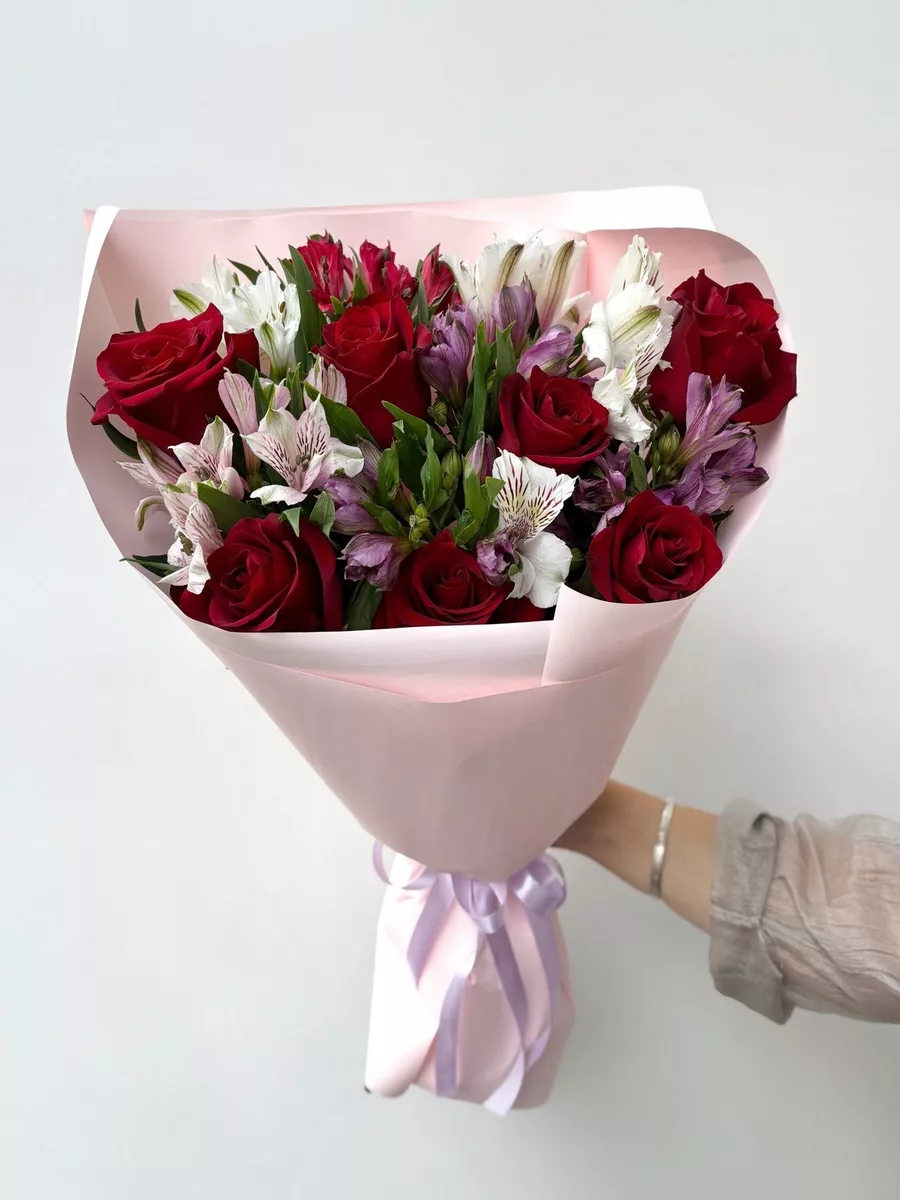


Which Flowers Actually Arrive in Good Condition
The varieties that survive long transit to remote Siberian and Far Eastern cities are a shorter list than most senders expect, and it is worth knowing it before you build a bouquet in your head. Chrysanthemums are the most reliable choice for Tynda year-round. Both spray chrysanthemums and single-headed varieties such as Zembla or Anastasia hold their structure through temperature fluctuation, tolerate dry air in transit packaging, and open slowly enough that the recipient gets several days of display time after arrival. Alstroemeria is another strong option — the buds travel in a closed state and open at room temperature over 48 hours, which actually works in the sender's favour for a long-distance order. Standard carnations, particularly Dianthus caryophyllus varieties in the 60 to 70 centimetre stem length range, are robust and widely underestimated by customers who associate them with cheaper arrangements; they hold water well and do not bruise easily in cold packing. What struggles badly on long routes to Tynda: garden roses with thin petals, ranunculus, anemones, sweet peas, and any tropical variety such as strelitzia or anthurium that reacts poorly to cold. Dutch roses in the Avalanche, Explorer or Mondial varieties are borderline — they travel acceptably in summer but need very careful thermal management in winter. Tulips are seasonal and only viable in spring when temperatures in transit are moderate. Hydrangea heads are fragile and prone to wilting if humidity drops during transit, which it usually does. Stick to the reliable list and the bouquet will look presentable on arrival.
Timing: When to Place the Order and What Affects the Window
The single most common mistake senders from abroad make is calculating delivery time from their own time zone rather than from Moscow time. Moscow is UTC plus 3, and Tynda is UTC plus 9, which means Tynda is six hours ahead of Moscow. When a customer in Los Angeles at 8 in the evening thinks they are placing a next-day order, it is already 7 in the morning the following day in Tynda. The order cutoff for same-day dispatch from our hub is typically early afternoon Moscow time, so senders in Western Europe have a reasonable window, but senders in the Americas need to plan a full calendar day ahead to be safe. The 1 to 2 hour delivery promise that applies within Saint Petersburg does not extend to Tynda — the city is simply too far for that model, and any shop claiming otherwise is not being straight with you. Realistic delivery to Tynda runs on a schedule that requires the order confirmed by a specific Moscow-time cutoff, after which the bouquet enters the next dispatch. For date-specific occasions — a birthday, an anniversary, a graduation — place the order two to three days before the target date. This buffer absorbs the most common delays: a flight rescheduled due to weather at the Tynda airport, a courier route adjusted because of road conditions, or a recipient who turns out to be unreachable at the first delivery attempt. Always provide the recipient's mobile number in Russian format if you have it, or confirm with the recipient that they are expecting a delivery and will be available. Missed first deliveries in remote cities are difficult to reschedule quickly.
Packaging and Cold-Chain Specifics for Extreme Temperatures
Packaging for Tynda is not the same as packaging for Kazan or Voronezh, and it is worth asking specifically about thermal preparation when you place an order for the coldest months. From November through March, bouquets destined for Tynda are packed with insulating kraft layers and, for particularly cold periods, thermal sleeves that slow heat transfer during the outdoor portion of delivery. The outer wrapping you might see on a standard bouquet — decorative paper, ribbon, open-top kraft — is replaced with a fully sealed construction that protects the stems and blooms from ambient temperatures below minus 20. This changes the visual presentation slightly, because the decorative outer layer goes on after the thermal layer is removed at delivery, not before. Some customers from warmer countries are surprised when the courier hands over something that looks more like a parcel than a bouquet; that is intentional and correct. In summer, the problem reverses. Tynda's July and August temperatures can stress flowers through heat and dehydration. Bouquets in warm months are packed with hydration gel sachets at the stem ends and dispatched in the coolest part of the daily courier schedule. Senders placing orders for summer delivery should avoid varieties with large, open blooms that lose moisture quickly — open-faced sunflowers, for example, or fully open peony roses. Request bud-stage flowers where possible, because they arrive with more display time ahead of them. The florist preparing the order will make this call automatically for remote destinations, but it helps to know the reasoning so you are not confused when the recipient describes buds rather than open flowers on arrival.
What Information You Need to Provide as a Sender from Abroad
Placing a flower order to Russia from outside the country requires more detail than a domestic order, and missing fields cause delays that are hard to fix once the bouquet is in transit. The recipient's full name in Russian, or at minimum in transliteration that matches their documents, is the starting point. Couriers in Russian cities confirm identity at delivery for orders above a certain value, and a name mismatch creates a problem. The delivery address must include the street, building number, apartment or office number, entrance number if the building has multiple entrances, and floor. Tynda apartment buildings often have coded entrance doors, so if you know the entry code, include it. If you do not know it, the recipient's mobile number becomes essential — the courier calls ahead, and the recipient buzzes them in. The mobile number should be in the format used in Russia: starting with 7 or 8 followed by ten digits. If the recipient uses a different number format, note that explicitly so the dispatch team can verify it. The card message, if you want one, can be written in any language — English, Korean, Japanese, German — and we will format it on the card as written. Do not assume the message must be in Russian; the recipient will read whatever language you write. Payment from abroad is handled through international card processing, and the billing address does not need to be a Russian address. Keep a copy of your order confirmation with the order number, because it is your reference point if you need to check status across time zones.
Russian Flower Customs a Foreign Sender Should Know
Russia has a few flower customs that are not obvious to senders from Western Europe, North America or East Asia, and getting them wrong can create an awkward moment for the recipient. The most important one is the odd-number rule. Bouquets in Russia are assembled with an odd number of flowers — 3, 5, 7, 11, 15, 25 — because even numbers are associated with funeral arrangements. This is not a rigid law but a deeply held convention, and recipients notice. When you order and specify a quantity, make sure it is odd. If you leave the count to the florist, this will be handled correctly automatically, but if you request a specific number, choose an odd one. The second custom is about red roses specifically. A bouquet of red roses in Russia reads as a romantic declaration — it is more pointed than in many other cultures. Sending red roses to a colleague, a teacher or a family friend can come across as unintentionally intimate. If the relationship is professional or friendly rather than romantic, mixed-colour arrangements, white roses, or chrysanthemum-based bouquets are safer choices. Yellow flowers carry a mild superstition in older Russian culture — some people associate them with separation or bad luck — though younger recipients in cities like Tynda are generally less concerned about this. It is worth knowing so you can make an informed choice. Wrapping paper in Russia is typically left on when the bouquet is presented; the recipient unwraps it themselves. The florist will wrap accordingly, so you do not need to request anything special on this point.
Checking Your Order and Following Up Across Time Zones
Once the order is placed, the time-zone gap between the sender and Tynda creates a follow-up challenge that is worth thinking through in advance. If you are in Vancouver and you placed an order for a Tynda delivery at 10 in the evening your time, it is 9 in the morning the next day in Tynda and 3 in the morning in Moscow. The dispatch team in Moscow is not yet at work, but the delivery window in Tynda may already be open. The practical advice is to place the order, confirm the order number by email, and then check status through the website order tracker rather than calling — the tracker updates in real time regardless of time zones. If there is a problem with the address or the recipient's phone number, the dispatch team will contact you by email first, because calling international numbers introduces cost and connection uncertainty. Check your email in the hours after placing the order, including your spam folder, because automated messages from Russian domains occasionally land there. If the recipient confirms they received the bouquet, that is your best confirmation. Ask them to send you a photo — Russian recipients are generally happy to do this, and it closes the loop for you as a sender who cannot see the delivery in person. If the first delivery attempt fails because the recipient was unreachable, you will be notified by email with a rescheduled window. In Tynda, the rescheduled attempt usually happens within the same day if the first attempt was in the morning, or the following morning if the first attempt was in the afternoon.
Tynda is not an impossible destination — it is a specific one, and the difference matters. Customers who plan two to three days ahead, choose robust varieties like chrysanthemums and alstroemeria, provide complete address information including entrance codes, and account for the Moscow-time cutoff have consistently good results. The climate extremes require appropriate packaging, and the distance requires realistic timing expectations, but neither of those is a barrier if you go in knowing what to expect. The flower customs around odd numbers and colour associations are easy to follow once you know them, and they make a real difference to how the bouquet lands with the recipient. We deliver bouquets across Russia in 1–2 hours.
Frequently asked questions
Can I order flowers to Tynda from outside Russia without a Russian phone number?
Yes. You need the recipient's Russian mobile number, not your own. Provide your international contact email for order confirmation and status updates. The dispatch team communicates with senders abroad by email, and the courier contacts the recipient in Tynda directly using the local number you supply with the order.
How far in advance should I place a flower order to Tynda for a specific date?
Two to three days before the target date is the safe window for international senders. This accounts for time-zone differences that can cause you to miss the Moscow-time dispatch cutoff, as well as potential delays from weather or a missed first delivery attempt. For major holidays, extend that buffer to four or five days.
Are there flowers I should definitely avoid ordering to Tynda in winter?
Avoid ranunculus, anemones, sweet peas, open-faced garden roses with thin petals, and tropical varieties like anthurium or strelitzia during November through March. These varieties do not tolerate the temperature conditions of long transit to a city with Tynda's climate. Chrysanthemums, carnations and alstroemeria are the reliable winter choices.
Why do Russian bouquets have an odd number of flowers?
Even numbers are associated with funeral arrangements in Russian tradition, so bouquets for living recipients are assembled with odd counts — 3, 5, 7, 11, 15 and so on. If you specify a quantity when ordering, choose an odd number. If you leave the count to the florist, this convention is applied automatically.
What happens if the recipient is not home when the courier arrives in Tynda?
The courier attempts to call the recipient using the mobile number provided with the order. If there is no answer, a second delivery attempt is scheduled — usually the same day if the first attempt was in the morning. You will receive an email notification about the missed attempt and the rescheduled window so you can alert the recipient.
Ready to send a bouquet?
Pick a city, choose the flowers, and we will hand them over with a photo confirmation.
Choose a city →