
Flower Delivery to Ust-Katav from Abroad: What Senders Need to Know
Ust-Katav sits in the southern Urals, a compact industrial city on the Yuryuzan River with around 25,000 residents. People order from abroad for birthdays, anniversaries, and professional milestones — and the questions we get are almost always the same: can you actually reach that address, how long does it take, and will the roses survive the trip in January. This article answers all three and covers the practical details that trip up international senders every time.
Where Ust-Katav Is and Why Geography Matters for Delivery
Ust-Katav is located in Chelyabinsk Oblast, roughly 200 kilometres west of Chelyabinsk city. That distance is the first thing to understand when ordering from Europe, the United States, or Asia: you are not sending flowers to a regional capital with a dense courier grid, you are sending them to a smaller city that requires a dedicated run from the nearest major hub. The Chelyabinsk Oblast has good road infrastructure along the M5 highway corridor, and Ust-Katav is reachable from Chelyabinsk within three to four hours by road. That transit time is built into our delivery window, which is why orders placed in the morning local Ust-Katav time are reliably fulfilled the same day, while late-evening orders shift to the following morning slot. For senders in Western Europe the time difference is typically plus two or three hours compared to Moscow, and Moscow is already three hours ahead of Chelyabinsk — so a sender in Berlin at noon is looking at 15:00 Moscow time and 18:00 Ust-Katav time. Knowing this prevents the most common mistake: assuming that placing an order at 14:00 your local time guarantees same-day delivery. It may not, depending on your time zone. Always convert to Chelyabinsk local time before you commit to a delivery date, and add a buffer of at least one calendar day if the occasion is fixed and non-negotiable. Geography is not an obstacle here, but it does require honest arithmetic.
Bouquets we can deliver



What the Ural Climate Does to Cut Flowers
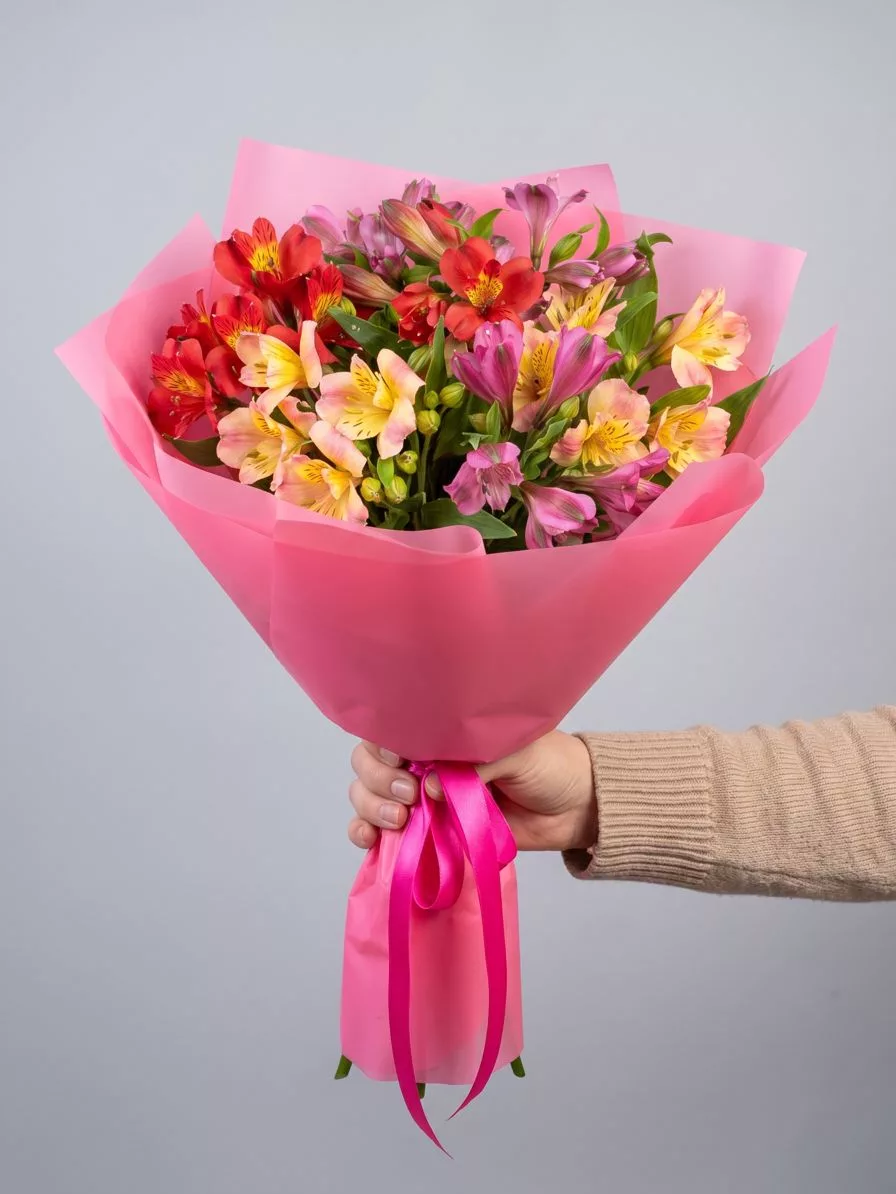
The southern Urals run cold from October through April, with January and February regularly hitting minus 20 to minus 30 Celsius in Ust-Katav. This is not a detail florists mention to alarm you — it is a direct variable in which varieties we recommend and how we pack them. Roses, spray roses, and chrysanthemums handle cold transit better than tropical varieties because their cell walls are denser and less prone to frost damage during the minutes between the courier vehicle and the recipient's door. Gerberas and anthurium, by contrast, show cold damage quickly: petals develop translucent patches and collapse within hours of chilling. We do not recommend gerbera-heavy arrangements for Ust-Katav deliveries between November and March. Dutch roses — specifically varieties like Explorer, Avalanche, and Red Naomi — travel well in insulated packaging and arrive with tight buds that open over 24 to 48 hours in a warm interior, which is actually a feature rather than a flaw: the recipient gets a longer display. Alstroemeria is another reliable cold-season choice; its multiple buds per stem mean that even if one or two are affected by a cold doorstep moment, the rest open normally indoors. In summer, from June through August, the Urals are warm and occasionally hot, and the concern reverses: bouquets need to move fast and not sit in a car with closed windows. Year-round, the packaging we use for Ust-Katav includes moisture-retaining wrapping around the stems and an outer insulating layer. Senders from warmer climates sometimes request open, unwrapped bouquets for photographs — that is not possible for this destination and this climate.
Varieties That Arrive Well and Ones to Avoid
When someone calls from Germany or the UK asking what to send to Ust-Katav, the answer depends on the season, but there is a core list of varieties that consistently perform well regardless of month. Standard roses in 50-centimetre and 60-centimetre stem lengths are the most reliable: they are grown in Ecuador and the Netherlands specifically for long supply chains, they hold water efficiently, and they tolerate the temperature fluctuations of a courier run. Spray roses — small-headed varieties like Lydia or Viviane — are excellent for mixed bouquets because their multiple heads per stem give visual density without adding fragility. Eustoma, also sold as lisianthus, is a strong performer in autumn and winter: its ruffled petals look delicate but the flower is structurally tough. Tulips are popular for spring orders, particularly March and April, when they are at peak availability and travel well from Dutch growers. However, tulips are geotropic — they continue growing toward light after cutting — so they arrive slightly curved, which some recipients interpret as damage. It is worth mentioning this to the recipient in advance if you are sending tulips. Peonies are available from late April through June and are extremely popular for anniversaries; they bud tightly for shipping and open dramatically over two to three days. Avoid bird of paradise, heliconia, and protea for Ust-Katav: these are tropical varieties that do not tolerate cold and are genuinely difficult to source at the quality level this route demands. Hydrangea works in summer but is risky in winter due to its high water content and susceptibility to frost.
How to Place an Order Correctly from Outside Russia
The single biggest source of failed or delayed deliveries from abroad is incomplete recipient information. Russian addresses follow a specific format that differs from Western conventions, and a missing detail — the building number, the apartment number, the entrance code — can stop a courier at the door. When placing your order, you need the full street name in Russian or transliterated clearly, the building number, the apartment or office number, and if the building has a door code or intercom number, that too. If you do not have the apartment number because you are surprising someone, call or message the recipient's neighbour or a mutual contact rather than guessing. A bouquet held at the door because the courier cannot get in is not a romantic gesture. Payment from abroad is handled via international card through our website; Visa and Mastercard issued outside Russia work at checkout, and the transaction processes in roubles with your bank converting at its current rate. There is no need to have a Russian bank account or use a Russian payment system. The order confirmation comes by email in Russian and English. The recipient's phone number is mandatory: our courier calls ahead, typically 30 to 60 minutes before arrival, to confirm someone is home. If the recipient is at work, provide the work address or ask them to arrange to be reachable. We cannot leave flowers unattended outside an apartment door in winter — they will freeze. The message card text can be submitted in any language; we print it as written, so if you want the message in Russian, write it in Russian or use a transliteration you trust.
Timing: When to Order for the Date That Matters
International senders consistently underestimate how much lead time a cross-region delivery inside Russia requires when it involves a smaller city. For Ust-Katav, the practical rule is this: place your order at least 24 hours before the desired delivery time, converted to Chelyabinsk local time. If the occasion is a birthday dinner at 19:00 on a Saturday, the order should be in by 19:00 Friday at the latest, and earlier is always better. We process orders around the clock on the website, but assembly and dispatch follow business hours at the sourcing end. Orders placed on Friday evening for Saturday delivery in Ust-Katav are possible but carry more risk than a Thursday order for Saturday. Public holidays in Russia are a separate consideration for international senders who may not track them. Russia celebrates New Year from January 1 through January 8 as an extended holiday; March 8 is International Women's Day and is the single busiest flower day of the year in Russia, comparable to Valentine's Day and Mother's Day combined in Western markets. If you are sending flowers for March 8, place the order no later than March 5. Demand on that date is extreme, and late orders either cannot be fulfilled or arrive with substitutions you did not choose. February 23 is Defender of the Fatherland Day, a common occasion for sending flowers to men. November 4 is a national holiday. These dates matter because florist logistics tighten around them, not because you must observe them — but knowing they exist prevents a surprise when you try to order on March 7 and find the earliest slot is March 9.
What Ust-Katav Recipients Typically Receive and Expect
Ust-Katav is a working city with a strong engineering and manufacturing culture — it is historically known for tram production. The residents are practical and the gift culture around flowers is genuine but not performative. A large, loosely arranged bouquet with greenery and mixed varieties is received warmly; an overwrought arrangement with excessive decorative elements can feel out of place. The most common orders we fulfil for this city are rose bouquets in odd numbers — 11, 15, 21, 25 stems — because odd numbers are the Russian convention for celebratory bouquets. Even numbers are associated with mourning, and while younger recipients may not hold strictly to this, older recipients notice immediately. If you are unsure, choose an odd number and you will never be wrong. Bouquet sizes that work well: 11 roses for a personal, warm gesture; 21 for a significant birthday or anniversary; 51 for a major milestone. The packaging style in Russia leans toward wrapped bouquets — the flowers are gathered and wrapped in kraft paper or a decorative sleeve with a ribbon — rather than the hand-tied, unwrapped style common in British floristry. Recipients in Ust-Katav expect a wrapped bouquet and know how to unwrap and arrange it themselves. Including a small box of chocolates or a plush toy is an option some international senders choose; these can be added to the order and travel with the bouquet. Balloon additions are available but are impractical for cold-season delivery to this address, as latex balloons deflate rapidly in sub-zero temperatures.
Checking Your Order Before You Confirm
Before you click the final confirmation button, run through this list. First, the recipient's phone number: it must be a working Russian mobile number in the format +7 followed by ten digits. If you only have a foreign number for the recipient, contact them separately and get a local number or confirm they will have Russian mobile coverage on the delivery day. Second, the delivery date converted to Chelyabinsk time: double-check that the date you selected on the website corresponds to the calendar day in Russia, not in your home country. A midnight order from Los Angeles on a Tuesday is already Wednesday morning in Russia. Third, the address completeness: street, building, apartment, entrance code if applicable. Fourth, the bouquet variety and stem count: confirm you have chosen an odd number if the occasion is celebratory. Fifth, the message card text: read it once more, because once the card is printed and attached, changes require a new order. Sixth, your email address for the confirmation: orders from abroad occasionally have typos in the email field, which means you receive no confirmation and no tracking update. Seventh, the payment: check that your card is enabled for international transactions — some banks block cross-border payments by default and require a prior notification. If the payment fails, the order is not placed. A quick call to your bank before ordering saves the frustration of discovering the block at midnight when the florist desk is not staffed for live support. These seven checks take under three minutes and eliminate the overwhelming majority of problems we see with international orders to smaller Russian cities.
Sending flowers to Ust-Katav from abroad is straightforward when you treat it as a logistics task rather than a wish. The city is reachable, the varieties that travel well are well-established, and the local customs around bouquet size and odd stem counts are easy to follow once you know them. The failures we see are almost always about timing arithmetic and incomplete addresses — both of which are entirely within the sender's control. Get the recipient's full address including apartment number, convert your desired delivery time to Chelyabinsk local time, place the order at least a day ahead for any fixed occasion, and choose roses or eustoma over tropical varieties in the cold months. Do that and the bouquet arrives on time, in good condition, and lands exactly as intended. We deliver bouquets across Russia in 1–2 hours.
Frequently asked questions
Can I pay for a flower delivery to Ust-Katav using a non-Russian bank card?
Yes. Visa and Mastercard issued outside Russia process at checkout without any workaround. The charge appears in roubles and your bank converts it at its current exchange rate. Before ordering, notify your bank that you are making an international transaction to avoid an automatic fraud block, which is the most common payment failure we see from abroad.
What is the minimum lead time for a birthday delivery to Ust-Katav?
Place the order at least 24 hours before the desired delivery time, calculated in Chelyabinsk local time. For fixed occasions like milestone birthdays, 48 hours is safer. Around major Russian flower holidays — particularly March 8 — order three to four days in advance, as demand compresses available slots and late orders risk substitution or next-day fulfilment.
Why do Russian bouquets use odd numbers of stems?
In Russian tradition, even-numbered bouquets are brought to funerals and mourning occasions. Odd numbers — 11, 15, 21, 25, 51 — are used for all celebratory and affectionate gifts. Younger Russians may not observe this strictly, but older recipients notice immediately. Choosing an odd stem count is always the safe and culturally correct option for any positive occasion.
Will flowers survive delivery in Ust-Katav during winter?
Yes, with the right variety selection and packaging. We use insulated wrapping for cold-season deliveries and recommend roses, spray roses, eustoma, and alstroemeria from November through March. These varieties tolerate brief cold exposure between the courier vehicle and an indoor space. We do not recommend gerberas, hydrangeas, or tropical varieties for winter delivery to this city.
What happens if the recipient is not home when the courier arrives?
Our courier calls the recipient 30 to 60 minutes before arrival. If there is no answer and no one is home, the courier attempts a second call and waits a short period. Flowers cannot be left outside in winter temperatures. Providing a work address or asking the recipient to stay reachable on delivery day prevents this. Always supply a working Russian mobile number in the order form.
Ready to send a bouquet?
Pick a city, choose the flowers, and we will hand them over with a photo confirmation.
Choose a city →