
Flowers for Your Boss in Russia: Etiquette, Varieties and Mistakes to Avoid
Every week someone calls the shop and asks a version of the same question: I need to send flowers to my director, what should I order? The answer is never just a colour. In Russia, gifting flowers to a manager carries a set of unwritten rules that most people outside the country — and plenty inside it — only half-know. Get it right and the bouquet lands as a mark of genuine professionalism. Get it wrong and it reads as careless, or worse, inappropriate. This article walks through the real decisions: stem count, variety choice, colours that work in an office, and the timing details that determine whether the flowers arrive looking fresh or exhausted.
Why Flower Etiquette Matters More in a Russian Office Than You Might Expect
In Russia, flowers carry social weight that goes well beyond aesthetics. Presenting flowers to a superior is a recognised gesture at anniversaries, professional holidays, and milestone birthdays, and colleagues will notice both what you brought and how it was packaged. A bouquet that looks cheap or hastily assembled reflects on the giver, not the florist. A bouquet that looks overly romantic creates its own awkward atmosphere. The office setting in Russia tends to be more formal than in many Western countries, particularly when a subordinate is giving to a manager. This means the flower choice is read as a statement about how seriously you take the relationship and the occasion. Most florists see the consequences of ignoring this: a customer orders a loose mixed bunch with bright orange gerberas because it looked cheerful online, and it arrives at a board meeting looking like a birthday party prop. The varieties that work in a professional gift are those that have a long-established association with formality and quality in Russian culture — roses, chrysanthemums, eustoma, and certain orchid varieties — rather than wildflower mixes or tropical novelties. None of this means the bouquet has to be stiff or joyless. It means the composition should feel considered. A well-chosen monobouquet of white or cream spray roses, properly conditioned and wrapped in structured paper, communicates exactly the right level of respect without crossing into sentimentality.
Bouquets we can deliver



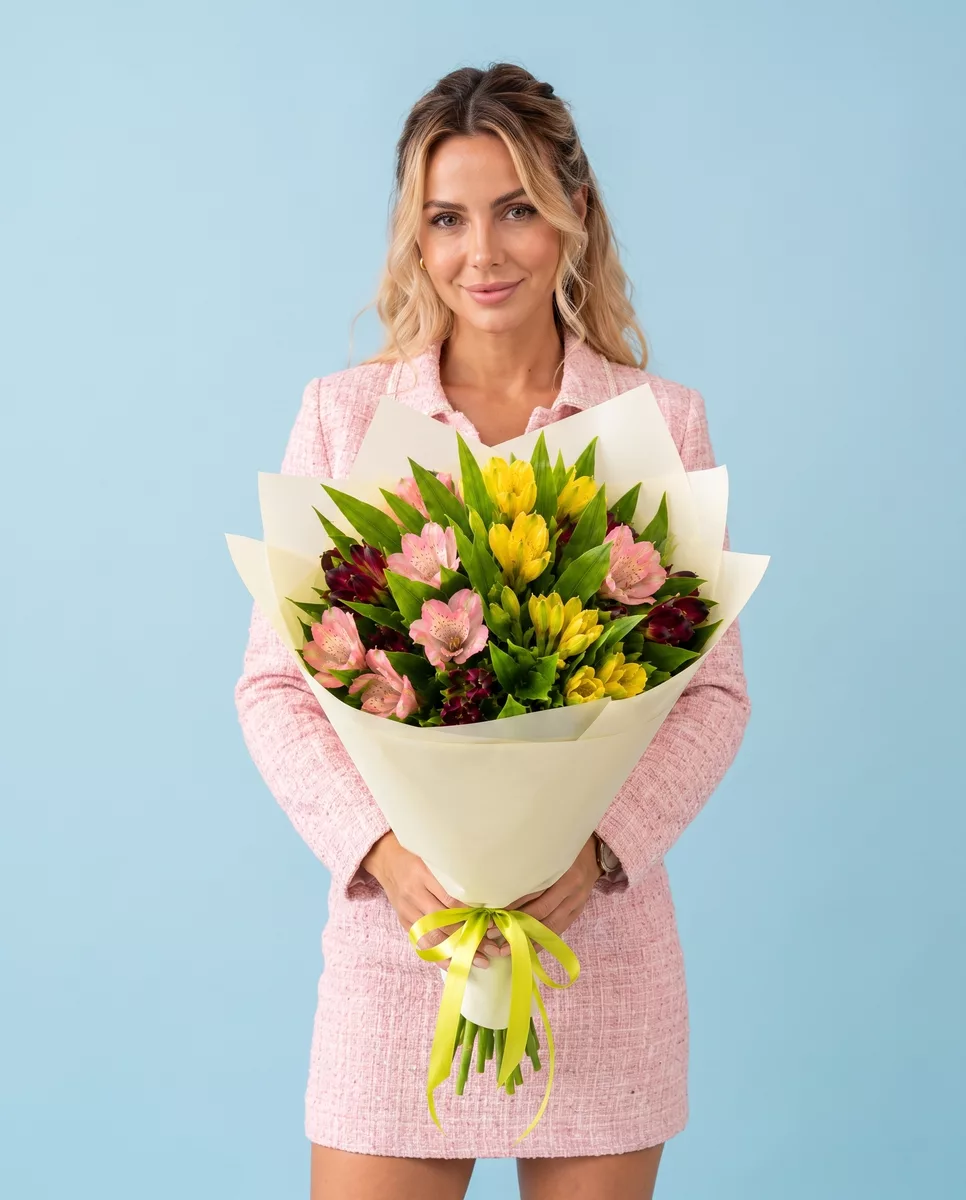
Stem Count: The Odd-Number Rule and When It Actually Applies
One of the first things customers get wrong is stem count. The widely repeated rule in Russia is that an even number of flowers is for funerals and an odd number is for celebrations. In practice, this rule is taken seriously by a significant portion of the population, particularly older recipients and those in more traditional professional environments. If your boss is over fifty or works in a conservative sector — law, government, academia, manufacturing — follow the odd-number rule without question. For a formal professional gift, the sweet spot is eleven, fifteen, or twenty-one stems. Nine can look minimal unless the flowers are large-headed, like peonies or garden roses. Seven is acceptable but can read as budget-constrained. Anything under seven for a director-level gift is usually a mistake. If you are ordering roses, fifteen long-stemmed varieties such as Explorer or Avalanche is a standard and well-received count for a senior manager. For spray roses, twenty-one stems in a single colour works well because the branching gives the bouquet visual density without requiring an enormous budget. The exception to the odd-number rule is when flowers are arranged in a box or hat-box format, where individual stem count is less visible. In that case, customers tend to focus on overall size and variety mix rather than counting stems. Still, most experienced florists will automatically keep the count odd even in a box arrangement, because it costs nothing and eliminates any risk of offence. When in doubt, ask the florist to confirm the count before the order is finalised.
Which Varieties Communicate Respect in a Professional Context
The varieties that consistently land well in professional gifting are those associated with longevity, structure, and a certain restraint. Long-stemmed roses remain the safest and most universally accepted choice — varieties like Mondial, Avalanche, and White Naomi hold their shape for days after delivery, which matters because a wilted bouquet on a manager's desk by the afternoon is worse than no bouquet at all. Eustoma, also sold under the name lisianthus, is an excellent secondary flower for structured arrangements: the blooms are layered and elegant, they last well in indoor temperatures, and they add volume without the informality of wildflowers. Chrysanthemums are broadly acceptable in Russia for professional occasions, though single large-headed varieties — sometimes called santini or disbud — read as more formal than the bushy spray types. Orchids in a pot or a cut stem arrangement signal a significant occasion and are appropriate for a director's milestone birthday or a major professional anniversary. Avoid sunflowers, gerberas, and alstroemeria in a boss gift — not because they are bad flowers, but because they carry a casual, everyday association in Russia that does not suit the formality of a superior-to-subordinate gesture in reverse. Peonies are popular and accepted when in season, but their short vase life means they need to arrive the same day the event takes place. For delivery to an office, always specify that stems should be cut and water-conditioned before dispatch, and ask whether the office has a vase — if not, a water-tube arrangement or a box with a foam base is more practical than a bare bouquet.
Colours That Work and Colours That Send the Wrong Signal
Colour choice in a professional gift is where customers make the most avoidable mistakes. White is the safest option across all professional contexts — it reads as respectful, clean, and intentional. Cream and ivory tones work equally well and can feel slightly warmer. Pale pink is acceptable for a female manager, particularly in roses or eustoma, but should stay on the cool or dusty side rather than hot or candy pink, which reads as informal. Deep burgundy and wine-red roses are a strong, dignified choice for either a male or female director and are consistently well-received in formal Russian professional culture. Red roses require more care. A bouquet of red roses for a manager of the opposite sex can be misread as romantic rather than professional, particularly if the count is twelve — which carries a specific romantic connotation in Russian culture. If you want to use red, go for a mixed arrangement that includes white or greenery to break the romantic reading, or choose a deep burgundy variety instead. Yellow flowers are sometimes avoided by older or more traditional recipients due to an association with separation or bad luck, though this belief is less widespread among younger professionals. It is safer to skip yellow entirely in a boss gift unless you know your manager specifically likes it. Orange and bright tropical colours — bird of paradise, anthuriums, bright gerberas — are too casual for a formal gift to a superior. Green and white mixed arrangements using varieties like white lisianthus, eucalyptus, and white roses are a modern, neutral choice that works across age groups and industries.
Occasions That Justify Sending Flowers to a Manager in Russia
Not every occasion calls for flowers to a boss, and sending them on the wrong day can feel presumptuous. The occasions that are genuinely standard in Russian professional culture are: the manager's birthday, Women's Day on March 8th, Defender of the Fatherland Day on February 23rd for male managers, the company's anniversary, and a significant professional milestone such as a promotion, an award, or the signing of a major contract. March 8th is by far the busiest day for professional flower gifting in Russia — teams typically pool together to send a bouquet to a female director, and the order volume at shops spikes dramatically. If you are organising a collective gift for March 8th, place the order at least two to three days in advance, because same-day availability of premium varieties like White Naomi roses or white peonies becomes limited by the afternoon of the 7th. Birthday flowers for a director are usually delivered to the office in the morning so they are visible throughout the working day. Arrival between 9 and 11 in the morning is the standard window. For a milestone occasion like a promotion, the flowers can arrive with a card from the team or from an individual colleague — both are acceptable. New Year is not typically a flower-gifting occasion in a Russian professional context; corporate gifts at that time tend to be confectionery, wine, or branded items. Sending flowers to congratulate a manager on a project completion is a warm gesture that is becoming more common in younger, creative industries but is not yet a universal expectation.
Packaging and Presentation: What Arrives at the Office Matters
The packaging of a professional bouquet is taken seriously in Russia, and a well-dressed arrangement in poor wrapping undermines the gesture. For an office delivery to a manager, structured wrapping in kraft paper or matte florist paper in neutral tones — white, grey, dark green, or ivory — is the right choice. Cellophane is considered outdated and cheap-looking by most recipients in a professional context, and transparent wrapping that fully exposes the stems reads as informal. A ribbon in a coordinating colour adds a finishing detail without looking fussy. Avoid novelty packaging like cartoon-printed paper or gift bags designed for casual presents. The card message is a separate decision. In Russian professional culture, the card should be brief and respectful — a sentence of congratulation and a signature. Long personal messages on a card accompanying a gift to a superior can feel overly familiar. If you are ordering from outside Russia and writing in English, consider whether your manager reads English comfortably; if there is any doubt, keep the message short and universal. For delivery to a large office building, always provide the full address including floor number, office number, and a contact phone number for the recipient or a colleague who can receive the bouquet. Many office buildings in Russian cities have reception desks that will hold flowers, but some require the recipient to come down, which can create an awkward interruption during a working day. Confirming the building's reception policy when you place the order saves complications at the door.
Timing, Temperature and What to Check Before You Confirm the Order
Fresh flowers delivered to an office in Russia face a specific practical challenge: office buildings are heated to high indoor temperatures in winter, which shortens vase life significantly. In January or February, an arrangement of roses that would last eight days at home may last four in a heated office. When ordering for a winter delivery, ask the florist to prioritise tight-budded stems rather than fully open blooms — they will open in the warmth of the office and last longer overall. In summer, the reverse problem applies: delivery vehicles and reception areas can be warm, and flowers left in direct sunlight near a window will deteriorate quickly. Eucalyptus, ruscus, and other sturdy greenery hold up better in warm conditions than delicate petals like ranunculus or sweet peas, which are better reserved for cooler months. Before confirming any order for a boss gift, check four things. First, confirm the exact delivery address including building entrance details — large Russian office complexes often have multiple entrances and the wrong one adds delay. Second, confirm the recipient's name is spelled correctly on the card, particularly if it is a Russian name you are transliterating. Third, confirm the delivery window: professional flower shops in Saint Petersburg can typically deliver within one to two hours of order confirmation, but specifying a two-hour arrival window around a meeting schedule gives the arrangement the best chance of landing at the right moment. Fourth, confirm that the stem count is odd if the occasion is celebratory. These four checks take two minutes and eliminate the most common reasons a professional bouquet misses its mark.
Sending flowers to a Russian manager is a gesture that lands well when the details are right and awkwardly when they are not. The variety, the stem count, the colour, the packaging, and the delivery timing all carry meaning in a professional Russian context, and none of these decisions is difficult once you know the conventions. White or cream roses in an odd count, structured wrapping, morning delivery, and a brief card message cover the majority of professional occasions correctly. When the occasion is significant — a director's milestone birthday, a team gift for March 8th — stepping up to a larger arrangement with eustoma or orchids signals that the gesture was considered rather than last-minute. The florist's job is to make sure the flowers arrive in the best possible condition; your job is to give them the right brief. We deliver bouquets across Russia in 1–2 hours.
Frequently asked questions
Is it appropriate for a male employee to send flowers to a male manager in Russia?
Yes, entirely normal. Flowers from a male subordinate to a male director are standard on birthdays, February 23rd, and professional anniversaries. Choose a formal variety like burgundy or white roses in an odd count, and keep the packaging structured. There is no social awkwardness attached to the gesture in a professional Russian context.
Can I send a potted plant instead of a cut bouquet to a boss in Russia?
A potted orchid is an accepted professional gift for a senior manager and has the advantage of lasting far longer than cut flowers. Avoid cacti, which some recipients consider bad luck, and very large plants that are difficult to transport home. A phalaenopsis orchid in a plain ceramic pot is a safe, well-received choice for a significant occasion.
What is the right budget range for flowers sent to a director versus a team leader?
Russian professional culture expects the gift to reflect the seniority of the recipient. A team leader gift can be modest — a small bouquet of eleven roses is perfectly appropriate. For a director or senior manager, the arrangement should be visibly more substantial, with a larger stem count or premium varieties. The visual impression at the moment of delivery matters as much as the exact spend.
Should I avoid red roses entirely when gifting to a female manager?
Not entirely, but use them carefully. A large bouquet of purely red roses to a female manager of the opposite sex can read as romantic. To keep it professional, mix red with white blooms or choose deep burgundy varieties instead of bright red. Alternatively, a clean monobouquet of white or cream roses removes any ambiguity and is universally appropriate.
How far in advance should I order flowers for March 8th delivery to an office?
Order at least two to three days before March 8th. It is the single busiest day in the Russian flower calendar, and premium white varieties — peonies, white roses, eustoma — sell out or become unavailable for same-day delivery by the afternoon of March 7th. Early ordering also lets you specify a precise delivery window so the bouquet arrives before the working day begins.
Ready to send a bouquet?
Pick a city, choose the flowers, and we will hand them over with a photo confirmation.
Choose a city →