
September 1 Flowers: What Russian Schoolchildren Receive on Knowledge Day
Every September 1 in Russia, millions of children walk through school gates carrying bouquets, and if you are new to this tradition, the scale of it is genuinely surprising. Knowledge Day — Den Znaniy — is a national holiday marking the first day of the school year, and flowers are its central prop. Teachers receive bouquets from students, first-graders carry single stems or small posies for a ceremonial line-up, and parents spend the last days of August hunting for the right combination of varieties, stems and colours. Getting it wrong is easy: too funereal, too bridal, too wilted by noon. This guide covers what actually goes into a September 1 bouquet, why certain flowers dominate the season, and what to check before you place an order.
The Tradition Behind the Bouquet
Knowledge Day was formalised as a Soviet holiday in 1984, though the custom of bringing flowers to school on the first day is older. The idea is straightforward: students honour their teachers with a gift, and flowers became the standard because they are perishable, personal and not expensive enough to feel like a bribe. In practice, a teacher at a large urban school may receive thirty or forty bouquets on September 1 alone, which means they go home with armfuls of asters, gladioli and dahlias and spend the evening distributing them among neighbours and relatives. The bouquet is therefore not meant to be kept — it is a gesture, and its freshness on the day matters far more than its longevity afterwards. First-graders occupy a special role in the ceremony. The youngest children, starting school for the first time, are led into the schoolyard by an eleventh-grader — the oldest student — and a first-grade girl is often lifted on the older student's shoulders to ring a ceremonial bell. That girl almost always holds a single large flower, traditionally a gladiolus, though dahlias and sunflowers now appear too. Understanding this context tells you something practical: the bouquet needs to survive a ninety-minute outdoor ceremony in early September heat, look presentable in photographs, and be easy for a seven-year-old to hold. Those three constraints shape everything about what you should order.
Bouquets we can deliver



Which Flowers Dominate September 1
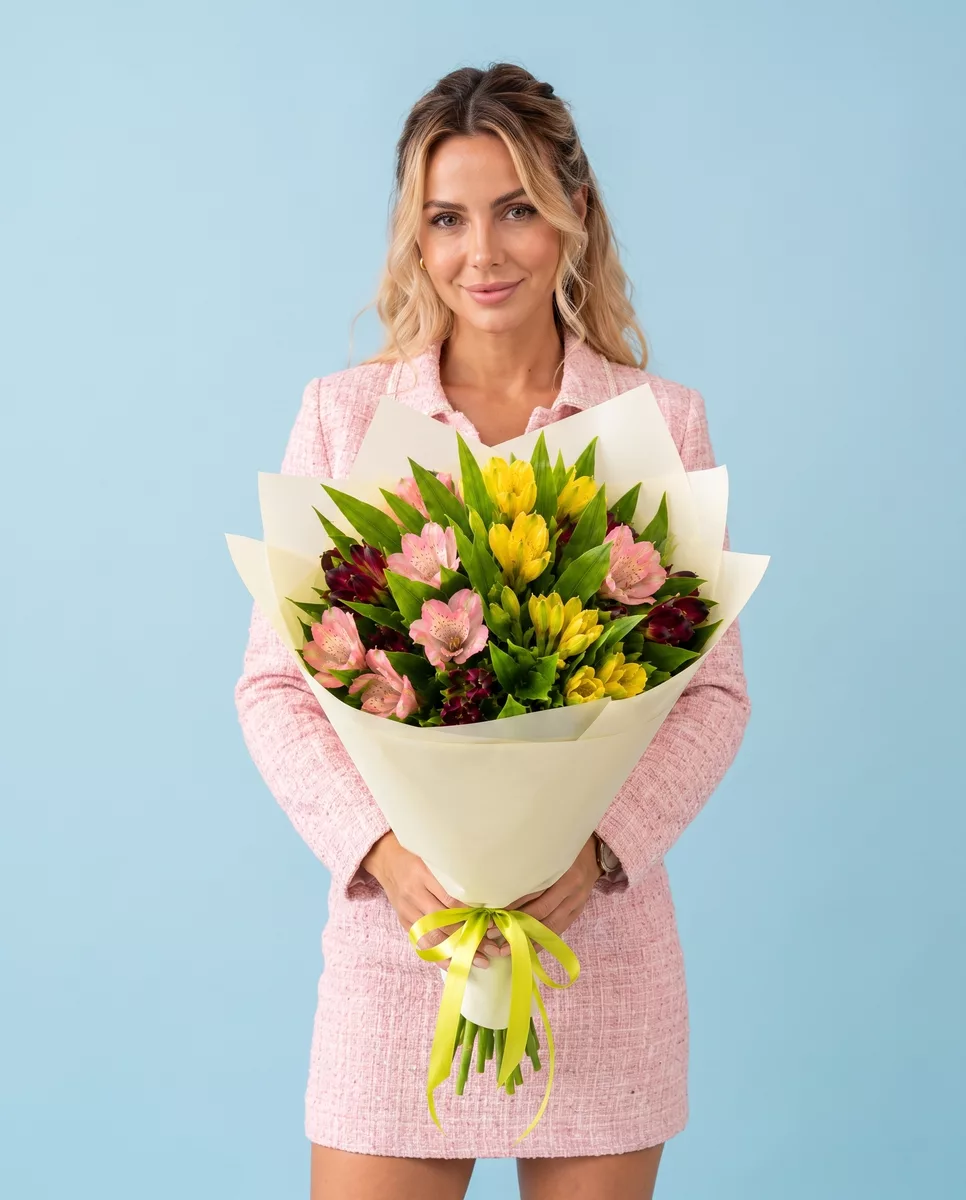
Asters are the defining flower of Russian Knowledge Day, and the reason is partly seasonal and partly historical. Garden asters — Callistephus chinensis — peak in late August and early September across Russia, which made them abundant and cheap during the Soviet era when imported flowers were scarce. They come in white, lilac, deep purple, pink and crimson, hold their shape well in warm weather, and photograph clearly against school uniforms. Gladioli are the second pillar of the tradition. Their tall spikes work visually in a crowd of children, and varieties in white, salmon, yellow and red are all acceptable. A single gladiolus stem is long enough to be seen above a child's head in a school photograph, which is partly why they became the flower of choice for the ceremonial bell-ringing moment. Dahlias arrive in full force by September and offer the most variety in form: pompom types, cactus-flowered, decorative — all work for school bouquets. Chrysanthemums, particularly spray types and single-headed santini varieties, appear in mixed bouquets and hold extremely well in heat. Sunflowers have grown in popularity over the last decade and suit larger, more informal compositions. Roses remain common but are less traditional for this specific holiday — they read more as a romantic or general-occasion flower in Russian culture. Gerberas, lisianthus and alstroemeria fill out mixed arrangements. What you will almost never see on September 1 is anything associated with funerals — carnations are used but carefully, and all-white monochrome bouquets are generally avoided by experienced florists for this occasion.
Bouquet Sizes and Formats by Recipient
The format of the bouquet depends almost entirely on who is receiving it. A class teacher — the homeroom teacher who will be with students for years — typically receives the most substantial arrangement from the class, assembled as a collective gift with contributions from each family. These class bouquets run large: fifteen to twenty-five stems, often mixed with seasonal foliage, wrapped in kraft paper or placed in a decorative box. Individual family bouquets for the same teacher are more modest, usually seven to eleven stems, and are brought alongside the class gift without competing with it. Subject teachers — the maths teacher, the music teacher, the PE instructor — receive smaller bouquets, typically five to seven stems, often monochromatic or in two colours. A bouquet of five white asters with eucalyptus is a completely normal and well-received gift for a subject teacher. For first-graders carrying their own flower in the ceremony, a single large stem — a gladiolus, a sunflower, or a dinner-plate dahlia — is the convention. Some families choose a small hand-tied posy of three to five mixed stems if the child is small and a tall gladiolus would be unwieldy. Older students in grades two through four sometimes bring a small bouquet for their own teacher as a personal gesture rather than contributing only to the class gift. By secondary school, the collective class gift dominates and individual family bouquets become less common. Knowing these distinctions before you order saves you from arriving with a lavish twenty-stem arrangement when five stems would have been exactly right, or the reverse.
Colours That Work and Colours to Avoid
Russian school uniforms on September 1 are almost universally dark: navy, black, dark grey or brown for jackets and skirts, with white shirts and blouses underneath. Girls traditionally add white hair ribbons and bows. This colour palette is the practical backdrop against which your bouquet will be photographed dozens of times, so contrast matters. Bright colours — yellow, orange, deep red, saturated pink — read well against dark fabric and show up clearly in outdoor photographs taken in flat September light. White flowers are elegant but disappear against white blouses in photos; florists often add a contrasting element — a single orange dahlia or a spray of yellow solidago — to give a white bouquet visual definition. Lilac and violet asters are a classic choice precisely because they sit between warm and cool tones and complement both navy and black uniforms without clashing. Avoid all-green compositions — they read as unfinished to Russian eyes in this context. Avoid very dark burgundy or near-black flowers like some dahlia varieties, not because they are inappropriate but because they are hard to distinguish from the uniform in photographs and lose their impact. Avoid anything that could be read as a mourning colour scheme: all white with no warm accent, all dark red, or combinations that echo funeral arrangements. This is not a formal rule but a strong cultural instinct among Russian parents and teachers. Warm mixed palettes — yellow, orange, white and green — are the safest and most universally liked choice, and they also happen to photograph well in morning sunlight, which is when the school ceremony takes place.
Timing: When to Order and When to Deliver
September 1 is a fixed date, which means every florist in Russia is working at maximum capacity on August 31 and the morning of September 1. Orders placed on August 31 after noon frequently face delays or substitutions because the most popular varieties — white asters, yellow gladioli, large-headed dahlias — sell out. The practical window for placing a September 1 order is August 28 through August 30, which gives the shop time to source specific varieties and prepare arrangements without the last-minute pressure that degrades quality. If you are ordering for delivery on September 1 itself, request a morning slot: ceremonies typically begin between 9:00 and 10:00, and you want the flowers in hand at least thirty minutes before the family leaves. A bouquet delivered at 10:30 when the ceremony ended at 10:15 is useless for its primary purpose. Flowers cut and arranged the evening before a September 1 delivery need proper cold storage overnight — between four and eight degrees Celsius — to arrive with tight, fresh heads rather than open, wilted ones. When you speak to the shop, ask specifically whether your order will be cut fresh the morning of delivery or prepared the night before, and whether it will be kept refrigerated. Gladioli in particular open rapidly at room temperature; a spike that is one-quarter open at 8:00 AM will be fully open and beginning to drop petals by noon if left in a warm car. Asters and chrysanthemums are more forgiving, which is one practical reason they dominate the holiday.
What to Check When Placing Your Order
Four things separate a good September 1 order from a disappointing one: variety specificity, stem count confirmation, delivery window, and packaging. On variety: do not order simply a mixed seasonal bouquet and hope for the best. State the flowers you want — asters, gladioli, dahlias — and the colours. A shop that cannot confirm which varieties will be in your bouquet is a shop that will substitute freely, and on September 1 that often means you receive whatever was left rather than what you planned. On stem count: Russian etiquette holds that an even number of flowers is for mourning; bouquets for living recipients should have an odd number of stems — five, seven, nine, eleven, thirteen. This is taken seriously by older recipients and their families, so confirm the count before finalising. On delivery window: specify a two-hour window, not just a date. Ask what happens if the driver is delayed — whether you receive a notification and whether there is a backup plan. On packaging: school bouquets spend time outdoors in September heat, often above ten degrees Celsius, and need packaging that protects the stems without trapping heat around the heads. Kraft paper wrap with the stems in a water-containing sleeve is the standard professional approach. Cellophane wrapping that encloses the entire bouquet, heads and all, accelerates wilting and should be avoided. Finally, if a first-grader will be holding the bouquet themselves, mention this when ordering — the florist can adjust handle length and remove thorns from any roses in the composition.
Ordering Across Russia for September 1
September 1 is observed on the same date across all of Russia, from Kaliningrad to Vladivostok, which means the logistical challenge of ordering flowers for a relative's child in another city is real and common. A grandmother in Saint Petersburg wanting to send a bouquet to her granddaughter's school in Novosibirsk, or a parent working in Moscow needing flowers delivered to a family in Kazan — these situations arise every year. The key variable when ordering across time zones is the ceremony time at the destination. Russia spans eleven time zones, and a 9:00 AM ceremony in Yekaterinburg is 7:00 AM in Moscow. When placing a cross-city order, state the local time of the ceremony at the destination, not your own local time, and confirm that the shop's delivery schedule accounts for this. Delivery within a single city — same-day, within one to two hours of ordering — is the most reliable format for September 1 because it removes the variables of inter-city logistics. If you are in Saint Petersburg and the recipient is also in Saint Petersburg, order the morning of August 31 or early on September 1 itself, specify the delivery window in relation to the ceremony time, and confirm the address includes the school name if the bouquet is going directly there rather than to a home address. Schools receive deliveries on September 1, but a driver needs a specific contact name and phone number to hand the flowers to the right person in a crowd of several hundred families. Providing that contact information when you order is not optional — it is what separates a successful delivery from a bouquet left at a gate.
September 1 bouquets are one of the most time-sensitive flower orders of the Russian calendar, and the margin for error is narrow because the ceremony happens once and at a fixed hour. The flowers that work best — asters, gladioli, dahlias, chrysanthemums — are all in full domestic season in early September, which means quality is available if you order early enough and specify clearly. Odd stem counts, warm colour palettes that contrast with dark uniforms, morning delivery windows, and proper cold-storage packaging are the practical details that determine whether the bouquet does its job. A first-grader holding a fresh gladiolus at 9:00 AM on a sunny September morning is the target outcome, and it is entirely achievable with a well-placed order. We deliver bouquets across Russia in 1–2 hours.
Frequently asked questions
How many flowers should a September 1 bouquet contain?
Russian tradition holds that bouquets for living recipients should have an odd number of stems — five, seven, nine, eleven or more. Even numbers are associated with mourning and will be noticed by older teachers and parents. Confirm the stem count with your florist before finalising the order, especially for collective class gifts where stems from multiple families may be combined.
Can a first-grader carry a full bouquet during the ceremony?
A small child can manage a single large stem — a gladiolus or sunflower — or a compact hand-tied posy of three to five stems with a short handle. A large mixed bouquet of eleven or more stems is heavy and awkward for a six or seven-year-old to hold during a ninety-minute outdoor ceremony. When ordering for a first-grader, mention their age so the florist can adjust size and handle length.
Which flowers last longest in September heat during an outdoor ceremony?
Asters and spray chrysanthemums are the most heat-tolerant cut flowers available in September and will hold their shape through a two-hour outdoor ceremony without wilting. Gladioli are also sturdy but open quickly in warmth. Roses and gerberas are more sensitive and may begin to droop if left in direct sun without water. Ask your florist to include a water-retaining stem sleeve in the packaging.
Is it acceptable to send flowers to a teacher rather than bring them in person?
Yes, and it is increasingly common, particularly for families who cannot attend the ceremony. A bouquet delivered to the school before 9:00 AM or to the teacher's home address on August 31 is a well-understood gesture. Include a small card with the student's name and class so the teacher knows who sent it — schools receive many deliveries on this day and attribution matters.
What is the latest I can order and still receive flowers on September 1 morning?
With a one-to-two-hour delivery service, you can place an order as late as 7:00 or 7:30 AM on September 1 and receive flowers before a 9:00 AM ceremony, depending on the shop's morning capacity. However, late orders on this specific date risk substitutions because popular varieties sell out. Ordering by August 30 guarantees you get the flowers you specified rather than whatever remains.
Ready to send a bouquet?
Pick a city, choose the flowers, and we will hand them over with a photo confirmation.
Choose a city →