
Teacher Appreciation Flowers in Russia: Varieties, Styles and School Delivery
Every September and October, and again in late May, Russian schools receive more flowers in a single morning than most florists sell in a week. If you are outside Russia and want to send something to a teacher who mattered — a relative's class teacher, a tutor, a professor — the customs here are specific enough that a generic bouquet ordered without local knowledge tends to arrive looking wrong. This article covers what teachers in Russia actually receive, which varieties hold up through a school morning, and what you need to check before placing a delivery order from overseas.
When Russians Give Flowers to Teachers
The two main occasions are September 1st, the first day of the school year, and Teacher's Day, which falls on the first Sunday of October under the international calendar — though many Russian schools celebrate it on the Friday before. End-of-year ceremonies in late May are the third major wave, particularly for graduating classes. Outside these peaks, name days and birthdays are common triggers, and university students often bring flowers before an exam session as a gesture of goodwill rather than bribery, though the line can feel thin. September 1st is the most logistically demanding date. Every child in the school may arrive with a bouquet, which means the teacher ends up holding twenty stems by 9 a.m. and needs to get them into water fast. This shapes what works: flowers that survive two hours out of water without wilting visibly. Chrysanthemums, spray roses and alstroemeria handle this far better than open garden roses or ranunculus. Teacher's Day in October is slightly calmer in volume but the expectation for quality is higher — parents who missed September often compensate here. For overseas senders, October is actually easier to plan around because the date is fixed and delivery windows are less compressed than the September rush, when the whole city orders simultaneously and courier slots fill by the evening before.
Bouquets we can deliver



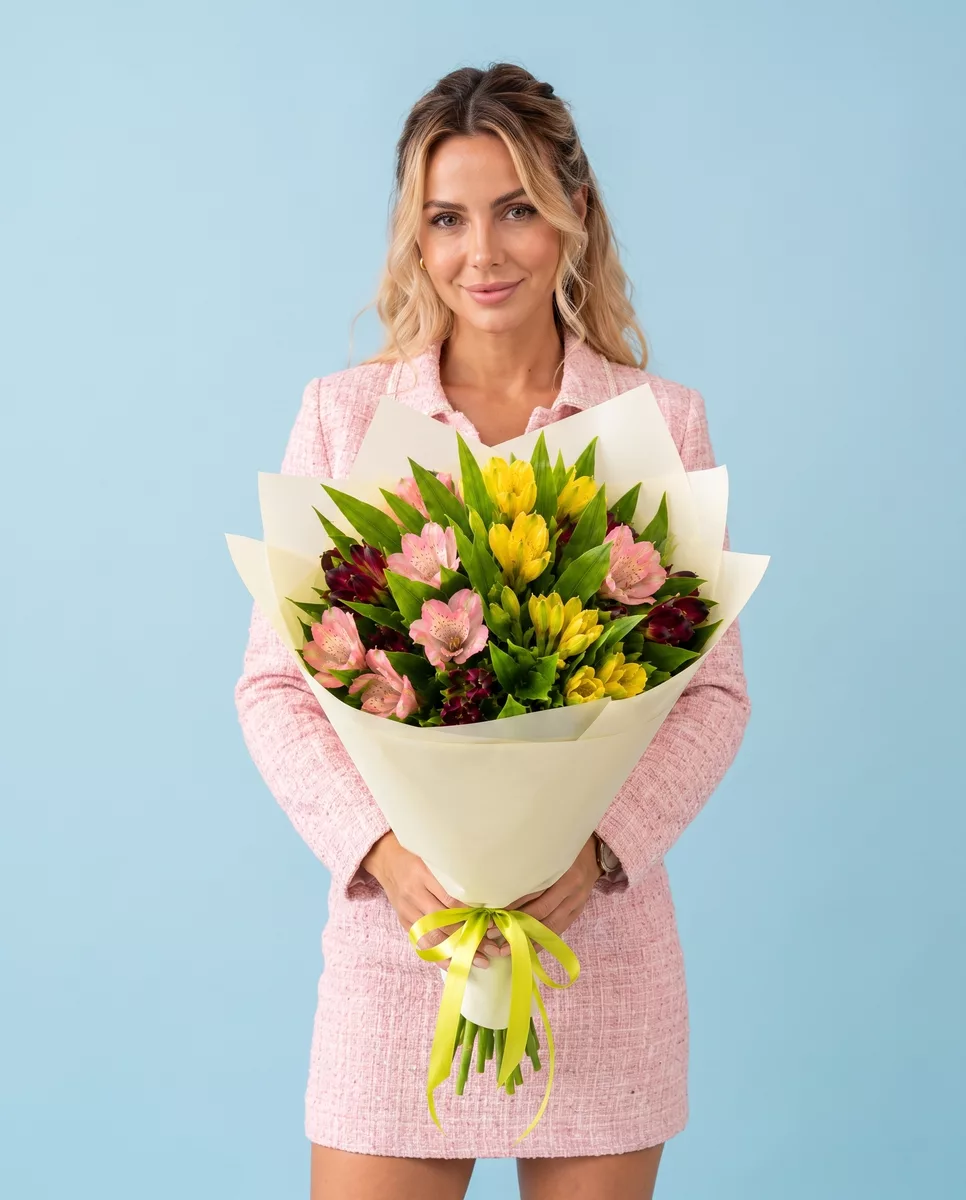
The Traditional Russian Teacher Bouquet
Russian teachers have received dahlias, gladioli and chrysanthemums for decades, and these remain the backbone of the traditional school bouquet. Gladioli in particular carry strong Soviet-era associations with September 1st — a single tall stem or a bundle of three is still given by older families, though younger parents have largely moved away from them because gladioli are fragile in transit and difficult to carry for a child. Chrysanthemums in spray form — the multi-headed branches rather than the large single blooms — are the most practical and remain popular because they are long-lasting, affordable and available in white, yellow, cream and burgundy throughout the autumn season. Dahlias appear from August through October and are genuinely beautiful in a school context: compact pompom varieties like Lollipop or small decorative types hold their shape well and look considered rather than generic. The traditional colour palette leans warm: yellow, orange, cream and white are the most accepted. Red roses are associated more with romantic occasions and are less common in a teacher context, though a mixed bouquet with a few red spray roses alongside white chrysanthemums reads as respectful rather than inappropriate. Bright pink gerbera daisies appear frequently in children's bouquets because they are cheerful and inexpensive, but for a more serious gesture from an adult sender, they read as low-effort. Wrapping style matters too: Russian florists typically use kraft paper or a structured cone of cellophane with a ribbon, not the loose tissue-paper wrapping common in Western Europe.
Varieties That Actually Last Through a School Morning
A teacher receives flowers at 8 a.m. and may not get them into water until noon. That four-hour window eliminates a significant number of popular varieties. Open peonies, for instance, drop petals rapidly when warm and should not be ordered for September delivery unless the school has immediate refrigeration access, which most do not. Garden roses with fully open heads face the same problem. What survives well: spray chrysanthemums, which can go six to eight hours without water at room temperature without visible damage; alstroemeria, which is surprisingly robust and comes in white, pink, yellow and burgundy; lisianthus, which looks like a delicate rose but holds significantly better; and statice or waxflower used as filler, both of which are nearly indestructible. Eustoma — the Russian trade name for lisianthus — has become increasingly popular in teacher bouquets over the past five years precisely because it photographs beautifully and holds up. Spray roses, the small multi-headed variety rather than large-headed hybrid teas, are another reliable choice: a bunch of white or pale pink spray roses wrapped in kraft paper is a classic that no teacher will find odd. If you are ordering from abroad and cannot control the exact bouquet composition, specifying that the arrangement should use varieties suitable for a school delivery — and mentioning the four-hour water gap explicitly — gives the florist the information needed to substitute intelligently rather than defaulting to whatever is most available that morning.
Bouquet Size, Wrapping and What Looks Right
Russian school bouquets tend to be more structured than bouquets in Western Europe or North America. Loose, garden-style arrangements with trailing greenery and an intentionally undone look are not the norm in a school context — they read as unfinished to a Russian eye. The standard shape is a gathered hand-tied bouquet with a clean stem end, wrapped tightly in paper with the flowers visible from the front. Size expectations vary by occasion: September 1st bouquets from children are typically small to medium, around seven to eleven stems, because the child carries it. Adult senders — parents, former students, overseas relatives — usually order larger, fifteen to twenty-five stems, which signals that the gesture is deliberate and considered rather than obligatory. Monochrome bouquets, all white or all yellow, are well-regarded in a professional setting and are easier to assemble quickly without looking accidental. Mixed bouquets work when the colour story is coherent: white and pale pink together, or yellow and cream with burgundy accents. Avoid mixing more than three flower types unless the florist is experienced with structured compositions, because a five-variety mix at a rushed production pace can look chaotic. Ribbon colour is a small but noticed detail: gold or dark green ribbon on a cream bouquet reads as formal and respectful. Bright plastic ribbon in primary colours is associated with children's bouquets and looks out of place on an adult gift. If you are ordering remotely, specifying ribbon colour takes thirty seconds and noticeably lifts the result.
Ordering School Delivery from Outside Russia
Delivering flowers to a school address from overseas requires more information than a home delivery. Schools in Russia are not staffed at the entrance the way an office building might be — there is typically a security post, a concierge or a duty teacher who receives deliveries, and they need to know a package is coming. When placing an order, you should provide the full school address including the building number and any corpus designation, the teacher's full name in Russian if possible, and the approximate delivery window. If you can reach the teacher or a contact at the school beforehand to let them know a delivery is coming, this significantly reduces the chance of a missed handoff. Time zones are the main complication for overseas senders. Saint Petersburg operates on Moscow Time, which is UTC plus three with no daylight saving adjustment. A sender in New York placing an order at 10 p.m. local time is placing it at 6 a.m. Saint Petersburg time the following morning — which is workable for a same-day school delivery if the school day starts at 8:30 or 9:00. A sender in Los Angeles at the same clock hour is placing the order at 9 a.m. Saint Petersburg time, which is tight but possible for afternoon delivery. The safest approach is to order at least twenty-four hours in advance and specify a delivery window of 9 a.m. to 1 p.m., which covers the morning assembly and the first break when a teacher is most likely to be accessible. Payment by international card is standard; the order and confirmation can be handled entirely in English through the shop's website.
What to Check Before Confirming the Order
Three things cause the most problems with school deliveries: an incomplete address, a name given only in transliteration rather than Cyrillic, and a delivery window that does not account for when the teacher is actually present. Russian school addresses often include a district name, a street, a building number and a separate corpus or stroenie number for multi-building campuses. Omitting the corpus number can send a courier to the wrong building on the same plot. If you are not sure of the full address, the school's official website — searchable by name in Yandex or Google — will list it in the contact section. The teacher's name matters at the security post. A note that says only a transliterated version like Natalya Ivanova may not be recognized if the guard's list uses the Cyrillic spelling. Providing both versions, or asking the florist to write the name in Cyrillic on the card, removes this friction. Check whether the school is open on the delivery date: Russian schools follow a schedule of holidays that does not match Western calendars, and Teacher's Day weekend sometimes results in a Monday holiday. A delivery arriving at a closed school is not retrievable without a second courier run. Finally, confirm that the bouquet includes a card with your name and a short message — teachers receive many bouquets on peak days and a card is the only way to know who sent which one. Most florists include a small card automatically, but if you are ordering remotely it is worth requesting explicitly and dictating the message text.
Card Messages and Small Additions That Work
Russian teacher appreciation cards are typically brief and formal in register. The standard opening is a version of 'Dear [name and patronymic]' followed by a short expression of gratitude and a closing wish for health and success. Using the name and patronymic — the first name plus the father's first name in its derivative form, such as Natalya Petrovna or Mikhail Alexandrovich — is not optional in a formal Russian context; it is the baseline of respectful address. If you do not know the patronymic, asking the student or a family member before placing the order is worth the effort. A card that uses only a first name reads as either very intimate or slightly ignorant of convention. The message itself does not need to be long. Three sentences is sufficient: an acknowledgment of the occasion, a specific line about what the teacher contributed, and a wish for continued health or professional success. Florists can print or handwrite the card in Russian if you provide the text, or they can transliterate your English message and translate it — worth confirming which service is offered when ordering. Small additions to a bouquet are common in Russia: a box of good chocolates, a small plant in a pot, or a decorative candle are all acceptable accompaniments. Potted plants have become increasingly popular as a teacher gift because they last beyond the flowers, and a compact kalanchoe or a small orchid in a ceramic pot adds substance to a bouquet without significantly increasing the total volume the teacher has to carry home. If the school day is long and the teacher is travelling by public transport, a separate delivery for any heavy additions is a practical consideration worth discussing with the florist.
Sending flowers to a teacher in Russia from overseas is straightforward when the logistics are handled in the right order: address verified, name in Cyrillic confirmed, delivery window matched to the school schedule, and varieties chosen for their ability to survive a busy school morning without water. The tradition is warm and genuinely appreciated — Russian teachers expect flowers on these occasions and notice when the bouquet is well-considered rather than generic. Spray chrysanthemums, alstroemeria and lisianthus in a structured kraft-paper wrap with a handwritten card using the teacher's name and patronymic will land exactly right, whether the sender is in London, New York or Tokyo. We deliver bouquets across Russia in 1–2 hours.
Frequently asked questions
Which flowers are most traditional for Russian Teacher's Day?
Spray chrysanthemums, dahlias and gladioli have the longest tradition in Russian schools. In practice today, chrysanthemums and alstroemeria dominate because they last well without water. Dahlias in compact pompom varieties are an excellent choice from August through October when they are in season and genuinely well-regarded by teachers.
Can I order flower delivery to a specific school in Saint Petersburg from abroad?
Yes. You need the full school address including any corpus number, the teacher's full name preferably in Cyrillic, and a delivery window that matches school hours. Orders can be placed in English through the Five Flowers website using an international card. Ordering at least twenty-four hours ahead is recommended for school deliveries.
Is it appropriate to send red roses to a teacher in Russia?
Red roses carry a strong romantic association in Russia and are less common in a teacher context. They are not offensive, but a bouquet of white or yellow flowers, or a mixed arrangement with spray roses in pale pink or cream, reads as more appropriate for a professional relationship. Most experienced florists will steer you toward a better choice if you ask.
What should the card say when sending flowers to a Russian teacher?
Address the teacher by first name and patronymic — for example, Natalya Petrovna — which is the standard respectful form in Russian professional settings. Keep the message to two or three sentences: the occasion, a line of genuine thanks, and a wish for health or success. The florist can write the card in Russian if you provide the text or ask for translation.
What time should I schedule delivery to a school?
A window of 9 a.m. to 1 p.m. local Saint Petersburg time works for most schools. The morning assembly ends by 9:30 and the first break is usually around 10:30, making the teacher accessible. Avoid scheduling after 2 p.m. on Teacher's Day as many schools hold events that move staff around the building and a courier may not find the recipient easily.
Ready to send a bouquet?
Pick a city, choose the flowers, and we will hand them over with a photo confirmation.
Choose a city →