
Flowers for a Russian Teacher: What to Send on Knowledge Day
On 1 September, Russian schoolchildren walk through the gates carrying flowers for their teachers — it is one of the most consistent floral traditions in the country, and it creates a very specific rush order window between roughly seven and nine in the morning. Parents order the night before or at six a.m., teachers receive dozens of bouquets by ten, and florists spend the last week of August sourcing enough gladioli, chrysanthemums and dahlias to cover the demand. If you are sending flowers to a teacher in Russia for the first time, or if you want to send something better than the standard corner-shop bunch, this article covers the tradition plainly, names the right varieties, and tells you what to check before you place the order.
What Knowledge Day Actually Is and Why Flowers Are Central to It
Knowledge Day, Den Znaniy, falls on 1 September every year and marks the first day of the school year across Russia. It is a public occasion: schools hold a formal assembly in the yard or gymnasium, younger children hand flowers directly to their class teacher, and the whole event is treated as a small ceremony rather than a routine morning. The flower-giving is not optional in a social sense — arriving without a bouquet for a primary school teacher on this day would be noticed, and most parents budget for it as a fixed September expense. Secondary school students sometimes skip the flowers by their teenage years, but primary school, years one through four, is where the tradition is strongest and most visible. The bouquets are carried by the children themselves, which means size and weight matter: a seven-year-old cannot comfortably hold a forty-stem arrangement. Single-variety bunches of seven to nine stems, tied tightly so they do not fall apart in small hands, are the practical standard. Teachers typically receive so many bouquets on this one day that they take most of them home; a compact, well-conditioned bunch travels better than a loose, elaborate design. Understanding this context helps you choose the right size and species rather than defaulting to something that looks impressive in a shop window but is awkward to carry and wilts by noon.
Bouquets we can deliver



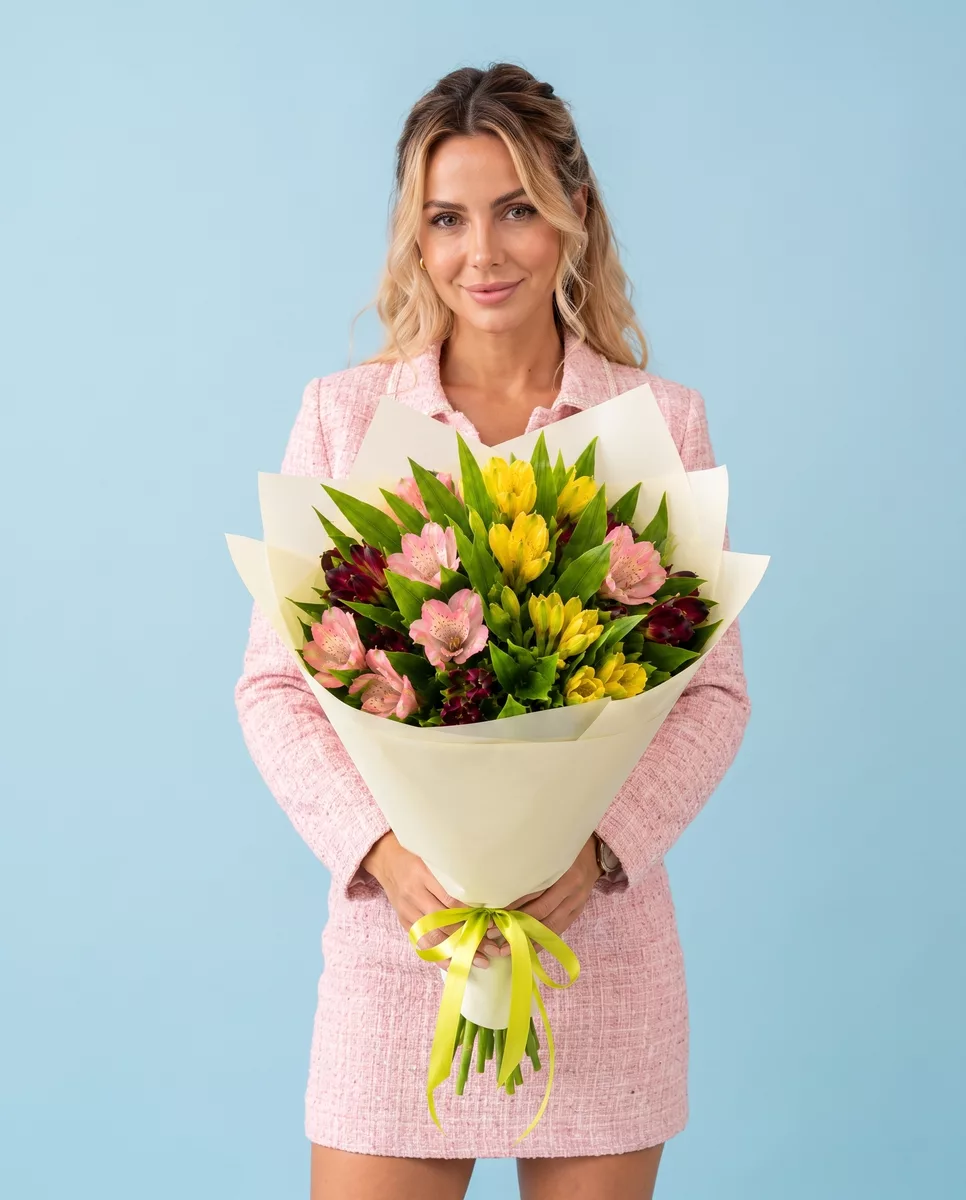
The Classic Choices: Gladioli, Dahlias and Chrysanthemums
Three species dominate Knowledge Day gifting in Russia, and they dominate for practical reasons rather than sentiment alone. Gladioli are the most recognisable: tall, dramatic, available in white, cream, pink, red and deep burgundy, they have been associated with the first of September for decades. A single stem of a large-flowered gladiolus variety, such as Priscilla or Nova Lux, already makes a visual statement, and a bunch of five to seven stems is considered a generous teacher's gift. Dahlias are the second classic choice and are perfectly timed for late August and early September because they are at peak field production in that window — you are not paying a premium for off-season forcing. Ball dahlias in white, yellow and orange hold their shape well after cutting and last four to six days in a cool room, which is relevant because teachers often leave their bouquets at school overnight. Spray chrysanthemums, particularly the multiflora types, are the third pillar of the tradition. They are robust, travel without bruising, and a bunch of seven stems fills out well without being heavy. Single large-headed chrysanthemums in white or yellow are also popular and carry a formal, respectful quality that suits the occasion. All three species are genuinely in season in early September in Russia, which keeps them fresh and keeps prices reasonable compared to, for example, roses forced in January.
Roses on Knowledge Day: When They Work and When They Do Not
Roses are the most ordered flower in Russia year-round, and many parents default to them on 1 September without thinking about whether they are the right fit. Roses absolutely can work for a teacher's gift, but the choice of variety and stem count matters more than it does with gladioli or chrysanthemums. Garden roses and spray roses in warm tones — peach, apricot, soft yellow — read as thoughtful rather than generic. A single-colour bunch of eleven stems of a medium-headed variety such as Mondial or Avalanche in white is formal and clean and works well for a secondary school teacher. What does not work is a small bunch of five red roses: in Russian floral culture, red roses in small quantities carry romantic associations, and giving them to a teacher is at best awkward. If you are ordering roses, go with fifteen stems or more, choose white, cream or yellow, and make sure the heads are at least half-open on delivery — roses that arrive as tight buds in cool September air can stay closed for two days, which means the teacher sees a nice bouquet only after the day is over. Ask when you order whether the roses have been conditioned at room temperature for at least four hours before dispatch. A florist who can confirm that detail is one who understands the timing problem specific to this date.
Stem Count, Odd Numbers and the Russian Gifting Rule
In Russia, even numbers of flowers are given at funerals and only at funerals. Gifting an even number of stems to a living person is considered a serious mistake, and while younger urban Russians are increasingly relaxed about this, teachers — who tend to be older and culturally traditional — will notice. Always order an odd number of stems: seven, nine, eleven, thirteen, fifteen. This is not superstition in the decorative sense; it is a social convention as firm as addressing someone by their first name and patronymic. If you are ordering from outside Russia and using a delivery service, confirm that the florist assembling the bouquet follows this rule, because some international platforms default to round even numbers for visual balance. Seven stems is the practical minimum for a teacher's bouquet on Knowledge Day — fewer than that looks sparse given the occasion. Nine to eleven stems is the most common range for primary school teachers. Fifteen stems is generous and appropriate if you want to acknowledge a teacher who has worked with your child for several years. Going above fifteen stems is possible but creates the weight and bulk problem mentioned earlier: the child still has to carry it. If you are sending directly to the school or to the teacher's home rather than having the child carry it, bulk is less of a concern and a larger arrangement becomes viable. A fifteen-stem dahlia bunch with foliage and a simple wrap is a well-proportioned gift that photographs well and lasts.
Timing the Order: The Window That Closes at Eight A.M.
Knowledge Day assemblies at Russian schools typically start between eight and nine in the morning. This means the flower needs to be in the child's hands, or at the school, before that window. If you are ordering delivery to a home address so that the family picks up the bouquet and the child carries it, the delivery needs to arrive by seven-thirty at the absolute latest — earlier is safer. Ordering the night before, for a delivery slot between six and seven-thirty a.m., is the most reliable approach. Same-day orders placed at five a.m. are possible with a shop that operates an early morning dispatch, but they carry risk: if there is any delay, the window closes. The week before 1 September is when you should be placing your order, not the morning of. Flower shops that handle Knowledge Day volume start preparing stock from roughly 25 August, conditioning stems and building up inventory of gladioli, dahlias and chrysanthemums specifically for this date. Ordering on 30 or 31 August gives you the best selection and the most reliable delivery slot. If you are ordering for delivery to an address in a city other than your own, factor in that the recipient needs to be home or reachable — a missed delivery on 1 September is very difficult to rebook because every slot is taken. Leave a phone number and confirm the recipient will be available from six a.m. onward.
What the Bouquet Should Look Like: Wrapping, Foliage and Colour
Knowledge Day bouquets follow a fairly consistent visual language in Russia: clean, formal, not overly designed. Kraft paper wrapping in brown or white is the standard, sometimes with a single layer of transparent cellophane underneath to protect the stems. Heavy floral foam arrangements, elaborate boxes and hat-box designs are not traditional for this occasion and look out of place when a child is walking into a school yard. The bouquet should be tied firmly so it does not shift in transit or in a child's hands. Foliage is typically minimal — ruscus or leather leaf as a backing layer is common, but the flowers should be the dominant visual element. Colour choices follow a clear pattern: white is the most universally appropriate colour for a teacher's gift because it reads as respectful and formal. Yellow is also traditional and associated with autumn and the start of the school year. Pink works well for younger primary teachers. Red, as noted, is best avoided in small quantities. Mixed-colour bouquets are less common for this specific occasion than single-colour or two-tone arrangements; the cleaner the palette, the more intentional the gift looks. If you are ordering a gladiolus bouquet, ask for stems that are showing two to three open florets at the base with the rest still in bud — this is the correct stage for transport and means the stem will continue opening over the next four to five days, which the teacher will appreciate.
Checking Your Order: Four Things to Confirm Before You Pay
Four details separate a successful Knowledge Day flower delivery from a frustrating one, and they are all worth confirming explicitly before you complete the order. First, confirm the delivery time slot in writing — not just the date, but the specific window, and make sure it lands before the school assembly starts. Second, confirm the stem count is an odd number; if the shop's default is an even number, ask them to adjust before dispatch. Third, ask about flower conditioning: gladioli and dahlias shipped straight from cold storage without any time at room temperature arrive stiff and closed, which is fine for transit but means the recipient sees a tight bunch rather than an open bouquet. A good florist conditions stems for several hours before wrapping. Fourth, confirm that the wrapping is suitable for a child to carry — a heavy ceramic vase or a water-tube box arrangement is not practical for a seven-year-old walking two hundred metres to a school assembly. If you are sending to a teacher's home address for them to bring to school themselves, the vase restriction does not apply and you have more flexibility. Beyond these four points, the variety choice matters more than any decorative addition: a clean, well-conditioned bunch of nine white gladioli in kraft paper will outperform an elaborate arrangement of flowers that arrived cold and closed, every time.
Knowledge Day is one of the most predictable floral events in the Russian calendar, which means it is also one of the most manageable if you plan a few days ahead. Choose a species that is genuinely in season — gladioli, dahlias or chrysanthemums — pick an odd stem count between seven and fifteen, confirm your delivery window lands before eight in the morning, and make sure the wrapping is practical for whoever is carrying it. A teacher who receives a well-conditioned, correctly wrapped bunch of nine white dahlias on the morning of 1 September will have a far better experience than one who receives an impressive-sounding arrangement that arrived closed, cold and overpackaged. The tradition is about the gesture and the flower, not the box. We deliver bouquets across Russia in 1–2 hours.
Frequently asked questions
Can I order Knowledge Day flowers the morning of 1 September?
It is possible if the shop has early morning dispatch, but it carries real risk. School assemblies start between eight and nine a.m., and same-day slots fill quickly on this date. Ordering on 30 or 31 August gives you a confirmed time window and better variety selection. Last-minute orders placed at five or six a.m. on the day itself may not reach the recipient before the assembly begins.
How many stems should I send a primary school teacher versus a secondary school teacher?
For a primary school teacher, seven to eleven stems is the standard range — practical for a child to carry and generous enough for the occasion. For a secondary school teacher, eleven to fifteen stems is appropriate. The key rule in both cases is an odd number of stems, which is a firm social convention in Russia and especially important when gifting someone of an older generation.
Are there flowers I should avoid sending a teacher on 1 September?
Avoid small bunches of red roses, which carry romantic associations in Russian gifting culture. Even numbers of stems should never be used for a living recipient in Russia. Very exotic tropical flowers such as anthuriums or birds of paradise are not traditional for this occasion and may read as odd rather than thoughtful. Stick to gladioli, dahlias, chrysanthemums, or white and yellow roses.
What if the teacher is not at home to receive the delivery?
Confirm the recipient's availability before placing the order, especially for early morning slots on 1 September. Leave a working phone number with the delivery instruction. If delivery to a home address is uncertain, consider sending to the school directly — call the school's administrative office in advance to confirm they accept flower deliveries and to get the correct address and contact name.
Do Knowledge Day flowers need to be in a vase when delivered?
No, and for most situations a vase is a disadvantage. If a child is carrying the bouquet to school, a simple kraft paper wrap tied firmly is correct. If the bouquet goes directly to the teacher's home or workplace, a vase is optional but not traditional for this occasion. The florist should include a water sachet on the stem ends for bouquets travelling more than thirty minutes.
Ready to send a bouquet?
Pick a city, choose the flowers, and we will hand them over with a photo confirmation.
Choose a city →