
Teacher Appreciation Flowers in Russia: Customs, Timing and Delivery
If you grew up outside Russia, the first time you see a school entrance on September 1st you will stop walking. Children arrive carrying armfuls of gladioli, chrysanthemums and roses — some bouquets nearly as tall as the students holding them. Giving flowers to a teacher is not a polite gesture here; it is a firm social expectation on several fixed dates through the year, and showing up without them reads as indifference rather than modernity. Whether you are a parent living abroad who wants to send something to your child's class teacher in Saint Petersburg, or a student who has moved overseas and wants to thank a university professor back home, this article explains what to send, when to send it, and how delivery to a school address actually works.
Why Flowers for Teachers Matter More in Russia Than You Might Expect
In Russian culture the teacher occupies a social position that carries genuine public respect, and flowers are the standard way that respect is made visible. This is not sentiment left over from Soviet times — it is practiced actively today. Parents coordinate with each other before the big dates so that a class teacher receives one well-made bouquet from the whole group rather than twenty small ones, though individual families still bring their own on top. University students do the same for lecturers they like. The custom is concrete enough that flower shops in every Russian city plan their stock weeks in advance around the school calendar. If you are ordering from abroad and you skip flowers on a key date, the teacher notices the absence, and so does your child. The three dates that carry the heaviest expectation are September 1st, Teacher's Day in October, and the last school bell in late May. On each of those days a teacher at a city school in Saint Petersburg or Moscow may receive between eight and twenty bouquets in a single morning. Knowing this, florists working those dates cut and condition stems the night before, because orders arrive in clusters between 7 a.m. and 9 a.m. and the window between order and delivery is tight. The practical takeaway: book at least 24 hours ahead on these dates, and if you are ordering from a different time zone, account for Moscow Standard Time when you calculate the cutoff.
Bouquets we can deliver



The Three Key Dates When Flowers Are Expected at Schools
September 1st, called Den Znaniy or Knowledge Day, is the date that catches most people from abroad off guard. Every student from first grade through eleventh grade attends a formal outdoor ceremony, and nearly every child brings flowers for the class teacher. The bouquets tend to be large and upright — gladioli are traditional precisely because their tall spikes photograph well at outdoor ceremonies and hold their shape in warm early-autumn weather. Dahlias and large-headed chrysanthemums also appear heavily on this date. Teacher's Day falls on the first Sunday of October, though schools usually celebrate it on the nearest Friday so the students are present. This occasion calls for slightly more refined arrangements — roses, lisianthus, alstroemeria — because the tone is celebratory rather than ceremonial. The last school bell, Posledniy Zvonok, happens in late May and marks the end of the academic year for graduating eleventh-graders. Flowers on this day come from the students themselves rather than from parents, and the mood is warm and informal, so mixed seasonal bouquets with peonies, ranunculus or garden roses work well if they are in season. Outside these three peaks, individual teachers also receive flowers on their personal birthdays if the class knows the date, and on International Women's Day, March 8th, which in Russia is observed as broadly as a national holiday and triggers another wave of flower deliveries to schools and universities across the country.
Which Flowers Russian Teachers Actually Receive — and Which Work Best
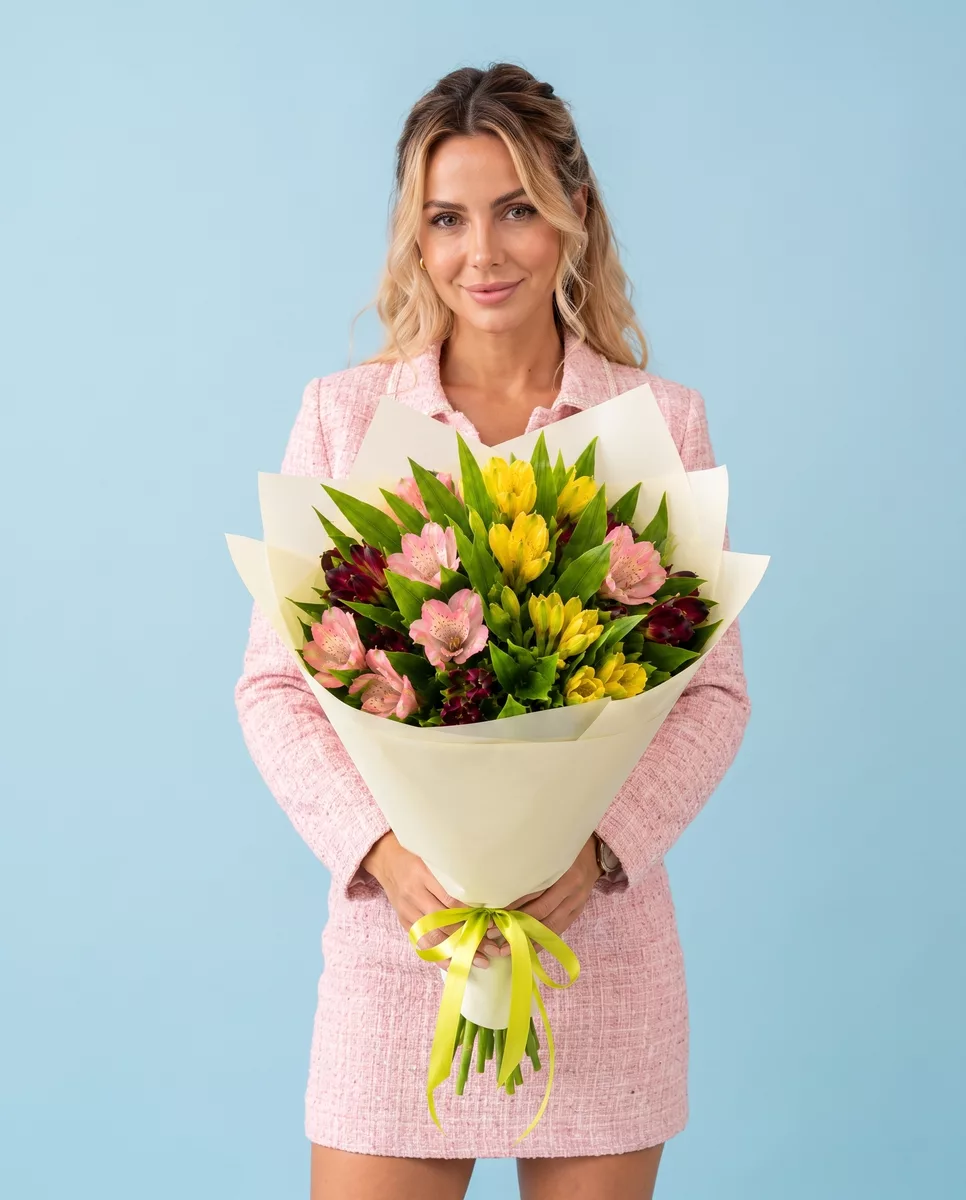
Gladioli dominate September 1st for practical reasons: they are tall, they open slowly over several days so they look good from morning ceremony through afternoon, and they are available in large volumes in late August. A single stem of gladiolus is considered too little; a bunch of seven or nine stems tied with a ribbon is the standard unit. Chrysanthemums — specifically the large single-headed varieties called spray or santini — are reliable for Teacher's Day in October because they are cold-tolerant and last ten to fourteen days in a vase, which matters to a teacher who receives multiple bouquets and needs them to survive the week. Roses are appropriate on every occasion but work best when they are not the default red: cream, peach, coral and pale yellow roses read as more considered than a standard red dozen. Lisianthus is popular with florists who work the school calendar because it fills volume without adding weight, holds well at room temperature, and photographs softly. Alstroemeria is a practical choice for a class-pooled bouquet because it gives many individual flowers per stem and keeps its color for a long time. Avoid flowers with strong fragrance — hyacinths, for example — because a classroom is a small enclosed space and a teacher who receives three heavily scented bouquets in one morning will have a headache by noon. Tulips are fine on March 8th but wilt quickly in heated school buildings in spring, so they need to be delivered on the morning of the date rather than the evening before.
Ordering Delivery to a School or University Address: What You Need to Know
Schools and universities in Russia have security desks at the entrance, and a delivery driver cannot walk into a classroom unannounced. When you place an order for delivery to a school, you need to provide the full street address including the building number and corpus if there is one, the recipient's full name — first name, patronymic, and surname — and a mobile phone number for the teacher. Russian schools expect the teacher's patronymic on any formal communication, so if you only know a first name, ask the school secretary or another parent before you order. The driver will call ahead and the recipient or a student will come to the entrance to collect. For university deliveries the process is the same but campuses are larger, so specifying the faculty building or department in the delivery notes saves significant time. If the teacher is not available at the moment of delivery — in a lesson, for example — the driver will hold the order for a short window and call again. This is why a working mobile number is not optional. For September 1st specifically, the ceremony usually begins at 9 a.m. and ends around 10 a.m., after which teachers go inside. Aim for delivery between 8 a.m. and 8:45 a.m. so the bouquet arrives before the ceremony, or after 11 a.m. once everyone is settled. Deliveries attempted during the ceremony itself create confusion because everyone is outside and no one is staffing the entrance desk.
Ordering from Abroad: Time Zones, Payment and What to Write on the Card
Russia operates across eleven time zones, and Saint Petersburg runs on Moscow Standard Time, which is UTC plus three with no daylight saving adjustment. If you are placing an order from Western Europe, you are one to three hours behind; from the United States East Coast you are eight hours behind; from California, eleven. This matters because a 9 a.m. school ceremony in Saint Petersburg happens at 6 a.m. in Berlin and at 1 a.m. in New York. Place your order the evening before from wherever you are, confirm the delivery time window in Moscow Standard Time, and you will avoid the most common mistake: ordering on the morning of the date in your local time when the ceremony in Russia is already over. Payment from abroad works through standard international card processing — Visa and Mastercard are accepted for orders placed on the Five Flowers website. The card message is worth thinking about carefully. In Russian schools it is normal to address the teacher by first name and patronymic on the card: for example, Natalya Sergeyevna rather than just Natalya. If you write the card text in English, that is fine — many teachers, especially at universities, read English — but if you want the message in Russian and you are not confident in the language, write it out phonetically or in Latin script and add a note that translation would be appreciated. The shop can also help format a standard congratulatory phrase in Russian if you request it when placing the order.
Bouquet Size, Composition and Budget: What Parents Actually Spend
Russian parents ordering for a class teacher on September 1st typically aim for a bouquet that looks substantial at an outdoor ceremony — something visible from a few meters away. That usually means a minimum of seven gladiolus stems or a mixed arrangement of fifteen to twenty stems combining roses, chrysanthemums and greenery. A single parent ordering individually will spend in a moderate range; a class pooling contributions will often commission a larger, more composed arrangement because the shared budget allows it. For Teacher's Day in October the scale is slightly smaller and the emphasis shifts toward arrangement quality rather than sheer volume — a tight cluster of lisianthus and spray roses in a paper wrap looks more deliberate than a large loose bunch. University students tend to order smaller bouquets than school parents, partly because the relationship with a lecturer is less daily and partly because a professor receiving flowers from one student rather than a whole class does not expect something monumental. Five to seven stems of a single variety, well-conditioned and properly wrapped, is appropriate and will not embarrass either party. Whatever the size, make sure the bouquet is wrapped for transport. Schools do not have vases at the entrance, and a teacher collecting a bouquet at the security desk needs to carry it through corridors. A tight paper or fabric wrap that keeps the stems together and protects the heads is practical, not decorative. Ask the florist to wrap accordingly when you specify delivery to a school.
Common Mistakes When Sending Flowers to Teachers in Russia
The most frequent mistake from customers ordering abroad is choosing an even number of stems. In Russian tradition, even numbers of flowers are associated with mourning and funerals; bouquets for living recipients are always in odd numbers — five, seven, nine, eleven. This rule is taken seriously enough that a teacher who counts an even-numbered bouquet will notice, even if she says nothing. The second common mistake is ordering flowers that cannot survive the conditions they will face. A school building in September is warm — Russian schools heat aggressively from the first of the month — and a bouquet of open tulips or garden roses left on a desk in a 24-degree Celsius room will look tired within four hours. Closed buds or varieties with natural longevity like chrysanthemums and alstroemeria handle the conditions better. The third mistake is providing an incomplete address. Russia uses a structured address format: street, house number, building or corpus number if applicable, apartment or office number for residential buildings. For schools the format is street and house number, and the school name helps the driver confirm the location. Omitting the corpus number in a large residential-style school complex can send the driver to the wrong entrance. The fourth mistake is not including the teacher's phone number, which as noted earlier is essential for the driver to coordinate collection. And finally: do not order the day before and request a 7 a.m. delivery without checking whether the shop's delivery window starts that early — on peak school dates it usually does, but confirm when you book.
Giving flowers to a teacher in Russia is a specific, practiced custom with its own dates, varieties, numbers and logistics — not a vague gesture you can approximate. September 1st, Teacher's Day in October, the last school bell in May, and March 8th are the four moments when a bouquet is genuinely expected, and each has its own appropriate flowers and delivery timing. The details that trip up customers ordering from abroad — time zones, odd stem counts, full names with patronymics, school entrance protocols — are all solvable if you know them in advance. Order with a working phone number for the recipient, a complete address, and enough lead time to account for the difference between your local clock and Moscow Standard Time, and the delivery will reach the teacher before the ceremony rather than after it. We deliver bouquets across Russia in 1–2 hours.
Frequently asked questions
Can I order flowers for a teacher in Russia if I live outside the country?
Yes. You can place an order on the Five Flowers website using an international card. Provide the teacher's full name including patronymic, the school's street address, and a Russian mobile number for the recipient. Account for the time difference between your location and Moscow Standard Time when selecting the delivery window, and place the order at least 24 hours ahead on major school dates.
Why do bouquets for teachers in Russia always have an odd number of stems?
In Russian tradition, even numbers of flowers are given at funerals and in mourning contexts. Bouquets for living recipients — teachers, family members, colleagues — are always composed of an odd number of stems: five, seven, nine, eleven and so on. This is a firm social convention, and a teacher who receives an even-numbered bouquet will notice. Always specify an odd quantity when ordering.
What is the best flower for a September 1st bouquet for a Russian teacher?
Gladioli are the traditional choice for September 1st because they are tall enough to be visible at outdoor ceremonies, open gradually through the day, and are available in large volumes in late August. Seven or nine stems tied together is the standard format. Large-headed chrysanthemums and dahlias are also common on this date and last well in warm school buildings.
How does delivery to a school entrance actually work?
Russian schools have a security desk at the entrance that controls access. The driver calls the recipient's mobile number on arrival, and the teacher or a student comes to the entrance to collect the bouquet. The driver cannot enter classrooms. This is why a working Russian mobile number for the teacher is essential — without it, the driver has no way to alert the recipient and the delivery cannot be completed.
Is Teacher's Day in Russia on the same date every year?
Teacher's Day in Russia falls on the first Sunday of October, established by a UNESCO-aligned date. Because schools need students present for the celebration, the actual school event is held on the nearest Friday. The delivery date that matters for ordering purposes is that Friday, not the Sunday. Check the calendar for the specific year, as the Friday date shifts between the first and second week of October.
Ready to send a bouquet?
Pick a city, choose the flowers, and we will hand them over with a photo confirmation.
Choose a city →