
Yellow Flowers in Russia: Superstition, Reality and When to Send Them
Almost every week someone calls us and asks, in a slightly nervous voice, whether it is really true that yellow flowers mean a breakup or bad luck in Russia. The short answer is: it depends entirely on who taught the recipient to think that way, and on the context of the occasion. The longer answer involves specific varieties, combinations and a few practical rules that will help you order with confidence rather than anxiety.
Where the Superstition Actually Comes From
The belief that yellow flowers bring separation or misfortune is genuinely widespread in Russia, particularly among people who grew up in the Soviet period or in more traditional households. It is not a medieval folk custom with deep roots — most flower historians trace it to the mid-twentieth century, when the range of available cut flowers was extremely narrow and yellow blooms were associated with autumn decline simply because chrysanthemums and certain dahlias were the only things in season before the first frost. When options are limited, associations harden quickly. The superstition then spread through popular culture: a line in a poem, a scene in a Soviet film, a grandmother's warning before a first date. By the 1980s it had become a kind of urban rule of thumb, repeated without much examination. What matters for anyone ordering flowers today is that the superstition is not universal. Younger Russians in large cities, people with any exposure to European or East Asian floral culture, and most professional settings do not hold this belief at all. A twenty-five-year-old in Saint Petersburg is statistically far less likely to be troubled by yellow roses than her grandmother in a smaller town. Knowing your recipient's background is therefore the single most useful piece of information you can have before placing an order.
Bouquets we can deliver



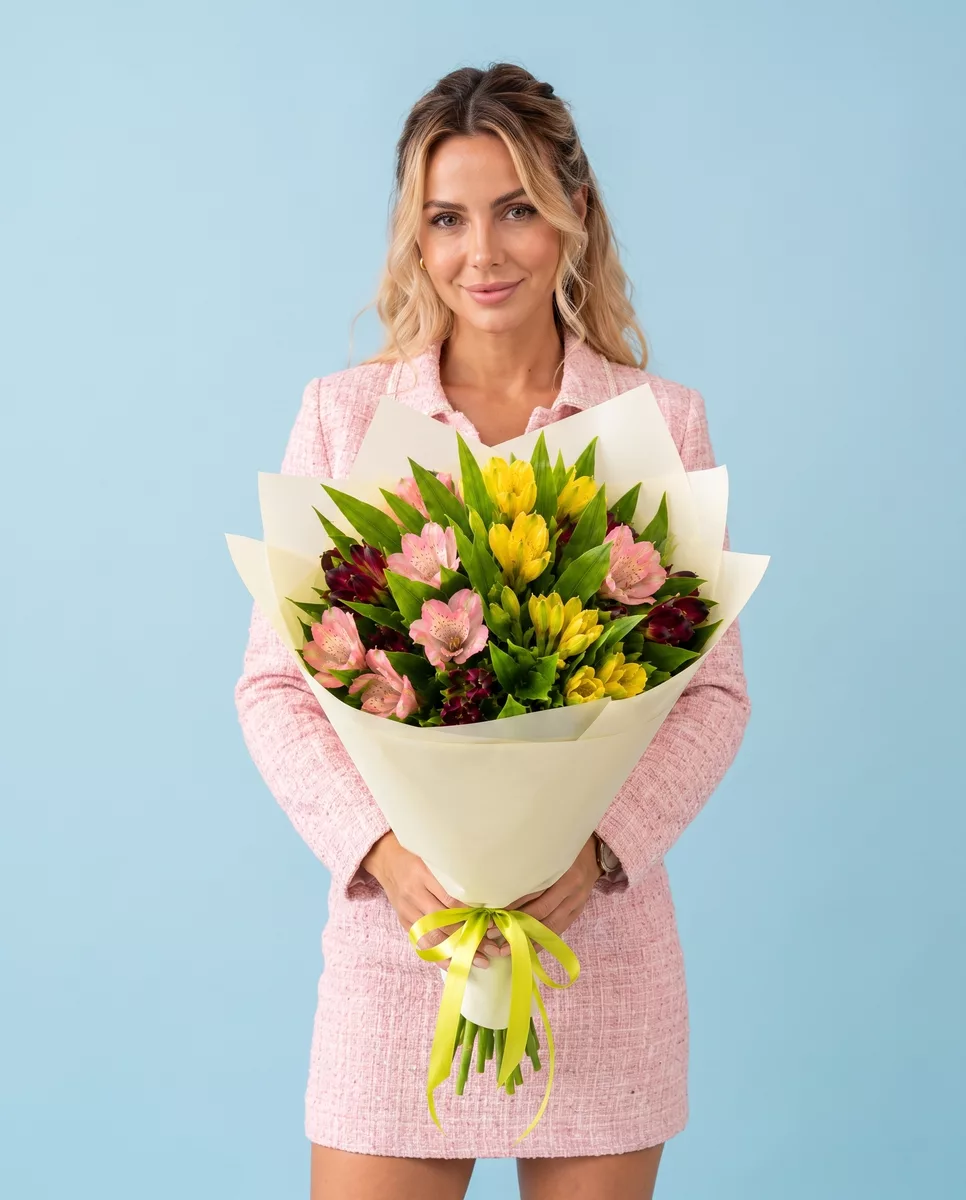
Yellow Varieties That Actually Sell Well in Russia Right Now
The practical reality on our shop floor is that yellow flowers move steadily all year, and certain varieties carry almost no superstitious weight because they are strongly associated with celebration rather than with any negative idea. Yellow spray roses — small-headed, multi-stemmed varieties like Solero or Hera — are ordered constantly for birthdays and corporate events because they read as cheerful rather than romantic, which sidesteps the romantic-separation reading entirely. Yellow tulips in February and March sell in enormous quantities for International Women's Day, when the volume of orders is so high that symbolic hesitation simply evaporates. Sunflowers, which are yellow by definition, are one of the most requested flowers in Russia and carry almost entirely positive associations — harvest, warmth, generosity. Ranunculus in butter-yellow tones has become popular in the last five years as Instagram aesthetics influenced what people want to receive, and younger customers rarely attach any superstition to them. Yellow freesia is another strong seller: its scent is distinctive enough that recipients focus on the fragrance rather than the colour. The varieties that do sometimes trigger the old association are single large-headed yellow roses given alone, particularly in a round dozen, because that format still reads as a romantic gesture and the colour then becomes more loaded. Changing the format — mixing stems, adjusting stem count, adding white or green — usually resolves the concern without abandoning yellow entirely.
Occasions When Yellow Flowers Are Entirely Appropriate
There is a clear set of occasions where yellow flowers not only avoid the superstition but are genuinely the strongest choice. Graduation is the most obvious: academic success is traditionally celebrated with bright, energetic colours in Russia, and a bouquet of yellow and white gerberas or yellow roses mixed with green hypericum reads as congratulatory without ambiguity. New job, promotion or business opening all fall into the same category — yellow signals optimism and forward movement, and in a professional context no one is reading romantic symbolism into a desk arrangement. Teacher appreciation, which peaks in Russia on Knowledge Day in early September and again in late May at the end of the school year, is another strong use case: teachers receive hundreds of bouquets and colour variety is welcome, with yellow chrysanthemums and yellow alstroemeria being practical choices because they last well in warm classrooms. Housewarming gifts in Russia often include flowers, and yellow is a natural fit because it suggests warmth in a new space. Baby announcements and new-parent visits are also occasions where yellow works well, particularly when the family has not announced a preference for pink or blue — yellow is genuinely neutral in that context. The common thread across all of these is that none of them carry a romantic subtext, which is where the separation reading lives. Remove the romantic frame and yellow becomes simply a bright, positive colour.
When to Be Cautious: Romantic Gifts and Traditional Recipients
There are situations where it is worth pausing before choosing yellow as the dominant colour. Sending flowers to a romantic partner for the first time, when you do not yet know their background or beliefs, is the highest-risk scenario. A single yellow rose or a monochrome yellow bouquet can genuinely unsettle someone who was raised with the superstition, and first impressions in a new relationship are not the moment to test whether your recipient is superstitious. Anniversaries carry similar weight — if the relationship is important, defaulting to red, pink or mixed palettes is simply safer. Sending flowers to an older woman, particularly in a smaller city or a more traditional household, is another situation where caution costs you nothing. A woman in her sixties or seventies who receives a yellow bouquet from a younger relative may not say anything but may privately feel unsettled. This is not about the flowers being objectively bad; it is about the recipient's experience of receiving them. The practical solution in both cases is the same: mix yellow with white or cream tones. White in Russian floral culture is associated with purity and sincerity, not with anything negative, and it neutralises the yellow-means-separation reading very effectively. A bouquet of yellow and white roses, or yellow tulips with white alstroemeria, reads as celebratory to almost everyone regardless of their position on the superstition. The ratio matters — roughly equal parts yellow and white works better than a token white stem dropped into a yellow arrangement.
How Mixing Colours Changes the Reading
Professional florists use colour mixing not just for visual balance but to manage exactly the kind of symbolic ambiguity that yellow creates in the Russian market. The principle is straightforward: a monochrome bouquet carries the full symbolic weight of that colour, while a mixed bouquet distributes attention across the combination. Yellow paired with purple or violet is one of the most commercially successful combinations in our shop — it reads as sophisticated and slightly unusual, and neither colour dominates enough to trigger a single-colour association. Yellow and orange together create an energetic, warm effect that is strongly associated with autumn celebrations and is almost universally well received. Yellow with deep green foliage — eucalyptus, ruscus, or large tropical leaves — shifts the bouquet toward a botanical, garden aesthetic that younger recipients in particular respond to positively. The one combination to avoid is yellow with white in equal parts when the occasion is romantic, because in some readings that combination echoes the palette of traditional Russian wedding flowers and can feel either too formal or oddly bridal for a casual romantic gesture. For non-romantic occasions, yellow-white is one of the safest and most versatile combinations available. When you are ordering remotely and cannot see the finished arrangement, asking specifically for mixed stems rather than a monochrome yellow bouquet is a simple instruction that gives the florist room to build something that will land well regardless of the recipient's views on yellow.
Seasonal Timing and What Is Actually Available
Yellow flower availability in Russia follows a clear seasonal pattern that affects both what you can order and what arrives in the best condition. Dutch import tulips in yellow — varieties like Strong Gold and Yellow Flight — are available from late December through April and are at their freshest from February to mid-March. During this window they are inexpensive relative to other flowers and have a vase life of seven to ten days in a cool room, which makes them practical for recipients who are not experienced at flower care. Yellow roses are available year-round from Ecuadorian and Kenyan farms, but the transit time to Russia means quality varies: summer shipments arriving in July and August sometimes show heat stress on the petals, so checking that the shop sources from refrigerated logistics chains matters more for roses than for hardier stems. Yellow chrysanthemums, both spray and single-headed, peak in September and October and are at their most affordable then — a large spray chrysanthemum head can last three weeks in water, making it one of the most durable options for a recipient who travels or is not at home consistently. Yellow freesia is available in reliable quality from October through April and is more delicate — it needs cool temperatures and should not sit in a car or warm hallway for more than an hour after delivery. Sunflowers are a summer and early autumn flower in Russia; imported sunflowers are available outside that window but at higher cost and with shorter vase life, so ordering them in January requires managing expectations about longevity.
What to Check Before You Place the Order
Before confirming an order with yellow flowers, there are four practical things worth verifying. First, confirm the delivery address and whether the recipient will be at home or at an office — yellow flowers, like all cut flowers, need to be received promptly and placed in water, and a bouquet left in a warm lobby for two hours will look significantly worse than one handed directly to the recipient. Second, if you are ordering tulips or freesia in warm months — anything above fifteen degrees Celsius outside — ask specifically whether the shop uses refrigerated transport for the last mile, because these varieties wilt faster than roses and the difference between a refrigerated van and an uninsulated courier bag is visible in the finished bouquet. Third, if you have any uncertainty about the recipient's views on yellow, specify in the order notes that you want yellow mixed with white or cream, and give the florist latitude to adjust the ratio — a good florist will balance the arrangement in a way that reads positively. Fourth, check the stem count. In Russia, even numbers of flowers are traditionally associated with occasions that involve condolence, so bouquets are almost always sold in odd numbers — five, seven, nine, eleven, fifteen, twenty-five. If you are ordering from a non-Russian platform or customising a bouquet manually, make sure the final count is odd. This rule applies regardless of colour and is one of the most consistent customs across all regions of Russia.
Yellow flowers are not bad luck in Russia — they are context-dependent, like almost everything in floral culture. The superstition is real enough that it is worth knowing, but it applies most strongly to monochrome romantic bouquets given to recipients from traditional backgrounds. For graduations, professional occasions, teacher gifts, housewarmings and celebrations of any kind, yellow is a strong and appropriate choice. Mixing yellow with white or green neutralises the symbolic risk further. Choosing the right variety for the season — tulips in late winter, sunflowers in summer, chrysanthemums in autumn — means the flowers will also arrive in the best possible condition, which matters more to the recipient than the colour theory behind the arrangement. We deliver bouquets across Russia in 1–2 hours.
Frequently asked questions
Is it really rude to send yellow flowers in Russia?
Not universally. The superstition is strongest among older recipients and in smaller cities. Younger Russians in major cities rarely attach negative meaning to yellow flowers, especially when they are mixed with other colours or presented for a non-romantic occasion like a graduation or work celebration. Knowing your recipient's background is more useful than avoiding yellow entirely.
Which yellow flowers have the least superstitious association in Russia?
Sunflowers carry almost no negative association — they are strongly linked to warmth and generosity. Yellow spray roses, ranunculus and freesia also tend to read as celebratory rather than romantic, which sidesteps the separation reading. Single large-headed yellow roses given alone in a romantic context are the format most likely to trigger concern.
Can I send yellow flowers to a woman in her sixties or seventies?
It depends on her background. If she grew up in a traditional household or a smaller city, she may hold the superstition sincerely. Mixing yellow with white is the safest approach — it reads as celebratory to almost any Russian recipient regardless of age. A florist can adjust the ratio so white is prominent without eliminating yellow entirely.
What is the best time of year to order yellow tulips for delivery in Russia?
February through mid-March is the optimal window. Dutch yellow tulips like Strong Gold are at peak freshness, prices are competitive due to high import volumes around International Women's Day, and vase life reaches seven to ten days in a cool room. Outside this window tulips are available but quality is less consistent and prices are higher.
Does the number of yellow flowers in a bouquet matter in Russia?
Yes, and this rule applies to all colours. Bouquets should contain an odd number of stems — five, seven, nine, eleven and so on. Even numbers are traditionally associated with condolence occasions in Russia. If you are customising an arrangement, always confirm the final stem count is odd before placing the order.
Ready to send a bouquet?
Pick a city, choose the flowers, and we will hand them over with a photo confirmation.
Choose a city →