
Alstroemeria in Russia: Why Florists Recommend It
Every week someone calls the shop asking for flowers that will still look good five days after delivery. Roses are the first answer most people expect, but florists who work with fresh stock daily will usually point to alstroemeria first. It holds water efficiently, its stems carry multiple buds that open in sequence, and it survives the temperature swings that are simply part of life in a Russian apartment — radiators blasting in winter, no air conditioning in summer. This article covers the real reasons it belongs in more orders, which varieties are worth requesting by name, and what to check before you confirm a delivery.
What Alstroemeria Actually Is and Why It Travels Well
Alstroemeria is a South American genus that has been cultivated commercially in the Netherlands, Colombia and Ecuador for decades, and those are the primary origins of the stems sold in Russian flower shops today. The flower is sometimes called the Peruvian lily, though it is not a true lily. What matters practically is its stem structure: each main stem branches into several smaller ones, each carrying a bud at a different stage of development. That staggered opening means a bunch delivered on Monday will still have fresh-looking blooms by the following weekend, which almost no other cut flower can reliably promise at the same price point. The petals are typically marked with fine streaks or flecks in a contrasting colour — a detail that gives the flower visual complexity without needing companion greenery to fill out a bouquet. Transport tolerance is another reason florists favour it. Alstroemeria ships and delivers well in cold conditions, and the stems do not bruise or wilt as quickly as tulips or gerberas during the last-mile delivery that happens in a van crossing Saint Petersburg in February. For online orders with a one-to-two-hour delivery window, that resilience is not a minor point — it is the difference between a bouquet that arrives looking fresh and one that looks like it has already had a hard day.
Bouquets we can deliver



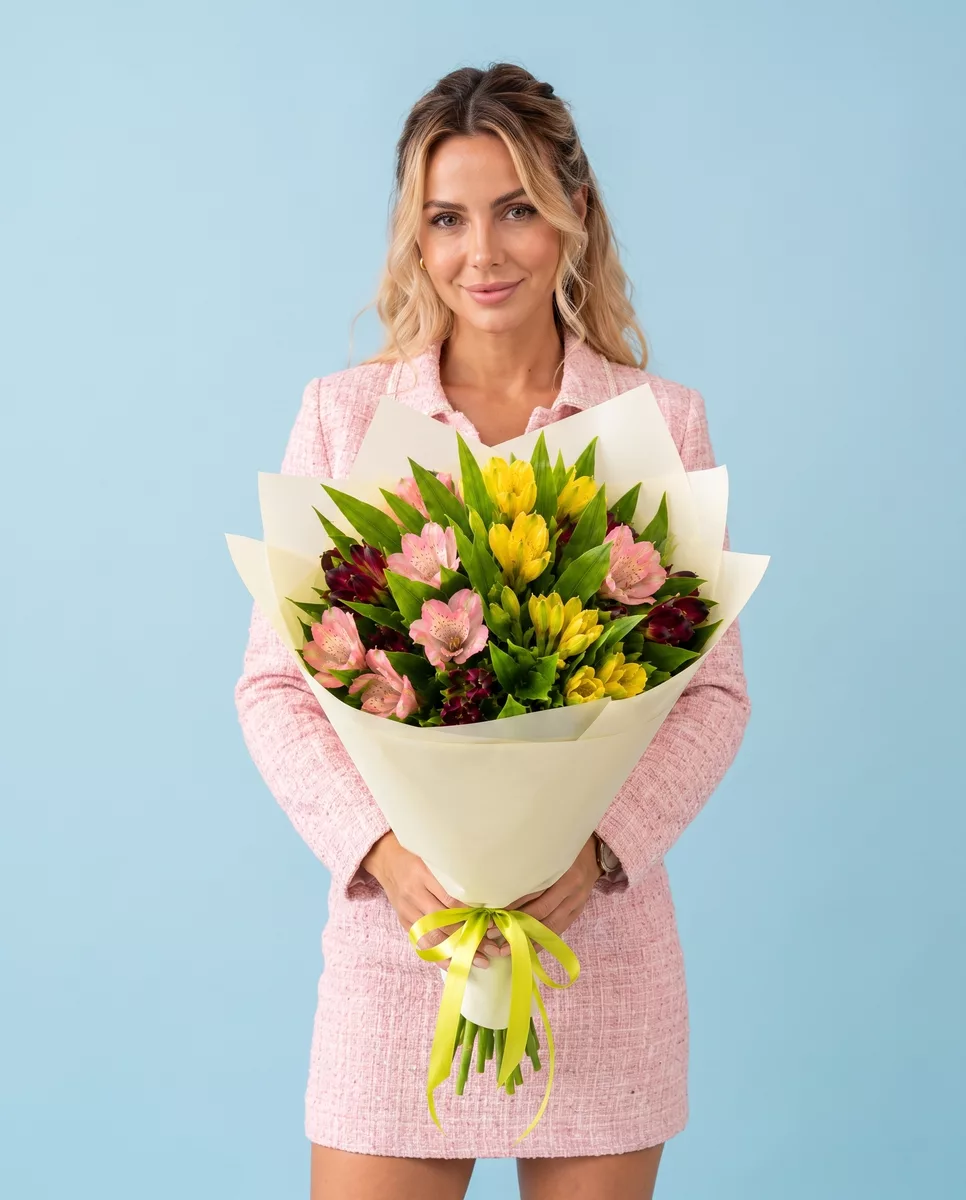
Main Varieties Available in Russian Wholesale and Retail
The varieties you will encounter most often in Russian retail come from Dutch breeding programmes, and a few names appear consistently enough to be worth knowing. Tesoro is a warm yellow variety with orange-red streaking and is one of the most requested shades for spring and early summer orders. Tiara is a white variety with a clean, minimal look that works in monochrome arrangements and alongside other white flowers without competing with them. Fuego is a deep red with strong stems and is often used when a customer wants something close to the richness of a red rose but with longer staying power. Inca varieties — Inca Ice, Inca Tropic, Inca Adagio — are a series developed for high bud count and reliable opening sequence, which makes them popular with florists assembling large mixed bouquets where consistency matters. Virginia is a soft pink with a cream centre that photographs well and is a frequent choice for bouquets ordered for women's birthdays. Beyond these, seasonal availability matters: some varieties arrive in larger quantities in spring when Colombian and Ecuadorian exports peak, and your florist should be able to tell you what is in stock rather than what is simply listed on the website. When ordering remotely, it is worth specifying the colour family rather than a single variety name, because the actual stem on the day may be a close relative of the one you had in mind, and a good florist will match the character of the flower even if the exact cultivar differs.
Vase Life: What the Numbers Mean in a Russian Home
The standard claim for alstroemeria vase life is fourteen to twenty-one days, and that range is accurate under the right conditions, but it needs unpacking for the reality of most Russian apartments. The primary enemy is heat. Central heating in Russia runs from roughly October through April and keeps indoor temperatures at twenty-two to twenty-five degrees Celsius or higher, sometimes regardless of what the occupant prefers. At those temperatures, vase life shortens noticeably — expect ten to fourteen days rather than three weeks. In summer, the opposite problem appears: apartments without air conditioning can reach twenty-eight degrees or more during July and August heat waves, and flowers on a sunny windowsill will deteriorate in four or five days. The practical rule is to keep the vase away from radiators, direct sunlight and fruit bowls, because ripening fruit releases ethylene gas that accelerates petal drop. Water management is straightforward: change the water every two days, recut the stems at an angle each time, and remove any leaves that fall below the waterline. Alstroemeria does not need flower food sachets to perform well, though they do not hurt. What it does need is a clean vase — bacteria in dirty glass are the most common reason a bouquet dies faster than expected. Compared to roses, which typically last seven to ten days in a warm Russian apartment, alstroemeria's performance is meaningfully better, and that gap is exactly what florists explain when a customer is choosing between the two.
When Alstroemeria Works as a Gift in Russia
Russia has a dense calendar of gift-giving occasions, and understanding which ones suit alstroemeria helps when you are ordering under time pressure. The flower is appropriate for birthdays across all age groups, which is not true of every flower — chrysanthemums, for example, carry funeral associations in Russian culture and are avoided for celebratory gifts by many people, though the taboo is generational and fading. Alstroemeria carries no such associations and is considered universally neutral and positive. March 8th, International Women's Day, is the single largest flower-buying day in Russia, comparable to Valentine's Day and Mother's Day combined in terms of volume. Alstroemeria is a practical choice for that date because it arrives in large quantities and holds up through the delivery rush better than tulips, which dominate the day but are fragile. Teacher's Day in early October and the last school bell in late May are occasions when children traditionally bring flowers to teachers, and a modest alstroemeria bouquet is both affordable and long-lasting enough that the teacher can enjoy it through the following week. For corporate gifting — a common practice in Russian business culture, where flowers are brought to meetings and office celebrations — alstroemeria in a single colour family looks intentional and professional without the expense of an all-rose arrangement. The flower also works well as a thank-you gift for a host after a dinner invitation, a custom that remains common in Saint Petersburg households.
How Florists Build Bouquets Around Alstroemeria
Alstroemeria is rarely the only flower in a professional arrangement, and understanding how it is used alongside other stems helps when you are describing what you want to a florist. Its branching structure means it contributes volume naturally, so it pairs well with flowers that have single, upright stems — lisianthus, spray roses, or matthiola — which provide vertical lines while alstroemeria fills the middle register. White or cream alstroemeria is a standard complement to blue and purple flowers like delphinium or eryngium, because the light petals prevent the arrangement from reading as too dark. Yellow and orange varieties — Tesoro, Inca Tropic — work alongside sunflowers in late summer compositions without the sunflower overwhelming everything else. Mono-bouquets of alstroemeria alone are also a legitimate choice and are more common than people expect. A bunch of fifteen to twenty stems in a single variety creates a dense, layered look that holds its shape as the buds open over the course of a week, and it reads as a considered gift rather than a filler arrangement. Stem count matters when ordering: fewer than ten stems of alstroemeria in a mixed bouquet will disappear visually, so if the flower is meant to be prominent, ask for it to represent at least half the stem count. Florists sometimes use alstroemeria as a structural element rather than a focal flower, threading it through the arrangement to create an even distribution of colour — a technique that is worth requesting explicitly if you want the finished bouquet to look full rather than sparse.
Ordering Alstroemeria for Delivery: What to Check
Remote ordering — by phone, app or website — introduces a gap between what the customer imagines and what arrives, and alstroemeria orders have a few specific points worth clarifying before you confirm. First, specify the colour family in plain terms: warm tones meaning yellow, orange and red, or cool tones meaning white, pink and purple. Florists can match a colour direction reliably; matching a single named variety is harder because stock rotates daily. Second, ask about bud stage. Alstroemeria ships and is often sold with buds still closed, which is correct — closed buds travel better and the customer gets the full opening sequence at home. If you are ordering for an event happening on the same day, ask whether the stems in stock are at a stage where at least some buds will be open on arrival, because a bouquet of entirely closed buds can look sparse to someone who does not know what to expect. Third, confirm the water situation for delivery. A bouquet that travels more than thirty minutes should be wrapped with a water source at the stem ends — either a water sachet or damp wrapping — especially in summer. Five Flowers handles this as a standard part of packing, but it is worth asking if you are ordering for a long-distance recipient. Finally, check the delivery address temperature situation: a bouquet left with a concierge in an unheated lobby in January will arrive in better condition than one left in a heated hallway for three hours, and timing your delivery to when the recipient is actually home makes a real difference to how the flowers look when they are finally unwrapped.
Price, Value and How Alstroemeria Compares to Roses
The honest reason florists recommend alstroemeria is that it offers more days of visible beauty per rouble than almost any other cut flower available in Russia at a similar price tier. Roses are the default gift flower and carry strong cultural weight, but they are also among the most expensive stems in the shop, and their vase life in a warm Russian apartment rarely exceeds ten days. Alstroemeria costs significantly less per stem, carries more buds per stem than a rose, and lasts longer — that combination is difficult to beat on a practical basis. The price difference becomes especially relevant when the order is for a large arrangement: a bouquet that would require thirty rose stems to look full might achieve the same visual density with fifteen alstroemeria stems, because each branch contributes multiple flower heads. This is not a reason to dismiss roses — they carry meaning that alstroemeria does not, and for certain occasions that meaning is exactly what the gift needs to communicate. But for a birthday bouquet, a thank-you arrangement, a teacher's gift, or a regular delivery to someone who simply loves having flowers in the house, alstroemeria is the more rational choice by most measurable criteria. Florists in Saint Petersburg see this play out every week: customers who switch to alstroemeria after one order tend to reorder it, because the recipient notices that the flowers are still looking good a week later and mentions it. That feedback loop — recipient comments, customer reorders — is the clearest signal that the flower is doing what it is supposed to do.
Alstroemeria earns its place in the shop not through marketing but through performance. It opens gradually, holds water well, survives the temperature conditions of a Russian apartment better than most alternatives, and arrives looking the same after a one-hour delivery as it did when it was packed. The varieties available in Russia cover the full colour spectrum, the stem structure makes it useful in mixed arrangements and as a standalone bouquet, and its cultural neutrality means it is appropriate for nearly every occasion on the Russian calendar. If you have been defaulting to roses because they feel like the safe choice, alstroemeria is worth trying once — and the vase on the recipient's table will make the case more effectively than any florist can. We deliver bouquets across Russia in 1–2 hours.
Frequently asked questions
How long will alstroemeria last after delivery in a Russian apartment?
In a typical Russian apartment with central heating running, expect ten to fourteen days. In summer without air conditioning, closer to seven to ten days. Keep the vase away from radiators, direct sun and fruit. Change the water every two days and recut stems at an angle to get the full vase life from the bouquet.
Is alstroemeria appropriate as a gift in Russia, or does it have any negative associations?
Alstroemeria has no negative cultural associations in Russia and is considered suitable for all celebratory occasions — birthdays, Women's Day, professional milestones and host gifts. Unlike chrysanthemums, which some people associate with mourning, alstroemeria is universally positive across generations and regions of Russia.
Why do alstroemeria buds arrive closed, and is that a problem?
Closed buds are correct and intentional. Alstroemeria is harvested and shipped before the buds open so the stems travel without damage and the recipient gets the full opening sequence at home. If you need some open flowers on arrival for a same-day event, mention this when ordering and the florist will select stems at a more advanced stage.
Can alstroemeria be used in a bouquet with roses, or do they need to be kept separate?
Alstroemeria and roses combine well. Roses provide a focal flower with strong cultural weight while alstroemeria adds volume, colour variation and longevity. Because alstroemeria outlasts roses by several days, the bouquet will shift in character over time, but this is not a problem — it simply means the alstroemeria carries the arrangement through the second week.
Which alstroemeria varieties are most commonly available for delivery in Russia?
The most consistently available varieties in Russian retail are Tesoro in yellow-orange, Tiara in white, Fuego in deep red, Virginia in soft pink, and the Inca series in multiple colours. Availability rotates with wholesale deliveries, so specifying a colour family rather than an exact variety name gives the florist flexibility to match your preference with what is actually in stock.
Ready to send a bouquet?
Pick a city, choose the flowers, and we will hand them over with a photo confirmation.
Choose a city →