
Sending Flowers Anonymously: Courier Contact, Timing and What to Share
Every week customers call us with the same request: they want flowers delivered to someone who must not know who sent them, and they are not sure what information to hand over or how the courier manages the doorstep moment without spoiling everything. The answer involves a few practical decisions made at the order stage — the recipient's address, how the courier reaches them, what goes on the card, and which bouquet survives a discreet handoff without looking like it was rushed. Get those details right and the surprise holds. Get them wrong and the recipient is calling the sender before the courier even leaves the building.
What Anonymous Delivery Actually Means at the Courier Level
Anonymous delivery does not mean the courier arrives in silence and leaves a bouquet on the mat. In Russia, most residential buildings have a locked entrance door, an intercom system, and sometimes a concierge or security desk on the ground floor. The courier must physically reach the recipient, which requires either calling their phone, buzzing the intercom, or coordinating with building staff. None of those steps automatically reveal who sent the order, but they do require the recipient's contact number or at minimum their flat number and building entrance code. When you place an order marked as a surprise, the courier is instructed not to mention the sender's name at the door and not to show the order screen if asked. The delivery note inside the bouquet is the only place the sender's identity appears, and you control exactly what that note says. If you leave the sender field blank, the card reads only the message you wrote. The courier's job at the door is to hand over the bouquet, confirm the recipient's first name, and leave. They do not explain where the order came from or how it was paid. This is standard practice for our team, not a special add-on. What you must supply is a working phone number for the recipient, because without it the courier cannot get past the building entrance in most Petersburg apartment blocks, and the bouquet cannot be left unattended on a step in temperatures that regularly drop below zero from October through April.
Bouquets we can deliver



Collecting the Recipient's Address Without Giving Away the Plan
The most common mistake is asking the recipient directly for their address in a way that telegraphs that something is coming. Customers often message their partner something like 'what's your office address again?' on the same morning they placed the order, and the partner immediately suspects a delivery. There are cleaner methods. If you already have the approximate address from a previous visit or a shared location, verify the flat number and entrance through a mutual friend or a family member who can be trusted. For workplace deliveries, the company's reception address is usually on their website or social media page, and a receptionist will accept the bouquet on the recipient's behalf without any prior warning. For home deliveries, building entrance codes in many Petersburg residential complexes are standard four-digit combinations that a neighbor or a mutual contact can confirm without raising suspicion. When you fill in the order form, list the full address including the building number, block letter if applicable, entrance number, floor, and flat number. A courier navigating Vasilyevsky Island or the new residential districts in Murino without a flat number will call the recipient directly to ask, which ends the surprise immediately. Supply every field completely and the courier has no reason to make that call. If the address covers a business premises with a reception desk, note that in the comments field so the courier goes to reception rather than trying to reach the recipient's direct extension.
Handling the Recipient's Phone Number Discreetly
You must provide the recipient's mobile number when placing the order. This is not optional. Our couriers use it to buzz through intercoms on newer buildings that route calls to the resident's phone rather than a fixed panel, to confirm they have the right floor in large complexes, and to coordinate a delivery window when the recipient is not yet home. The number itself is never shown to the recipient on any document and the courier's phone displays as a standard mobile number with no shop name attached. When the courier calls, they say only that they have a delivery and ask the recipient to open the entrance door or come down. They do not say it is flowers, they do not say who sent it, and they do not mention the shop. If the recipient asks directly, the courier's standard answer is that all details are inside the package. In practice, most recipients hear 'delivery' and assume it is a courier parcel from a marketplace like Ozon or Wildberries, which are extremely common in Russian cities, so the call raises no suspicion on its own. If you are genuinely unable to share the recipient's number — for instance, you are sending to a public figure's office or a hospital ward — note the situation in the comments and we will advise on the best approach for that specific address. Do not leave the phone field blank and hope for the best; a bouquet of garden roses or ranunculus sitting in a cold entrance lobby for forty minutes will not look its best by the time it is collected.
Writing a Card That Protects the Secret
The card is a small printed slip placed inside the wrapping, usually tucked between the stems and the outer paper. It is the only written record of who sent the flowers, and you have complete control over its content. If you want full anonymity, leave the sender name field empty and write only a message. The card will then show just your text — something like 'Happy birthday' or a specific line that only the recipient will understand. If you want partial anonymity, sign with a nickname, an initial, or a phrase that identifies you to the recipient without being legible to anyone else who might handle the bouquet, such as a receptionist or a flatmate. Avoid signing with a name that appears on your payment card or account, because that is not visible to the recipient anyway — the card text is typed manually during order placement and is entirely separate from billing details. One practical point: keep the message short enough to fit the card without the florist having to abbreviate it. Cards typically hold three to five lines of text. Long poems or multi-sentence declarations get cut off or require a separate sheet of paper, which changes the presentation. A direct, specific line lands better than a vague one. 'The white peonies are from our first walk in the Botanical Garden' tells the recipient exactly who sent them without a name appearing anywhere, and it is far more effective than a generic romantic phrase that could come from anyone. Think about what detail only you and the recipient share, and use that.
Choosing Bouquets That Travel Well and Look Deliberate
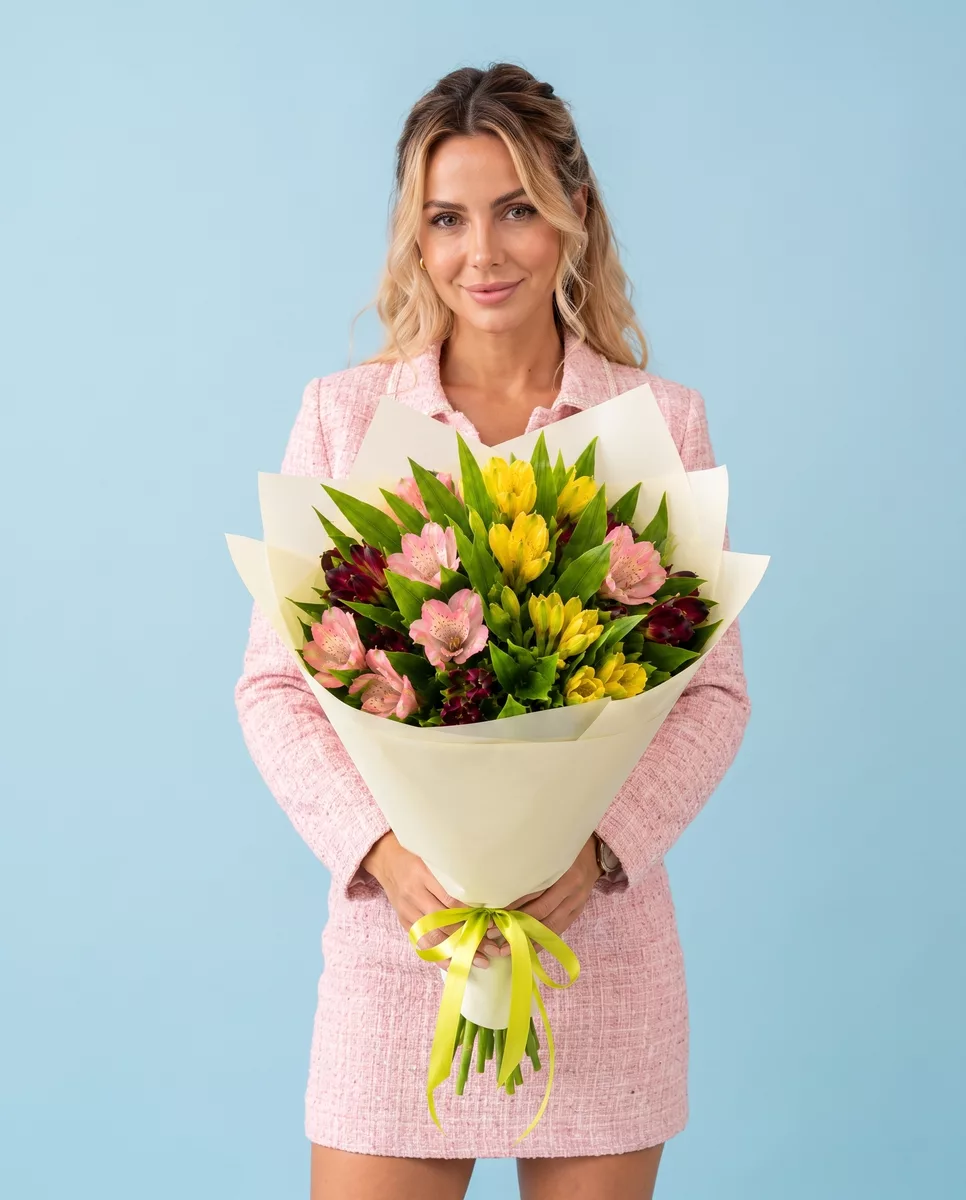
A surprise delivery needs a bouquet that arrives looking intentional rather than improvised. Flowers that travel poorly — open garden roses in summer heat, fully open peonies in late May, or large-headed hydrangeas in temperatures above twenty degrees — can arrive looking tired, which undercuts the gesture regardless of how well the logistics were managed. For year-round reliability, Dutch spray roses in varieties like Bombastic or Lydia hold their form through a one-to-two hour delivery window without refrigeration. Chrysanthemums, both single-stem santini and standard varieties, are extremely robust and arrive looking exactly as they left the shop. Alstroemeria is another strong choice: the buds are usually partially closed on delivery and open over the following two to three days, which means the recipient gets a bouquet that develops rather than one that peaks and fades on the same day. In colder months from November through March, tulips travel exceptionally well in Petersburg's climate and arrive firm. In warmer months, eustoma — also sold under the name lisianthus — is a reliable alternative to roses when you want something that looks refined without requiring strict cold-chain handling. Avoid fully open peonies, large open ranunculus, and any bouquet with a high proportion of foliage that wilts quickly in warm delivery bags. When ordering a surprise, mention in the comments that the bouquet needs to be assembled for travel rather than for immediate display, and the florist will adjust the stage of bloom accordingly.
Timing the Delivery So the Recipient Is Actually There
A surprise delivery only works if the recipient is present to receive it. This sounds obvious but it is the most frequent reason surprise orders go wrong. If you are not certain of the recipient's schedule, you have two reliable approaches. The first is to coordinate with someone in the recipient's immediate environment — a colleague, a flatmate, a family member — who can confirm the person will be at that address during the chosen window without tipping them off. The second is to choose a delivery window that corresponds to a predictable part of the recipient's day: their home address between seven and nine in the evening if they finish a standard working day, or their office address between ten in the morning and one in the afternoon when most office workers are at their desks rather than in meetings or at lunch. For birthday deliveries, morning slots before work are popular and tend to work well because most people are home until at least eight-thirty. For anniversary deliveries to a home address in the evening, the window between seven and nine hits the period when both partners are typically home but the evening has not yet started, which makes the timing feel considered rather than random. If the recipient is not home when the courier arrives, the courier will call the number you provided. If there is no answer, the bouquet cannot be left unattended outdoors in winter or in a warm entrance lobby in summer. A failed delivery attempt means the order must be rescheduled, which adds time and risks the flowers. Build in a buffer by choosing a window that is thirty minutes later than you expect the recipient to arrive.
What to Do If the Recipient Calls You Before the Bouquet Arrives
It happens. The recipient sees an unknown delivery number on their phone, calls you to ask if you know anything about it, or a colleague mentions that someone sent flowers to the office. The surprise is partially compromised but not entirely lost, and how you handle the next few minutes determines whether the gesture still lands. The most effective approach is to say nothing until the bouquet is actually in the recipient's hands. 'I have no idea what you're talking about' is a reasonable holding response that buys you the remaining delivery window. Once the flowers arrive, the reveal still has a physical moment — the unwrapping, the card, the specific varieties you chose — and that moment carries its own weight even if the recipient had a ten-minute suspicion beforehand. If the recipient is at a workplace and the bouquet has already been accepted by reception, the reveal happens when they collect it from the desk, which is often in front of colleagues and has its own effect. For future orders, you can reduce the chance of this happening by noting in the order comments that the courier should not call the recipient unless strictly necessary for building access, and that they should try the intercom first. In buildings where the intercom connects directly to a flat rather than a phone, the courier can buzz without triggering a call to the recipient's mobile at all. Knowing the building type in advance — whether it has a fixed intercom panel or a phone-routing system — helps us advise on the right approach before the courier leaves the shop.
Sending flowers anonymously is largely a logistics exercise rather than a mystery. Supply the full address, the recipient's phone number, and a card message that says exactly what you want it to say — nothing more and nothing less. Choose a bouquet assembled for travel rather than for a vase, pick a delivery window when the recipient is reliably at the address, and brief anyone in the recipient's circle who needs to know. The courier handles the door. The card handles the reveal. Your job is to give us the information we need to get the bouquet there in good condition without making a single unnecessary call. We deliver bouquets across Russia in 1–2 hours.
Frequently asked questions
Can the courier deliver without calling the recipient at all?
In some buildings with a fixed intercom panel, yes — the courier can buzz the flat directly without calling the recipient's mobile. However, many Petersburg apartment blocks route intercom calls to the resident's phone, making a call unavoidable for access. Supply the entrance code if you have it and note this in the comments; we will use every option available before resorting to a direct call.
Will my name appear anywhere on the delivery documentation the recipient sees?
No. The recipient sees only the bouquet and the card you wrote. Payment details, your name, and your contact number are held in the order system and are never printed on anything handed to the recipient. The card text is whatever you typed during checkout — if you left the sender field blank, the card shows only your message.
What happens if the recipient is not home when the courier arrives?
The courier will attempt to call the recipient using the number you provided. If there is no answer, the bouquet cannot be left unattended — this protects both the flowers and building security norms. The order will need to be rescheduled, which may affect flower condition. Choosing a delivery window when you are confident the recipient is present avoids this entirely.
Can I send flowers to a hospital ward anonymously?
Hospital deliveries require coordination with ward reception staff, who will need to confirm the patient is admitted and able to receive visitors or items. The courier cannot access wards directly. Note the ward number and the patient's full name in the comments; reception staff handle the handoff and typically do not reveal sender details to the patient before they see the card.
Which flowers last longest if the recipient is not home immediately and the bouquet sits for a short time?
Spray roses, alstroemeria, and chrysanthemums hold the best in a cool entrance lobby for up to an hour. Avoid fully open peonies or large-headed hydrangeas for any delivery where there is a risk of a wait. In warm months, ask for buds at a closed or half-open stage so the bouquet peaks over the following day rather than on arrival.
Ready to send a bouquet?
Pick a city, choose the flowers, and we will hand them over with a photo confirmation.
Choose a city →