
Russian Birthday Card Messages: Phrases, Phonetics and Order Tips
Every week we take calls from people in London, Berlin, Tel Aviv and New York who want to send flowers to someone in Russia and have absolutely no idea what to write on the card. They worry about spelling, about accidentally writing something rude, about the recipient seeing a blank card and thinking the sender did not care enough to personalise it. The card matters more than most people expect — Russian recipients almost always read it aloud or photograph it and share it with family. This article gives you working phrases, pronunciation guides written in plain English syllables, and the specific field-by-field instructions for adding your message when you place an order with us.
Why the Card Is Taken Seriously in Russian Gift Culture
In Russia a birthday bouquet without a signed card is considered slightly cold, the way an unsigned gift feels in many cultures. The card is not decoration — it is the spoken part of the gift, and the person who receives the flowers will often keep it. Recipients in their fifties and older especially appreciate a handwritten or printed message in Russian rather than English, because it signals that the sender made an effort rather than copying a generic template. Younger recipients in Moscow and Saint Petersburg read English well, but they still notice and appreciate Russian text from a foreign sender.
When you order through our website or by phone, there is a dedicated card-message field. Whatever you type into that field is printed exactly as written onto a small card that goes into an envelope attached to the bouquet. We do not edit, translate or interpret your message — we print it. That means if you paste correct Russian text, the recipient gets correct Russian text. If you paste garbled characters or Latin letters where Cyrillic is expected, that is what gets printed. So it is worth spending ten minutes on this step before you confirm the order.
One practical note on timing: our couriers in Saint Petersburg deliver within one to two hours of order confirmation. The card is prepared at the same time as the bouquet, so there is no way to update the message after the order is placed and the florist has started assembling. Get the text right before you hit confirm, and if you are ordering from a time zone several hours ahead of Moscow, factor in that the shop operates on Saint Petersburg time.
Bouquets we can deliver

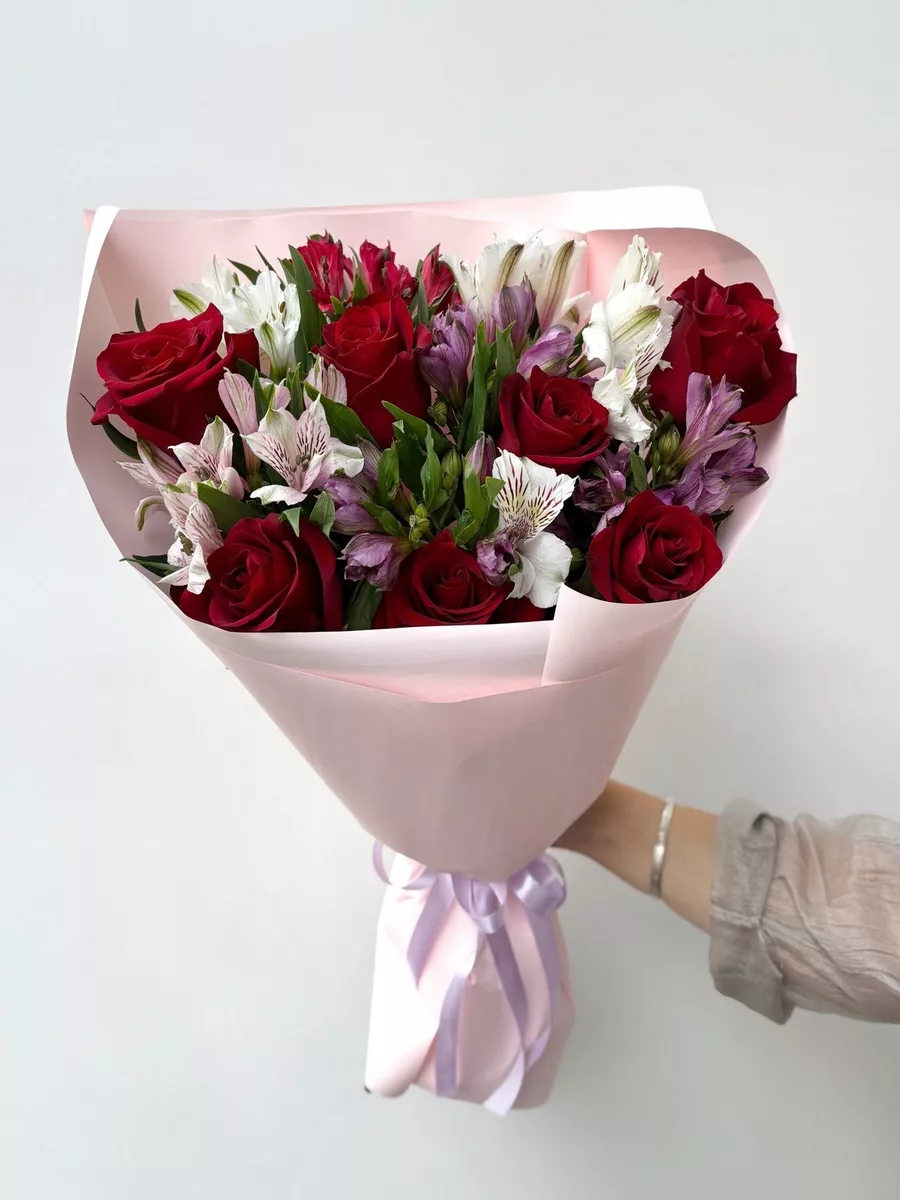


The Standard Birthday Phrase and How to Pronounce It
The single most useful phrase for a birthday card is: С днём рождения! It means Happy Birthday and every Russian speaker recognises it immediately. In phonetic English it sounds like: s DNYOM rozh-DYE-nee-yah. The first word, с, is just the letter S with a soft hiss. Днём is the tricky part — the DY sound is a soft D followed by a short YO vowel, similar to the DY in the English word during but clipped. Рождения breaks into four syllables: rozh-DYE-nee-yah, with the stress on the second syllable.
If you want to add a name, Russian uses a grammatical case called the vocative-like dative, which changes the ending of names slightly. For most female names ending in A — Anna, Maria, Natasha — you drop the A and add E: Анне, Марии, Наташе. For male names ending in a consonant — Andrei, Dmitri, Ivan — you add the name as-is after the phrase. A safe, grammatically correct format is: С днём рождения, [Name]! For example: С днём рождения, Андрей! or С днём рождения, Анна!
If you are not confident about name endings, simply write the phrase without the name and add a warm closing line instead. The phrase alone is completely normal and does not read as impersonal. Russian cards are typically shorter than English ones — two or three sentences is considered a full message, not a brief one. Avoid writing paragraphs; the card is small and the text should be legible in a standard print size.
Ready-Made Phrases You Can Copy Directly into the Order Field
Below are phrases written in Cyrillic that you can copy and paste directly into the card field on our order form. Each one is followed by a phonetic guide and a plain English meaning.
С днём рождения! Желаю тебе здоровья и счастья. Phonetic: s DNYOM rozh-DYE-nee-yah. Zhe-LAH-yu te-BYE zdah-ROV-yah ee SHAS-tyah. Meaning: Happy Birthday! I wish you health and happiness.
Поздравляю с днём рождения! Пусть всё будет хорошо. Phonetic: poz-drav-LYAH-yu s DNYOM rozh-DYE-nee-yah. Poost vsyo BOO-det ha-ra-SHOW. Meaning: Congratulations on your birthday! May everything go well.
С праздником! Желаю радости и удачи. Phonetic: s PRAZ-dni-kom. Zhe-LAH-yu RAH-dos-ti ee oo-DAH-chi. Meaning: Happy holiday! I wish you joy and luck.
От всего сердца поздравляю тебя. Phonetic: ot vsye-VO SYER-dtsa poz-drav-LYAH-yu te-BYAH. Meaning: I congratulate you with all my heart.
These phrases are grammatically correct in their informal register, which is appropriate when you know the recipient personally. If you are sending to a colleague or someone you address formally, replace тебе and тебя with вам and вас respectively — that single swap shifts the register from familiar to respectful without changing the warmth of the message. For example: Желаю вам здоровья и счастья. The rest of the phrase stays identical. If you are unsure which register applies, the formal version is always the safer choice for recipients you have not met in person.
Formal versus Informal Russian: Choosing the Right Register
Russian has two pronouns for you — ты (ty, informal) and вы (vy, formal or plural) — and they ripple through the entire sentence, changing verb endings and possessive forms. Getting this wrong is one of the most common mistakes senders make, and it is the kind of thing a Russian recipient notices immediately, the way an English speaker notices someone saying thee and thou unexpectedly. The informal register is used with family, close friends, children and people of the same age group who have explicitly switched to informal address. The formal register is used with bosses, older relatives you are not close to, acquaintances and anyone you would address by first name and patronymic in conversation.
For birthday cards specifically, informal is fine for a sibling, a university friend, a childhood neighbour. Formal is appropriate for a parent-in-law, a business partner, a professor, or any recipient you have never met. When in doubt, use formal — it reads as respectful, never as cold. The phrases in the previous section use informal forms. To convert them to formal, the main changes are: тебе becomes вам, тебя becomes вас, and any second-person verb like будь (be) becomes будьте.
One thing that does not change with register is the birthday greeting itself. С днём рождения works in both registers because it is a fixed phrase with no pronoun. You can use it universally and then follow it with either a formal or informal wish depending on your relationship with the recipient. This makes it the most reliable phrase to anchor your card around regardless of your level of Russian knowledge.
How to Type Cyrillic If You Do Not Have a Russian Keyboard
The simplest method is to use Google Translate or any online Cyrillic keyboard, type or paste the Latin phonetic version, and then copy the Cyrillic output. However, machine translation of short phrases is unreliable for nuance — it sometimes produces awkward word order or overly literal phrasing. For the phrases listed in this article, copying directly from the Cyrillic text here is more reliable than asking a translation tool to generate new text.
On a Windows computer, you can add a Russian keyboard layout in under two minutes through Settings, Time and Language, Language, and then Add a Language. Once installed, you switch between layouts with Alt and Shift or the language bar. On a Mac, go to System Settings, Keyboard, Input Sources, and add Russian. On a mobile device, go to keyboard settings and add Russian as an input language — on both iOS and Android this takes about thirty seconds and the keyboard appears as a swipe option.
If none of that appeals, the most practical solution for a one-time order is to open a Google Doc, enable Russian input through the keyboard settings there, and type or dictate your message. Google Docs on mobile allows voice input in Russian if you select the Russian keyboard before pressing the microphone. Alternatively, ask a Russian-speaking colleague or friend to type the phrase for you and send it by message — then copy and paste it into the order field.
One technical warning: make sure your browser is not auto-correcting Cyrillic characters. Some older browsers and certain phone keyboards will silently replace Cyrillic letters with visually similar Latin letters. Always preview what is in the field before confirming the order.
What to Write After the Main Phrase: Closings and Signatures
Russian cards almost always end with a closing and a name. The most common closings are: С любовью (s lyu-BOV-yu, meaning with love), С уважением (s u-va-ZHE-nee-yem, meaning with respect, used formally), and Твой/Твоя (tvoy/tvo-YAH, meaning your, as in yours, used informally — Твой for a male sender, Твоя for a female sender). After the closing word, you simply write your name in the Latin alphabet if you prefer — Russian recipients are entirely comfortable seeing a foreign name in Latin letters on a card from abroad.
A complete card might read: С днём рождения, Наташа! Желаю тебе здоровья и много радости. С любовью, Emma. That is three lines and it is a perfectly complete, warm message by Russian standards. There is no need to fill the card with text. Russian birthday cards are not the same as English greeting cards where a long personal paragraph is expected — brevity is normal and not considered lazy.
If you want to add one more sentence of personal content, common options include: Скучаю по тебе (SKOO-chah-yu po te-BYE, I miss you), Обнимаю (ob-NEE-mah-yu, I am hugging you, very common in informal cards), or Жду встречи (ZHDOO FSTRE-chi, looking forward to seeing you). These phrases work well between the main birthday wish and the closing, and they add a personal touch without requiring knowledge of complex grammar. Keep the total card to four or five lines maximum — the physical card is small and the florist prints in a readable font size.
Checking Your Message Before You Confirm the Order
Before you submit the order, read through the card text field one more time with these specific checks in mind. First, confirm that all characters are Cyrillic and not accidentally Latin — the letters A, C, E, O, P, X and several others look identical in both alphabets but are different characters, and mixing them produces text that displays correctly on screen but prints as corrupted characters on some systems. If you copied from a reliable Cyrillic source and did not retype anything, you are likely fine.
Second, check the name spelling. Russian recipients notice misspelled names immediately, and there is no way to correct the card after the bouquet is assembled. If you are unsure how to spell a Russian name in Cyrillic, search the name on any Russian-language site and copy the spelling from there. Common names like Анна, Мария, Александр, Наталья, Дмитрий and Ольга are easy to verify this way.
Third, check the register consistency. If you started with formal вам, make sure you have not slipped into informal тебе later in the message — mixing registers in a single card reads as careless to a Russian speaker.
Fourth, check the punctuation. Russian uses an exclamation mark after С днём рождения in almost all contexts — it is the standard punctuation for this phrase and omitting it looks incomplete. Commas before names are standard in Russian: С днём рождения, Анна! not С днём рождения Анна.
Finally, if you are ordering a bouquet of roses, peonies, tulips or any perishable arrangement, remember that the florist starts building it as soon as the order is confirmed. The card is prepared at the same moment. There is no edit window after confirmation, so these thirty seconds of checking before you click are the only opportunity you have.
Sending flowers to Russia from abroad is straightforward when the logistics are handled by a shop that delivers itself, without hand-offs or third parties. The card is the one part that depends entirely on you, and it is the part the recipient will remember longest after the flowers have faded. A single correct phrase in Russian, a name spelled properly and a warm closing in whatever language you choose is enough to make the card feel personal and considered. Use the phrases in this article, copy them carefully, check the register and the punctuation, and confirm the order with confidence. We deliver bouquets across Russia in 1–2 hours.
Frequently asked questions
Can I write the card message in English instead of Russian?
Yes, you can write in English and we will print it exactly as entered. Younger recipients in major Russian cities generally read English well. However, if the recipient is over fifty or lives outside a large city, a Russian message will feel significantly more personal and will be easier for them to read and share with family members.
What if I make a spelling mistake in the Russian text — can I correct it after ordering?
Unfortunately no. The card is printed at the same time the florist begins assembling the bouquet, and our one-to-two-hour delivery window does not allow for reprints after confirmation. Check the Cyrillic text carefully before you click confirm, paying particular attention to the recipient's name and any pronoun register choices you have made.
Is it acceptable to leave the card message blank?
It is acceptable but not recommended. In Russian gift culture a bouquet without a signed card reads as slightly impersonal. Even a single line — С днём рождения and your name — is far better than nothing. If you are genuinely unsure what to write, the phrase С днём рождения followed by your name in Latin letters is a complete and appropriate message on its own.
How do I know whether to use the formal or informal register for the recipient?
Use informal — тебе, тебя — for close friends, siblings, children and people your own age you know well. Use formal — вам, вас — for parents, in-laws, bosses, older relatives and anyone you address by first name and patronymic. When uncertain, always default to formal. It is never offensive and reads as respectful rather than distant.
Can the florist translate my English message into Russian before printing?
We print the card field exactly as submitted and do not offer translation as part of the order process. For reliable Russian text, use the ready-made phrases provided in this article by copying the Cyrillic directly. If you need a custom translated message, prepare it before ordering using a trusted bilingual contact or a professional translation service.
Ready to send a bouquet?
Pick a city, choose the flowers, and we will hand them over with a photo confirmation.
Choose a city →