
Bouquet Packaging or No Packaging: What Russian Recipients Actually Expect
The question comes in almost every day: should the bouquet arrive in full wrapping, or is it better to let the flowers show through? Customers ordering from outside Russia often assume that more packaging signals more effort, while Russian recipients sometimes feel the opposite. The answer depends on the flower variety, the transit time, the season, and a set of presentation habits that have shifted noticeably over the last decade in cities like Saint Petersburg. Getting this wrong does not ruin a gift, but getting it right makes the moment land exactly as intended.
What Russian Flower Presentation Looked Like Historically
For most of the Soviet and early post-Soviet period, flowers were sold loose at street kiosks with minimal wrapping — a single sheet of thin paper folded around the stems, or nothing at all. The flowers themselves were the statement: a dozen long-stemmed red roses handed over bare carried more weight than the same roses buried in cellophane. That habit shaped expectations that are still visible today, especially among recipients over fifty. A grandmother receiving peonies or garden roses will often unwrap them immediately and put them straight into water, treating any packaging as disposable clutter rather than part of the gift. Younger recipients in Saint Petersburg and Moscow have absorbed Instagram-era aesthetics and now expect at least some intentional wrapping, but they tend to prefer materials that look considered rather than voluminous. The shift is real but uneven across age groups and regions. Understanding this split matters when you are ordering remotely and cannot read the room. If you know the recipient well, you can choose accordingly. If you are unsure, the safest default is moderate wrapping — enough to protect the stems and signal care, not so much that the flowers disappear inside layers of kraft paper and ribbon. The florist's job is to make that balance work within the delivery window, which in our case runs one to two hours across Saint Petersburg.
Bouquets we can deliver



The Three Main Wrapping Styles Used in Russian Flower Shops Today
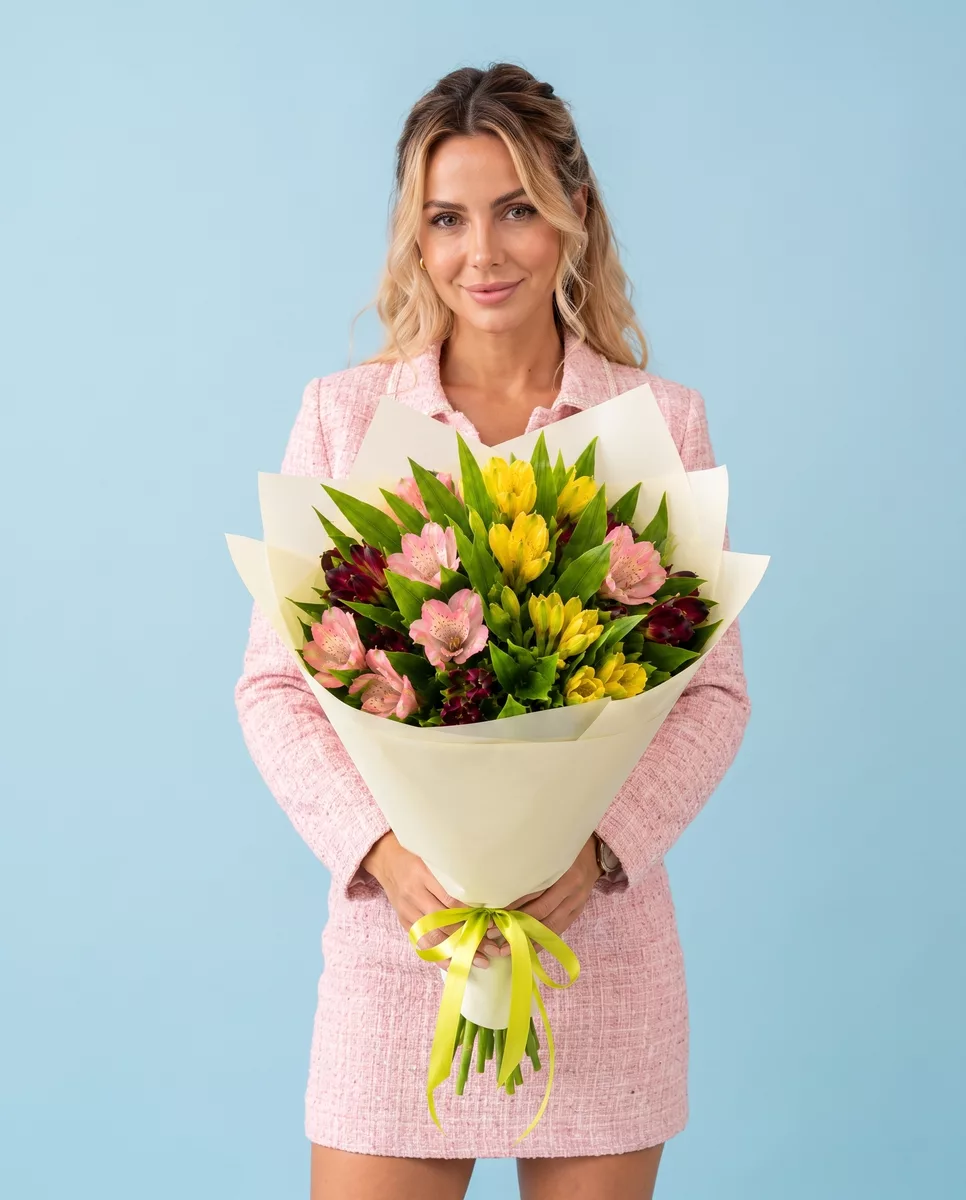
Russian florists currently work with three broad packaging approaches, and each suits a different situation. The first is full sleeve wrapping, where the entire bouquet — blooms included — sits inside a cone or sleeve of kraft paper, matte film, or frosted cellophane. This protects delicate varieties like ranunculus, anemones, and garden roses during transit and looks substantial on delivery, but it hides the flowers until the recipient opens it. The second approach is open-top wrapping, where the stems and lower foliage are bound and covered while the flower heads remain fully visible. This works well for structured bouquets built around tulips, spray roses, or lisianthus, and it photographs well at the door. The third style is minimal or no wrapping beyond a water capsule on the stem ends and a simple kraft band around the middle. This suits large statement bouquets — think peonies in season, sunflowers, or long-stemmed hybrid tea roses — where the volume and variety speak for themselves and additional layers would make the bouquet awkward to carry. Each style has a different relationship with temperature. In winter, a full sleeve traps warmth around the blooms during the walk from the car to the door. In summer heat above 25 degrees Celsius, dense wrapping can accelerate wilting if the delivery runs longer than planned, which is an argument for open or minimal packaging on hot days.
Which Varieties Hold Up Without Wrapping and Which Need Protection
Not every flower tolerates an unwrapped ride across the city equally well. Tulips are among the most forgiving: their stems are sturdy, they travel upright without bruising, and their heads do not shatter on contact the way some double-flowered varieties do. Standard chrysanthemums and alstroemeria are similarly robust and arrive looking composed even with minimal packaging. At the other end of the scale, garden roses with many-petalled blooms — David Austin varieties in particular — lose outer petals to friction if they rub against paper or each other during transit. Ranunculus, with their paper-thin petals, need a sleeve that holds them apart. Calla lilies bruise at the spathe edges if they press against anything firm. Hydrangea heads wilt faster than almost any other cut flower when exposed to dry air, making a protective sleeve important even on short runs. Orchid sprays, both Phalaenopsis and Cymbidium, are surprisingly travel-tolerant but look wrong without at least a minimal wrap because their stems are irregular and the bouquet loses shape without support. When you are ordering a mixed bouquet that combines robust and fragile varieties — roses with tulips, for example — the florist should wrap to the needs of the most delicate element in the arrangement. Telling the shop which varieties you want, rather than just a colour palette, gives the team the information needed to choose the right protection level without you having to specify it directly.
Seasonal Timing and How It Changes the Packaging Decision
Saint Petersburg has a climate that makes packaging a practical question as much as an aesthetic one. From November through March, outdoor temperatures regularly fall below zero, and an unwrapped bouquet carried from a warm car into cold air and then into a warm hallway goes through two rapid temperature shifts in under two minutes. For cold-sensitive varieties like tropical imports — bird of paradise, anthuriums, and certain orchid hybrids — that shock can cause blackening at the petal edges within hours. A sleeve does not eliminate the shock, but it slows it enough to matter. In the white-night months of June and July, the problem reverses: high ambient temperatures and long daylight hours mean that a tightly wrapped bouquet sitting in a warm car for even twenty minutes starts to sweat inside its packaging. The moisture promotes botrytis, the grey mould that attacks rose petals and peony buds first. For summer deliveries, open-top or minimal wrapping is the better call, and our couriers carry insulated bags for particularly heat-sensitive loads. Spring is the most forgiving season for packaging decisions because temperatures are moderate and the flowers in peak supply — tulips, ranunculus, hyacinths, narcissi — are all reasonably hardy. Autumn brings dahlias and late-season roses, both of which prefer a protective layer once temperatures drop below ten degrees. The practical rule: if you are ordering in winter or high summer, mention the season's constraints when you place the order and let the florist adjust the wrapping accordingly.
When Elaborate Packaging Adds to the Gift and When It Subtracts
Elaborate packaging — layered kraft paper, wide satin ribbon, dried botanical accents tucked into the wrap, a branded box — works well in specific circumstances and poorly in others. It works when the recipient is receiving the bouquet in a public or semi-public setting: an office, a theatre lobby, a restaurant. In those contexts the packaging is part of the social signal; it tells onlookers that this is a considered gift, not a last-minute stop at a kiosk. It also works when the flowers themselves are a secondary element — when the real gift is the gesture and the flowers are the vehicle. Elaborate wrapping works against the flowers when the blooms are genuinely exceptional: a hand-tied bouquet of fully open garden peonies in June, or a sculptural arrangement of parrot tulips in three colours, or a bunch of sweet peas that have almost no shelf life and need to go straight into water. In those cases, layers of packaging delay the moment the recipient can actually see what they have received, and the flowers are better served by arriving in a way that puts them immediately on display. There is also a practical point that customers outside Russia sometimes miss: Russian recipients almost always unwrap bouquets immediately and put them in water within minutes of receiving them. This means elaborate outer packaging has a very short lifespan as a visual element. Spending significantly more on wrapping than on the flowers themselves is rarely the right allocation.
Water Capsules, Wet Wrap and Stem Conditioning for Longer Deliveries
One packaging element that is always worth including, regardless of aesthetic choices, is stem hydration for the transit period. For deliveries within thirty minutes, a dry stem end loses very little, but our standard window is up to two hours, and on routes to the farther districts of Saint Petersburg that window can be tested. The most common solution is a small water capsule — a sealed plastic or silicone tube filled with water that fits over the cut stem ends and keeps them hydrated during the ride. Capsules are invisible inside wrapping and add almost no bulk. A more traditional alternative is wet kraft paper wrapped around damp cotton wool at the stem base, then covered with a second layer of dry paper to prevent the outer wrap from soaking through. Both methods work; capsules are cleaner and easier for the recipient to remove. What does not work well is simply cutting stems and leaving them dry for more than forty minutes, especially for water-hungry varieties like hydrangea, gerbera, and cut lilac. These flowers begin to show stress — drooping heads, softening stems — faster than most customers expect, and no amount of revival in a vase fully corrects a long dry transit. When you order a bouquet for a recipient who may not be home immediately, mention it: the team can adjust the stem conditioning to buy an extra hour of freshness after delivery. This is a detail that makes a real difference in how the bouquet looks when it finally goes into a vase.
Practical Checks to Make Before You Confirm the Order
Before you finalise any bouquet order with a packaging preference, run through four concrete checks. First, confirm the delivery environment: is the recipient at home, at an office with a reception desk, or in a public place? Office and public deliveries favour more structured wrapping because the bouquet may sit at a front desk for an hour before it reaches the intended person. Home deliveries can go either way. Second, check the season and current outdoor temperature if you are ordering in winter or summer — not the forecast, the actual temperature at delivery time — and flag it to the florist if it is below minus five or above twenty-eight degrees Celsius. Third, identify the most delicate variety in the arrangement and make sure the packaging decision is calibrated to protect it, not just to look good in a photo. If you are ordering ranunculus or garden roses, ask specifically whether the sleeve will prevent petal contact. Fourth, consider the time gap between delivery and when the recipient will put the flowers in water. If there is likely to be a delay of more than an hour — a surprise delivery to an office where the recipient is in meetings, for example — ask for a water capsule on the stems regardless of what the outer packaging looks like. These four checks take two minutes and prevent the most common packaging-related complaints we hear after delivery.
Packaging is a real decision, not a default, and the right answer changes with the variety, the season, the recipient's age and setting, and the length of the delivery route. The general principle that holds across all of those variables is this: wrap to protect the flowers and to suit the moment, not to add volume for its own sake. A well-conditioned bouquet of garden roses in a clean open-top kraft wrap, stems hydrated and heads unobstructed, will make a stronger impression at a Saint Petersburg door than the same roses buried in three layers of cellophane and ribbon. The flowers are the gift. Everything around them should make them easier to see and longer to last. We deliver bouquets across Russia in 1–2 hours.
Frequently asked questions
Is it rude to send flowers without any wrapping in Russia?
No, it is not considered rude, particularly for robust varieties like tulips or sunflowers delivered at home. Older recipients often prefer minimal packaging because they put flowers straight into water. For office deliveries or formal occasions, some wrapping is more appropriate because the bouquet may pass through several hands before reaching the recipient.
Do Russian florists always add water capsules, or do I need to request them?
Practice varies. At Five Flowers we include stem hydration on all deliveries over thirty minutes by default, but if you are ordering a particularly thirsty variety — hydrangea, gerbera, lilac — it is worth specifying this in the order comments. For deliveries where the recipient may not be home immediately, always request it explicitly.
Does the packaging affect how long the flowers last after delivery?
Indirectly, yes. Dense wrapping in hot weather traps moisture and heat, which accelerates mould on rose petals and peony buds. In cold weather, a sleeve reduces temperature shock for tropical varieties. The biggest factor in post-delivery longevity is stem conditioning during transit, not the outer wrap material.
What wrapping style works best for a surprise delivery to an office?
A full sleeve or structured open-top wrap is better for offices than minimal packaging. The bouquet may sit at a reception desk for up to an hour, and some protective wrapping keeps it presentable. Include a water capsule on the stems, since office environments are often dry and warm, which accelerates wilting in unhydrated stems.
Can I ask for no branding or shop labels on the packaging for a more personal feel?
Yes, this is a straightforward request to include in the order comments. Many customers prefer a clean kraft wrap without printed labels, especially for intimate gifts. The card with your personal message remains; only the shop branding on the outer wrap is removed. Specify this when you place the order.
Ready to send a bouquet?
Pick a city, choose the flowers, and we will hand them over with a photo confirmation.
Choose a city →