
Bouquet Split: Dividing One Large Bouquet Into Smaller Arrangements
Splitting a bouquet means taking one large arrangement apart and rebuilding it as two, three or more smaller ones, each in its own vase. It is the simplest fix when a gift bouquet is too big for any vase you own, and it also helps the flowers last longer, because fewer stems share the same water and air. Done carefully, every smaller vase still looks finished rather than like leftovers.
In our Saint Petersburg shops we hear this question almost every week, usually in the form 'I was given 51 roses and I only have a one-litre jug'. Below is the method our florists use behind the counter: which stems to separate, how to group them, what to do with the tie and the wrapping, and how to look after each part afterwards.
When it makes sense to split a bouquet
The most common reason is size. Large round bouquets of 25, 51 or 101 roses are built as one dense dome, and that dome needs a heavy vase with a wide opening and several litres of water. Most homes do not have one, and squeezing the stems into a narrow neck crushes them, so the heads bend and the water fouls within a day or two.
The second reason is mixed vase life. A bouquet that combines roses, eustoma, chrysanthemums and greenery will not age evenly: chrysanthemums can go on for two weeks, while eustoma or some spray roses fade sooner. Once two or three stems start to wilt, they release ethylene and bacteria into the shared water and shorten the life of everything around them. Splitting the bouquet early lets you remove tired stems without disturbing the rest.
The third reason is simply enjoyment. One big bouquet usually stays on a single table. Divided into a few small vases, the same flowers can sit in the kitchen, on a bedside table and on a desk, and the recipient sees them all day rather than only in the living room.
Before you cut the tie: preparing the workspace
Clear a table, lay down newspaper or a tray, and fill every vase you plan to use with cool water before you start. Flowers out of water for twenty minutes start to take in air through the cut, which blocks the stem, so it is better to have the vases ready and work quickly. Wash the vases first; a film inside an old vase is full of bacteria that will cut vase life by several days.
You will need sharp secateurs or a sharp knife, scissors for the ribbon, and a bucket or deep bowl of water for holding stems while you sort them. Avoid blunt kitchen scissors: they crush the stem and close the water channels instead of opening them.
Take a photo of the bouquet from the top before untying it. It sounds trivial, but customers who bring a bouquet back to the shop to be rebuilt nearly always wish they had one, because the photo shows how the florist balanced colours and textures, which you can copy at a smaller scale.
Bouquets we can deliver



How to divide the stems step by step
Cut the ribbon and the tie, remove the wrapping, and immediately put the whole bunch into the bucket of water. Then lift the stems out one at a time and sort them into groups on the table: focal flowers such as roses, peonies or lilies; filler flowers such as spray roses, eustoma or gypsophila; and greenery. Keep each flower in water for as long as possible and work in small batches.
Build each small arrangement the same way a florist builds a large one. Start with three or five focal flowers, add filler between them so the heads do not touch, and finish with a little greenery around the edge. Odd numbers look more natural in a small vase and, for a gift in Russia, are also the traditional choice. Turn the bunch slightly in your hand as you add stems so they settle into a loose spiral rather than a flat fan.
Recut every stem before it goes into a vase, removing 2-3 cm at a sharp angle, and strip off any leaves that would sit under the water. Stems from the centre of a dome bouquet are often shorter than those at the edge, so measure each group against its vase: the flowers should stand roughly one and a half times the height of the vase. For a closer look at matching shapes, see our guide to vase shape for your bouquet.
Ideas for splitting different kinds of bouquets
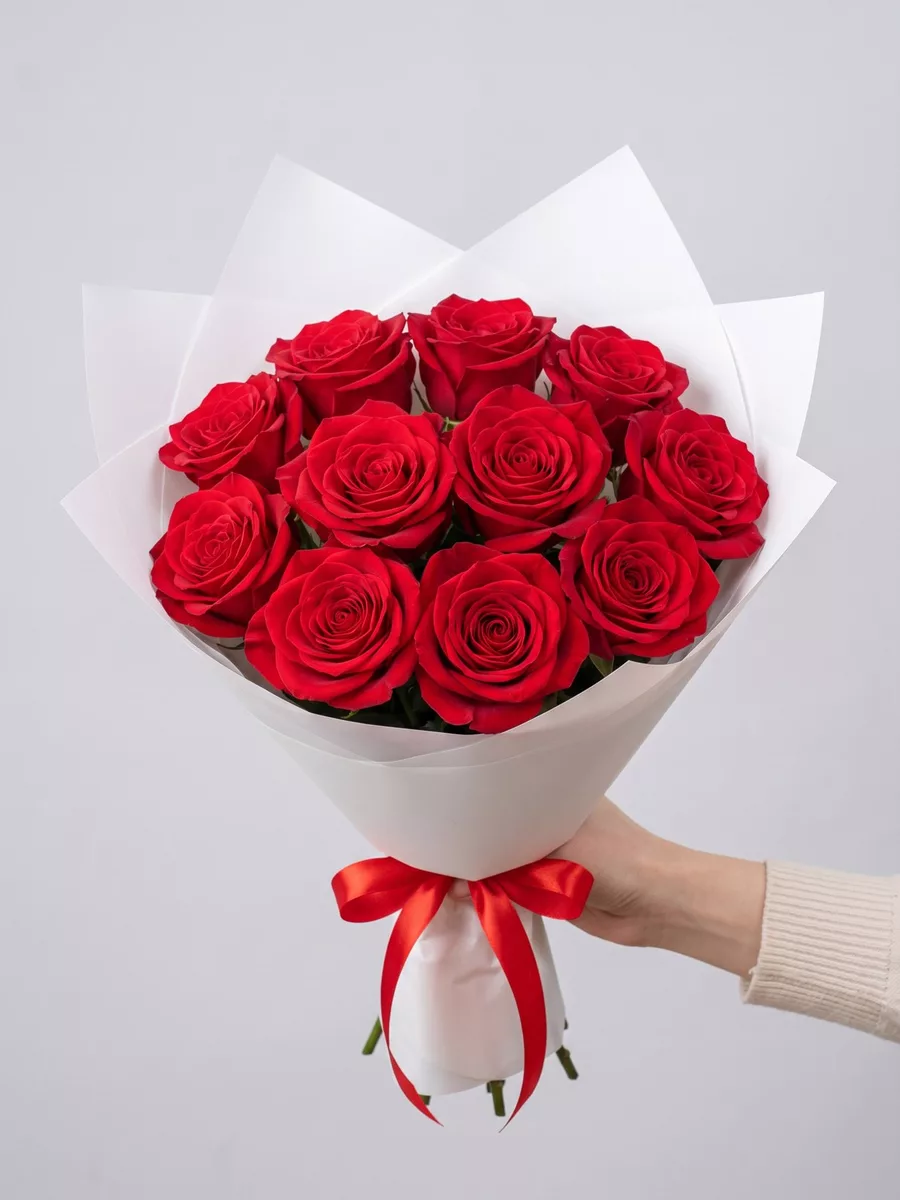
A mono-bouquet of roses splits most easily. Fifty-one roses usually make three good vases of fifteen to seventeen stems each, or one medium vase and several bud vases of three roses for the bedroom and bathroom. Keep the longest stems for the main vase and use the shorter centre stems for the small ones.
A mixed bouquet is better divided by character rather than evenly. Put the long-lasting flowers, such as chrysanthemums, alstroemeria and carnations, into one vase that will stay for two weeks, and the delicate ones, such as eustoma, ranunculus or garden roses, into another that you will refresh more often. This way one tired variety never spoils the whole display.
Do not throw away short pieces. Single heads with 5-7 cm of stem look lovely floating in a shallow bowl or in a glass of water on a windowsill away from radiators. Greenery such as eucalyptus or pistachio leaves often outlives the flowers and can be added to a fresh bouquet later.
Caring for the split arrangements
Small vases hold less water and run dry faster than one big vase, so check the level every morning and top up with cool water. Change the water fully every two days, rinse the vase, and recut the stems by about a centimetre each time. If the bouquet came with a sachet of flower food, divide it between the vases in proportion to their volume rather than putting it all into one.
Place the vases away from heating, direct sun and fruit bowls. A kitchen near the stove or a windowsill above a radiator will shorten the life of any flower by several days. Bathrooms with no window are fine for a short time but too dark and humid for a week. Between bouquets, scrub each vase properly; our article on how to clean a vase between bouquets explains how to remove the film that builds up inside.
Check each vase daily and remove any stem that has gone soft or dropped its head. With a split bouquet this takes seconds and does not disturb the rest, which is one of the main advantages over keeping everything in a single dome.
Ordering a bouquet that is easy to split
If you are sending flowers to someone who you know has small vases, mention it when you order and choose a bouquet that is assembled in sections or with a natural spiral, which comes apart easily. Our bouquets catalogue shows how each bouquet is built, and you can add a free card with your own text suggesting where to put the vases. Delivery is anonymous by default, so the courier does not name the sender.
We deliver across Russia. City delivery costs 500 RUB; for remote districts and suburbs the operator confirms the price when confirming the order. In large cities express delivery takes 1-2 hours after confirmation, or you can choose an exact time (plus or minus 30 minutes), a window such as 09-12 or 15-18, or pre-order 1-30 days ahead. In Saint Petersburg, where our three own shops have worked since 2011, delivery runs around the clock. The courier calls the recipient about 15 minutes before arrival, and if nobody is home we agree a second delivery the same day or, with your consent, leave the flowers with a neighbour or concierge.
You can pay online by bank card, SBP or Yandex Pay, and foreign bank cards are accepted via Robokassa, which matters if you are ordering from abroad. Full terms are on the delivery and payment page, and for any question about a specific bouquet you can call us on 8 (812) 507-67-05.
Frequently asked questions
Will splitting a bouquet damage the flowers?
No, as long as you keep the stems in water while sorting and recut them before they go into the vases. Most flowers last longer after splitting because each vase has cleaner water and better airflow.
How many vases do I need for 51 roses?
Two or three medium vases usually work well, with fifteen to twenty-five stems in each. You can also make one main vase and several small bud vases from the shorter stems.
Should I keep the original wrapping and ribbon?
Remove the wrapping before the flowers go into water, because paper and film trap moisture and encourage rot. The ribbon can be reused around one of the smaller vases if you like.
What do I do with flower food if I split the bouquet?
Divide the sachet between the vases according to how much water each holds. If there is no flower food, change the water every two days and recut the stems.
Can I ask for a bouquet that is easier to divide?
Yes. Call 8 (812) 507-67-05 when ordering and say the recipient has small vases, and choose a bouquet built in a spiral or in sections.
Ready to send a bouquet?
Pick a city, choose the flowers, and we will hand them over with a photo confirmation.
Choose a city →