
Bringing Flowers When Visiting a Russian Family: House Rules
Every week someone calls us thirty minutes before they are due at a friend's apartment asking what to bring. The question is almost always the same: is there a rule about numbers, and will roses cause offence? There are rules, they are taken seriously, and getting them wrong does register with the host even if nobody says anything at the door. This article covers what Russian guests and foreign visitors alike need to know — the odd-number convention, which flowers carry unwanted associations, which varieties actually work well as house gifts, and how to pre-order so the bouquet is ready before you leave home.
Why Russians Count the Stems Before Accepting a Bouquet
The odd-number rule is not folklore preserved only by grandmothers — it is active in everyday life across Russia and is observed by people of all ages. Even numbers of flowers are associated with funeral rites: wreaths and grave arrangements are built on even counts, and a bouquet of ten or twelve stems arriving at a birthday dinner will make the host uncomfortable regardless of how beautiful the flowers are. The convention applies to the total stem count in the bouquet, so a mixed arrangement of roses, alstroemeria and eucalyptus branches still needs to add up to an odd number. One, three, five, seven, nine, eleven — these are all correct. The number thirteen is technically odd but many people prefer to avoid it, so florists typically move to fifteen when a larger bouquet is needed. The rule does not change based on the occasion: housewarming, name day, birthday, ordinary Sunday lunch — odd count every time. When you order by phone or through an app, confirm the stem count with the florist explicitly rather than assuming the shop will handle it. At Five Flowers we count before we wrap, but a specific request from the customer removes any doubt. If you are ordering a bouquet that includes filler greens or decorative branches, ask whether those count toward the total — different shops handle this differently, and our answer is that structural greenery does not count but flowering stems do.
Bouquets we can deliver



Flowers That Create Problems at the Door
Yellow flowers are the most discussed category. The widespread belief is that yellow means separation or betrayal, and while younger Muscovites and Petersburgers increasingly push back on this, a significant portion of Russian hosts — particularly anyone over forty — will notice and feel uneasy. The safe approach is to avoid a purely yellow bouquet unless you know the recipient well and know their position on the question. A mixed bouquet where yellow appears alongside white, orange or coral is generally read as a colour choice rather than a message. Chrysanthemums in Russia carry a stronger funeral association than in most of Western Europe, where they are common florist staples. White chrysanthemums in particular are closely tied to cemetery visits. If you are bringing flowers to an older host or to a family where traditional customs are observed, chrysanthemums are worth skipping. Red roses given to a woman by a man carry a clear romantic meaning, so bringing a dozen red roses to your colleague's mother for a family dinner sends a signal that is almost certainly unintended. Lilies with very heavy fragrance — certain Oriental hybrids — can be overwhelming in a small apartment, and some hosts will quietly move them to a balcony. Stargazer lilies are the most common offender here. Carnations occupy a complicated position: they are associated with Soviet-era official events and with military commemorations, so many people find them dated or sombre. They are not forbidden, but they rarely feel like a warm personal gift.
Varieties That Work Well as Russian House Gifts
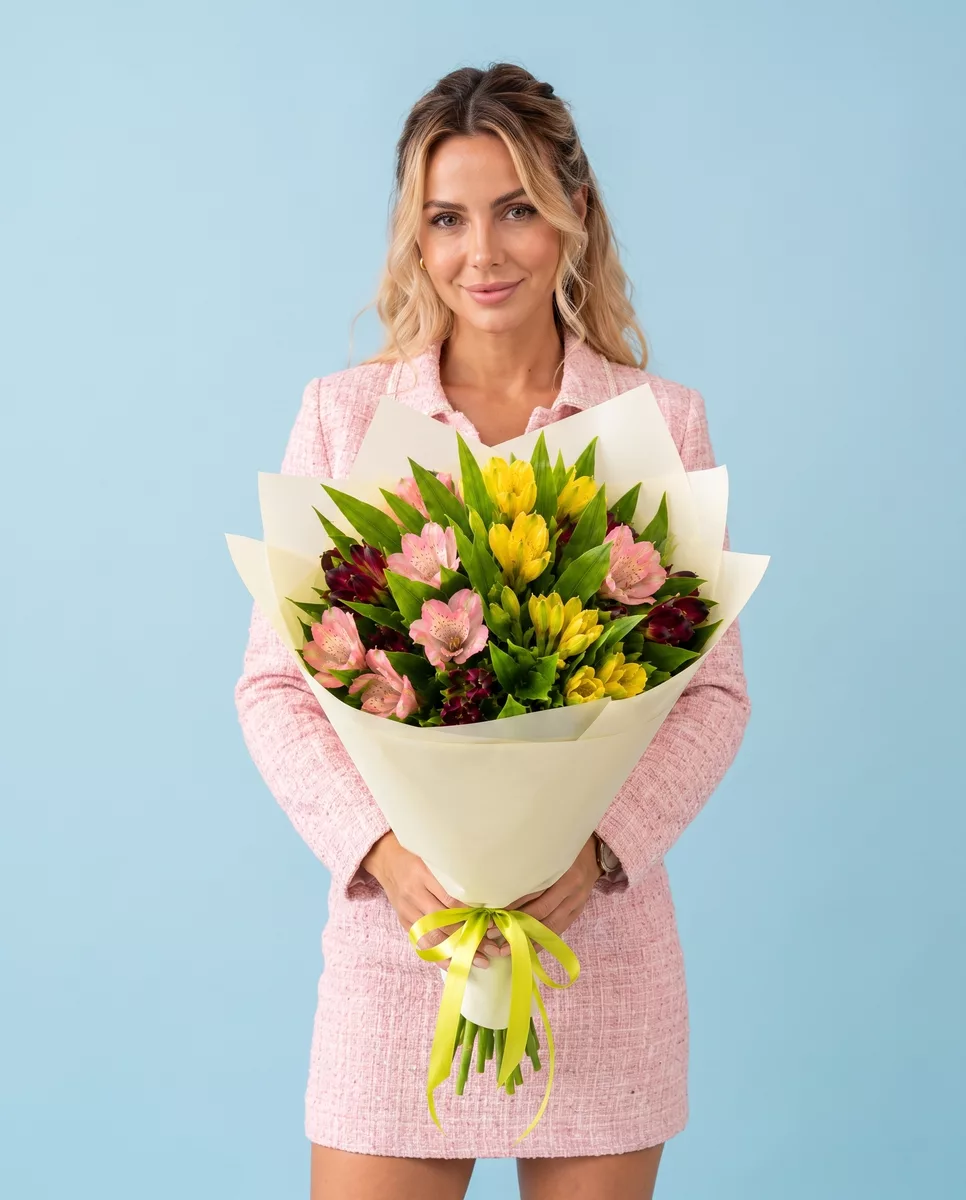
Spray roses — the multi-headed variety on a single stem — are consistently well received because they read as decorative rather than romantic, they last well in a vase, and they are available in a wide colour range including whites, creams, soft pinks and corals that avoid the yellow and red concerns. A bouquet of fifteen spray rose stems with some ruscus or pittosporum greenery is a reliable, appropriate choice for almost any household visit. Ranunculus are popular in spring and early summer and carry no difficult associations in Russian culture. They are delicate in transit and need to be ordered from a shop that keeps them cool and delivers quickly — a ranunculus bouquet that has spent two hours in a warm car is not a gift. Peonies, when in season from late May through June, are the most enthusiastically received flower for home visits in Saint Petersburg. Hosts who claim not to care about flowers will still put peonies in the best vase. Order them a day ahead if possible, since the buds need to be at the right stage — fully closed buds will not open in time if the visit is the same evening. Tulips work well for spring visits and are straightforward to transport. Lisianthus, sometimes sold under the name eustoma, is a good alternative to roses when you want something that looks generous without the romantic weight. Alstroemeria is durable, long-lasting and cheerful in mixed arrangements, though it works better as a component than as the sole flower in a bouquet.
Seasonal Timing and What Is Actually Fresh in Saint Petersburg
Saint Petersburg's flower supply follows import schedules more than local growing seasons, but the calendar still matters for quality. Roses and alstroemeria are available year-round with consistent quality. Tulips peak in availability and freshness from February through April — ordering tulips in August is possible but the stems are often shorter and the colour range narrower. Peonies arrive from late May and are largely gone by early July. Ranunculus come in from roughly March through May. Hydrangeas are available most of the year but are at their best and most affordable from June through September. When you order a bouquet for a home visit, ask the florist what arrived that morning rather than requesting a specific flower that may have been in the cooler for several days. A fresh stem of something in good supply will outlast a tired stem of your first choice by four or five days in the vase. Temperature matters in transit. In winter, a bouquet leaving our shop is wrapped in insulating paper and should be moved indoors within fifteen minutes of delivery or pickup — roses and ranunculus are particularly sensitive to freezing. In summer, direct sun through a car window can damage petals in under twenty minutes. If you are picking up a bouquet and then travelling by metro or on foot, ask for the stems to be wrapped with the heads protected. A bouquet that looks perfect at pickup can arrive wilted if it is carried head-down or crushed against a coat.
Pre-Ordering So the Bouquet Is Ready When You Leave Home
The most common mistake is deciding to bring flowers and then looking for a shop on the way to the address. This produces one of two outcomes: you arrive late because you stopped, or you arrive on time with whatever happened to be available at the nearest kiosk. Neither is ideal. Pre-ordering for a specific pickup or delivery time solves both problems. At Five Flowers we take orders for same-day delivery with a minimum lead time of two hours, and for pickup the bouquet is assembled and refrigerated until you arrive. If you know the visit is on Saturday evening, ordering Friday afternoon gives the florist time to source exactly what you want rather than working from current stock. When you place the order, give the florist three pieces of information: the occasion, the recipient's approximate age and gender, and any colour preferences or restrictions. This is enough to make a good decision. You do not need to specify every stem. If you have a firm budget, say it — a florist working within a clear number will make better choices than one guessing. For delivery to the host's address directly — if you are travelling from another city and want the flowers to arrive before you do — order with a one-hour delivery window ahead of your estimated arrival. Confirm the recipient's name and that someone will be home to accept the delivery. Our delivery radius covers Saint Petersburg and surrounding areas, and we deliver within one to two hours of order confirmation across our full service zone.
What to Say and Do When You Hand Over the Flowers
In Russia, flowers brought as a house gift are handed to the host at the door, not placed on a table and left for later. You present them directly, usually with a brief phrase — congratulations if there is an occasion, or simply that you brought these for the house. The host will almost always unwrap them immediately and put them in water, which is considered attentive rather than impatient. Do not be surprised if the host inspects the bouquet closely — this is normal and is not a sign of dissatisfaction. Wrapping matters to Russian hosts more than it does in some other cultures. A bouquet that arrives in a plain sleeve of plain paper reads as less considered than one that has been properly wrapped, even if the flowers inside are identical. At Five Flowers all bouquets leave in branded wrapping with the stems in a water sachet for deliveries, so the presentation is intact when it arrives. If you are picking up and carrying the bouquet yourself, keep it upright and avoid letting the heads touch anything. A small practical point: if the visit involves a meal and you are bringing both wine and flowers, hand the flowers first. Flowers are the personal gesture; wine is the contribution to the table. Hosts notice the order. If you are a foreign visitor unfamiliar with the household, a neutral colour palette — whites, creams, soft pinks, light purples — is the safest choice and will not conflict with interior colours or personal associations you cannot know in advance.
Ordering for a Home Visit: What to Check Before You Confirm
Before you confirm any order for a home visit bouquet, work through a short checklist. First, verify the stem count is odd — ask the florist to state the number explicitly. Second, confirm there are no even-number fillers being counted separately that would confuse the total. Third, check that the bouquet contains no pure yellow arrangements or chrysanthemums if the recipient is traditional or older. Fourth, confirm the delivery window: if you are ordering delivery to the host's address, the bouquet should arrive ten to fifteen minutes before you do, not after. A bouquet sitting in a hallway waiting for the guest is awkward for the host. Fifth, check the transit protection — in winter this means insulating wrap, in summer it means the shop is not leaving the order in a warm vehicle. Sixth, if you are ordering flowers that are sensitive to timing — peonies that need to open, ranunculus that need to stay cold — ask the florist what stage the buds are at and whether they will be presentable by the time of your visit. Seventh, if you are paying online and the order is for delivery, double-check the recipient address and the contact phone number. Our couriers call ahead before arriving, and an unreachable number means a delayed delivery. Finally, if the occasion is significant — a major birthday, a housewarming for a new apartment — consider adding a note card with a handwritten message. We include blank cards on request and can pass a message to be written at the shop if you are ordering remotely. A card is not obligatory but it is remembered.
Bringing flowers to a Russian home is a straightforward tradition once you know the three core points: the count must be odd, certain colours and varieties carry associations worth avoiding, and the bouquet should be ordered ahead rather than grabbed on the way. The rest is choosing flowers that are fresh and appropriate for the season, wrapping them well, and handing them over at the door. A florist who knows what they are doing will handle the details if you give them the occasion, the recipient and the timing — which is exactly the conversation we have with customers every day. We deliver bouquets across Russia in 1–2 hours.
Frequently asked questions
Does the odd-number rule apply to every flower in the bouquet, including greenery?
At Five Flowers we count flowering stems only — roses, spray roses, tulips, peonies and similar. Structural greenery like ruscus, eucalyptus or pittosporum does not count toward the total. If your bouquet mixes several flowering varieties, the combined stem count of those flowering stems must be odd. Confirm this with your florist when you order.
Can I bring yellow flowers to a Russian home at all?
A purely yellow bouquet is the version most likely to cause discomfort, particularly with older hosts. Yellow flowers mixed into a bouquet alongside white, orange or coral are generally read as a colour palette choice rather than a symbolic statement. If you are unsure about the recipient's views, a mixed arrangement that includes yellow as one element among several is the safer route.
How far in advance should I order a bouquet for a same-day home visit?
Two hours is our minimum lead time for same-day orders. For flowers that need specific preparation — peonies at the right bud stage, for example — ordering the evening before gives better results. If you are ordering delivery to arrive before you do, add a buffer of fifteen minutes between the delivery window and your own arrival time so the host is not waiting with unwrapped flowers.
What is the best bouquet for a first visit to a Russian family I do not know well?
A bouquet of spray roses or lisianthus in white, cream or soft pink, with an odd stem count between seven and fifteen, is the most universally appropriate choice. It avoids all the common association problems, travels well, lasts in the vase, and reads as thoughtful without being over-formal. Add ruscus or eucalyptus for structure and you have a complete, well-received gift.
Should the bouquet be delivered to the host's address or should I pick it up and bring it myself?
Either works, but if you are coming from outside the city or travelling by public transport, delivery directly to the host's address ten to fifteen minutes before you arrive is cleaner. If you are driving and the route passes near our shop, pickup keeps the bouquet fresher because transit time is shorter. In winter, pickup also means you control how the flowers are protected from the cold during the final leg.
Ready to send a bouquet?
Pick a city, choose the flowers, and we will hand them over with a photo confirmation.
Choose a city →