
How to Say Wedding Congratulations in Russian
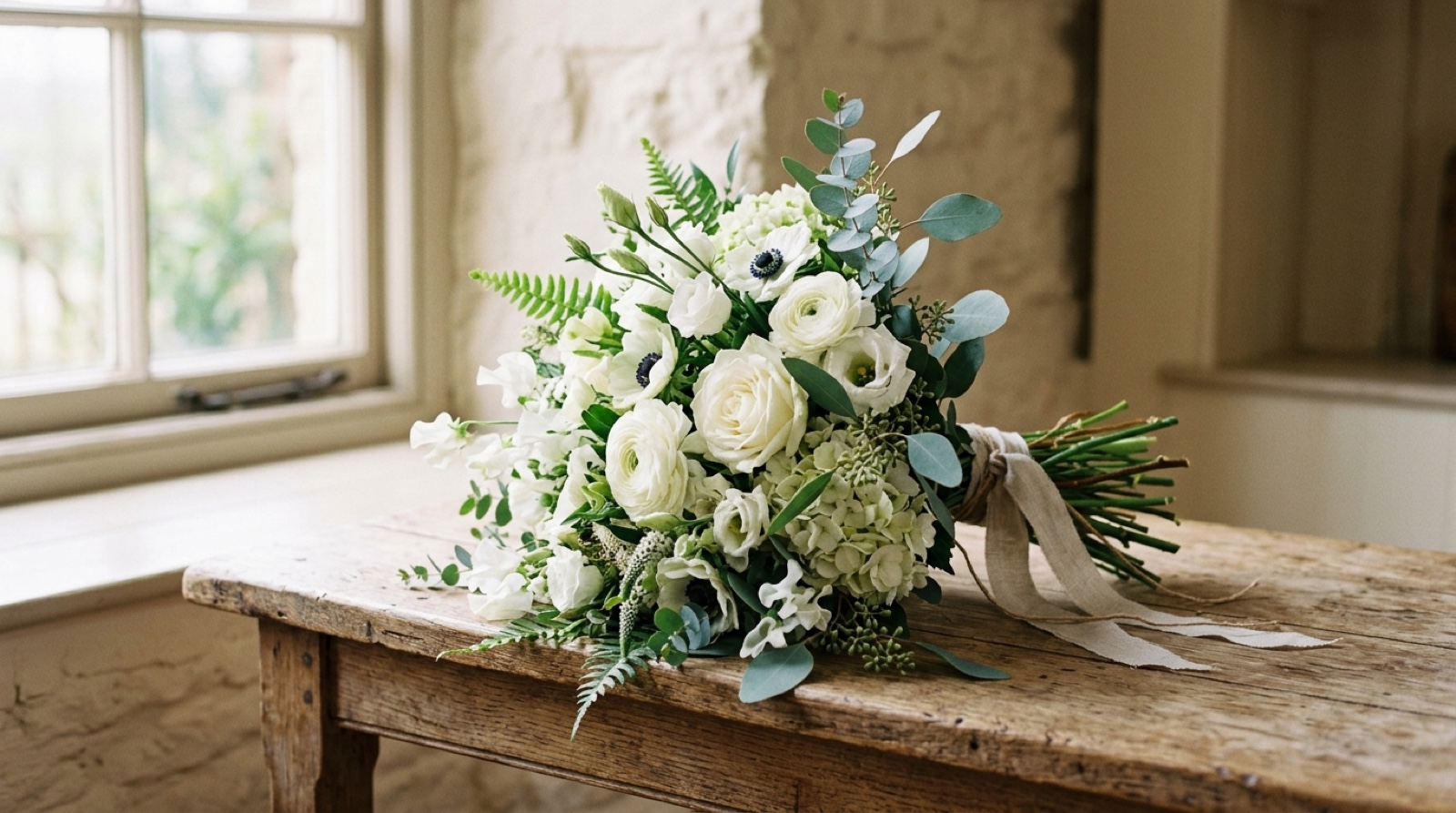
For wedding congratulations in Russian, say "Pozdravlyayu vas so svadboy!", meaning "Congratulations to you both on your wedding!" A shorter option is "S dnyom svadby!", or "Happy wedding day!" Both work in a card or in person; the Russian phrases below use Latin letters so you can read them without knowing the Russian alphabet.
Customers choosing wedding flowers often need help with the accompanying words: something warm enough for family, but easy to pronounce and appropriate for both newlyweds. At Pyat Tsvetov (5 Flowers), we have served customers in Saint Petersburg since 2011. Our practical advice is to address the couple together, choose one sincere wish and sign the card clearly, especially when sending flowers from abroad.
Choose a Russian greeting that matches the sender
"Pozdravlyayu vas so svadboy!" is suitable when the message comes from one person. If you are writing as a couple, family or group, use "Pozdravlyayem vas so svadboy!", meaning "We congratulate you on your wedding!" The small change matters because the verb identifies whether one person or several people are sending the congratulations.
For an easy phrase to say aloud, choose "S dnyom svadby!" A rough English pronunciation is "s dnyom SVAHD-bih", with the stress on the first syllable of "svadby". This is a pronunciation aid rather than an exact rendering of Russian sounds. Say it slowly, then continue in English if that lets you express your feelings more comfortably.
Add "Zhelayu vam schastya i lyubvi", meaning "I wish you happiness and love", for a complete personal greeting. From several senders, change the beginning to "Zhelayem vam", or "We wish you". The word "vam" addresses both newlyweds here, so the wish includes the couple even when you know one of them much better.
Write a wedding card that feels personal
A useful card has three parts: the couple's names, your congratulations and your signature. For example: "Anna and Alex, s dnyom svadby! Wishing you a happy marriage and many wonderful years together. With love, Emma." Mixing a short Russian greeting with an English message is a practical choice when you want warmth without risking a longer translation.
For a message entirely in transliterated Russian, write: "Dorogie Anna i Maksim! Pozdravlyayem vas so svadboy! Zhelayem vam schastya, lyubvi i mnogo schastlivykh let vmeste. S lyubovyu, Kate i Daniel." This means: "Dear Anna and Maksim! Congratulations on your wedding! We wish you happiness, love and many happy years together. With love, Kate and Daniel."
Use the names and spellings the couple use themselves, rather than guessing Russian nicknames. Avoid jokes about divorce, pressure to have children or advice about who should lead the marriage. A specific, affectionate sentence about the couple usually reads better than a list of grand wishes. Keep private memories out of a card that may be read by relatives or displayed beside the flowers.
Bouquets we can deliver




Give a short toast and understand 'Gorko!'
If you are invited to speak, prepare a greeting, one personal thought and a closing wish. You might say: "Dorogie Anna i Maksim, s dnyom svadby! We are so happy to celebrate with you. May you keep making each other laugh and supporting each other through everyday life." Practise the names and Russian greeting aloud before the reception.
"Za molodykh!" means "To the newlyweds!" and makes a concise ending to a toast. An approximate pronunciation is "zah mah-lah-DYKH", although the final Russian sound has no exact English equivalent. There is no need to deliver the whole speech in Russian. A brief phrase you understand is easier to say naturally than a long passage learned only by sound.
At some Russian weddings, guests call "Gorko!", literally "Bitter!", to invite the newlyweds to kiss. It is a wedding custom, rather than a translation of "congratulations", and it does not suit every celebration. Follow the couple's preferences and the host's lead. You can offer a warm toast without using it or asking the couple to perform.
Match the flowers to the couple and the occasion
A guest's gift bouquet serves a different purpose from the bridal bouquet carried during the ceremony. Choose it as a present for the couple, taking account of their tastes and how they will carry gifts home. A manageable bouquet can be more convenient than a very large arrangement when the newlyweds have several venues to visit. Our guide to flowers for a Russian wedding guest explores the etiquette in more detail.
When giving a small bouquet with individually countable stems, an odd number follows the usual Russian convention for celebratory flowers. Even numbers are traditionally associated with mourning, so this detail matters particularly for a simple bunch of roses. Colour meanings are less reliable as a guide to an individual couple's preferences. Choose colours they enjoy instead of treating every shade as a fixed message.
Roses are a familiar wedding gift, but the couple's preferences should guide the final choice. Before choosing strongly scented flowers, consider whether they will stand beside food or in a small room. If you know the wedding colours, you can use them as inspiration without trying to reproduce the bridal bouquet. Browse the bouquets catalogue with the card message and practical size in mind.
Arrange delivery to Russia around the wedding schedule
For a wedding gift, confirm where the couple will actually be able to receive flowers. A home address may be easier than a venue during the ceremony, photographs or speeches. Check the recipient's name, telephone number, full address and intended date before placing the order. For delivery to a venue, establish who can receive the bouquet and where it can wait safely.
We deliver flowers across Russia, with city delivery costing 500 RUB. For remote districts and suburbs, the operator confirms the delivery price when confirming the order. In large cities, express delivery is available in 1–2 hours after order confirmation; other options include an exact time with a tolerance of plus or minus 30 minutes, or the windows 09–12, 12–15, 15–18 and 18–21. Orders can be placed 1–30 days ahead, and delivery in Saint Petersburg is available around the clock.
Read the delivery and payment information, then check the payment options displayed at checkout, which uses CloudPayments. Do not assume that a particular foreign card will be accepted. Include your greeting when ordering: a card with your text is free. Delivery is anonymous by default and the courier does not name the sender, so sign the card if you want the couple to know who sent it.
Plan the handover and help the flowers last
The courier calls the recipient about 15 minutes before arrival, so choose a contact who can answer around the delivery time. A surprise bouquet still needs a workable handover plan, particularly during a wedding ceremony. If the recipient is absent, we agree a second delivery that day or, with the sender's consent, hand the flowers to a neighbour or concierge. Do not assume an unattended reception desk will accept them.
Once the bouquet reaches the couple, flowers intended for a vase should have their stems freshly trimmed with a clean, sharp tool. Remove leaves that would sit below the waterline and use a clean vase with fresh water. If flower food is supplied, follow its packet instructions. An arrangement set in floral foam needs a different approach: keep its water reservoir supplied rather than pulling the stems out to recut them.
Place the flowers away from direct sun, radiators and ripening fruit, and check the water daily. Remove fading flowers and submerged debris so the remaining stems stand in clean water. If the couple will leave for a honeymoon soon, arranging delivery before their departure or after their return may make the gift easier to enjoy. For questions about an order, call 8 (812) 507-67-05.
Frequently asked questions
What is the simplest wedding congratulations phrase in Russian?
"S dnyom svadby!" means "Happy wedding day!" For a fuller greeting from one person, use "Pozdravlyayu vas so svadboy!", meaning "Congratulations to you both on your wedding!"
Can I write a Russian wedding card using English letters?
Yes, transliterated Russian is a practical option when you cannot write in the Russian alphabet. You can also use one Russian greeting followed by a personal message in English.
Does 'Gorko!' mean congratulations?
No, it literally means "Bitter!" and is a traditional call inviting the newlyweds to kiss at some Russian weddings. Use a wedding greeting for your congratulations and follow the couple's lead about this custom.
Should I put my name on flowers sent as a wedding gift?
Sign the card if you want the couple to identify the gift. Our delivery is anonymous by default, the courier does not name the sender, and a card with your text is free.
Can I pay for wedding flowers to Russia with a foreign card?
Online checkout uses CloudPayments; check the payment options displayed there for your order. Acceptance of a particular foreign card is not guaranteed.
Ready to send a bouquet?
Pick a city, choose the flowers, and we will hand them over with a photo confirmation.
Choose a city →