
Flowers for a Russian Wedding Guest: Varieties, Sizing and Timing
Every week someone calls the shop and asks the same thing: they are going to a Russian wedding as a guest and have no idea whether to bring flowers, send them ahead, or skip flowers entirely and just hand over an envelope. The answer depends on a few specific customs that are easy to follow once someone explains them plainly, and getting it wrong is more embarrassing than most guests realise — walking in with a bouquet larger than the bride's is genuinely noticed and talked about at the table.
Why Flowers Still Matter at Russian Weddings
In Russia, arriving at a wedding without flowers as a guest is considered noticeably bare-handed, even if you are also giving a cash gift. The tradition is old and has not faded in the way it has in some Western countries. Flowers are presented to the couple — usually to the bride — at the moment of greeting, before the ceremony or at the entrance to the reception venue. The gesture is brief and public, which is exactly why the choice of bouquet matters: it is seen by everyone standing nearby at that moment. The practical rule that florists repeat constantly is that a guest bouquet should be clearly smaller and less elaborate than the bridal bouquet. The bride typically carries something between forty and sixty stems in a round or cascading shape; a guest bouquet of fifteen to twenty stems in a compact hand-tied form sits comfortably within that boundary. Beyond size, colour matters: white is the bride's territory at most Russian weddings, so guests who arrive with an all-white bouquet of white roses or white peonies are quietly stepping on the bride's visual space. This is not a hard taboo the way it is with funeral flowers, but it is considered thoughtless. A florist who knows the occasion will steer you toward blush, coral, soft yellow, or mixed seasonal tones rather than pure white. Understanding these two rules — size and colour — resolves most of the uncertainty before you even start choosing varieties.
Bouquets we can deliver



Which Varieties Work Best for a Guest Bouquet
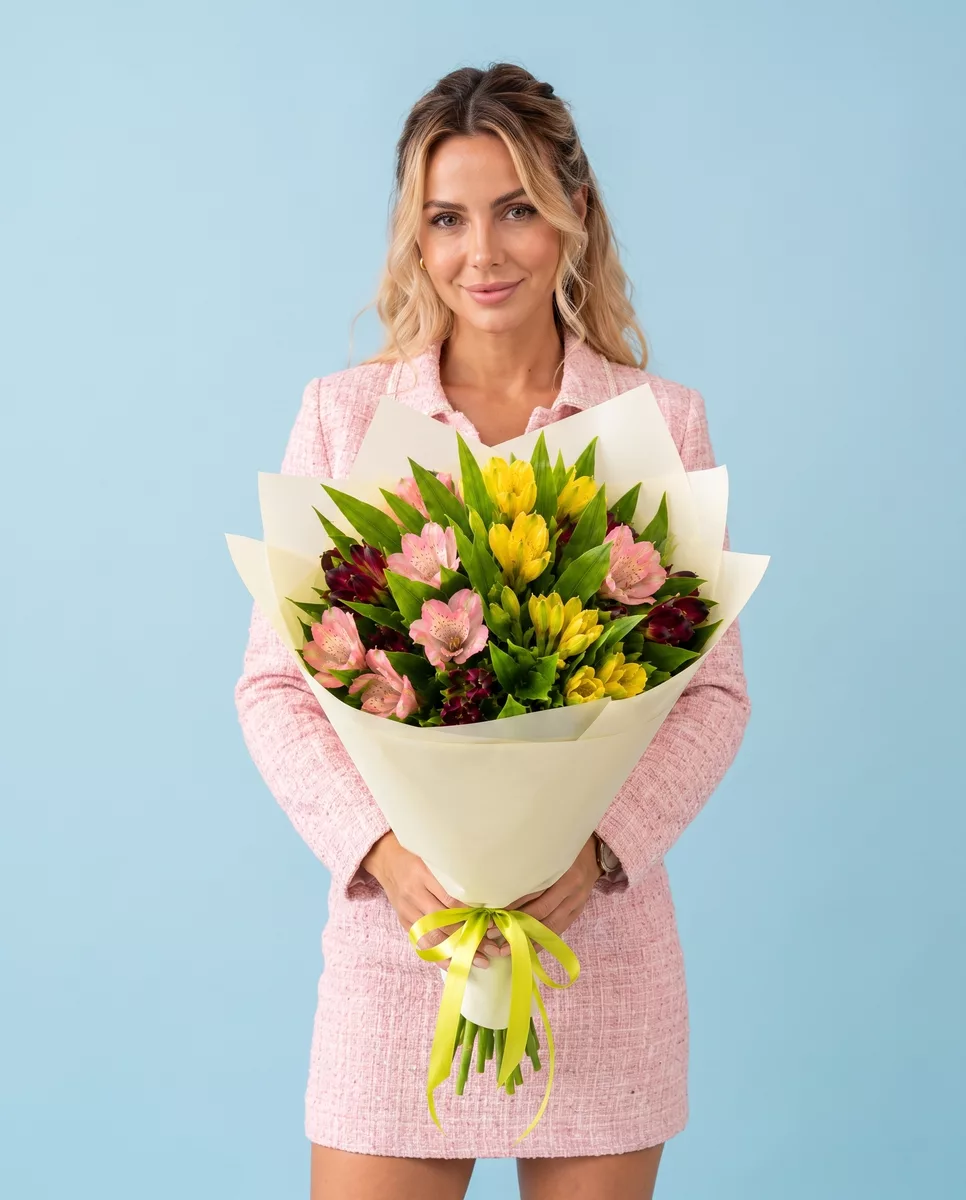
The varieties that hold up well in a guest bouquet are those with strong stems, good vase life, and colours that read as celebratory without being bridal. Garden roses in blush, apricot, or deep coral are the most requested choice at this shop for wedding guests, and for good reason: they look generous without requiring a large stem count, they travel well in a box, and they do not wilt in a warm reception hall the way some softer flowers do. Spray roses add texture without bulk and cost less per stem, which helps keep the bouquet proportionate. Lisianthus — sometimes sold as eustoma — is underused by guests but excellent for weddings: the ruffled petals read as luxurious, the stems are sturdy, and the colours in purple, white-edged purple, and pale pink sit perfectly in a mixed guest bouquet without competing with bridal arrangements. Alstroemeria is another reliable filler that lasts well in heat, though it works better as a supporting flower than as the centrepiece of the bouquet. Ranunculus are beautiful in spring but need to be ordered and delivered the same day because they open fast and look tired within hours in a warm room. Chrysanthemums are worth mentioning only to rule them out: in Russia they carry a strong association with mourning and cemeteries, and even modern florists who know they are technically just a flower will advise guests against them at a wedding. Stick to roses, lisianthus, and seasonal fillers and you will not go wrong.
Size and Stem Count: The Numbers That Matter
A guest bouquet for a Russian wedding should sit in the range of fifteen to twenty-five stems depending on what those stems are. A hand-tied bouquet of eighteen garden roses in a single colour is an appropriate, respectful size. Adding five stems of lisianthus and a few eucalyptus branches to twelve roses gives you a mixed bouquet that looks full without being large. The diameter of the finished bouquet, laid flat, should not exceed about thirty centimetres — anything wider starts to look like a ceremonial arrangement rather than a guest gift. Florists measure this instinctively but it is useful to know when you are ordering by phone or online and cannot see the finished piece. If you are a close friend of the bride, you might go to the upper end of that range; if you are a colleague of the groom or a distant relative, fifteen stems of a single quality variety is perfectly correct. One mistake that comes up repeatedly: guests order a bouquet by budget alone and end up with either too many cheap stems or too few expensive ones. Communicating the occasion and the relationship to the florist matters more than a fixed number. A good florist will ask which role you play at the wedding before suggesting a size. Packaging also affects perception: a bouquet in a flat box arrives looking considered and intentional, while the same flowers wrapped loosely in cellophane look like they were grabbed on the way to the metro. Specify box packaging when you order.
Colour Rules for Wedding Guests in Russia
The clearest colour rule for a Russian wedding guest is to avoid pure white as the dominant tone of your bouquet. This does not mean white must be absent — a blush rose with white edges or a lisianthus with a white centre is perfectly fine — but an all-white bouquet of white roses or white hydrangea reads as bridal and will be noticed. Beyond white, there are no strict prohibitions, but experienced florists follow a few practical guidelines. Red roses are appropriate but carry a romantic connotation that can feel odd when you are a colleague or a distant acquaintance rather than a close friend. Deep red or burgundy in a mixed bouquet is less loaded than a dozen red roses on their own. Yellow flowers have an old reputation in Russia as a sign of separation or jealousy, though this belief is weaker among younger couples and in larger cities. If you are uncertain about the couple's age or background, blush, peach, coral, and soft lavender are safe across all demographics. Bright orange or hot pink reads as energetic and modern and is entirely appropriate at a contemporary wedding. For spring weddings, tulips in coral or soft pink make a strong guest bouquet: they are seasonal, they look intentional, and they are a fraction of the cost of roses, which allows you to order more stems without the bouquet growing too large. The key principle is that your bouquet should look like it belongs to the occasion without looking like it belongs to the bride.
Timing the Delivery: Before the Ceremony or at the Door
Most Russian wedding receptions begin in the early afternoon, with the civil ceremony at the registry office happening in the morning. Guests are expected to present flowers at the start of the reception, not during the ceremony itself. If you are ordering delivery rather than carrying the bouquet yourself, the safest window is two to three hours before the reception is scheduled to begin, delivered to the venue address. Delivering to the couple's home the morning of the wedding is also done, but it requires knowing that someone will be there to receive the flowers and put them in water — on a wedding morning, the home is often empty or chaotic. A venue delivery two hours before guests arrive gives the couple or their coordinator time to put the bouquet in water and have it looking its best when people start arriving. In summer, when Saint Petersburg temperatures can reach twenty-five degrees Celsius or above, stems of garden roses and lisianthus need to arrive in water or in a hydrated box, not dry-wrapped. Always specify the delivery temperature requirement when ordering for a summer wedding. If you are carrying the bouquet yourself, pick it up no more than three hours before you plan to present it, keep it out of direct sun and away from car heating vents, and do not lay it flat in a hot boot. A bouquet that arrives wilted is worse than no bouquet, so timing and transport conditions matter as much as variety selection.
What to Write on the Card
Russian wedding cards from guests are short and direct by convention. A typical message is a congratulation to the couple with a wish for happiness, health, and many years together. The phrase many years together — in Russian, mnogoletiya or dolgikh let schastya — appears in almost every wedding card and is entirely expected rather than clichéd. If you are writing in English for a couple who will understand it, a short and warm message is perfectly appropriate; the format matters more than the language. Keep the card to three or four lines at most. Do not write a long personal note on a wedding card — that is for the speech at the table or a private moment later. The card should include your name clearly, because at a large Russian wedding the couple may receive twenty or thirty bouquets and will genuinely not remember who gave which flowers by the end of the evening. If you are sending the bouquet by delivery without attending in person, the card carries more weight: mention that you are sorry to miss the celebration and wish them well. Florists at this shop print cards on request and can write the text in Russian if you provide a transliteration or a rough translation. One thing to avoid: do not write the monetary amount of a cash gift on the flower card. Cash gifts are common at Russian weddings and entirely normal, but the amount stays private between the giver and the couple.
Common Mistakes Guests Make and How to Avoid Them
The most common mistake is ordering too late. Guests who call on the morning of a wedding expecting a same-day delivery of garden roses in a specific colour often find that the variety they want is not available in the right shade on short notice. For a wedding, order at least two days ahead and confirm the delivery time the day before. The second mistake is choosing flowers by price alone without specifying the occasion. A budget set without context produces whatever is in season at the lowest cost, which might mean a large bunch of chrysanthemums — the one variety to avoid at Russian weddings — or a monochrome arrangement in a colour that clashes with the wedding palette. Always tell the florist it is for a wedding guest gift and describe your relationship to the couple. The third mistake is ignoring the venue. An outdoor summer wedding in a garden setting calls for something more relaxed and seasonal — garden roses, sweet peas if available, ranunculus in spring — while a formal banquet hall wedding suits a more structured hand-tied bouquet with clean lines and no loose trailing greenery. The fourth mistake is sending flowers to arrive during the ceremony. The couple is not at the venue during a registry office ceremony; flowers that arrive then sit unattended and often go unnoticed. Stick to the two-to-three-hour pre-reception window. Finally, guests sometimes bring flowers in addition to a large decorative arrangement they have ordered as a group gift. If a group arrangement is already planned, coordinate with the others and consider whether an individual bouquet is necessary or whether a card with your personal note is the more graceful choice.
Choosing flowers as a Russian wedding guest comes down to three decisions made in the right order: settle on a size that is clearly smaller than the bridal bouquet, pick a colour that is celebratory rather than bridal, and order early enough that the variety you want is actually available. Garden roses, lisianthus, and spray roses in blush, coral, or soft lavender cover most situations without any risk of misstep. Avoid chrysanthemums, avoid all-white, and avoid same-day ordering for a specific variety. Get those three things right and the bouquet will be received exactly as intended — as a warm and considered gesture from a guest who knew what they were doing. We deliver bouquets across Russia in 1–2 hours.
Frequently asked questions
Is it acceptable to bring flowers to a Russian wedding as a foreign guest?
Yes, and it is expected. Foreign guests are not exempt from the custom, and arriving without flowers reads as an oversight rather than a cultural difference. A compact hand-tied bouquet of fifteen to twenty stems in blush or coral is universally understood and appreciated. If you are uncertain, call the shop and describe the situation — the florist will suggest something appropriate for the occasion.
Can I send flowers to the couple's home the morning of the wedding?
You can, but the risk is that no one is home to receive them. Wedding mornings are busy and the couple often leaves early for the registry office. If you choose a morning delivery to the home, confirm with a family member that someone will be present to take the flowers and put them in water. A venue delivery two to three hours before the reception is more reliable.
Are peonies appropriate for a Russian wedding guest bouquet?
Peonies are popular at Russian weddings and entirely appropriate in the right colour. Blush, coral, and deep pink peonies work well as a guest bouquet. White peonies on their own are better avoided because they sit too close to bridal territory. Peonies are seasonal — available roughly from late April through June — so outside that window you will need to substitute with garden roses of a similar shape.
What if I cannot attend the wedding but want to send flowers?
Send the bouquet to the venue two to three hours before the reception begins, include a card with your name clearly written and a short personal note explaining that you cannot be there. A delivery to the venue is more certain than a home delivery on the wedding day. Keep the bouquet in the fifteen-to-twenty-stem range — the same size as if you were attending — and specify box packaging so it arrives looking intentional.
Do Russian couples prefer flowers or a cash gift from guests?
Both are expected in most cases. Cash gifts are entirely normal and common at Russian weddings, typically placed in an envelope and given privately or to a designated family member. Flowers are a separate gesture presented publicly at the greeting. Most guests bring both. If you are only able to do one, a cash gift is more practically useful to the couple, but flowers without cash is also perfectly acceptable.
Ready to send a bouquet?
Pick a city, choose the flowers, and we will hand them over with a photo confirmation.
Choose a city →