
Corporate Flower Accounts for Saint Petersburg Offices: Scheduled Deliveries, Invoices and a Dedicated Manager
Every week someone from a Saint Petersburg office calls us in a mild panic — the CEO's anniversary is in two hours, the accountant needs a proper invoice by end of day, and nobody wrote down what flowers went to which department last quarter. A corporate flower account solves all three problems at once, and most office managers who set one up say they wish they had done it six months earlier. Here is exactly what the account includes, how the logistics work across the city, and what your procurement team needs to know before signing the first order.
What a Corporate Flower Account Actually Includes
A corporate account at Five Flowers is a standing arrangement between your company and our shop, not just a discount card or a saved address. When you open the account, you get a named manager on our side who learns your preferences, your internal approval chain, and the names of the people who typically receive flowers — the CFO who dislikes lilies, the front-desk team that always gets something on the first of September for Knowledge Day. The account covers scheduled recurring deliveries, ad-hoc urgent orders placed by phone or messenger, and a monthly consolidated invoice that your accounting department can post against a single supplier. All documents — invoice, act of completion, VAT certificate if your company is VAT-registered — arrive in one package either digitally or by post, whichever your bookkeeper prefers. Payment terms are agreed in advance: most corporate clients choose post-payment on a 10- or 15-day cycle, which keeps cash flow predictable. There is no minimum monthly spend written into the contract, though in practice offices that order fewer than two or three bouquets a month rarely find the administrative setup worth it. The account also stores your delivery addresses — multiple offices, a warehouse reception, a director's home address for special occasions — so the person placing the order does not have to type them out each time. Think of it as a flower logistics layer built into your company's operating calendar.
Bouquets we can deliver



Scheduled Deliveries: How the Calendar Logic Works
The most useful feature for most offices is the standing delivery schedule. You tell us the dates — every Monday a reception arrangement, roses for the 8th of March across three floors, a bouquet for each employee birthday — and we load them into the production calendar. Our florists cut and condition the stems the evening before or early the same morning depending on variety and season. Roses and standard spray chrysanthemums can be cut the evening before and held overnight at four degrees Celsius without any loss of vase life. Tulips and ranunculus are more sensitive and are always cut the morning of delivery. For offices that want a fresh reception arrangement every week, we usually recommend rotating between two or three compositions so the front desk does not see the same thing month after month: a loose garden-style mix of lisianthus, alstroemeria and eucalyptus one week, a tighter arrangement of standard and spray roses the next. The schedule is not rigid — you can shift a date by 24 hours with a simple message to your manager, and most seasonal substitutions (when, say, peonies are not yet in from the Dutch auction) are handled by us proactively with a quick confirmation call. Public holidays in Russia follow a pattern that surprises some international companies: the May holidays, for example, can run across nine or ten consecutive days, and flower demand spikes sharply on the 8th of March and the 1st of September. We flag these dates to corporate clients in advance so orders are placed before supply tightens.
Delivery Zones and Timing Across Saint Petersburg
Saint Petersburg is a large city with very different traffic patterns depending on the district and the time of day. The historic centre — Tsentralny, Admiralteysky, Vasileostrovsky — is reachable within one hour for most orders placed before noon. Business clusters further out, such as the Pulkovo area near the airport, the Primorsky district office parks, or Kronstadt, require longer windows and should be booked at least two to three hours ahead. We deliver ourselves with our own couriers, which means we control the cold chain from the moment the bouquet leaves the workbench to the moment it arrives at your reception. Flowers travel in insulated bags in cooled vehicles; in summer this matters especially for garden roses and hydrangeas, which wilt quickly if left in a warm car. For corporate accounts, we agree on preferred delivery windows per address — for example, a standing instruction that the Nevsky Prospekt office always receives flowers between 10:00 and 11:00, before the morning meeting. Same-day orders placed before 14:00 can usually be fulfilled for central districts; orders after that cut-off are handled case by case and depend on current production load. For recurring scheduled deliveries, timing is locked in and treated as a firm commitment on our side. If a courier is delayed for any reason — road works on Ligovsky, a bridge opening on the Neva — your manager calls ahead rather than letting the delivery arrive unannounced late.
Choosing Flowers for an Office Context: Varieties That Last
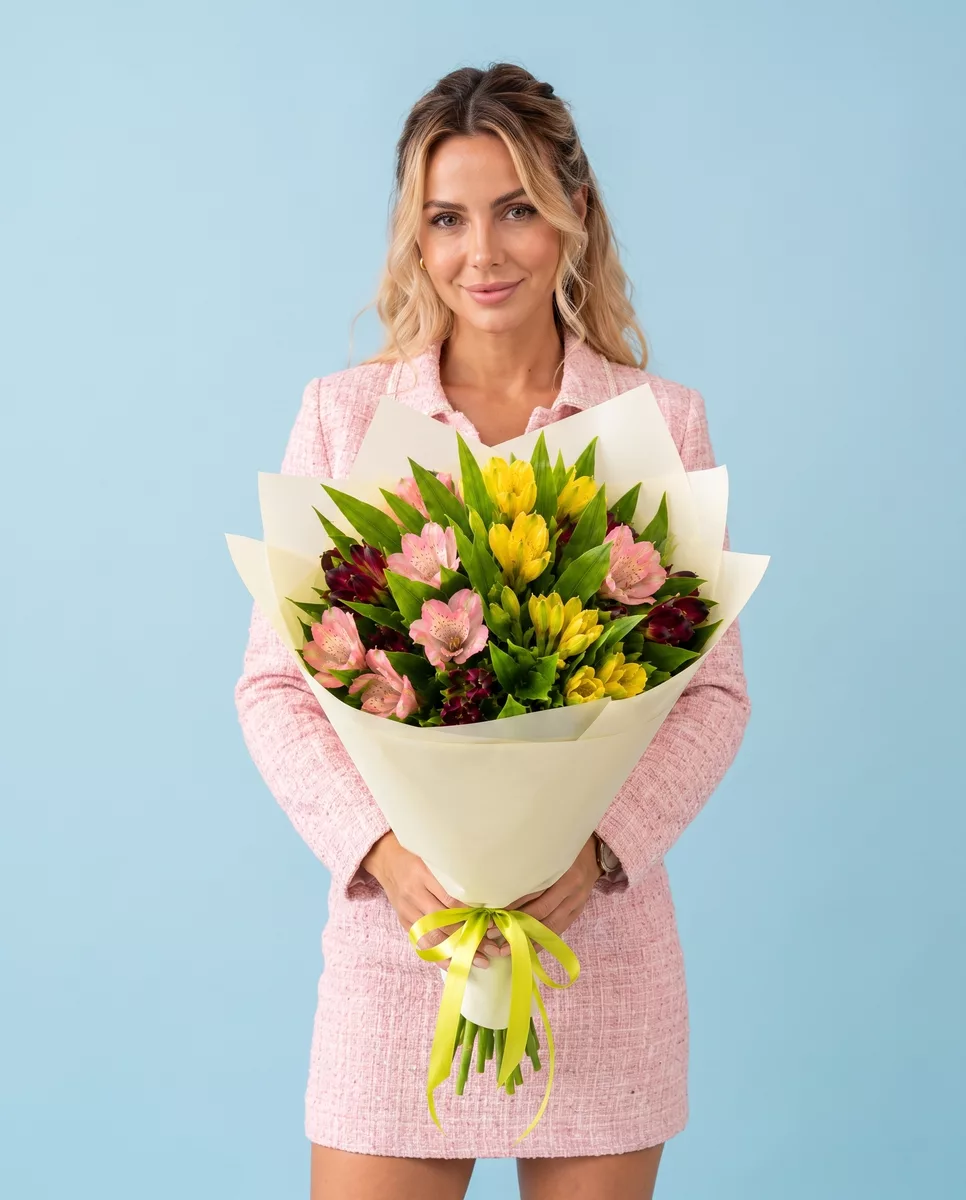
An office is not a home. The bouquet sits on a reception desk or a meeting-room table, often in a warm room with low humidity and no one remembering to change the water. This means variety choice matters more than it does for a personal gift. Standard roses from reliable Dutch growers — David Austin garden varieties are popular but need attentive care — hold well if the stems are recut on arrival and placed in clean water. Spray roses, which have multiple smaller blooms per stem, tend to last longer in office conditions because they open gradually. Alstroemeria is one of the most practical office flowers: it opens over several days, tolerates warmth better than most, and comes in a wide colour range including white, yellow, coral and burgundy. Chrysanthemums, both standard and pompon types, are similarly robust. Lisianthus adds an elegant ruffled texture and lasts well. We generally advise corporate clients to avoid flowers that shed pollen heavily — standard lilies, for instance — because the orange pollen stains tablecloths and suits and generates complaints. If a client specifically wants lilies, we use varieties where the anthers are removed before delivery, which is standard practice on our end but worth confirming when ordering. Tropical varieties like anthuriums and birds of paradise last two weeks or more and work well for reception areas where someone can water them consistently. Seasonal flowers — tulips in February and March, peonies in May and June, sunflowers in summer — are worth using when available because they are fresher and often more cost-effective than out-of-season imports.
The Invoice and Document Flow for Russian Accounting
This is the section that office managers often skip and then regret. Russian accounting requires specific documents for any B2B transaction: a schet-faktura (invoice), an akt vypolnennykh rabot (act of completed work or delivery), and if your company works with VAT, a corresponding VAT invoice. For companies operating under a simplified tax regime, the set of documents is shorter, but it still needs to match your internal purchase order system. When you open a corporate account, we collect your company's full legal details — INN, KPP, legal address, bank details for the contract — and all subsequent documents are issued in your company's name automatically. Monthly consolidated invoices bundle every delivery made in the calendar month into one document, which is far easier to process than a separate invoice per bouquet. If your internal system requires a purchase order number on each invoice, tell your manager at the start; we add it to every document from that point forward. Some international companies operating in Saint Petersburg have a Russian legal entity but route approvals through a headquarters in another country — in this case we can issue documents in English as a supplementary set, though the primary Russian-language documents remain the legally binding ones. Electronic document exchange through systems such as SBIS or Diadoc is available if your accounting department already uses one of these platforms, which speeds up signing and archiving considerably. The key mistake to avoid is placing the first few orders informally and then trying to retroactively document them — Russian tax authorities look closely at the dates on primary documents, so the contract and the first invoice should be in order before the first delivery.
Typical Corporate Scenarios and What Gets Ordered
The range of situations that corporate clients bring to us is wider than most people expect. The most common recurring order is a weekly or biweekly reception arrangement — a vase composition that signals to visitors that the office is well-run and attentive. These typically use medium-to-large format arrangements with a mix of focal flowers (roses, lisianthus, hydrangeas) and filler greenery (eucalyptus, ruscus, pittosporum). The second most common category is employee recognition: a bouquet for a work anniversary, a promotion, or a significant personal milestone. Russian workplace culture places genuine weight on these moments — arriving at a colleague's desk with flowers on a round birthday (30, 40, 50) is standard practice, and skipping it is noticed. International companies sometimes underestimate this and then scramble. The third category is client and partner gifts: flowers sent to a client's office after signing a contract, or a bouquet delivered to a business partner for a company anniversary. For these, presentation matters — a neat kraft wrap or a box arrangement with a printed card carries more weight than a casual bunch. We also handle conference and event decoration for corporate clients on account: table centrepieces for a board dinner, a welcome arrangement for a product launch. These are planned at least a week ahead and priced separately from the standing account, but the invoicing flows through the same consolidated monthly document. The least expected but entirely real scenario is flowers for an office dog on its birthday — yes, this has happened more than once, and yes, we made the bouquet.
Opening the Account: What You Need and What to Expect
Setting up a corporate account takes one working day once we have your company's legal details. The process starts with a call or a message to our corporate team — not the general order line — where you describe the rough volume and frequency of what you need. We then send a draft service agreement that covers delivery terms, payment schedule, document flow, and the procedure for urgent or out-of-hours orders. Most companies sign within two to three days after their legal department reviews the standard terms; we can adjust specific clauses if your procurement rules require it, though the core delivery and payment terms are standard. Once the contract is signed, your manager is assigned and you exchange direct contacts — a phone number and a messenger handle, not a general inbox. The onboarding call covers your address book, any allergies or preferences among regular recipients, your preferred delivery windows, and any dates already on the horizon. We ask for a short briefing document if you have one, or we fill it in together on the call. The first delivery is treated as a test run in the sense that your manager follows up afterward to confirm timing, presentation and any feedback. After that, the account runs on its own rhythm. The most common early mistake is not telling us about a key date until the day before — the 8th of March is the clearest example, when demand across the city is extremely high and our production capacity is allocated weeks in advance. Corporate account holders get priority allocation for high-demand dates, but only if the order is placed with reasonable lead time, not the morning of.
A corporate flower account is essentially a small piece of office infrastructure — unremarkable when it runs well, very noticeable when it does not. The companies that get the most out of ours are the ones that brief their manager properly at the start, flag the important dates on the calendar in advance, and let the document flow run automatically without chasing individual invoices. If your office currently handles flowers through informal one-off orders, the shift to a standing account usually saves the office manager two to three hours a month in coordination and eliminates the last-minute scramble that happens every time a significant date appears on the calendar. The flowers themselves do not change — the same fresh stems, the same same-day delivery across Saint Petersburg — but the process around them becomes invisible in the best possible way. We deliver bouquets across Russia in 1–2 hours.
Frequently asked questions
Is there a minimum order volume required to open a corporate account?
There is no formal minimum, but the administrative setup — contract, dedicated manager, consolidated invoicing — makes most practical sense for companies placing at least two or three orders per month. Smaller volumes are welcome; we just want to make sure the structure genuinely saves you time rather than adding paperwork for a single occasional bouquet.
Can we place urgent same-day orders even with a standing account?
Yes, and this is one of the main advantages. Your dedicated manager handles urgent requests directly by phone or messenger. Same-day delivery in central Saint Petersburg districts is available for orders placed before 14:00. For districts further from the centre, a two-to-three-hour lead time is more realistic. Out-of-hours urgent orders are handled case by case.
What happens if the flowers we ordered are not available on the delivery date?
Your manager contacts you in advance — not on the morning of delivery — to confirm a substitute of equivalent quality and price. We do not make substitutions silently. If a specific variety is critical for the occasion, tell us when booking and we will source it ahead of the delivery date or advise on realistic alternatives given current auction availability.
Can documents be issued to a foreign legal entity or in a foreign currency?
Our primary documents are issued in Russian rubles to a Russian legal entity, as required by Russian law. If your Saint Petersburg office is a branch or representative office of a foreign company with a registered Russian INN, we issue documents to that entity. Supplementary English-language documents can be provided alongside the primary Russian set for internal reporting purposes.
How far in advance should we book flowers for the 8th of March or other peak dates?
For the 8th of March — International Women's Day, the busiest flower date in Russia — corporate account holders should submit their full order at least two weeks ahead. For other high-demand dates such as the 1st of September or New Year, one week is usually sufficient. We send advance reminders to all account holders before each major peak period.
Ready to send a bouquet?
Pick a city, choose the flowers, and we will hand them over with a photo confirmation.
Choose a city →