
Flowers on Long-Distance Routes: Packaging, Temperature and Transit Care
The most common question we get when someone orders delivery to Moscow, Kazan or Yekaterinburg is a simple one: will the flowers still look alive when they arrive? It is a fair question. A bouquet of garden roses or ranunculus that leaves our shop in Saint Petersburg at seven in the morning faces a very different journey than one handed across a counter. The answer depends almost entirely on what happens in the first thirty minutes after cutting, how the stems are packed, what temperature the flowers travel at, and whether the courier understands that a box of peonies is not a box of books. This article explains exactly what we do at each stage, variety by variety where it matters, so you can order with a clear picture of what is actually happening to your flowers in transit.
Why the First Hour After Cutting Determines Everything
Florists talk about conditioning, and it sounds technical, but the idea is straightforward: a stem that has been cut and left dry for even twenty minutes begins sealing its vascular tissue to stop water loss. Once that seal forms, the flower struggles to drink even when it is placed back in water. This is why every bouquet we prepare for a long-distance route goes through a strict conditioning sequence before it is ever touched by packaging material. Stems are cut at a forty-five-degree angle under water, placed immediately into buckets of cool, clean water with a measured dose of flower food, and held in our cooler at between four and six degrees Celsius for a minimum of two hours. Roses, lisianthus and chrysanthemums tolerate this conditioning phase well and arrive with firmer petals and stronger stems as a result. Tulips are more sensitive: they continue growing after cutting, so they are conditioned for a shorter window and packed when they are still slightly closed, because they will open naturally during transit. Peonies need the longest conditioning of all the common varieties — at least three to four hours in cool water — because their dense heads hold heat and they wilt dramatically if packed warm. Skipping or shortening this phase is the single most common mistake made by shops that treat long-distance delivery as an afterthought. We do not shorten it regardless of order volume, because a bouquet that wilts on arrival costs far more in reputation than the time saved.
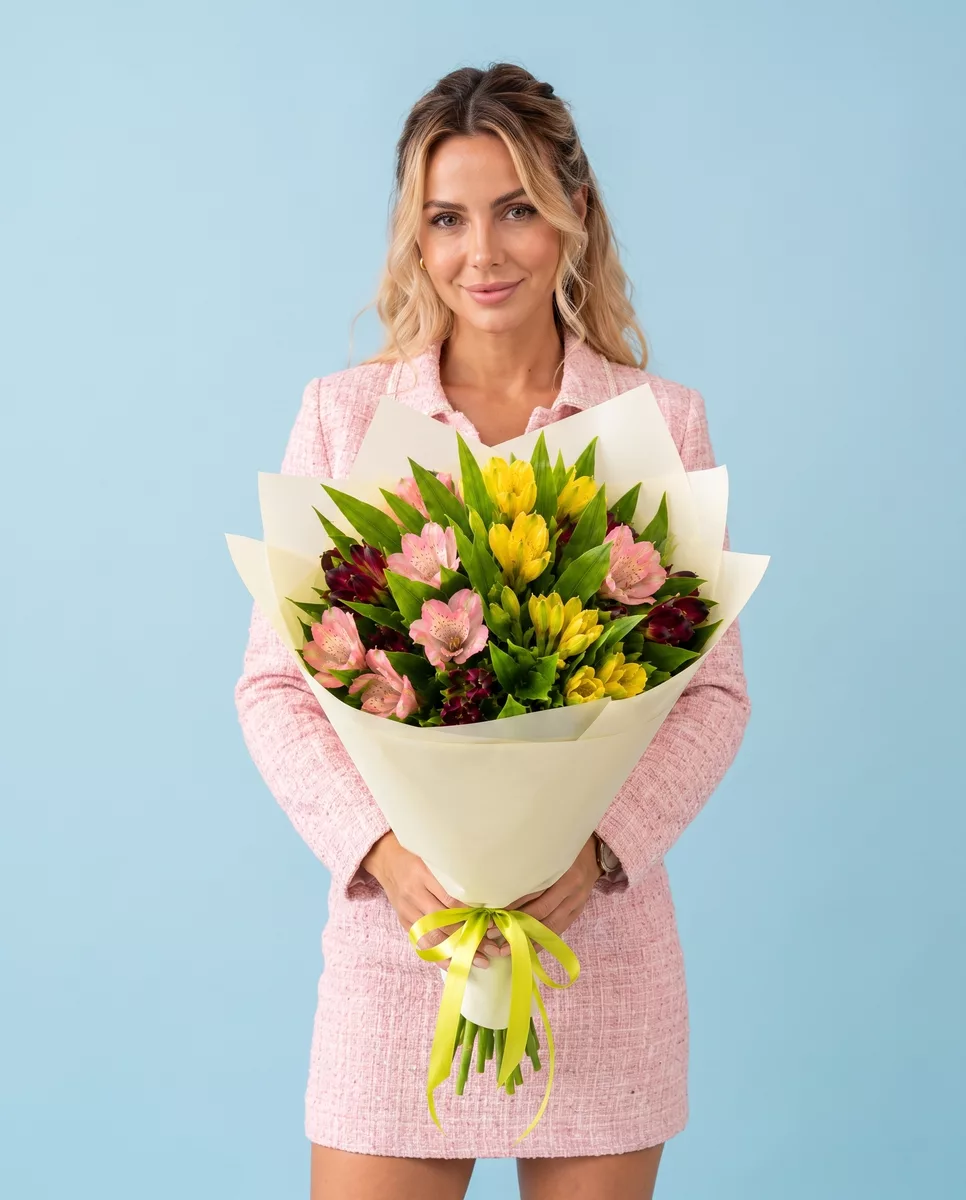
Bouquets we can deliver



Packaging Materials and Why Each Layer Has a Job
The outer box is corrugated cardboard rated for the weight of the arrangement plus ice packs, which can add significant mass to a large bouquet. Inside, the stems sit in a water source — either a sealed aqua pack, which is a small plastic bag of gel-treated water clamped around the stem ends with a rubber band, or a foam block soaked through and wrapped in polyethylene. The aqua pack is preferred for routes under twelve hours because it is lighter and keeps stems hydrated without risk of leakage. For routes beyond twelve hours, the foam block is more reliable because it holds a larger water reservoir. Above the stems, the flower heads are separated from the box walls by a sleeve of kraft paper formed into a loose cone, which prevents the petals from pressing against cardboard and bruising. A second layer of tissue paper wraps the heads individually for varieties with fragile petals: garden roses, ranunculus and anemones all get this treatment. Delphinium spikes and gladiolus are wrapped in a tight paper sheath along their full length because any lateral pressure snaps the florets. The lid is taped but not sealed airtight — small ventilation gaps on two sides allow moisture to escape, which prevents condensation from pooling on petals and causing botrytis, the grey mould that appears on roses and peonies when they sit in humid, still air. Every box is marked on all four sides with orientation arrows and a temperature range, so anyone handling it at a transfer point knows immediately how to hold it and where not to place it.
Temperature Ranges by Variety and Why They Differ
Not all flowers travel at the same temperature, and this is one of the details that surprises customers most when they ask about the process. The standard transit range for most cut flowers is between two and eight degrees Celsius. Within that band, different varieties have preferences that affect how we pack and which vehicle section they travel in. Roses are comfortable at four to six degrees and hold well for up to thirty-six hours at that range. Orchids — most often phalaenopsis and cymbidium in our arrangements — are cold-sensitive and suffer chilling injury below ten degrees, which shows up as translucent, water-soaked patches on the petals. For any order containing orchids, the box is insulated with an additional layer of bubble wrap and the ice packs are positioned away from the flower heads rather than directly beside them. Tropical varieties including anthuriums and birds of paradise share this cold sensitivity and are treated the same way. Tulips prefer the lower end of the range, around two to four degrees, because warmth accelerates their growth and they open faster than intended. Lilies travel well across the full standard range but must be kept away from fruit in any shared vehicle, because ethylene gas from ripening fruit causes lilies to drop petals prematurely. This is not a theoretical concern — it is a real problem on any route where the courier vehicle carries mixed cargo, which is why our long-distance runs use dedicated flower transport only.
How Transit Time Affects Your Choice of Varieties
When a customer calls to order a bouquet for delivery to a city eighteen or twenty hours away by road, the variety choice is not purely aesthetic. Some flowers simply do not have the structural durability for a long transit, and recommending them would be dishonest. Anemones, for example, are beautiful but their stems are hollow and their petals bruise against almost any surface during movement. They are suitable for routes up to six hours and work well for deliveries within the Leningrad Oblast or to nearby cities, but we advise against them for anything longer. Freesias hold slightly better but share the same fragility concern. The varieties that consistently perform well on routes of twelve to twenty-four hours are spray roses, alstroemeria, statice, lisianthus and solidago. These have firm stems, dense petals or naturally dry textures that resist mechanical damage from vibration and shifting. Standard roses in bud form — not fully open — also travel well because the tight bud protects the inner petals. Chrysanthemums are arguably the most durable cut flower in transit: their stems are woody, their petals are layered tightly, and they tolerate a wide temperature range without visible stress. For deliveries beyond twenty-four hours, we build arrangements primarily around these durable varieties and use more delicate additions sparingly and only in the centre of the box where movement is most limited. Customers who have a specific variety in mind for a long route should ask directly — we will give a straightforward answer about whether it is realistic rather than accepting the order and hoping for the best.
What Couriers Check at Each Stop and Transfer Point
Long-distance deliveries in Russia often involve one or more transfer points — a regional hub, a relay driver, or a handoff between vehicle types. At every transfer, the courier assigned to the order runs through a fixed checklist before the box changes hands. First, the outer box is checked for any compression damage: a dented corner on a flower box usually means the contents have shifted, and the courier opens the box to inspect before signing any transfer document. Second, the aqua pack or foam block is checked for leakage, because a wet box base weakens the cardboard and can cause the bottom to fail during the next leg. Third, the temperature of the box interior is measured with a probe thermometer — we use a target of no more than ten degrees at any transfer point, and a reading above that triggers a decision about whether additional cooling is needed before the next leg continues. If ice packs have exhausted their cooling capacity, they are replaced at the transfer point from a cooler carried in the vehicle. Fourth, the courier photographs the box interior and exterior and sends the image to our dispatch team, who log it against the order. This documentation step matters because it creates a clear record of the bouquet's condition at each stage, which is useful if a customer reports damage on arrival and we need to identify exactly where in the route the problem occurred. Customers can request to see these photos, and we share them without hesitation.
Common Mistakes Customers Make When Ordering Long-Distance
The most frequent problem we see is customers ordering fully open peonies or garden roses for a destination that is more than eight hours away. Open flowers are beautiful in the shop and photograph well, but they have already used a significant portion of their vase life, and the mechanical stress of transit accelerates petal drop. We always ship peonies in the marshmallow stage — firm, showing colour but not yet open — so they arrive and bloom over the following day. The second common mistake is specifying a delivery window that is too narrow for the actual route. A customer ordering for a city twelve hours away and requesting delivery before noon on the same day the order is placed is asking for something that is physically impossible without the bouquet spending the night in transit, which is not how we operate. We are clear about realistic windows at the point of order, and we ask customers to build in a buffer of at least two to three hours beyond the minimum transit time. The third mistake is not telling us about the receiving conditions. If the recipient lives in a building without a doorman and the courier cannot reach them, the bouquet may sit in a warm entrance hall for an hour. We can hold delivery and call ahead to confirm the recipient is available, but only if the customer flags this when ordering. The fourth mistake, less common but serious, is ordering tropical varieties for winter delivery to cities in Siberia without understanding that the temperature differential between the vehicle and the outdoor air at the destination can cause condensation shock on the petals the moment the box is opened.
What to Check When Your Bouquet Arrives
When the courier hands over the box, do not wait to open it. Open it in front of the courier if possible, or within the first five minutes of receiving it. Check that the aqua pack or foam block is still damp — dry stems on arrival after a long route mean the water source failed at some point, and the flowers will show stress within hours even if they look fine initially. Check the petals of any roses or lisianthus for translucent patches, which indicate either chilling damage or condensation exposure. Check delphinium and gladiolus spikes for snapped florets along the stem, which is the most common transit damage for these varieties and usually happens at transfer points if the box was placed on its side. If you find any of these issues, photograph them immediately and contact us — the documentation from the route gives us the information we need to understand what happened and to make it right. Once you have confirmed the bouquet is in good condition, recut the stems under water before placing them in a vase, even if the aqua pack kept them hydrated throughout the journey. A fresh cut removes any dried tissue that formed around the stem end during transit and restores full water uptake. Change the vase water after the first twenty-four hours and keep the bouquet away from direct sunlight, heating radiators and fruit bowls. Radiators are a particular concern in Russian apartments during the heating season, which runs roughly from October through April — the dry, warm air accelerates wilting faster than almost any other factor in a home environment.
Long-distance flower delivery is not a gamble if the preparation is done correctly from the moment of cutting to the moment the box is handed over. Conditioning, packaging, temperature management and courier discipline at transfer points are not optional extras — they are the actual work. The variety choices we recommend for longer routes are not a limitation but a practical decision based on what survives the journey in good condition. When you order from us for a destination beyond Saint Petersburg, you are getting a bouquet that has been built for the route it is taking, not simply wrapped and hoped for the best. We deliver bouquets across Russia in 1–2 hours.
Frequently asked questions
How long can cut flowers stay fresh inside a delivery box without water?
With a properly sealed aqua pack or soaked foam block, most cut flowers — roses, lisianthus, alstroemeria — remain fresh for twelve to eighteen hours. Delicate varieties like anemones or open peonies have a shorter window of six to eight hours. Conditioning before packing extends these times significantly.
Can I order tropical flowers like orchids for delivery to a city in Siberia in winter?
Yes, but the packaging must account for cold sensitivity. Orchids and anthuriums suffer chilling injury below ten degrees Celsius, so we insulate the box heavily and position ice packs away from the flower heads. The bigger risk is condensation when the box is opened in a warm room after travelling through very cold air — open it gradually.
Why do you send roses in bud rather than open for long routes?
An open rose has already used a portion of its vase life and its petals are physically exposed to vibration and pressure during transit. A tight bud protects the inner petals and continues opening naturally after arrival, giving the recipient the full blooming experience over one to two days rather than flowers that are already past their peak.
What happens if the recipient is not home when the courier arrives?
The courier contacts our dispatch team, who call the recipient. If there is no answer within a reasonable window, the bouquet is held in the cooled vehicle rather than left in a warm hallway. Tell us at the point of ordering if access to the building is difficult or if the recipient has unpredictable availability — we can schedule accordingly.
Is there a maximum distance beyond which you will not deliver flowers?
We do not publish a fixed kilometre limit, but transit time is the practical constraint. Routes beyond thirty-six hours require variety selection to be built almost entirely around the most durable flowers — chrysanthemums, spray roses, alstroemeria, statice. We discuss this honestly at the order stage so you know exactly what the bouquet will contain.
Ready to send a bouquet?
Pick a city, choose the flowers, and we will hand them over with a photo confirmation.
Choose a city →