
Flori Eustoma: Choosing, Giving and Caring for Lisianthus
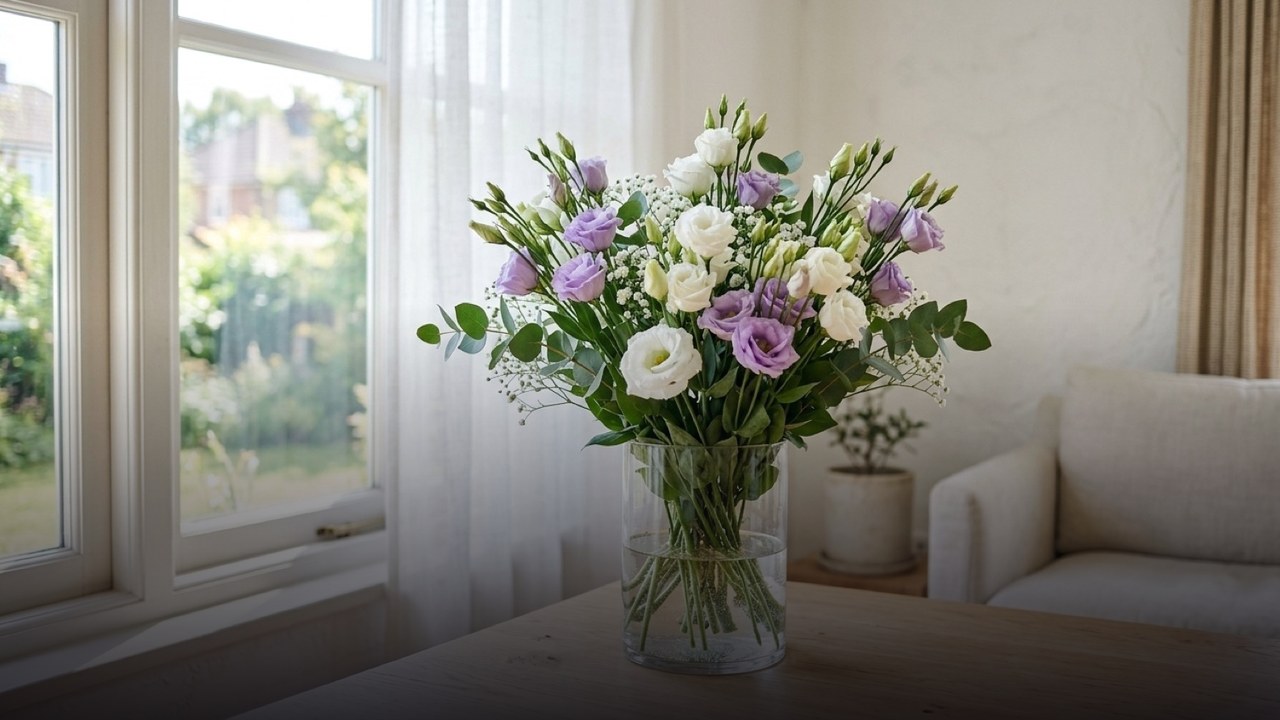
“Flori eustoma” is Romanian for “eustoma flowers”: the soft, cup-shaped blooms also known as lisianthus. Customers often ask whether these are roses, but eustoma is a different flower, with several buds and blooms branching from a single stem. For a gift, look at the balance of open flowers, developing buds and foliage rather than judging the bouquet by stem count alone.
At Pyat Tsvetov (5 Flowers), customers choosing flowers for someone in Russia often want help with three practical decisions: colour, bouquet size and delivery timing. We have been working in Saint Petersburg since 2011 and have three flower shops in the city. This guide explains how to assess eustoma, make it suit the recipient and care for cut stems, then covers the details to prepare when ordering from abroad.
Recognising eustoma and choosing a good bouquet
Eustoma may have a single layer of petals or fuller, double flowers with a rose-like shape. Its branching stems give a bouquet a loose, airy outline, while the smaller buds add height and movement above the open blooms. White, pink, lilac and purple are useful colour references when describing what you like, although availability needs checking. The flower's name alone does not specify its colour, fullness or the finished bouquet's dimensions.
When examining cut eustoma, look for petals that hold their shape, firm stems and leaves without widespread yellowing. Avoid judging freshness by closed buds alone: very small, immature buds may never open in a vase. A mixture of open flowers and developed buds gives you flowers to enjoy immediately, with some potential for further opening. In the bouquets catalogue, read the composition as well as looking at the photograph; a similar silhouette can come from quite different flowers.
Colour, meaning and the etiquette of giving eustoma
Eustoma is often associated with appreciation, tenderness and gratitude, but flower meanings are conventions rather than a fixed language. Pink can suit an affectionate birthday message, while lilac may appeal to someone who prefers cooler colours. White can look restrained and elegant, though an all-white bouquet may carry different associations in different families. The recipient's taste and the occasion are more useful guides than a list of symbolic meanings.
For a romantic gift, make your intention clear in the card instead of relying on colour to communicate it. For a colleague, teacher or relative, a specific thank-you usually feels more personal than a formal quotation. In Russia, an odd number of flowers is customary for celebratory gifts where individual flowers are counted; even numbers are associated with mourning. Because eustoma branches into several blooms, distinguish stems from flower heads when discussing a count, and explain if that tradition matters to the recipient.
Bouquets we can deliver




Choosing the size and composition for the recipient
A bouquet made mainly from eustoma highlights its layered petals and branching shape; a mixed bouquet gives it a different role alongside other flowers. Neither approach is automatically better for a gift. Think about where the recipient will put it: a modest arrangement may be easier to accommodate on a desk or small table than a wide bouquet. Also consider whether they will receive it at home or need to carry it after work or a celebration.
Describe the effect you want with concrete details such as a pale palette, a rounded outline or a light, open shape. A photograph helps communicate these preferences, but it is still worth reading the stated composition rather than assuming every visible detail is included. If colour is your main concern, our pink eustoma guide explores that choice in more detail. Avoid choosing only by stem count: branching, flower size and the number of open blooms all affect how substantial a bouquet appears.
Caring for cut eustoma from the first day
Prepare a clean vase before unwrapping the bouquet, and use fresh water with cut-flower food according to the packet instructions if you have it. Remove any leaves that would sit below the waterline, then trim the stem ends with a clean, sharp tool before placing them in water. Keep the branching stems supported while handling them, because bending a thin side shoot can damage it. Loosen wrapping where necessary so it does not prevent the stems from sitting properly in the vase.
Place the vase away from direct sun, radiators, strong draughts and ripening fruit. Check the water level daily, replace cloudy water promptly and clean the vase when changing it; remove faded blooms and any fallen plant material as you go. If a stem end becomes dirty or damaged, make a fresh cut with a clean tool. Vase life varies with the flowers' condition and the room, so no fixed number of days is a reliable promise, and every small bud should not be expected to open.
Planning delivery to Russia from another country
We deliver flowers across Russia, so start with the destination city, full address and the date in the recipient's local time. City delivery costs 500 RUB; for remote districts and suburbs, the operator confirms the delivery price when confirming the order. In large cities, express delivery is available in 1–2 hours after the order is confirmed. That timing starts with confirmation, so allow for the order details to be checked when planning a same-day gift from another time zone.
Other timing options are delivery at an exact time with a margin of plus or minus 30 minutes, or a window of 09–12, 12–15, 15–18 or 18–21. You can also pre-order 1–30 days ahead, which is useful when you already know a birthday or anniversary date. In Saint Petersburg, delivery is available around the clock; this does not describe the schedule in every other city. Read the delivery and payment information and choose a time when the recipient is likely to be at the address.
Ordering, payment and what happens at the door
Before checking out, prepare the recipient's name, phone number, full delivery address and any access details needed to find the entrance. Add your card message carefully: a card with your text is free, and delivery is anonymous by default, with the courier not naming the sender. Sign the card if you want the recipient to know who sent the flowers. Online checkout uses CloudPayments; check the payment options displayed there, because acceptance of every foreign-issued card cannot be guaranteed.
The courier calls the recipient about 15 minutes before arrival, so a surprise delivery still involves contact shortly before the handover. If the recipient is absent, we agree a second delivery the same day or, with the sender's consent, handing the flowers to a neighbour or concierge. Include useful address information from the start, and avoid treating an unattended workplace or building reception as an agreed handover point. For questions about an order or delivery details, call 8 (812) 507-67-05.
Frequently asked questions
What does “flori eustoma” mean?
It means “eustoma flowers” in Romanian. Eustoma is also known as lisianthus and has branching stems with cup-shaped flowers and buds.
Is eustoma the same flower as a rose?
No, although double eustoma flowers can resemble roses because of their layered petals. Eustoma usually carries several flowers and buds on branching stems, which gives a bouquet a different outline.
Will all the buds in an eustoma bouquet open?
Not necessarily: very small, immature buds may remain closed. Choose a balance of open flowers and developed buds, and keep the stems in a clean vase with fresh water.
Can I pay for delivery to Russia with a foreign card?
Online checkout uses CloudPayments, and you should check the options displayed at checkout. Acceptance of every foreign-issued card is not guaranteed.
Can I send eustoma anonymously with a personal message?
Delivery is anonymous by default: the courier does not name the sender. A card with your text is free, so you can sign it or leave your name out.
Ready to send a bouquet?
Pick a city, choose the flowers, and we will hand them over with a photo confirmation.
Choose a city →