
Flower Delivery in Sorsk: Zones, Timing and What to Expect
Sorsk is a compact industrial town in the Republic of Khakassia, and people order flowers here for the same reasons they do anywhere else — birthdays, anniversaries, a surprise for no reason at all. What changes is the logistics. Customers call us expecting the same one-hour window they see advertised for central Saint Petersburg, and the first thing we do is explain how delivery actually works when the destination is a Siberian town rather than Nevsky Prospekt. This article lays out the real picture: which streets and districts we reach, how long it takes, what bouquets travel well, and what you should double-check before you confirm the order.
Where We Deliver Inside Sorsk
Sorsk sits in the Ust-Abakan district and covers a relatively small area, which is actually good news for delivery logistics. The main residential zones — the central streets around Gornyakov and Mira, the older Soviet-era blocks near the mining administration, and the newer low-rise housing on the town's southern edge — are all within our standard delivery radius. We do not split the town into premium and secondary zones; if there is a named street with a house number, we will reach it. What matters more than the zone is the address quality. Sorsk uses a standard Russian address format: oblast, rayon, city, street, building number, apartment number. When customers fill in the form and skip the apartment number for a multi-storey building, delivery slows down because the courier has to call ahead and wait at the entrance. For private houses, the building number alone is usually enough, but a gate or yard description in the comments field saves time, especially in the older parts of town where numbering is not always sequential. If the recipient lives in a hostel attached to one of the industrial facilities, note that in the order — access is sometimes restricted and the courier needs a contact name at the checkpoint. Getting the address right at the start is the single most reliable way to keep the delivery on schedule, and it costs nothing.
Bouquets we can deliver



Realistic Delivery Timing for Sorsk
We are honest about this from the first click: Sorsk is not a one-hour delivery location. The town is roughly 4,600 kilometres from our Saint Petersburg base, and while we use a combination of air freight and road transport to move flowers across Russia, the total door-to-door time for Sorsk is typically within a same-day or next-day window depending on when you place the order. Orders confirmed before noon Moscow time on a weekday almost always arrive the same calendar day. Orders placed in the afternoon are delivered the following morning. Weekend logistics are slightly longer because air cargo schedules thin out on Saturdays and Sundays, so if you need flowers for a Sunday event, placing the order on Friday is the safest approach. Customers sometimes ask whether we can guarantee a specific hour, say 14:00 exactly. We cannot promise a one-hour precision slot for Sorsk the way we can for Saint Petersburg neighbourhoods, but we can commit to a half-day window — morning or afternoon — and the courier calls the recipient thirty minutes before arrival. That call is important: in Sorsk, as in many smaller Russian cities, people are often at work during the day and appreciate the heads-up so they can step outside or arrange for a colleague to receive the order. If the recipient is completely unavailable, we hold the bouquet in temperature-controlled conditions and redeliver without an extra charge.
Which Flowers Survive the Journey to Sorsk
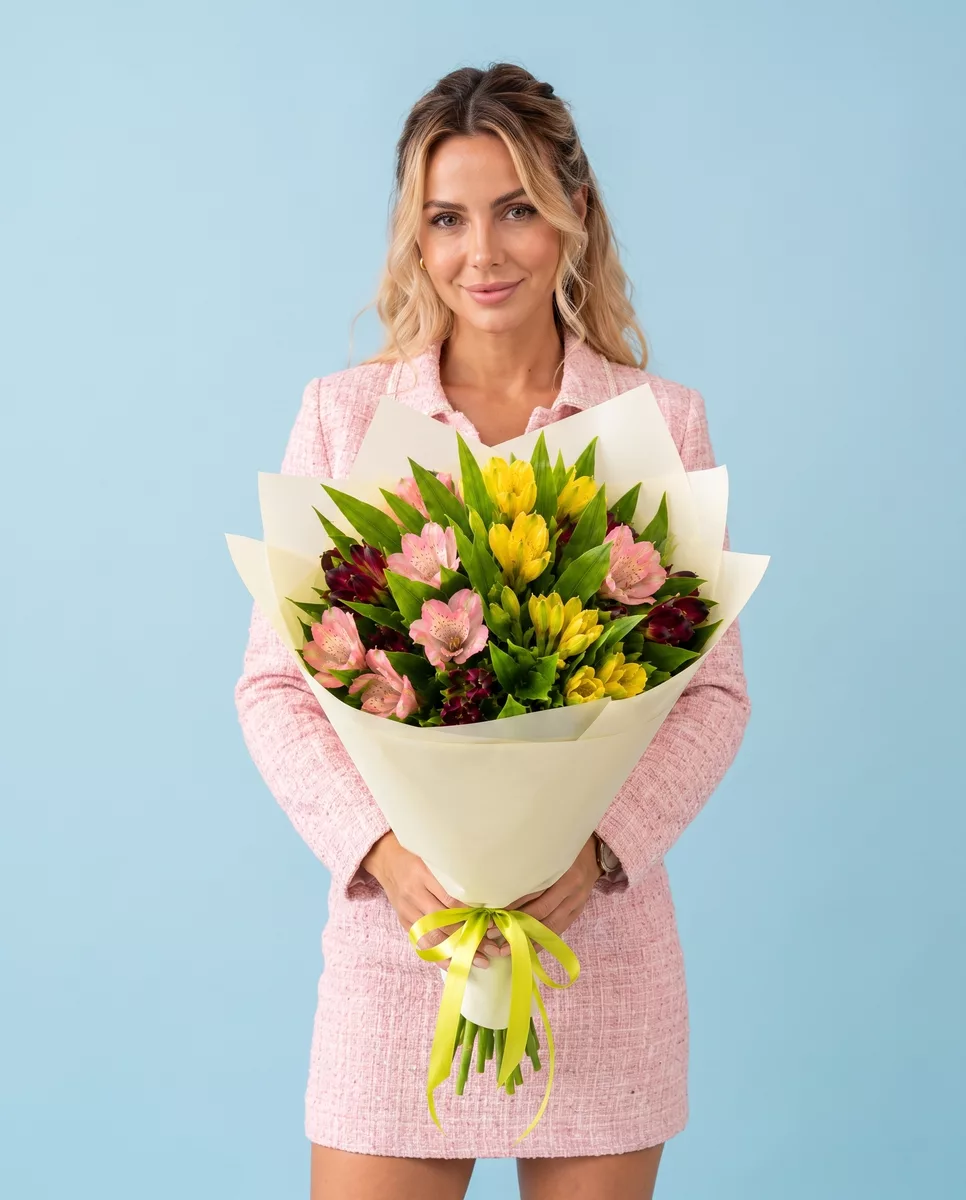
Long-distance delivery changes the selection calculus. A garden rose that looks magnificent in the shop window may arrive with bent petals after twelve hours in transit even under refrigeration, while a spray chrysanthemum will look almost exactly as it did when it was cut. We steer customers toward varieties that have proven themselves on Siberian routes. Alstroemeria is the standout choice — the stems are robust, the buds open gradually over several days after arrival, and the colour range is wide enough for any occasion. Standard and spray roses travel well when they are cut at the tight-bud stage, which is how we pack them for long routes. Eustoma, often called lisianthus, holds its ruffled petals through temperature shifts better than many people expect. Carnations remain underrated; they are genuinely tough, they last ten to fourteen days in a vase, and they are available in dozens of colours. We are more cautious with open peonies, fully open garden roses, and large-headed sunflowers on routes this long, not because they cannot make it, but because the margin for error is smaller. Orchid stems — specifically cymbidium — are excellent for long transit because the flowers are already partially open and very firm. If a customer has a specific variety in mind, it is worth calling us to check current stock and travel suitability rather than ordering blind. Seasonal availability also shifts: tulips are abundant from February through April, while dahlias peak in late summer.
Bouquet Sizes and Compositions That Make Sense for Sorsk
The most popular format for long-distance delivery to Sorsk is a mono-bouquet of eleven or twenty-five stems rather than a complex mixed arrangement. The reason is practical: a tightly packed single-variety bouquet survives packaging and unpacking better than a loose mixed design where delicate focal flowers sit next to heavy structural stems. Eleven roses in a kraft paper wrap with eucalyptus is a classic that works on any route. Twenty-five alstroemeria stems in two or three complementary colours make a generous gift that opens beautifully over three to four days after arrival. Customers ordering for a significant birthday often go to fifty-one stems, which is a number with meaning in Russian gifting culture — odd numbers are traditional for celebratory bouquets, even numbers are reserved for mourning, so a foreign sender should keep that convention in mind. Mixed bouquets are absolutely available for Sorsk delivery; we just build them with transit in mind, using eustoma as filler instead of delicate ranunculus, and keeping large open blooms to a minimum. Hatbox arrangements and floral boxes travel particularly well because the rigid container protects the stems during handling. A hatbox of roses or spray chrysanthemums arrives looking almost identical to how it left the workshop. We also send potted plants — orchid phalaenopsis is the most requested — which have the advantage of lasting weeks rather than days, making them a good choice when the recipient's schedule is unpredictable and you are not sure exactly when they will be home.
Temperature and Seasonal Conditions in Sorsk
Sorsk has a sharply continental climate. Winters are cold and long, with January averages well below minus fifteen Celsius, and summers are warm and dry. Both extremes affect flower delivery in specific ways. In winter, the critical risk is freezing during the final road leg from the nearest freight hub to the recipient's address. We pack cold-weather orders with insulating materials — thermal sleeves and sealed kraft wrapping — that keep the flowers above freezing for several hours. Even so, a bouquet that sits in an unheated car boot for forty minutes in January weather will suffer, which is why we instruct couriers to keep flowers in the passenger cabin. When the recipient opens the door and receives the bouquet, they should not put it directly onto a cold windowsill or near a drafty entrance — flowers that have been cold-packed need fifteen to twenty minutes at room temperature before being placed in water, otherwise the stem capillaries contract and uptake suffers. In summer, the risk flips: heat above twenty-five Celsius accelerates wilting, so we use cool gel packs in the packaging from June through August. Customers ordering in July should avoid asking for delivery during the hottest part of the afternoon if there is any flexibility in timing. Spring and autumn are the easiest seasons for Sorsk delivery — moderate temperatures, no extreme handling requirements, and the widest variety of flowers available from growers. If you are planning a delivery for a specific date and the forecast looks extreme in either direction, call us and we will advise on the safest composition for that day.
What to Write in the Card and How Cards Work in Russia
Every order to Sorsk can include a printed card, and this is something customers unfamiliar with Russian customs sometimes overlook or underuse. In Russia, the card accompanying a bouquet is read aloud or shared with others present — it carries more social weight than in some Western contexts where the card is a private note. If you are sending flowers from abroad or from another city in Russia, a warm, specific message in the card tells the recipient immediately who sent the flowers and why, which matters when they receive them at work or in a shared space. We print cards in Russian or English depending on what the customer writes in the order form. If you write in English, we print in English; if you want a Russian translation, note that in the comments and we will handle it. Keep the message under two hundred characters for the standard card format — longer messages can be accommodated on a larger card, but flag that when ordering. Avoid abbreviations that may not translate well. The sender name should be written exactly as the recipient knows you — a nickname is fine if that is how you are known to them, a formal full name is better for professional relationships. If you want the delivery to be anonymous, simply write Anonymous in the sender field and we will omit the name from the card entirely. One thing customers ask regularly: can we include a small gift alongside the bouquet? Yes — chocolates, a soft toy, or a small candle can be added to most orders and packed with the flowers in a single delivery.
Checking Your Order Before It Goes Out
The five minutes you spend reviewing an order before confirming it prevent the majority of delivery problems we see. First, check the recipient's phone number. We call ahead of delivery, and a wrong digit means the courier cannot reach the person. Russian mobile numbers are eleven digits starting with 7 or 8 — if you are entering a number from outside Russia, use the international format with the country code. Second, verify the address includes the apartment number for any multi-storey building. Third, confirm the delivery date is correct — the calendar on the order form defaults to the current date, and customers occasionally place an order late at night intending next-day delivery but leave the date as today. Fourth, read the card text one more time; typos in a name are surprisingly common and noticeably awkward. Fifth, check that the bouquet you selected is listed as available for long-distance delivery — most of our catalogue is, but a few compositions are flagged as Saint Petersburg only because they use particularly fragile elements. If you are ordering as a gift and the recipient does not know it is coming, add a note in the comments asking the courier to call you rather than the recipient when they are thirty minutes away — we can arrange that. Finally, save the order confirmation number. If you need to change anything — the delivery window, the card text, the address — the confirmation number lets us find the order instantly without searching by name. Changes are possible up to two hours before dispatch.
Delivering flowers to Sorsk is straightforward when the order is built around how the town actually works — its address conventions, its climate, its transit timeline, and the varieties that arrive in the best condition. The customers who get the best results are the ones who plan a day ahead, pick robust varieties like alstroemeria, spray roses, or eustoma, check the address carefully, and leave a clear card message. We have been moving fresh flowers across Russia long enough to know where the friction points are, and almost all of them are preventable at the order stage. If anything is unclear before you confirm, call us — a three-minute conversation before the order is placed is worth far more than a problem to solve after dispatch.
Frequently asked questions
Can I order flowers for same-day delivery in Sorsk?
Yes, if you place the order before noon Moscow time on a weekday. Orders confirmed in the afternoon are typically delivered the following morning. Weekend orders take slightly longer because air cargo schedules are reduced on Saturdays and Sundays, so Friday ordering is safest for Sunday events.
What happens if the recipient is not home when the courier arrives in Sorsk?
The courier calls thirty minutes before arrival so the recipient can prepare. If they are still unavailable at the door, we hold the bouquet in temperature-controlled conditions and redeliver at the next available slot without an additional charge. We ask customers to provide a working mobile number for the recipient.
Are there flowers I should avoid ordering for delivery to Sorsk in winter?
Fully open peonies, large garden roses in full bloom, and delicate ranunculus are harder to protect over a long cold-weather route. Tight-bud roses, alstroemeria, spray chrysanthemums, carnations, and eustoma are much more reliable in winter conditions and arrive looking fresh.
Why do Russian bouquets always have an odd number of stems?
In Russian tradition, even numbers of flowers are associated with mourning and are brought to funerals. Odd numbers — five, seven, eleven, twenty-five, fifty-one — are used for celebrations. If you are sending flowers as a gift in Russia, always choose an odd stem count to follow this convention correctly.
Can I include a message in English on the card for a recipient in Sorsk?
Yes. We print the card in whatever language you write the message. If you want the message translated into Russian, note that in the order comments and we will handle the translation before printing. The standard card fits up to two hundred characters; longer messages can go on a larger card if requested.
Ready to send a bouquet?
Pick a city, choose the flowers, and we will hand them over with a photo confirmation.
Choose a city →