
Flower Delivery in Kartaly: Zones, Timing and What to Expect
Kartaly sits in the Chelyabinsk region, close to the Kazakhstan border, and customers ordering flowers here often have the same first question: will they actually arrive fresh? The short answer is yes, but the details matter — which part of the city you are sending to, what time of year it is, and which varieties you choose all affect what lands on the doorstep. This article covers every practical point so your order goes smoothly the first time.
Where in Kartaly We Deliver and How the City Is Divided
Kartaly is a compact industrial city, but it has distinct districts that affect delivery routing. The central part of the city, including the area around the railway station and the main administrative streets, is the easiest zone to reach and typically sees the fastest turnaround. Residential micro-districts further from the centre, including newer housing blocks on the outskirts, add some time to the route but are fully within our delivery coverage. Private house streets and dacha-adjacent addresses on the edge of the city boundary require confirmation at the time of ordering, because road conditions there can vary significantly by season. In winter, some unpaved access roads become difficult after snowfall, so our dispatcher will ask for a precise address and sometimes a landmark to avoid delays. Apartment buildings require a flat number and ideally an intercom code or the recipient's phone number so the courier does not wait in the lobby. If you are sending to a workplace — an office, a school, a government building — note that many of these have security desks that require the recipient to come down, so we recommend giving the recipient a heads-up before the delivery window. The city's relatively small size means that most central and mid-ring addresses can be covered in a single courier run without the order sitting in a vehicle for an extended period, which matters a great deal for the condition of the flowers when they arrive.
Bouquets we can deliver



Delivery Timing: What the 1–2 Hour Window Means in Practice
When we say one to two hours, that refers to the time from order confirmation to the courier arriving at the door, not from when you first open the website. Order confirmation happens after our dispatcher checks the address, confirms stock and processes payment — this usually takes five to ten minutes during business hours. Peak demand periods, particularly on 8 March, 14 February and 1 September, extend that confirmation step because order volume is high and we are assembling many bouquets simultaneously. On those dates we strongly recommend ordering the evening before or at least four to five hours ahead of your intended delivery time. For same-day orders placed before noon, delivery before the early evening is almost always achievable across the main districts. Orders placed in the late afternoon for same-day delivery to outlying addresses carry more risk of pushing into the evening slot, so be realistic about timing when the address is not central. Night delivery is available but must be arranged explicitly — it is not automatic, and there is a separate fee for it. One practical thing many customers overlook: if the recipient is not home, the courier will call and wait a reasonable time, but they cannot leave fresh flowers outside a door in summer heat or winter frost. Confirming the recipient's schedule before ordering saves everyone the trouble of a failed delivery and a rescheduled run. The courier carries the bouquet in a temperature-controlled bag for protection, but that only works if the handover happens promptly.
Which Flowers Travel Well to Kartaly and Which Need Extra Care
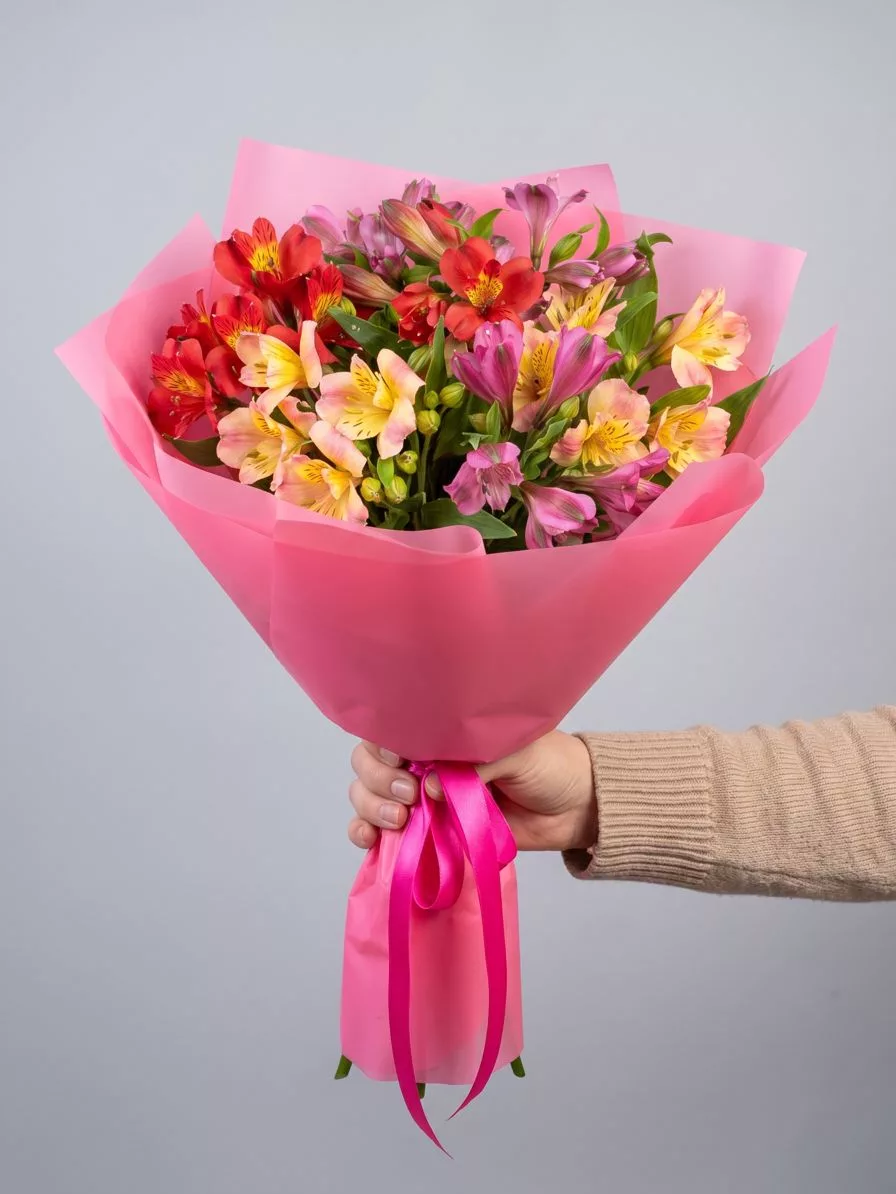
Distance and climate both shape which varieties make sense for a delivery to Kartaly. Roses are the most requested flower and they travel well when cut correctly and kept hydrated, but they are sensitive to temperature swings. In January and February, when Kartaly regularly sees temperatures below minus twenty Celsius, roses need careful wrapping and a fast handover — lingering on a doorstep for even a few minutes in that cold causes petal damage at the edges. Spray chrysanthemums and alstroemeria are significantly more cold-tolerant and are worth considering for winter orders, especially if the recipient's building entrance is exposed. Gerberas are popular for their bold colour but their stems are fragile and they do not like being jostled, so they work better in structured bouquets with supporting greenery rather than loose single-stem arrangements. Tulips in spring are fast movers and arrive looking excellent, but they continue to grow after cutting — a tulip bouquet that looks compact at delivery will open fully within twenty-four hours, which is actually a feature, not a problem. Peonies are a seasonal choice, available mainly from late May through June, and they are worth ordering when in season because they are genuinely difficult to replicate with any substitute. Orchid branches, specifically Cymbidium and Dendrobium, hold up very well in transit and last considerably longer than most cut flowers, making them a practical choice when the recipient will not be home to put flowers in water immediately.
Seasonal Considerations: Winter Cold and Summer Heat in the Chelyabinsk Region
The Chelyabinsk region has one of the more demanding climates in European Russia, and Kartaly is no exception. Winters are long and genuinely cold, with hard frosts from November through March, and summers can be hot and dry with temperatures pushing above thirty Celsius in July and August. Both extremes affect flowers in transit. In winter, the main risk is freezing — even a short exposure to minus fifteen or colder will cause water-filled cells in petals to rupture, leaving brown patches that cannot be reversed. Our couriers use insulated packaging and minimise the time between vehicle and door, but customers can help by being ready to receive the delivery rather than making the courier wait outside. In summer, heat is the enemy of vase life. Cut flowers in a warm car or on a sunny doorstep lose hours of freshness in minutes. For summer orders, we recommend choosing varieties with naturally longer heat tolerance — statice, lisianthus and spray roses hold better than large-headed hybrid tea roses in high temperatures. Requesting delivery in the cooler morning hours rather than midday also makes a measurable difference. Autumn in Kartaly is often overcast and mild, which is actually ideal for flower transport — moderate temperatures and lower light mean bouquets arrive in excellent condition. Spring is variable, with late frosts possible into April, so the same cold-weather precautions apply until the weather stabilises. Knowing the season you are ordering in and adjusting your variety choice accordingly is the single most effective thing a customer can do to ensure a good result.
Bouquet Sizes, Compositions and What the Numbers Actually Mean
Flower counts in bouquets are a source of genuine confusion, and it is worth explaining the Russian convention plainly. In Russia, even numbers of flowers are traditionally associated with mourning, so bouquets for celebrations, birthdays, and romantic occasions are almost always assembled in odd numbers — five, seven, eleven, fifteen, twenty-five, fifty-one and so on. If you are ordering from outside Russia and request ten roses, we will typically suggest adjusting to nine or eleven and will note the reason. This is not superstition for its own sake — it is a social convention that recipients in Kartaly will notice and that reflects care on the part of the sender. Bouquet size descriptions on our site correspond to actual stem counts and approximate assembled dimensions. A small bouquet of seven stems is genuinely compact and suitable for a table arrangement. A large bouquet of twenty-five to thirty-one stems is a substantial armful that makes an impression at a door. Mixed bouquets combine focal flowers — roses, peonies, gerberas — with filler flowers like waxflower or limonium and structural greenery such as eucalyptus or ruscus. The greenery is not padding; it supports the focal flowers during transport and extends vase life by reducing ethylene concentration around the blooms. When ordering a mixed bouquet, specifying a colour palette rather than exact varieties gives us the flexibility to substitute if a particular flower is not at its peak that day, which results in a better bouquet overall than insisting on a specific variety that arrived in poor condition.
What to Check Before Confirming Your Order
A few minutes spent on details before confirming an order prevents the majority of problems we see. First, verify the recipient's address completely — street name, building number, apartment or office number, and any access details like an intercom code or gate combination. In Kartaly, as in most Russian cities, street numbering can be non-sequential and building numbers sometimes include letter suffixes like 14A or 14B, which are different buildings. Second, check whether the recipient will actually be at that address during the delivery window. Sending flowers to a workplace on a day the person is working from home, or to a home address when they are at a day shift, means a failed delivery. Third, if you are adding a card message, write it as you want it to appear — our florists copy the text exactly, so spelling and punctuation are your responsibility. Fourth, consider whether the recipient has any known allergies. Lilies, particularly Oriental lilies like Stargazer, produce heavy pollen and a strong scent that some people find overwhelming or that triggers reactions. We can substitute lily varieties or remove stamens on request, but only if you tell us. Fifth, confirm your own contact number is correct on the order — our dispatcher may need to reach you if there is a question about the address or if a requested variety is unavailable and a substitution is needed. These five checks take two minutes and cover the vast majority of order issues we deal with daily.
After Delivery: Keeping Flowers Fresh in a Kartaly Apartment
What happens after the courier leaves determines how long the flowers last, and many recipients in any city make the same avoidable mistakes. The first step is re-cutting the stems at an angle under running water or while the stems are submerged — this removes the air bubble that forms at the cut end during transport and immediately improves water uptake. Use a clean, sharp knife rather than scissors, which crush the stem tissue. The vase should be clean and filled with cool water; warm or room-temperature water accelerates bacterial growth. Most of our bouquets include a small sachet of flower food, which is a balanced mix of sugar for energy, acidifier to maintain correct pH and a mild antibacterial agent. Use it in the correct proportion — more is not better and can actually damage stems. Place the vase away from direct sunlight, heating radiators and fruit bowls. Fruit, particularly apples and bananas, releases ethylene gas which accelerates flower ageing noticeably. In Kartaly apartments in winter, central heating creates very dry air, which shortens vase life for thin-petalled flowers like ranunculus and anemones. A light misting of the petals in the morning helps. Change the water every two days and re-cut stems each time. Roses that begin to droop can often be revived by re-cutting the stem and placing the entire stem in deep cool water for an hour. Chrysanthemums and alstroemeria are the least demanding in terms of aftercare and consistently outlast other varieties in a home environment, often staying fresh for ten days or more with basic attention.
Ordering flowers to Kartaly is straightforward once you understand the variables — address detail, seasonal temperature, variety choice and recipient availability. The flowers that arrive in the best condition are the ones ordered with a full address, a realistic delivery window and a variety suited to the weather on that particular day. Five Flowers handles the logistics and the assembly; the information you provide at the time of ordering is what makes the difference between a bouquet that impresses and one that almost did. We deliver bouquets across Russia in 1–2 hours.
Frequently asked questions
Can you deliver flowers to Kartaly on the same day I order?
Yes, same-day delivery is available for orders confirmed before early afternoon for central and mid-ring addresses. For outlying streets or private house addresses, earlier ordering gives more reliable timing. On major holidays like 8 March, ordering the evening before is strongly recommended because assembly and routing take longer when order volume is high.
What happens to the flowers if the recipient is not home when the courier arrives?
The courier will call the recipient and wait a reasonable amount of time. If there is no answer, they will contact the sender. Flowers cannot be left outside unattended, particularly in Kartaly's winter temperatures or summer heat, as even brief exposure causes damage. Rescheduling is possible but adds time, so confirming the recipient's schedule before ordering is the simplest solution.
Why do Russian bouquets always have an odd number of flowers?
Even numbers of flowers are associated with mourning in Russian tradition and are used at funerals. For any celebratory occasion — birthdays, anniversaries, congratulations — odd numbers are the convention, and recipients in Kartaly will notice the difference. If you order an even number without knowing this, we will typically flag it and suggest adjusting by one stem.
Which flowers are best for a winter delivery to Kartaly given the cold temperatures?
Spray chrysanthemums, alstroemeria and carnations handle cold transit better than large-headed roses or gerberas. If you want roses in winter, they travel fine with proper insulated packaging and a fast handover, but the recipient should be ready at the door. Avoid thin-petalled varieties like ranunculus for very cold days unless delivery timing is tightly controlled.
Can I write a card message in English for a delivery in Kartaly?
Yes, we copy card text exactly as provided, including English. Keep in mind the recipient may not read English, so if the message is intended to be understood by them, writing in Russian is more practical. If you need help translating a short message, note it in the order comments and our team will do their best to assist.
Ready to send a bouquet?
Pick a city, choose the flowers, and we will hand them over with a photo confirmation.
Choose a city →