
Flower Delivery in Kushva: Zones, Timing and What to Expect
Kushva sits in the Ural mountains, and that geography shapes everything about getting fresh flowers there reliably. Customers call us asking why a bouquet ordered for noon sometimes arrives closer to three, or why certain roses look different in January than in May. The answers are practical ones — altitude, road conditions, cold chain logistics and what the wholesale market actually carries on a given week. This article covers the real picture: where we deliver in Kushva, how long it takes, which flowers travel well on that route and what you should confirm before placing an order.
The Delivery Zone and What It Covers
Kushva is a mid-sized industrial town in Sverdlovsk Oblast, roughly 170 kilometres north of Yekaterinburg. The delivery zone covers the central districts along Pervomayskaya and Lenina streets, the residential areas near the metallurgical plant, and the private housing sectors on the town's eastern edge. Addresses in the immediate centre typically receive orders faster than those on the outskirts, where road quality and distance add time to every run. If you are sending to a specific microdistrict or a numbered residential block, include the building number and entrance number in your order — Kushva has several streets with long numbering sequences, and couriers lose time when the address is incomplete. The town's population is concentrated enough that we do not treat it as a remote destination, but it is not a same-city delivery from Saint Petersburg either. The route runs through the Ural highway network, which means weather in the mountain passes can affect timing, particularly between November and March. We account for this when we confirm your delivery window, so the estimate you receive already includes a buffer for seasonal road conditions. If you are ordering for a specific event time — a birthday dinner, an anniversary lunch — tell us the hard deadline when you place the order rather than selecting a generic afternoon slot. That single detail lets us dispatch at the right moment and choose the fastest available route segment.
Bouquets we can deliver



Timing: What the 1–2 Hour Promise Means on This Route
The 1–2 hour delivery window that Five Flowers advertises applies to deliveries within Saint Petersburg itself. For Kushva, the logistics work differently and we are transparent about that. Orders placed before 10:00 Moscow time on weekdays are assembled from the morning wholesale intake, which means the flowers are cut within the last 24 hours. Dispatch to Kushva follows a scheduled run rather than an on-demand courier, so the realistic delivery window is confirmed at the point of order — usually a specific four-hour slot on the agreed day. What does not change regardless of distance is the cold chain: flowers travel in temperature-controlled conditions, kept between two and eight degrees Celsius, which is the range that keeps rose stems turgid and prevents premature petal drop in tulips and ranunculus. Customers sometimes assume that a longer journey means wilted flowers on arrival. In practice, a well-packed bouquet that stays cold throughout transit arrives in better condition than one that sat in a warm car for forty minutes locally. The risk points are the handoff moments — loading and unloading — and we pack specifically to minimise exposure at those stages. If your recipient will not be home during the delivery window, arrange an alternative: a neighbour, a building manager or a workplace address. Leaving flowers in an unheated stairwell in a Ural winter is the fastest way to lose a bouquet to frost damage, and that is not a condition we can reverse once it happens.
Which Flowers Travel Well to Kushva
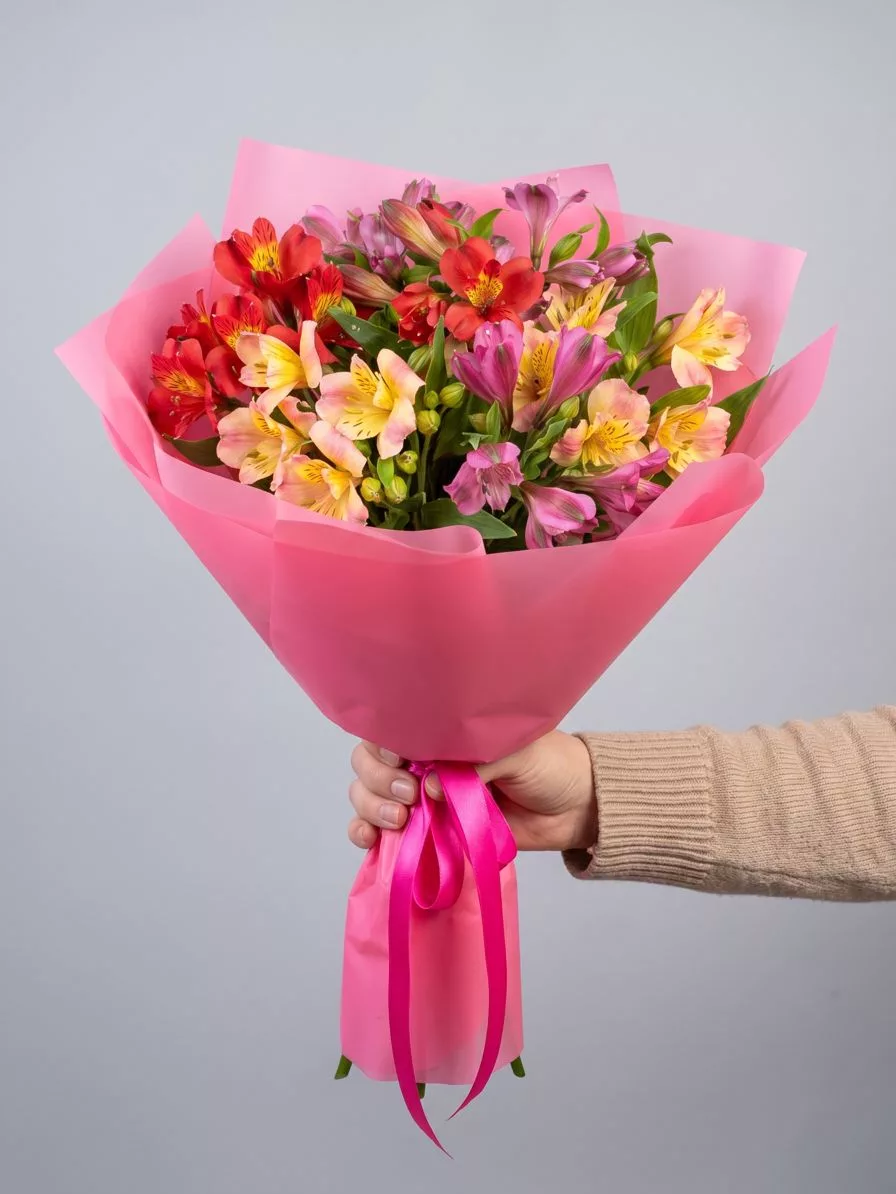
Not every variety handles a long cold-chain journey equally. Roses with a stem length of 60 to 70 centimetres — standard Ecuadorian and Dutch grades — are the most reliable for this route. Their water uptake after arrival is strong, and they open predictably over three to five days once the recipient places them in a clean vase with fresh water. Chrysanthemums, both spray and single-headed varieties, are exceptionally resilient and arrive looking close to how they left the shop. Alstroemeria is another good traveller: it is tightly budded when packed and opens gradually over a week, which recipients often appreciate more than fully open flowers. Peonies are seasonal — available roughly from late April through June — and they travel well when cut at the tight bud stage, though they need a warm room to open fully within 24 hours of arrival. Tulips are reliable in winter and early spring but become unpredictable in warm weather because they continue growing after cutting and can shift position in the bouquet. Gerberas and open-faced dahlias are more fragile; they bruise easily in transit and are better suited to local same-day delivery. If you want to include them, we recommend combining them with sturdier stems so the bouquet holds its shape. Orchid stems — specifically Cymbidium — travel exceptionally well because of their thick petals and low water requirement during transit. For Kushva deliveries, we generally steer customers toward varieties in the rose, chrysanthemum and alstroemeria families unless there is a specific request.
Seasonal Availability and What Changes Month to Month
Wholesale availability in Russia follows a pattern that surprises customers who assume the same flowers are always in stock. January and February are dominated by imported roses, spray carnations and Gypsophila, with limited fresh local product because Russian greenhouse output is lower in deep winter. This is also when prices for premium Ecuadorian roses are highest, because demand spikes around the seventh of March — International Women's Day — which is the single largest flower-buying day in Russia and affects supply chains for two to three weeks on either side of it. If you are ordering for early March delivery to Kushva, place the order at least five days in advance. March through May brings tulips, hyacinths, narcissus and early peonies into the market. These are popular for spring birthdays and are genuinely fresh because European and domestic greenhouse production is at its peak. Summer months offer a wider range of seasonal varieties including lisianthus, statice and snapdragons, which add texture to mixed bouquets without raising the price significantly. Autumn is chrysanthemum season — the variety range is widest from September through November, and the quality is consistently high. Winter orders should lean on roses, chrysanthemums and tropical varieties like anthurium and Cymbidium orchid, which are not seasonal in the same way because they are grown year-round in controlled environments. When you call or message to order, ask what arrived that morning from the wholesale market — that is always the freshest and best-value option for that specific day.
Packaging for the Ural Climate
Temperature in Kushva drops below minus twenty Celsius on some winter nights, and even daytime temperatures from November through March regularly sit between minus ten and minus fifteen. Flowers packed for delivery in these conditions need more than standard craft paper wrapping. We use layered packaging: an inner moisture-retaining sleeve around the stems, a middle layer of insulating material, and an outer wrap that protects against wind and brief exposure to freezing air during the handoff at the door. This is not decorative packaging — it is functional, and it means the bouquet may look less elaborate when it arrives than a florist's display piece. The recipient should unwrap it promptly, trim the stems at an angle under running water and place it in a vase. Waiting to unwrap it or leaving it in cold packaging once it is indoors can cause condensation damage to the petals. In summer, the concern reverses: heat above twenty-five degrees Celsius accelerates flower aging sharply. Summer deliveries to Kushva are packed with gel cooling inserts and dispatched in the cooler morning hours where the schedule allows. Customers ordering summer bouquets should choose recipients who will be home to receive the delivery rather than leaving it outside. The outer packaging for summer orders is also lighter, which means the bouquet looks more like a traditional wrapped arrangement when it arrives. Regardless of season, the first thing a recipient should do is cut one to two centimetres off each stem and put the flowers in water — this single step extends vase life by two to three days more than any other action.
What to Check Before You Confirm the Order
Several details consistently cause problems with Kushva deliveries, and all of them are fixable at the order stage. First, confirm the recipient's address includes the street, building number, apartment or office number and — for residential blocks — the entrance number and floor. Kushva has multi-entrance residential buildings where the wrong entrance can add thirty minutes to a delivery. Second, verify that the recipient's phone number is current and that the person will actually answer an unfamiliar number. Couriers call ahead when they are fifteen to twenty minutes away; a missed call means a missed delivery window. Third, check whether the recipient has any known allergies. Lilies, particularly Stargazer and Oriental varieties, produce heavy pollen that can cause reactions in sensitive individuals — if there is any doubt, ask us to use lily varieties with the stamens removed, or choose a lily-free composition. Fourth, if the bouquet is a surprise, tell us so we can instruct the courier not to announce the sender when calling ahead — just confirm delivery and arrival time. Fifth, decide in advance what happens if the recipient is not home: a neighbour who can take the bouquet, a workplace address as a backup or a reschedule to the next available slot. Rescheduling adds at least one day on this route, so the contingency plan matters more than it would for a local city delivery. These five checks take two minutes and prevent the majority of delivery complaints we receive.
Bouquet Choices That Work Well as Gifts in Kushva
Russian gift culture around flowers follows a few conventions that are worth knowing if you are ordering from outside Russia or sending on behalf of someone unfamiliar with local customs. Odd numbers of flowers are for living recipients; even numbers are associated with mourning and should be avoided. This applies to the total stem count in a bouquet, so a composition of ten roses would be adjusted to nine or eleven before we send it. Red roses remain the most popular choice for romantic occasions and are widely understood as such across all age groups. For a mother's birthday or a professional occasion — a teacher, a doctor, a colleague — mixed bouquets with chrysanthemums, alstroemeria and seasonal greenery read as respectful and considered rather than romantic. White flowers are acceptable for celebrations in Russia, unlike in some other cultures where they signal mourning; a white and green bouquet for a birthday is perfectly appropriate. For children's occasions, bright colours work well — orange gerberas, yellow spray roses, pink tulips in season. Kushva has a significant industrial workforce, and many recipients are practical people who appreciate flowers that last: roses and chrysanthemums over delicate open-faced blooms. If you are unsure, a monobouquet — one variety in one colour, an odd number of stems — is always a clean and confident choice. A bouquet of fifteen or twenty-one spray roses, for example, photographs well, travels reliably and reads as a genuine gesture rather than a default selection.
Ordering flowers for delivery to Kushva is straightforward when you know what the route actually involves. The cold chain keeps the flowers in good condition; the packaging accounts for Ural temperatures; and the delivery window is confirmed rather than estimated loosely. The variables that cause problems are almost always on the information side — an incomplete address, an unanswered phone or a variety choice that does not suit the journey. Give us the correct details, choose varieties from the reliable list, and the bouquet that arrives in Kushva will look close to what left the shop in Saint Petersburg. We deliver bouquets across Russia in 1–2 hours.
Frequently asked questions
Why do roses ordered for Kushva sometimes look different in January compared to summer?
In January and February, wholesale supply to Russian distributors is dominated by imported Ecuadorian and Dutch roses. These varieties are bred for long transport but have tighter, darker heads than the garden-style roses available in May through August. The flower itself is fresh, but the variety differs. If you want a specific look, name the variety when ordering, not just the colour.
Do deliveries reach the private housing sectors on Kushva's eastern edge on the same schedule as central addresses?
No. Central addresses along Pervomayskaya and Lenina streets are served earlier in the delivery run. The eastern private housing sector is the last stop, which can add one to two hours compared to a central drop. If the occasion has a fixed time, order for a central address or build that gap into your timing.
Which stem lengths actually survive the journey from Yekaterinburg to Kushva without wilting?
Roses at 60 to 70 centimetres — standard Ecuadorian and Dutch commercial grades — handle the cold-chain transit consistently. Shorter stems and delicate open-headed varieties like garden roses or ranunculus are riskier over this distance. Chrysanthemums, both spray and single-headed, also travel well. If you are unsure, ask specifically about what arrived in the morning wholesale intake that day.
What does the morning wholesale intake deadline actually mean for my order?
Orders placed before 10:00 Moscow time on weekdays are assembled from flowers cut within the last 24 hours, sourced from that morning's wholesale delivery. Orders placed after that cutoff are built from the following day's intake. For Kushva specifically, this affects not just freshness but which dispatch run your bouquet joins, so the cutoff is more consequential here than for a local Saint Petersburg delivery.
Can chrysanthemums and carnations handle Kushva winters better than roses?
Spray carnations and chrysanthemums are more cold-tolerant during transport and show stronger water uptake after arrival than many rose varieties. In January and February they are also reliably in stock at wholesale, which means the stems you receive were not held as substitutes. For winter deliveries to Kushva, a bouquet built around these varieties rather than premium long-stem roses is a practical choice.
Ready to send a bouquet?
Pick a city, choose the flowers, and we will hand them over with a photo confirmation.
Choose a city →