
Flower Delivery in Pitkyaranta: Zones, Timing and Prices
Pitkyaranta sits on the western shore of Lake Ladoga, roughly 240 kilometres northeast of Saint Petersburg, and customers call us regularly asking whether we actually deliver there or whether they need to find someone local. We deliver there ourselves, and this article explains exactly what that means in practice: which parts of the city we reach, how long the drive takes at different times of year, which flowers survive the route in good condition, and what you should check before placing an order.
Where We Deliver in Pitkyaranta and the Surrounding Area
Pitkyaranta is a small city of roughly 10,000 residents, and its street layout is compact enough that we cover the entire city proper in a single delivery zone. That includes the central streets around Lenina and Pobedy, the residential neighbourhoods closer to the lake shore, and the industrial quarter to the north. We also reach the village of Salmi, about 30 kilometres south along the Ladoga coast, and Suistamo to the northwest, though those outlying points add time and we ask customers to book at least a day ahead for those addresses. The Karelian Republic border formalities do not apply here since Pitkyaranta is well within the Russian Federation, but the road from Saint Petersburg passes through Sortavala and the quality of the A121 highway varies by season, which affects our scheduling. If you are sending flowers to a hospital, the Pitkyaranta Central District Hospital accepts deliveries at the main entrance on weekdays between 9:00 and 18:00, and we coordinate timing with the recipient in advance. For private addresses, we confirm the exact entrance and floor by phone or messenger before the courier leaves Saint Petersburg, because GPS navigation in smaller Karelian towns sometimes points to the wrong building. Giving us the full postal address plus a mobile number for the recipient is the single most reliable way to avoid a missed delivery.
Bouquets we can deliver



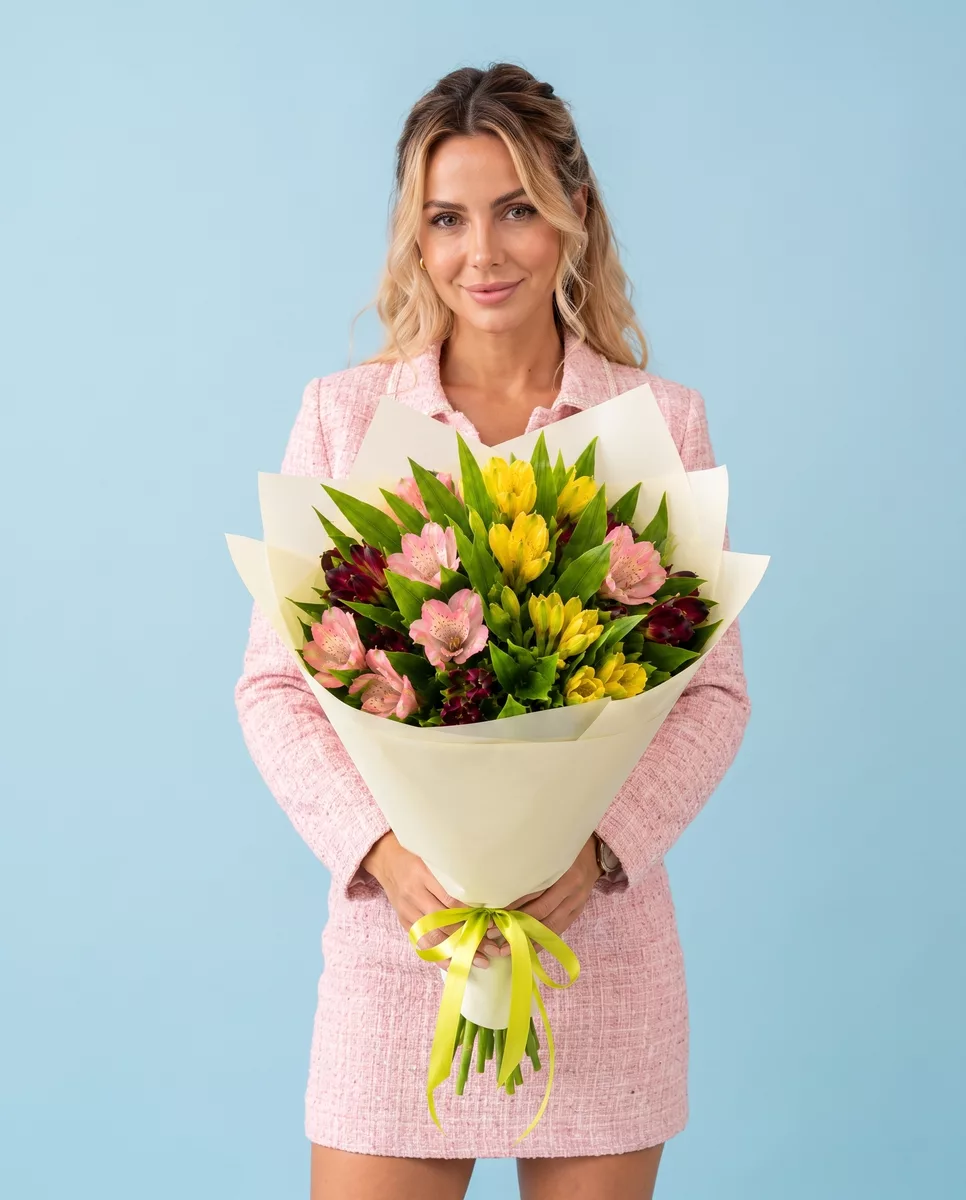
How Long the Drive Actually Takes
The road distance from our shop in Saint Petersburg to the centre of Pitkyaranta is approximately 240 kilometres, and under normal summer conditions a courier driving without stops covers it in roughly three hours and fifteen minutes to three hours and forty minutes. In winter, particularly between November and March, ice on the A121 between Priozersk and Sortavala slows traffic noticeably, and we plan for four to four and a half hours on those dates. The famous Ladoga ice road does not apply to our route since we stay on the main highway throughout the year. We do not promise a one-hour window for Pitkyaranta the way we do for deliveries inside Saint Petersburg, and any florist who tells you otherwise for this distance is not being honest. Our standard commitment for Pitkyaranta is same-day delivery when orders arrive before 10:00 Moscow time, with the bouquet reaching the recipient by early to mid afternoon. Orders placed after 10:00 are scheduled for the following morning, and we tell customers this plainly at checkout rather than accepting the order and then sending an apology message. If a birthday falls on a specific day and you are ordering from outside Russia, build in a one-day buffer to account for any road delays, particularly in autumn when the Karelian highway sees heavy logging truck traffic.
Which Flowers Travel Well on This Route
A three-to-four-hour drive in a temperature-controlled vehicle is manageable for most cut flowers, but the route to Pitkyaranta has two challenges: summer heat when the car door opens repeatedly at stops, and winter cold when temperatures around Ladoga regularly drop to minus 20 Celsius or lower. In summer we recommend roses with tight bud closure, alstroemeria, chrysanthemums and lisianthus, all of which hold their structure well in transit and do not bruise easily when the bouquet shifts in the box. Hydrangeas and open garden roses are more fragile and need extra packaging in warm weather; we use water tubes and insulated wrapping, but customers should know that a fully open hydrangea head arriving after four hours of summer travel will be slightly less crisp than one picked up at a city shop. In winter, tropical varieties including anthuriums and bird-of-paradise are vulnerable to cold shock even in a heated vehicle, because the brief exposure when loading and unloading at minus 15 or lower can cause petal blackening within hours. Our florists recommend spray roses, solidago, waxflower and carnations for winter deliveries to Pitkyaranta, since these varieties tolerate brief cold exposure without visible damage. Tulips are popular in spring and travel well in cool conditions, but in summer heat they open very quickly and may arrive fully open rather than in bud, which some customers love and others do not expect, so we mention it when you order.
Packaging for a Long Cold-Weather Delivery
Packaging for a route of this length is different from what we use for a 20-minute city run, and customers sometimes ask why their receipt shows a packaging fee for long-distance orders. For Pitkyaranta in any season, we wrap stems in damp kraft paper, place the bouquet in a rigid cardboard sleeve, and seal the outer box with insulating foam lining in winter. This is not decorative: it keeps the internal temperature stable for up to five hours even when outside temperatures are extreme. In summer we add a small gel cool pack near the stem ends, never touching the petals, which prevents premature opening on particularly hot days above 25 Celsius. The outer packaging looks plain from the outside, which is intentional: a plain brown box does not signal to anyone that it contains an expensive gift, which matters for unattended doorstep deliveries in residential areas. We always include a small card holder in the lid so your handwritten or printed message stays dry and readable. If you are sending flowers for a birthday and want the bouquet to look festive the moment the box opens, ask us to add a decorative inner wrap; we do this at no extra charge when noted in the order comments. One practical point: the recipient should cut one to two centimetres from each stem and place the bouquet in fresh water within an hour of receiving it, especially in summer, because the stems have been out of water for the duration of the drive.
What Russians Typically Send and What Visitors Often Miss
Customers ordering from outside Russia sometimes ask whether Russian recipients have strong preferences about flower types or colours, and the honest answer is yes, some traditions are quite specific. Red roses remain the most requested flower for romantic occasions in Russia and Pitkyaranta is no exception; a bouquet of 11 or 25 red roses is a completely standard gift and never considered excessive. Odd numbers are the convention for living recipients, and even numbers are reserved for memorial contexts, so if you are ordering 10 stems of anything, our florists will gently suggest 9 or 11. Yellow flowers carry a folk association with separation or bad luck in some regions of Russia, and while younger city residents often ignore this, older recipients in smaller cities like Pitkyaranta may notice it; we mention this not to forbid yellow flowers but so you can make an informed choice. White flowers are entirely appropriate for celebrations, congratulations and new babies, contrary to what some Western visitors assume. Mimosa is closely associated with International Women's Day on March 8th and is enormously popular in the week before that date; if you are ordering around that time, book early because mimosa availability is tight nationwide. Peonies in late May and June are a beloved seasonal gift and sell out quickly in our shop; if peonies are important to you for a Pitkyaranta delivery in that window, ordering 48 hours ahead is strongly advised.
How to Place an Order and What Information We Need
Ordering for Pitkyaranta follows the same process as any order on our website, but there are a few fields that matter more for long-distance delivery than for a local Saint Petersburg run. The recipient's full street address including the apartment or office number is essential; partial addresses like just a street name cause delays because the courier cannot call ahead and then arrive at a building with 200 flats and no flat number. We need a working mobile number for the recipient, and if the delivery is a surprise, we need your number as a backup so we can call you if the recipient does not answer the door. The delivery date and preferred time window are the next critical fields: for Pitkyaranta, we offer morning delivery (arriving 11:00 to 14:00 local time) and afternoon delivery (arriving 15:00 to 18:00 local time), and we confirm which slot is available for your chosen date at checkout. Payment is processed online in full before dispatch; we do not offer cash-on-delivery for long-distance orders. If you want to include a gift beyond the bouquet, such as a box of chocolates or a small soft toy, note this in the comments and we will confirm availability and any additional weight considerations before accepting the order. Customers sometimes write very long dedication messages expecting them to appear on a full A4 card; our standard card fits roughly 200 characters, and longer messages should be sent as a separate printed insert, which we can arrange when requested in advance.
Common Mistakes and How to Avoid Them
The most frequent problem we see with Pitkyaranta orders is a customer placing the order on the morning of the event expecting same-day delivery without checking our cutoff time. Our 10:00 Moscow time cutoff for same-day delivery to Pitkyaranta is firm, not a guideline, because the courier needs to be on the road by 10:30 at the latest to reach the city by early afternoon. If you miss that window, the next available slot is the following morning, which is a hard outcome on a birthday. The second common mistake is providing a landline number instead of a mobile number for the recipient; couriers driving through Karelian countryside cannot reach a home landline when they are 40 kilometres out and need to confirm someone is home. Third, customers sometimes select the cheapest bouquet option without noting that small bouquets of five to seven stems look proportionally modest after long-distance packaging, and a slightly larger arrangement of 15 stems travels just as easily and looks considerably more generous on arrival. Fourth, ordering tropical flowers in January without flagging it: we will always check with you before substituting, but if you have your heart set on a specific variety in winter, tell us so we can either source it with extra protection or explain honestly why we recommend an alternative. Finally, some customers forget that Pitkyaranta operates on Moscow time, which is the same as Saint Petersburg, so there is no time zone confusion to worry about on this particular route, unlike deliveries further east into Russia.
Flower delivery to Pitkyaranta is entirely straightforward when the order has the right information and lands before our cutoff. The drive is long enough that variety choice and packaging matter more than they do for a city delivery, and the seasonal road conditions around Ladoga mean winter orders need a slightly longer planning window. If you are ordering for the first time, pick a hardy variety like spray roses or chrysanthemums, provide a mobile number for the recipient, and place the order the evening before the occasion rather than the morning of. Our florists are available by phone and chat to help you choose what will actually arrive looking its best after 240 kilometres of Karelian highway.
Frequently asked questions
Can you deliver flowers to Pitkyaranta on the same day I order?
Yes, if your order is placed before 10:00 Moscow time. Orders received by that cutoff are dispatched the same morning and reach Pitkyaranta by early to mid afternoon. Orders placed after 10:00 are scheduled for the following morning. We confirm the delivery window by message after you complete the order.
What flowers do you recommend for a winter delivery to Pitkyaranta?
In winter we recommend spray roses, carnations, waxflower, solidago and chrysanthemums. These varieties tolerate brief exposure to cold during loading and unloading without blackening or wilting. We use insulated packaging for all winter long-distance orders, but variety choice still matters significantly on a route where temperatures around Ladoga can reach minus 20 Celsius.
Do you deliver to addresses outside the city centre, such as Salmi or Suistamo?
Yes, we deliver to Salmi and Suistamo, but these addresses require advance booking of at least one full day because of the additional distance. Please provide the full postal address and a mobile number for the recipient when ordering. We confirm availability and timing for outlying addresses before processing payment.
Why do Russians give flowers in odd numbers?
In Russian tradition, even numbers of flowers are associated with memorial occasions, so gifts for living recipients are always in odd numbers: 1, 3, 7, 11, 15, 25 and so on. This is widely observed across Russia including in smaller cities like Pitkyaranta. Our florists automatically arrange bouquets in odd numbers unless you specifically request otherwise.
What should the recipient do when the flowers arrive?
The recipient should unwrap the bouquet promptly, cut one to two centimetres from the bottom of each stem at an angle using scissors rather than a knife, and place the flowers in a clean vase with fresh cool water. In summer especially, doing this within the first hour of arrival makes a noticeable difference to how long the bouquet lasts.
Ready to send a bouquet?
Pick a city, choose the flowers, and we will hand them over with a photo confirmation.
Choose a city →