
Flower Delivery in Sovetskaya Gavan: Zones, Timing and What to Expect
Sovetskaya Gavan sits on the coast of the Tatar Strait in Khabarovsk Krai, roughly 9,000 kilometres from our shop floor in Saint Petersburg. Customers call us about this city more often than you might expect — a birthday in a naval family, an anniversary for someone working the port, a thank-you bouquet for a colleague who relocated east. The questions are always the same: can you actually get there, how long does it take, and will the roses still look like roses when they arrive? Here is what we know from experience.
Where Sovetskaya Gavan Sits and Why Distance Shapes Everything
Sovetskaya Gavan is a port town of roughly 24,000 people on the eastern coast of Russia, close to the Japanese Sea and about 500 kilometres from Khabarovsk by road. That geography matters the moment you place a flower order. The city is connected to the broader Russian rail and air network, but it is not a hub — there is no large international airport with dozens of daily connections, and road access from the nearest major city involves a long stretch of highway through taiga. When we send flowers here, the route from Saint Petersburg passes through Moscow or Khabarovsk depending on the day's logistics, and the total transit time is measured in days rather than hours. This is not a failure of planning; it is simply the reality of the Russian Far East. Customers who understand this upfront make much better ordering decisions. They choose hardier stems, they build in buffer days before the occasion, and they do not expect the same-day window that works perfectly inside Saint Petersburg or even in Kazan. The 1–2 hour delivery promise that defines our work in Saint Petersburg applies within the city itself. For Sovetskaya Gavan, the honest figure is 2–5 days depending on the chosen shipping method, the time of year, and whether there are any weather disruptions along the route. Khabarovsk Krai winters are serious — temperatures regularly drop below minus 25 Celsius — and that affects how we pack and what we recommend.
Bouquets we can deliver



Which Flowers Actually Survive the Journey to the Far East
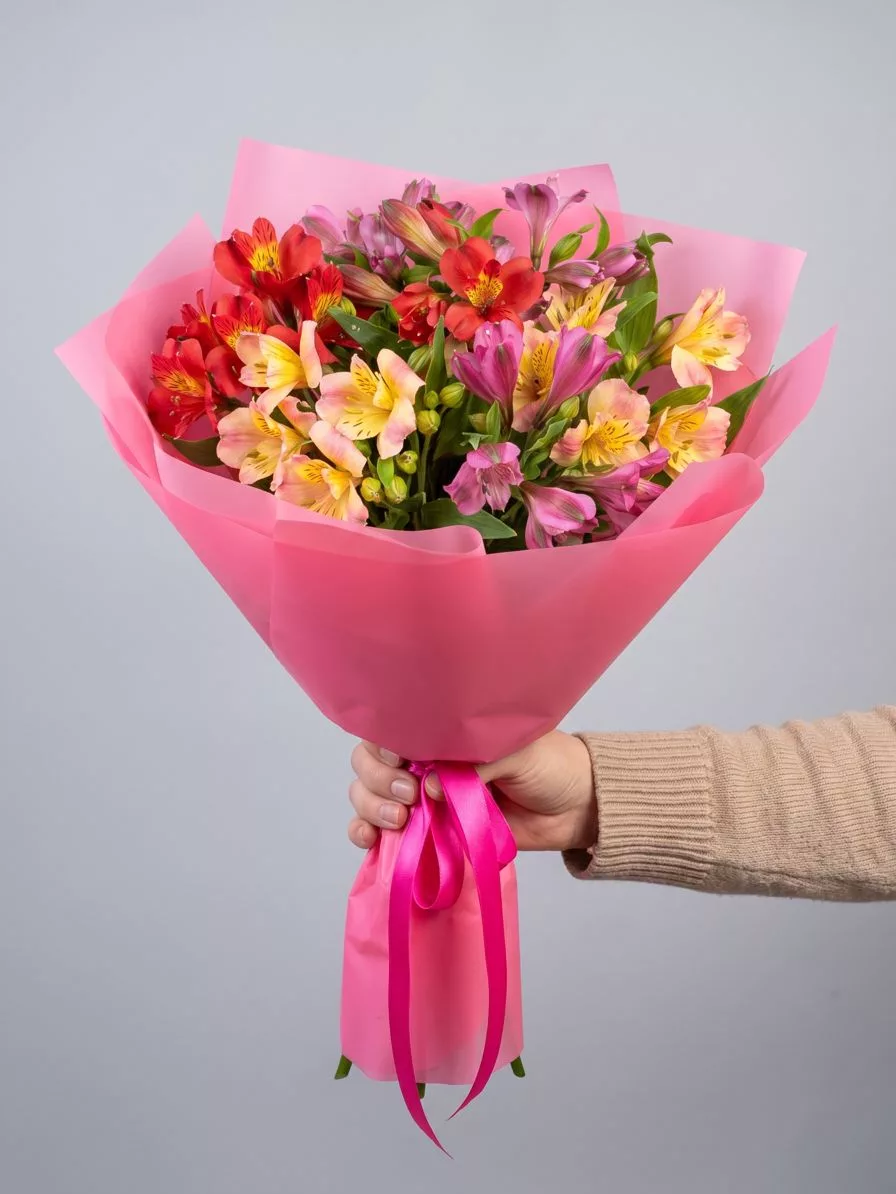
Not every flower on our shop floor is a good candidate for a multi-day transit to the Pacific coast. Customers sometimes ask for garden ranunculus, sweet peas, or open peonies — beautiful choices for local delivery, but fragile ones for long-haul shipping. The stems that consistently perform well over distance are spray chrysanthemums, alstroemeria, carnations, and standard roses in bud form, not open bloom. Spray chrysanthemums in particular are exceptional travellers: the individual florets are small, the stems are woody enough to hold water efficiently, and the variety holds colour for 10–14 days after cutting when properly conditioned. Alstroemeria arrives in tight bud and opens over several days in the recipient's home, which means the person in Sovetskaya Gavan actually gets to watch the bouquet develop — a detail customers often find unexpectedly lovely. Carnations have an unfair reputation in Russia as a Soviet-era cliché, but modern varieties in cream, burgundy, and coral are genuinely elegant and nearly indestructible in transit. Standard roses work well if we send them at the tight-bud stage; we never ship roses that have already begun to open, because an open rose loses petals under vibration and temperature fluctuation. Lilies are borderline — oriental lilies in tight bud can make the journey, but we advise customers to confirm the season and current shop stock before choosing them. Tropical stems like anthuriums and heliconias handle cold poorly and are not recommended for Far Eastern winter deliveries.
Packaging for a Minus 25 Winter and a Plus 30 Summer
The Khabarovsk Krai climate swings hard. January averages in Sovetskaya Gavan sit well below freezing, and the coastal humidity makes cold feel sharper than the thermometer suggests. July and August bring genuine heat, sometimes above 30 Celsius, with high humidity from the sea. Both extremes require specific packaging decisions, and this is an area where ordering from a shop that understands Far Eastern conditions matters. For winter shipments, we use insulated boxes with thermal lining and gel packs that buffer temperature without freezing the stems. The flowers go in water-retaining foam at the cut end, and the box is sealed to minimise cold air infiltration during loading and unloading at transit points. The critical danger moment is not the flight itself but the 20–40 minutes a parcel sits on an airport tarmac or loading dock between vehicles. For summer shipments, the concern flips: we use cool packs rather than warmth-retaining materials, and we time dispatch to avoid the hottest part of the transit day where possible. Customers ordering in July should know that some varieties simply cannot be recommended for Sovetskaya Gavan summer delivery — open garden roses and ranunculus are off the list entirely. A bouquet of spray chrysanthemums, alstroemeria, and green fillers like ruscus or pittosporum is a much safer summer combination. We always include a care card in Russian with the shipment explaining how the recipient should unpack, recut stems, and place the bouquet — many people in smaller cities have not received a shipped bouquet before and do not know the first steps.
Timing Your Order: When to Place It and What Dates to Avoid
The single most common mistake customers make when ordering flowers for Sovetskaya Gavan is treating the order deadline the same way they would for a Saint Petersburg delivery. For a birthday on a Saturday, a local customer might order Thursday evening and be fine. For Sovetskaya Gavan, that same Saturday birthday requires an order placed no later than Tuesday morning, and Monday is safer. This gives us time to select and condition the stems, pack for the specific season, dispatch through the appropriate route, and absorb any one-day delay at a transit hub without missing the occasion. Russian public holidays compress everything. The New Year period from late December through early January, International Women's Day on March 8th, and Victory Day on May 9th all create surges in demand that affect transit capacity across the country. If you are sending flowers for March 8th to someone in Sovetskaya Gavan, the order should be placed by March 3rd at the absolute latest — March 1st is better. Carriers are overloaded, sorting centres slow down, and a parcel that would normally take 3 days can take 5. We tell customers this plainly because a late bouquet for a significant date is worse than a bouquet that arrives two days early. Early arrival is actually a feature for shipped flowers: the recipient gets to enjoy them longer, and the stems arrive fresher than they would after a last-minute rush dispatch. Ask us about the current transit estimate when you order — we check carrier schedules in real time and give you a specific window, not a vague range.
What the Recipient Should Do When the Box Arrives
A surprising number of delivery problems in remote cities happen not in transit but in the first 30 minutes after the box reaches the door. The recipient, excited and perhaps unfamiliar with shipped flowers, opens the box, pulls the bouquet out, and sets it in a vase without recutting the stems. The cut ends have sealed over during transit — even with water-retaining foam, this happens — and the flowers cannot drink. Within a few hours the heads begin to droop, the customer calls us upset, and what looked like a delivery failure is actually a care failure. The care card we include addresses this directly, but we also tell the ordering customer so they can pass it on. The steps are simple: unwrap carefully, trim 2–3 centimetres off each stem at a 45-degree angle using scissors or a sharp knife, place immediately in a clean vase with cool water, and keep away from direct sun and heat sources. For alstroemeria and chrysanthemums, removing the lower leaves that would sit below the waterline prevents bacterial growth and extends vase life significantly. Carnations benefit from a small amount of sugar dissolved in the water — a teaspoon per litre — which feeds the stems. Roses should have their outer guard petals gently removed if they look bruised; the inner petals are almost always perfect. In winter, if the flowers arrive very cold, let them warm gradually at room temperature for 15–20 minutes before placing in water — a sudden shift from cold to warm water can shock the stems. These are not complicated steps, but they make the difference between a bouquet that lasts four days and one that lasts ten.
Customising the Order: Sizes, Add-Ons and What Works at Distance
Customers often want to add something to the bouquet — a box of chocolates, a small soft toy, a greeting card. For local Saint Petersburg delivery, this is straightforward. For Sovetskaya Gavan, the answer depends on what the add-on is. Greeting cards travel perfectly; we print or handwrite the message and include it inside the box, protected from moisture. A small box of chocolates in a sealed wrapper is usually fine in cooler months but risky in summer heat — chocolate melts and can damage the packaging around the flowers. Soft toys add bulk and weight, which increases shipping cost, but they travel safely. Balloons are not practical for multi-day transit. Regarding bouquet size, customers sometimes assume bigger is better for a long-distance gift. In practice, a well-composed medium bouquet of 15–21 stems travels better than an oversized arrangement of 35–40 stems, because the smaller bouquet fits the insulated box more precisely with less movement during transit. We can build a bouquet that looks generous and full without the structural problems that come from overpacking a shipping container. If the occasion calls for something truly substantial, we recommend splitting the order into two separately packed boxes rather than cramming everything into one. Seasonal greenery like eucalyptus, ruscus, and pistache adds volume and fragrance without fragility — these are excellent fillers for Far Eastern shipments because they condition well and hold their colour. Ask specifically about what is in stock the week of your order; we do not substitute without asking, but we may suggest a swap that improves the bouquet's travel performance significantly.
Tracking, Communication and What to Do If Something Goes Wrong
Every shipment to Sovetskaya Gavan leaves our shop with a tracking number, and we send it to the ordering customer by text or messaging app as soon as the parcel is handed to the carrier. The tracking updates at each major transit point — typically Moscow or Khabarovsk — and then again when it enters local delivery. Customers can follow the parcel in real time, which eliminates most of the anxiety around long-distance flower orders. The most common question we get mid-transit is whether the flowers are still alive inside the box. The honest answer is that we cannot see inside the box once it leaves us, but we can tell you that our packaging holds temperature and moisture for 72–96 hours under normal conditions, and most Far Eastern shipments arrive within that window. If the tracking shows an unusual delay — the parcel is stuck at a hub for more than 24 hours — contact us immediately. We can sometimes intervene with the carrier, and in cases of genuine carrier failure we discuss compensation or a replacement shipment. What we cannot do is redeliver within hours the way we can in Saint Petersburg; the logistics of the Far East do not allow it. If the recipient opens the box and the flowers are clearly damaged due to cold exposure or rough handling rather than care errors, photograph everything before touching the bouquet and send the photos to us. We assess each case individually. Flowers that arrive in poor condition due to an error on our side are always addressed — we do not ask customers to simply accept a bad outcome. Clear communication in both directions makes these situations resolvable.
Sending flowers to Sovetskaya Gavan is genuinely possible, and done correctly it lands beautifully. The key variables are timing — order early, build in buffer days, avoid the last-minute approach that works fine inside the city — variety selection suited to the season and the transit length, and recipient preparation so the bouquet gets the care it needs the moment it arrives. The Far East is not a barrier; it is a logistics problem with known solutions. We have sent flowers to Khabarovsk Krai through January frosts and July humidity, and the orders that go well are the ones where the customer gave us enough lead time and trusted our variety recommendations for the route. Place your order with the date and occasion in mind, tell us the recipient's address and any access notes for the building, and we handle everything from stem selection to packing to tracking. We deliver bouquets across Russia in 1–2 hours.
Frequently asked questions
How many days in advance should I order flowers for delivery to Sovetskaya Gavan?
Place your order at least 4–5 days before the occasion, and 6–7 days ahead during major holidays like March 8th or New Year. Transit from Saint Petersburg to the Far East takes 2–5 days depending on the route and season, and you need a buffer in case of any delay at a transit hub in Moscow or Khabarovsk.
Which flowers are best for a winter delivery to Sovetskaya Gavan when it is very cold?
Spray chrysanthemums, carnations, and alstroemeria in tight bud are the most reliable winter choices. We pack them in insulated boxes with thermal lining and gel packs. We avoid open roses, ranunculus, and tropical varieties in winter because they do not tolerate the cold exposure that happens during loading and unloading at transit points.
Can I add chocolates or a gift to the flower order for Sovetskaya Gavan?
Greeting cards and small sealed gifts travel well. Chocolates are safe in cooler months but risk melting in summer heat and can damage the flowers. Soft toys add weight but travel safely. We advise against balloons for multi-day transit. Tell us what you want to include and we will confirm whether it is practical for the current season and route.
What should the recipient do when the flower box arrives?
Recut the stems by 2–3 centimetres at a 45-degree angle immediately after unpacking — the cut ends seal during transit and the flowers cannot drink until you recut them. Place in cool water in a clean vase, remove leaves below the waterline, and keep away from direct sunlight and heat. In winter, let very cold flowers warm for 15 minutes before putting them in water.
What happens if the flowers arrive damaged in Sovetskaya Gavan?
Photograph the bouquet before touching anything and send the photos to us right away. We assess each case individually. If the damage is due to carrier handling or a failure in our packaging, we address it — either a replacement shipment or a refund discussion. We do not ask customers to accept a poor outcome caused by an error on our side or the carrier's side.
Ready to send a bouquet?
Pick a city, choose the flowers, and we will hand them over with a photo confirmation.
Choose a city →