
Flower Delivery in Staraya Russa: Zones, Timing and Prices
Staraya Russa sits about 290 kilometres south of Saint Petersburg, and every week we send bouquets there for birthdays, anniversaries and spontaneous gestures that people decide on the same morning. The questions we hear most are the same ones: will the flowers arrive the same day, what happens to roses in summer heat or February frost, and which bouquets actually survive a four-hour road trip without looking exhausted at the door. This article answers all of that with the same directness we use on the shop floor.
Where in Staraya Russa We Deliver and How Long It Takes
Staraya Russa is a compact city of roughly 28,000 residents in the Novgorod region, and our courier covers the central districts, the embankment area along the Polist River and the residential quarters on the eastern side of the city without any zoning surcharge. Addresses in the immediate outskirts, including dachas and private houses along the Ramushevo road or the Shimsk highway, are deliverable but require us to confirm the exact location before we dispatch, because rural house numbering in this part of Russia can be inconsistent and a wrong turn adds real time. The transit from our Saint Petersburg warehouse to a central Staraya Russa address takes between three and a half and four and a half hours depending on traffic on the M10 corridor and the section through Novgorod. We dispatch morning orders assembled by 07:00 first, so a customer who places an order before midnight the day before will typically see delivery between 12:00 and 15:00. Same-day orders placed before 10:00 Saint Petersburg time have a realistic chance of afternoon delivery; orders placed after 13:00 are scheduled for the following day. We are honest about this on the order form rather than promising windows we cannot keep, which is the most common complaint customers have had about other services they tried before finding us.
Bouquets we can deliver



Which Flowers Survive the Road Trip in Good Shape
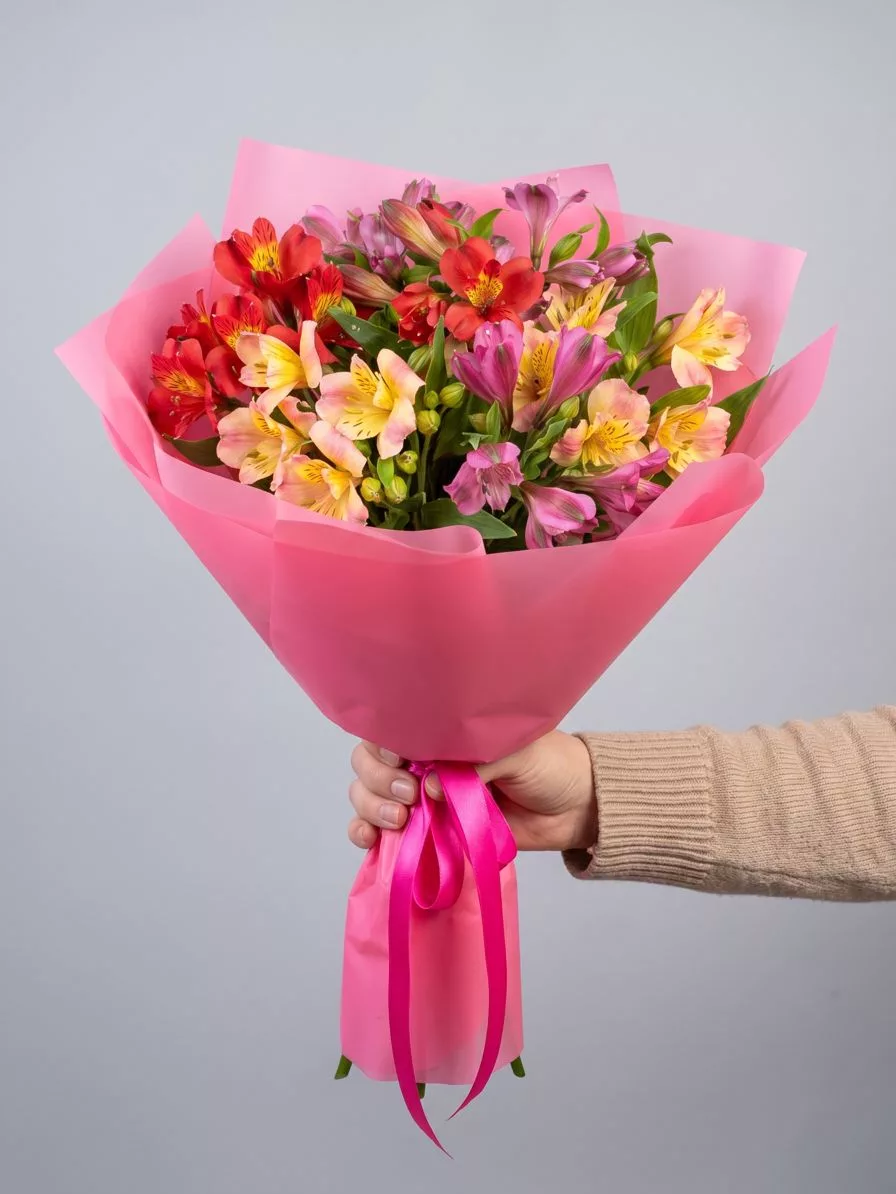
Not every variety handles a four-hour refrigerated transit equally well, and choosing the right flowers is the single most practical decision a customer makes. Roses with a stem length of 60 to 70 centimetres, particularly the varieties Avalanche, Explorer and Red Naomi, are structurally robust and arrive with tight buds that open beautifully over the following two days. Chrysanthemums, both the single-headed santini type and the spray varieties, are genuinely road-hardy and hold their form even if the refrigeration unit cycles slightly warmer than ideal during loading. Alstroemeria is another reliable choice: the stems are flexible, the flowers do not bruise easily and a bunch of fifteen stems looks generous without being heavy to carry. Flowers we handle more carefully for long-distance orders include garden-type peonies in high summer, when even an hour of warmth causes them to blow open and arrive looking overblown rather than fresh, and delicate ranunculus, which is beautiful in the shop but needs to be packed with extra tissue support for this distance. Tulips are seasonal: between November and April they travel perfectly; in June and July the heat makes them droop within the first hour out of refrigeration, so we substitute them only when a customer specifically insists and we have explained the risk. Hydrangea heads are large and dramatic but they drink water constantly, so we fit them with water-filled stem capsules for any order going beyond 200 kilometres, which adds a small amount to the packing cost but keeps them presentable at the door.
Seasonal Temperature Conditions and How We Handle Them
Staraya Russa has a genuine continental climate with cold winters and warm summers, and the temperature difference between our refrigerated van and the outdoor air matters for every delivery. In January and February the outdoor temperature regularly falls to minus 15 or minus 20 Celsius, and roses and tropical varieties like strelitzia need insulated kraft wrapping and a thermal sleeve around the bouquet before the courier steps out of the vehicle. Without this protection, a rose petal exposed to minus 15 for even three minutes develops dark translucent patches that do not recover. We include this wrapping automatically on all orders dispatched between November and March, and customers do not need to request it separately. Summer presents the opposite problem: July and August in Staraya Russa can reach 28 to 32 Celsius, and the moment a bouquet leaves the refrigerated van it begins to warm. Our couriers carry insulated bags for the final walk from the vehicle to the door, and we ask customers to have someone available to receive the order rather than leaving it on a doorstep, because fifteen minutes in direct sun at 30 degrees will wilt even a robust chrysanthemum arrangement. The shoulder seasons of May and September are the easiest for flower transit: temperatures are moderate, roads are dry and the flowers arrive looking exactly as they left the shop. If you are planning a delivery for a specific outdoor event, May or early June is the most forgiving window in this region.
What a Typical Bouquet for Staraya Russa Contains and Why
When customers ask us to put together something suitable for a long-distance delivery without specifying varieties, we work from a short list of combinations that have proven themselves on this route. A classic option is twenty-five stems of Avalanche roses at 60 centimetres, arranged in a spiral with eucalyptus filler and wrapped in kraft paper with a ribbon, which reads as generous and formal without being ostentatious. For a warmer, more relaxed feeling, we build around spray chrysanthemums in white or yellow combined with alstroemeria in peach or coral, a combination that photographs well and lasts eight to ten days in a vase. When a customer wants something that feels more unusual, we use lisianthus, which resembles a peony but travels far better and comes in cream, purple and deep violet; a bouquet of twenty stems of lisianthus with minimal greenery is striking and survives the transit without any special handling. We avoid mixing very short-lived varieties with long-lasting ones in the same bouquet because the wilting of one type makes the whole arrangement look neglected within a day or two. Customers sometimes ask whether they can include potted plants with a bouquet order for Staraya Russa; we can do this for succulents and small orchid plants, which are not sensitive to road vibration, but we do not send potted hydrangeas or large tropical plants on this route because the transit conditions are not suitable for root systems that need stable humidity. The order notes field is the right place to mention any colour preferences or allergies to strong-scented flowers like lilies.
How to Place an Order Correctly and What Information Matters
The most common reason a delivery to Staraya Russa is delayed or misrouted is an incomplete address, and this is worth spending two minutes on before you confirm the order. Staraya Russa uses a standard Russian address format: street name, house number, apartment or office number, and entrance number if the building has more than one stairwell. Buildings in the older central districts sometimes have a korpus designation, which is a secondary building number on the same plot, and omitting it means the courier may arrive at the wrong entrance entirely. If you are sending to a private house rather than an apartment building, include the full postcode and any landmark that helps locate the gate, because GPS navigation in residential outskirts of smaller Russian cities is less precise than in Saint Petersburg. The recipient's mobile phone number is not optional: our courier calls ahead approximately thirty minutes before arrival, and if the phone is switched off or unanswered, the delivery slot is held for one hour before we need to reschedule. We do not leave bouquets with neighbours without explicit written permission from the customer, because flowers are a personal gift and handing them to the wrong person causes obvious problems. If the recipient is at work rather than at home, the workplace address is perfectly acceptable and often more reliable than a residential address during business hours. Finally, if you are ordering for a specific event time such as a birthday dinner at 19:00, tell us the hard deadline in the order notes and we will schedule dispatch to arrive by that time rather than within the general delivery window.
Customs Around Giving Flowers in Russia That Visitors May Not Know
Russia has a few practical flower-giving customs that are worth knowing if you are sending a bouquet from outside the country or if this is your first time ordering for a Russian recipient. The most important one is the odd-number rule: bouquets for living recipients are always made with an odd number of stems, such as eleven, fifteen, twenty-five or fifty-one. Even numbers are associated with mourning in Russian tradition, and while younger urban recipients are less strict about this, many people in a city like Staraya Russa, which has a strong traditional character, will notice and feel uncomfortable. We automatically count stems to odd numbers on all standard bouquets, and if a customer specifies an even number we flag it before confirming the order. Red roses carry a romantic meaning that is quite direct in Russian culture, so sending a large red rose bouquet to a colleague or a distant acquaintance can be misread as a declaration of interest; mixed-colour bouquets or white roses are safer for professional or friendly contexts. Yellow flowers have a reputation in older Russian folk tradition for bringing separation or bad luck, though this belief is fading among people under forty. We do not refuse to make yellow bouquets, but we mention the association if a customer asks for an all-yellow arrangement. Giving flowers on arrival rather than at departure is the standard approach at celebrations, and if you want the bouquet to arrive before the party rather than during it, building in an hour of buffer is wise.
What to Check After the Bouquet Arrives
A bouquet that has travelled four hours in refrigeration needs a few minutes of attention from the recipient to perform at its best, and sharing this information with the person receiving the flowers is one of the most useful things a sender can do. The first step is to cut two to three centimetres off the bottom of each stem at a diagonal angle, ideally under running water or in a bowl, because the stem ends seal over during transit and cutting them opens the vessels so the flower can drink immediately. Removing any leaves that would sit below the waterline in the vase is the second step; submerged leaves rot within a day and cloud the water, which shortens the life of the whole bouquet. The vase water should be cool, not cold, and changed every two days. Roses and alstroemeria do well in a cool room away from direct sunlight and away from fruit bowls, because ripening fruit releases ethylene gas that accelerates petal drop. If any flower heads arrive looking slightly soft or drooping after the transit, it usually means they are thirsty rather than damaged: re-cutting the stems and placing them in fresh water for two hours typically revives them. Chrysanthemums and lisianthus are the most forgiving in this regard. We include a small care card in Russian with every bouquet, but if the recipient does not read Russian, the steps above cover everything necessary. Customers who have a concern about the condition of a delivery should photograph the bouquet within two hours of receipt and contact us directly; we assess every claim individually and replace flowers that arrive in genuinely poor condition.
Delivery to Staraya Russa is one of our regular longer routes, and the orders that go smoothly are the ones where the customer has put the correct address, included the recipient's phone number and chosen varieties suited to the season. Roses, chrysanthemums, alstroemeria and lisianthus cover most occasions well and arrive looking as they should. If you are unsure about timing or variety selection for a specific date, the order notes field or a quick message to our team before you confirm is always the right move. We deliver bouquets across Russia in 1–2 hours.
Frequently asked questions
Can I order flowers for same-day delivery to Staraya Russa?
Yes, if you place the order before 10:00 Saint Petersburg time on the day. Orders confirmed by that cutoff are dispatched in the morning batch and typically arrive in Staraya Russa between 13:00 and 16:00. Orders placed after 13:00 are scheduled for the following day, and we show the realistic delivery date on the order confirmation screen before you pay.
What happens if the recipient is not home when the courier arrives?
Our courier calls the recipient approximately thirty minutes before arrival. If there is no answer, the courier waits at the address for up to one hour, then contacts us. We then reach out to the sender to arrange a new delivery window. We do not leave bouquets unattended or with neighbours without written permission from the customer, because flowers left in a hallway or outdoors deteriorate quickly.
Do you deliver to private houses and dachas outside the city centre?
We deliver to private addresses in the outskirts of Staraya Russa, but we ask you to include the full postcode, the exact street and house number, and a brief description of how to find the gate or entrance. Rural house numbering in this area is sometimes non-sequential, and a clear address saves the courier significant time and prevents delays on what is already a long-distance route.
Why do Russian bouquets always have an odd number of flowers?
Odd numbers are the standard for gifts to living recipients in Russian tradition. Even-numbered bouquets are associated with mourning occasions. The rule is observed widely across generations in smaller cities like Staraya Russa. We count all our bouquets to odd numbers automatically, so you do not need to specify this, but if you request an even number we will flag it before confirming your order.
Which flowers should I avoid ordering in summer for this route?
Tulips are the main variety to avoid between June and August on any route over 200 kilometres. They droop quickly once the temperature rises above 20 Celsius. Garden peonies in peak summer also risk arriving fully blown open rather than in bud. Roses, spray chrysanthemums, alstroemeria and lisianthus all handle summer transit reliably when our courier uses insulated bags for the final delivery step.
Ready to send a bouquet?
Pick a city, choose the flowers, and we will hand them over with a photo confirmation.
Choose a city →