
Flowers for Your Mother-in-Law in Russia: Safe Choices
A Russian mother-in-law is a specific audience, and florists hear about the mistakes after the fact. Too casual reads as disrespect. Too flashy reads as showing off. The wrong color combination carries meanings the buyer never intended. This article lays out which bouquet styles, flower varieties and color palettes consistently land well — based on what customers order, what gets photographed and sent back as a thank-you, and what comes back as a complaint.
Why the Bouquet Matters More Than the Gift in Russian Culture
In Russia, flowers are not a secondary gesture attached to a box of chocolates — they are often the primary gift, and they are read carefully. A mother-in-law receiving flowers from a son- or daughter-in-law is assessing the relationship through what arrives at her door. The size, the freshness, the color logic and the variety selection all communicate something. Florists in Saint Petersburg regularly get calls from customers who say their partner told them to order something nice, with no further brief — and that is the brief that requires the most care. Russian women of the generation that is typically a mother-in-law today grew up with a strong cultural vocabulary around flowers. Roses mean one thing, chrysanthemums mean another, and white flowers in certain combinations carry associations with mourning that are worth avoiding entirely. This is not superstition so much as embedded cultural grammar. Getting it right does not require you to know every rule — it requires you to order from someone who does and to communicate the relationship clearly. When you place an order, say explicitly: this is for my partner's mother, she is around sixty, the occasion is her birthday or a family visit. That sentence changes the composition, the size and the color palette of what gets assembled. A florist who asks no follow-up questions after that sentence is not paying attention. The bouquet should feel considered, not generic.
Bouquets we can deliver



Colors That Convey Warmth and Respect Without Overstepping
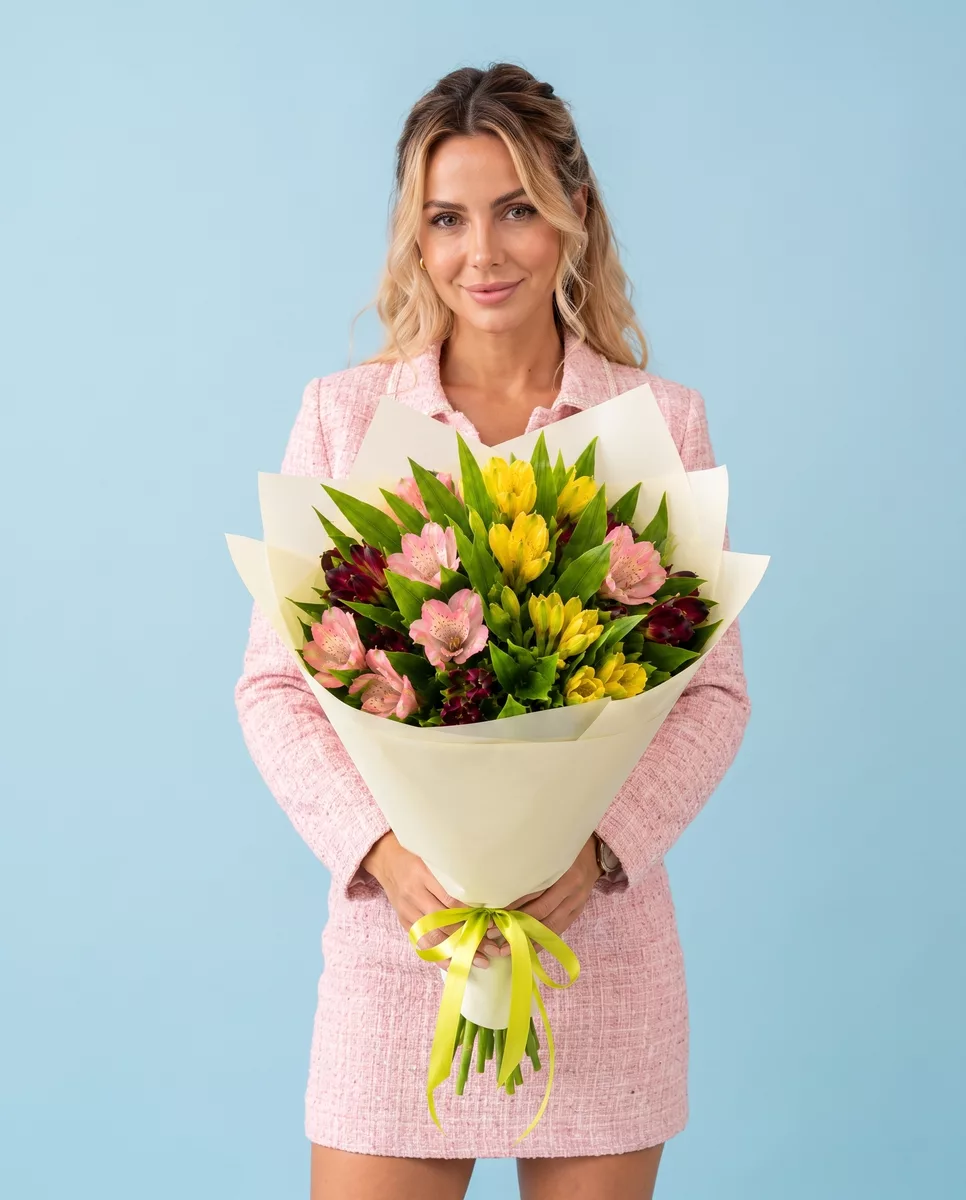
The safest and most appreciated palette for a Russian mother-in-law sits in the warm range: soft peach, apricot, coral, dusty rose and cream. These colors read as warm rather than romantic, respectful rather than formal, and they photograph well in a home setting, which matters because the bouquet will almost certainly be photographed and shared with friends. Pure red is a complicated choice — it is the color of romantic love in Russian tradition, and presenting deep red roses to your partner's mother can land awkwardly depending on the family dynamic. If red is requested specifically, moving to a burgundy or deep wine tone softens the romantic association while keeping the richness. Pure white alone is the most commonly flagged mistake by customers after the fact. White flowers are used at funerals and memorials in Russia, and while a mixed bouquet with white accents is generally fine, an all-white arrangement for a living relative raises eyebrows. Yellow is complicated too — there is a folk belief, particularly among older generations, that yellow flowers signal separation or infidelity. Not everyone holds this belief, but enough people do that yellow as a dominant color is a risk not worth taking for this specific recipient. Lilac, lavender and soft purple work very well — they read as elegant and mature without being cold. A bouquet built around lilac spray roses, dusty miller and eucalyptus hits the right register for most occasions. Pink in its softer shades is almost universally safe and is the color most often chosen by experienced florists for this recipient type.
Flower Varieties That Work Consistently Well
Roses remain the most reliable choice for a Russian mother-in-law, but variety and stem length matter more than most buyers realize. Garden roses — varieties such as David Austin types with dense, many-petaled heads — read as more considered and less generic than standard hybrid tea roses. If you are ordering standard roses, ask for stems of at least fifty centimeters; shorter stems are associated with budget arrangements and the difference is immediately visible. Eustoma, also sold as lisianthus, is an excellent supporting flower — it has a ruffled, peony-like appearance, holds well for seven to ten days in a vase and adds volume without inflating cost dramatically. Peonies are deeply loved in Russian culture and are a strong choice from late April through June when they are in season. Outside that window, asking for peonies means accepting imported stock that may have been in cold storage for two weeks, and the vase life drops accordingly. Alstroemeria works well as a filler and lasts exceptionally long in a vase — up to two weeks — which means the recipient keeps a beautiful arrangement around for longer, and that reflects well on the sender. Spray roses add texture and a sense of abundance. Freesia is worth including when available because the scent is distinctive and pleasant without being overpowering. Avoid carnations as the dominant flower in this context — they are associated with Soviet-era official bouquets and can read as impersonal. A few stems of carnation tucked into a larger arrangement are fine, but a carnation-forward bouquet for a mother-in-law is a missed opportunity.
Bouquet Size and Structure for Different Occasions
The occasion changes the appropriate scale significantly. A casual Sunday visit calls for something in the fifteen to twenty-five stem range — enough to be a genuine gift without looking like you are compensating for something. A birthday, name day or major holiday like March 8th calls for something more substantial: thirty-five stems and above, with a clear compositional logic rather than a handful of mixed stems bundled together. Name days are worth knowing about — in Russia, many women celebrate their name day as seriously as their birthday, and it follows the Orthodox calendar. If your partner's mother is named Tatiana, Valentina, Lyudmila or Natalya, among many others, her name day is a real occasion and arriving with flowers is expected by the family even if nobody sent you a calendar reminder. Structure matters as much as size. A round, dome-shaped bouquet reads as classic and intentional. A hand-tied bouquet with visible stems and natural asymmetry reads as more modern and artisanal. Both work for a mother-in-law, but the round format tends to land better with recipients over fifty-five who associate it with quality floristry. Avoid flat, wide arrangements that look designed for a table centerpiece — they are harder to carry and present in person. The bouquet should be something she can hold and receive at the door, then place in a vase herself. Wrapping matters: kraft paper with a satin ribbon reads well. Excessive cellophane reads as a petrol station purchase.
Timing the Delivery: When to Arrive and What to Avoid
Delivery timing for a mother-in-law requires more thought than for most recipients. If the bouquet is arriving at her home without you present — for example, you are in another city — confirm that she will actually be home in the delivery window. Russian women of this generation often have full schedules and do not always share them in advance. A bouquet left at a door in summer heat loses two to four hours of vase life for every hour it sits unwatered in temperatures above twenty degrees Celsius. In winter, the risk is the opposite: flowers left in an unheated entrance hall or outside a door in sub-zero temperatures can suffer cold damage within fifteen minutes, and petals that have frozen and thawed look bruised and translucent. When ordering for a morning arrival, specify a window of ten to twelve rather than eight to ten — many women this age are out early for errands or at the market, and a missed delivery requires a re-delivery that the flowers do not benefit from. For major holidays — March 8th International Women's Day, May 9th Victory Day if she is of that generation, and New Year's — order at least three days in advance. Florists across Russia are at full capacity on those dates, and same-day orders on March 8th in particular are genuinely difficult to fulfill at the quality level a careful order deserves. If the occasion is a birthday, same-day delivery within Saint Petersburg is achievable with a one to two hour window, but the earlier in the day you order, the better the stem selection available.
What to Say When You Place the Order
Florists build better bouquets when they have real information, and the information most buyers omit is exactly what changes the composition. Tell the florist the recipient's approximate age — a bouquet for a fifty-eight-year-old woman is different from one for a seventy-five-year-old woman, and experienced florists adjust stem choices, color depth and arrangement density accordingly. Tell them the occasion: birthday, name day, family visit, thank-you after staying with her for the weekend. Tell them whether the recipient lives alone or with family, because a large arrangement in a small apartment with limited surface space is a logistical problem for her, not a gift. If you know her taste — she has a dacha and loves garden flowers, or she is a city woman with a modern apartment — say so. If you know she has allergies, mention it: lilies in particular have strong pollen and are a genuine irritant for some people, and a florist can substitute without affecting the overall composition significantly. If you are ordering from outside Russia and your Russian is limited, writing the details in English or using a translation tool is completely acceptable — florists who handle international orders are accustomed to this. What matters is the information, not the language it arrives in. Finally, include a card. A handwritten note — even a short one — is expected with flowers in Russian culture, and a bouquet arriving without any message reads as an oversight. The card does not need to be elaborate: her name, a warm phrase, your name. That is enough.
Mistakes Customers Make and How to Avoid Them
The most common mistake is ordering the cheapest available option and assuming it will look fine in person. Florists see this frequently around holidays: a customer selects the smallest bouquet at the lowest price point, the recipient receives fifteen stems of mixed filler flowers in a color palette chosen by the algorithm rather than by a person, and the relationship takes a small but real hit. A mother-in-law notices. The second most common mistake is ignoring the color rules described earlier — specifically the all-white bouquet or the yellow-dominant arrangement. These mistakes are entirely avoidable with one sentence to the florist: please avoid white as the dominant color and avoid yellow. The third mistake is leaving the delivery address incomplete. Russian apartment buildings require a building number, an entrance number, a floor and an apartment number. A courier with a partial address will call the recipient to ask for directions, which eliminates the surprise element and can be embarrassing if the bouquet is meant to be a gesture of respect rather than a coordinated family gift. The fourth mistake is ordering on the day of a major holiday without accounting for demand. On March 8th, florists across Saint Petersburg are processing hundreds of orders simultaneously, and the stem quality available at noon is different from what was available at eight in the morning. Early ordering is not just about logistics — it is about getting the best flowers from the morning delivery. The fifth mistake is skipping the card. It costs nothing and changes how the bouquet is received entirely. Write something, even if it is brief.
Ordering flowers for a Russian mother-in-law is not complicated once you know the framework: warm colors in the peach-to-pink range, reliable varieties like garden roses and eustoma, a size matched to the occasion, a delivery window confirmed with the recipient's schedule in mind, and a card with her name on it. The cultural context is real but navigable. Florists who work with this audience every day can steer you correctly if you give them the information they need — the recipient's age, the occasion, the address details and any known preferences or sensitivities. Get those elements right and the bouquet does what it is supposed to do: it communicates that you put genuine thought into it, which is exactly what a mother-in-law is looking for. We deliver bouquets across Russia in 1–2 hours.
Frequently asked questions
Is it acceptable to send flowers to a Russian mother-in-law without a specific occasion?
Yes, and it is often more appreciated than an obligatory holiday bouquet. A spontaneous delivery on a regular Tuesday reads as a genuine gesture rather than a social duty. Keep the size moderate — fifteen to twenty stems — and choose a warm, simple composition. Roses or eustoma in peach or soft pink work well for an unprompted visit or delivery.
Can I include lilies in a bouquet for a Russian mother-in-law?
Lilies are beautiful and well-regarded in Russia, but they produce strong pollen that stains fabric and can trigger allergies. If you do not know the recipient's sensitivity, ask the florist to include Oriental lilies with the stamens removed, which eliminates most of the pollen risk. Asiatic lilies have less scent and lower pollen volume and are a safer default.
What is the right bouquet size for a birthday versus a casual visit?
For a birthday, aim for thirty-five stems and above with a clear color palette and a structured round composition. For a casual visit or a thank-you gesture, fifteen to twenty-five stems is appropriate and avoids the impression that you are trying too hard. The structure and freshness matter more than raw stem count — a tight, fresh twenty-stem bouquet outperforms a loose, tired forty-stem one.
How far in advance should I order for March 8th delivery?
Three to four days minimum. March 8th is International Women's Day and the single busiest floristry date in Russia. Florists receive the bulk of their stem deliveries in the days before, and early orders get first selection of the freshest stock. Same-day orders on March 8th are often possible but carry real risk of limited variety availability and longer delivery windows.
Does the wrapping style matter for a Russian recipient?
It does. Kraft paper with a fabric or satin ribbon reads as considered and artisanal. Heavy cellophane wrapping is associated with low-budget arrangements and petrol station purchases. If you are ordering for delivery, specify that you want quality wrapping — a good florist will use it by default, but it is worth confirming, particularly for a recipient who will judge the presentation carefully.
Ready to send a bouquet?
Pick a city, choose the flowers, and we will hand them over with a photo confirmation.
Choose a city →