
Flowers for a Russian Girlfriend: What to Choose and When
Every week we take orders from men abroad who want to send flowers to a girlfriend in Saint Petersburg or another Russian city and are not sure whether roses are too obvious, whether colour matters, or whether an even number of flowers will cause offence. These are real questions with real answers, and the answers come from what we see on the shop floor every day — which bouquets get photographed and shared, which ones prompt a call asking whether something went wrong, and which ones a woman keeps on her desk for a week.
The Odd-Number Rule and Why It Still Matters
The single most consistent question we get from customers ordering from outside Russia is whether the odd-number rule is real. It is. In Russian tradition, even numbers of flowers are associated with mourning and are brought to funerals. Giving a girlfriend twelve roses or ten tulips reads as a serious cultural misstep, even among younger, urban women who may not consciously think about it. The feeling is instinctive rather than reasoned, which makes it harder to explain away. Stick to odd numbers: one, three, five, seven, eleven, fifteen, nineteen, twenty-five. These are the counts we cut and wrap dozens of times a day. A single large peony or one long-stemmed garden rose is a confident, deliberate gesture that works well for an early date or a spontaneous delivery. Five or seven mixed stems — spray roses alongside lisianthus or ranunculus — make a compact bouquet that travels well and photographs well. Eleven or fifteen stems of a single variety, roses or tulips, is the standard romantic volume for a birthday or anniversary. Twenty-five is a step up, used when the occasion is significant or when the sender wants to make a clear impression. We sometimes get requests for one hundred and one roses, which is a Russian tradition for declarations of love, but that is a large-format order that requires advance notice and a specific delivery window rather than a same-day rush.
Bouquets we can deliver



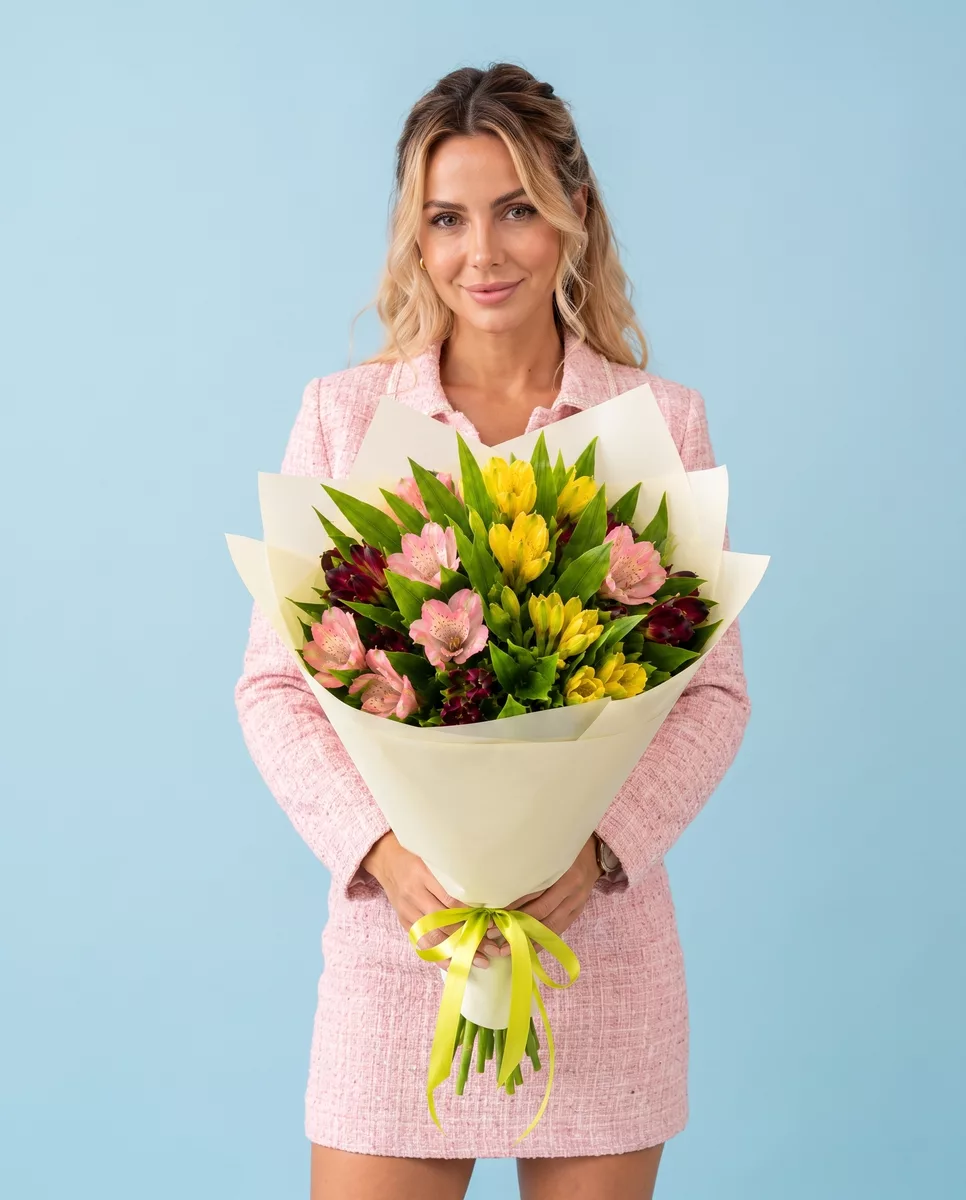
Roses: Which Variety to Order and Which to Avoid
Roses are the dominant choice for romantic deliveries in Russia, and within roses the variety and stem length matter more than most customers realise. Long-stemmed Ecuadorian roses — varieties like Explorer, Red Naomi or Mondial — have large heads and stay open for seven to ten days when kept in clean water at room temperature. These are the roses that appear in the photographs women actually share. Shorter-stemmed roses grown in the Netherlands or locally are cheaper but the heads are smaller and the vase life is shorter; they are fine for a mixed bouquet but underwhelming as a single-variety arrangement. Spray roses, which carry several small blooms per stem, are a different product entirely — they work well as a supporting element alongside peonies or ranunculus but rarely impress on their own as a romantic gift. Garden roses — varieties like David Austin types — have a softer, more layered look and a stronger scent, but they are seasonal and not always available; if you want them, confirm availability when ordering rather than assuming. One common mistake is ordering red roses by default without specifying stem length. A bouquet of fifteen short red roses looks thin and cheap next to a bouquet of eleven long-stemmed ones. Ask for stems of at least sixty centimetres for a stand-alone rose bouquet. We cut stems at an angle before boxing and wrap the heads to protect them during transit, which matters in summer when car temperatures can spike.
Beyond Roses: Peonies, Ranunculus and Tulips
Peonies are the most requested non-rose flower for romantic deliveries in Russia, and for good reason — they are large, scented and visually dramatic. The main limitation is season: peonies are available fresh from approximately late May through early July, with the peak being June. Outside that window what you find is imported peony that has often been in cold storage, and the quality drops sharply. If you are ordering in winter, do not insist on peonies; the florist is telling you the truth when they say the product is not at its best. Ranunculus are available from late winter through spring and are a strong alternative — they have layered petals similar to a peony, come in white, cream, pale pink, deep burgundy and coral, and last well in a vase. A bouquet of fifteen ranunculus in two complementary tones is a sophisticated choice that most recipients find more interesting than a standard rose arrangement. Tulips are the dominant spring flower in Russia and carry strong positive associations — they are the flower most commonly given on March 8th, International Women's Day, which is the single busiest delivery day of the Russian floral calendar. Dutch tulips in single colours, particularly white, pale pink, and deep purple, make clean, modern arrangements. Mix no more than two colours in a tulip bouquet or the result looks cluttered. Lisianthus, sometimes sold under the name eustoma, works well as a filler or as a standalone bouquet in white or violet and is available year-round.
Colour Meanings in Russian Flower Culture
Colour associations in Russia are more specific than in many Western countries, and getting them wrong produces a reaction the sender cannot predict from abroad. Red is unambiguously romantic and is the safe default for a girlfriend, though some women find it conventional and prefer something less expected. White is associated with purity and is appropriate for a first meeting or early in a relationship; it is also used at weddings, so it carries no negative weight. Pink in any shade reads as affectionate and warm rather than intensely romantic — it is a good choice when the relationship is still forming or when you want to signal care without pressure. Yellow flowers have a complicated reputation in Russia. Among older generations, yellow is associated with separation or infidelity; this association is fading among people under thirty-five but has not disappeared. If your girlfriend is older or more traditional, avoid yellow as the primary colour. A mixed bouquet where yellow is one element among several is less loaded than an entirely yellow arrangement. Orange is generally positive and energetic with no negative associations. Purple and violet — in lisianthus, tulips or irises — are considered elegant and slightly unusual, which works in your favour if you want the bouquet to stand out. White and pink combined is the most universally safe choice for a romantic arrangement when you are uncertain about personal preference. Avoid combining white with red in large quantities, as that specific combination appears on funeral wreaths and can feel uncomfortable even when the context is completely different.
Seasonal Timing: When to Order What
The Russian floral market follows European growing seasons closely, and ordering against the season is the fastest way to spend more and get less. January and February are dominated by imported roses, chrysanthemums, alstroemeria and spray flowers; local greenhouse product is limited. This is also the run-up to February 14th and March 8th, which are the two peak demand periods of the year — ordering the day before either date means reduced variety and longer delivery windows. If you are planning a Valentine's Day or Women's Day delivery, place the order three to five days in advance and specify your preferred delivery time slot. March through May brings tulips, ranunculus, hyacinths and the first anemones; this is one of the best periods for variety and freshness. June is peak peony season and also brings garden roses and sweet peas when available. July and August are challenging — heat affects transit quality, and we pack bouquets with cooling materials for same-day delivery, but the recipient needs to get flowers into water within two hours of arrival, which matters if she is not home. September and October bring dahlias, which are underused in romantic contexts but are striking and long-lasting. November and December return to imported product, with amaryllis and ornamental branches appearing in the mix. A bouquet built around what is genuinely in season will always outlast and outperform one built around a variety that has been forced or stored.
Adding a Personal Message: What to Write and How
We attach handwritten cards to every order, and the message is something a significant number of customers underestimate. A card that says only 'Happy Birthday' or 'With love' is a missed opportunity when the flowers are arriving from a distance and the sender cannot be there in person. The card is the only part of the delivery that speaks directly, and it should do actual work. Write the message in the language she reads most comfortably. If you write in English and she reads Russian better, the effect is diminished — not because the sentiment is wrong but because she has to translate before she can feel it. When you place an order remotely, you can submit the card text in any language and we transcribe it exactly onto the card. If you want to write in Russian but are not confident in the text, write what you mean in English and ask us to translate it; we do this regularly. Keep the message specific rather than general. 'I keep thinking about the evening in Nevsky last month' lands differently than 'Thinking of you.' Specific details show that the flowers are not a routine gesture. Avoid long paragraphs on a card — three to five sentences is the right length for a handwritten note. If the occasion is a birthday, mention it explicitly alongside something personal. If there is no specific occasion, that is worth saying too: 'No reason except that I wanted you to have flowers today' is a message that works consistently well and requires no explanation.
What to Check Before Confirming the Order
Remote orders for a girlfriend require a few specific checks that in-person buyers handle automatically by being present. First, confirm the delivery address is current — we have rerouted bouquets because the recipient moved recently and the sender did not know. If she works from home some days and at an office others, ask which she prefers for a delivery and on which days; a bouquet arriving at an empty apartment in summer sits in a hot corridor and the flowers suffer. Second, check that someone will actually receive the order. We can leave a bouquet with a doorman or a neighbour if the recipient is briefly unavailable, but this should be agreed in advance and noted in the order. Third, confirm the delivery time window with her schedule in mind — a lunchtime delivery is often the best option because she is likely to be reachable and the flowers become part of her day rather than something she finds in the evening. Fourth, verify that the phone number on the order is correct; our courier calls ahead, and a wrong number means a failed delivery. Fifth, if you are ordering flowers that require refrigeration — like peonies in July or hyacinths in a warm apartment — mention it in the order notes so we can advise on timing. Finally, review the card text one more time before submitting. We print or write exactly what is submitted, including errors, so read it as if seeing it for the first time.
Ordering flowers for a girlfriend in Russia from abroad is straightforward when you know the three things that actually determine whether the bouquet lands well: the right count, the right variety for the current season, and a card message that is specific enough to mean something. The odd-number rule is not superstition — it is a real cultural signal, and respecting it costs nothing. Seasonal varieties will always look better than out-of-season ones regardless of price. And the card, written with a single concrete detail about her or about the two of you, is what she will remember after the flowers are gone. We deliver bouquets across Russia in 1–2 hours.
Frequently asked questions
Can I order flowers for delivery in Saint Petersburg if I am outside Russia?
Yes. You can place an order through our website from any country. You will need a working phone number for the recipient so our courier can call ahead. Payment is processed online. Specify the delivery address, time window and card text in the order form, and we confirm the order before dispatch.
Is it really a problem to give an even number of flowers in Russia?
In practice, yes. Even numbers are associated with funerals in Russian tradition, and the association is strong enough that most women notice it, even if they do not say anything. It does not ruin a gesture entirely, but it introduces an uncomfortable note. Odd numbers are easy to follow and eliminate the issue completely.
What flowers should I avoid sending to a girlfriend in Russia?
Avoid entirely yellow bouquets, particularly for older or more traditional recipients, as yellow carries associations with separation in Russian culture. Also avoid combining large quantities of red and white, which appears on funeral arrangements. Even numbers of any flower are best avoided. Outside these points, variety choice is largely a matter of season and personal preference.
How far in advance should I order for March 8th, International Women's Day?
At least three to five days before the date. March 8th is the single busiest delivery day in the Russian floral calendar. Ordering the day before means reduced variety, higher prices and longer delivery windows. Early orders allow you to specify a preferred time slot and get first choice of available varieties, particularly tulips and roses.
Can I write the card message in English if my girlfriend speaks Russian?
You can submit the text in English and ask us to translate it into Russian for the card — we do this regularly. Alternatively, submit the Russian text directly if you have it. A message in her native language will always have more immediate emotional impact than one she needs to mentally translate first, so it is worth the extra step.
Ready to send a bouquet?
Pick a city, choose the flowers, and we will hand them over with a photo confirmation.
Choose a city →