
Flower Delivery to Russian Employees on Company Milestone Dates
Every week an HR manager somewhere outside Russia asks the same question: the company turns five, or ten, or twenty-five years old on a specific date, there are forty employees spread across several Russian cities, and every one of them should receive a bouquet that morning before the internal celebration call. It sounds complicated, but the logistics are straightforward once you understand how same-day delivery in Russia actually runs, which varieties hold up in transit, and what information you need to collect from your staff list before you place a single order.
Why Company Anniversaries in Russia Call for Physical Flowers
In Russian office culture a round-number anniversary — five years, ten years, twenty-five years — carries real weight. Employees expect the company to mark it with something tangible, not just a banner on the intranet. A bouquet delivered to the home or office is read as a personal gesture from management, and that reading matters especially when the management team sits in another country and staff rarely see them in person. Digital gift cards and online vouchers are common, but they are also easy to ignore; a bouquet sitting on a desk for three days is a continuous reminder. Russian colleagues will notice who received flowers and who did not, so coverage matters as much as quality. If your list has forty names, all forty need a delivery on the same date, not thirty-eight with two arriving a day late. Gaps get talked about. The practical consequence is that you are not really ordering flowers — you are coordinating a logistics operation that happens to involve flowers, and the florist you choose needs to treat it the same way. Five Flowers handles bulk corporate orders of this kind regularly from Saint Petersburg, dispatching to addresses across Russia with a delivery window that fits inside a working morning. The key is submitting the full address list early enough that routes can be planned, not dropped into a queue one by one.
Bouquets we can deliver



Which Bouquets Work for a Corporate Milestone
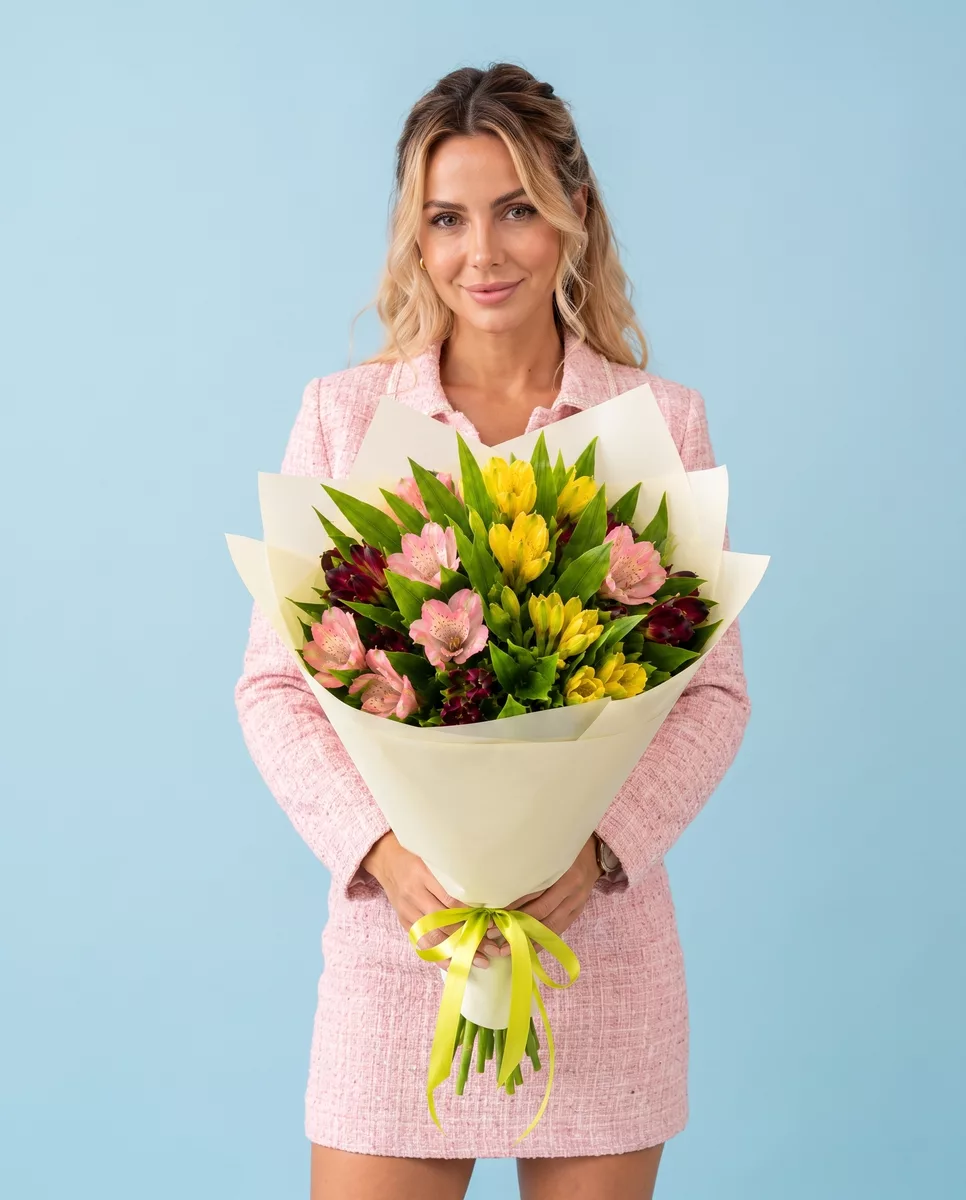
Corporate anniversary bouquets need to look deliberate, not like something grabbed off a shelf. The varieties that read as intentional and hold their condition through a courier journey are roses, spray roses, alstroemeria, chrysanthemums, and lisianthus. Single-variety bouquets of Dutch roses — typically fifteen or twenty-one stems in white, cream, or a single saturated color — photograph well, survive being carried in a bag, and do not require any explanation from the recipient about what they are looking at. Mixed bouquets work too, but keep the palette tight: two or three colors maximum, otherwise the arrangement looks random rather than curated. Avoid flowers with large open faces that bruise in transit, such as fully open peonies or garden dahlias. Tulips are popular in Russia and cost-effective, but they continue to grow after cutting and will look different by the end of the day; they are better for spring campaigns than for a formal milestone delivery. For a company anniversary, roses or a rose-and-lisianthus combination in a corporate color is the most reliable choice. Lisianthus, sometimes called eustoma in Russian flower shops, adds texture without adding fragility. If the company has a brand color, it is worth asking whether the florist can match it — white roses with a ribbon in the brand color is a clean solution that travels well and photographs consistently across forty different delivery photos if you are collecting them for an internal report.
Timing the Delivery: What Same-Day Means in Practice
Same-day delivery in Russian cities means the bouquet is cut, assembled, and dispatched within a few hours of the order being confirmed. Five Flowers operates from Saint Petersburg and delivers within one to two hours of order confirmation across the city, with routes extending to other Russian cities depending on distance and local logistics. For a corporate order covering multiple addresses, the realistic approach is to request a morning delivery window — typically between nine and noon — so that bouquets arrive before or during the working day rather than after everyone has left the office. To hit that window, the full address list and payment need to be confirmed the evening before, or by eight in the morning at the latest on the delivery date. HR managers in European time zones have an advantage here: their workday starts before Russia's, so a seven or eight o'clock local morning submission can still reach the florist before the Russian morning rush. Managers in North American time zones need to plan the submission the night before, accounting for the time difference. The single most common mistake in corporate flower orders is submitting the list in batches — sending twenty addresses, then adding ten more an hour later, then correcting five of them. This fragments the route planning and pushes some deliveries into the afternoon. Send the complete, checked list once.
What Address Information You Actually Need from Employees
Russian addresses have a specific structure that differs from Western formats, and a partially correct address will cause a delivery failure. You need: the city, the full street name, the building number, the apartment or office number, the floor if the building has no intercom directory, and a working mobile phone number for the recipient. In Russian residential buildings the courier will often call ahead rather than ring a doorbell, so the phone number is not optional — it is the primary way the delivery is confirmed. Office deliveries require the company name and the floor or room number; many Russian office buildings have a reception desk that will accept deliveries, but the courier still needs to know which company to ask for. If you are collecting this data from employees, use a simple form with mandatory fields for each of these elements. Do not accept free-text address entries — they will produce formats that are unusable. Ask employees to write the address exactly as it appears on their registration documents or utility bills; that format is the one Russian couriers recognize. For employees who work remotely and live in smaller towns or rural areas, confirm in advance whether same-day delivery is available to that location. Not every address in Russia is reachable within a single day, and it is better to know that two weeks before the milestone than on the morning of the event.
How to Handle Different Cities in One Order
A company with forty Russian employees rarely has all forty in one city. A typical distribution might be fifteen in Moscow, twelve in Saint Petersburg, eight in Yekaterinburg, and the rest scattered across smaller cities. Each city requires its own delivery confirmation, and the lead times can differ. Saint Petersburg and Moscow have dense courier networks and can absorb same-day orders placed that morning. Cities further east or with smaller populations may need the order placed one or two days in advance to guarantee a morning delivery. When you build your staff list, sort it by city first, then by address within each city. This makes it immediately visible where you have coverage and where you need to check availability. Submit the list to the florist with a note on which cities you are uncertain about — a good florist will flag the ones that need early confirmation rather than letting you find out on delivery day. One practical detail: if the company anniversary falls on a Monday, place the order on Thursday or Friday of the preceding week. Flower shops receive fresh stock on specific days, and a Thursday order for Monday delivery gives the florist time to source the correct quantities and varieties. A Monday-morning order for Monday delivery is possible for small numbers of bouquets but risky for a forty-address corporate run.
The Card Message: What to Write and What to Avoid
Every bouquet in a corporate anniversary delivery should carry a printed card. Handwritten cards are not practical at scale, and printed cards look professional when the text is well chosen. The message should be short — two or three sentences — and should name the milestone explicitly: the number of years, the company name, and a direct acknowledgment of the employee's contribution. Russians respond well to specificity; a card that says 'thank you for five years of work together' lands better than a generic 'congratulations on this special day.' Avoid superlatives and marketing language on the card — phrases like 'our incredible team' or 'amazing journey' read as hollow in Russian office culture, where directness is valued. If the company leadership wants to sign the card, use the actual name of the CEO or HR director, not a department name. A card signed 'The Management Team' is weaker than one signed with a real name. One thing to know about Russian etiquette: even numbers of flowers are associated with funerals, so bouquets should always contain an odd number of stems — eleven, fifteen, twenty-one. A good florist will already know this and will assemble accordingly, but if you are specifying stem counts in your order, make sure every number is odd. This is not superstition for its own sake; it is a convention that every Russian recipient will notice, and getting it wrong signals that the sender does not know local customs.
Confirming Delivery and Collecting Proof for Internal Records
HR managers running a company anniversary campaign often need to report back to leadership that every employee received their bouquet. Collecting this proof across forty addresses in multiple cities is a real coordination task. The most reliable method is to ask the florist to send a delivery confirmation for each address — a timestamp and, where the recipient consents, a photo. Five Flowers provides delivery confirmations as a standard part of corporate orders. On your side, build a simple tracking sheet before the delivery date: one row per employee, with their city, address, phone number, and a column for confirmation status. As confirmations come in, mark them off. For employees who work in offices with a reception desk, the confirmation may come from the receptionist rather than the employee directly; that is still a valid delivery. If a delivery fails — wrong address, recipient not available, building access issue — you want to know within the delivery window so a second attempt can be made the same day. This requires that someone on your team is monitoring the confirmation sheet during Russian working hours on the delivery date, not checking it at the end of their own workday. The time difference is the most common reason a failed delivery goes unresolved: the HR manager in Berlin sees the failure notification at six in the evening, by which time the Russian courier has finished their shift.
A company anniversary flower delivery to Russian staff is a logistics project first and a gesture second. The flowers matter — variety, stem count, condition on arrival — but none of that is visible if the address is wrong, the delivery falls in the afternoon after the celebration call, or three employees on the list receive nothing. Start with a clean, complete address list sorted by city, confirm timing and availability for each location at least a week before the milestone date, choose varieties that travel without bruising, and have someone monitoring confirmations during Russian working hours on the day itself. Done that way, forty bouquets across six cities on the same morning is entirely achievable. We deliver bouquets across Russia in 1–2 hours.
Frequently asked questions
How far in advance should an HR manager abroad place a corporate flower order for a Russian company anniversary?
For orders covering multiple Russian cities, submit the complete address list at least five to seven days before the milestone date. This gives the florist time to confirm same-day delivery availability in each city, source the correct flower quantities, and plan routes. Orders placed the day before are possible for Saint Petersburg and Moscow but risky for smaller or more distant cities.
Why does the number of stems in a bouquet matter in Russia?
In Russian tradition, even numbers of flowers are associated with funeral and mourning contexts. Bouquets given as gifts should always contain an odd number of stems — eleven, fifteen, twenty-one are all standard. Every recipient will notice the stem count, and an even number signals unfamiliarity with local customs. Five Flowers assembles all bouquets with odd stem counts by default.
What happens if an employee is not home when the courier arrives?
The courier will call the recipient's mobile number before arrival and again on reaching the address. If the recipient is unavailable, a second delivery attempt or a revised time slot can usually be arranged within the same day, provided the HR manager is monitoring confirmations and flags the issue promptly. This is why a working mobile number for every recipient is mandatory, not optional.
Can the bouquets be customized to match a company's brand colors?
Yes, within the range of available flower colors. White roses with a ribbon in the brand color is the most reliable approach and works for most palettes. Fully custom color matching depends on what varieties are in stock for your chosen date. Specify the brand color when you submit the order and the florist will confirm what is achievable before you finalize.
Is same-day delivery available in smaller Russian cities, not just Moscow and Saint Petersburg?
Availability depends on the specific city and the time the order is placed. Major regional centers such as Yekaterinburg, Novosibirsk, and Kazan are generally covered with advance notice. Very small towns or rural addresses may require a next-day window. Confirm city-by-city availability when you submit your address list, so there are no surprises on the delivery date.
Ready to send a bouquet?
Pick a city, choose the flowers, and we will hand them over with a photo confirmation.
Choose a city →