
Flowers for a Russian Female Boss: Varieties, Sizing and Workplace Protocol
Every week someone calls the shop and says roughly the same thing: I need flowers for my boss, she is a woman, I do not want it to look wrong. That hesitation is reasonable. Russian workplaces have unwritten rules about flowers that differ sharply from Western office culture, and getting it wrong in front of colleagues is genuinely uncomfortable. This article gives you the specific varieties, stem counts, and presentation choices that read as respectful professional appreciation rather than flattery or, worse, a romantic signal.
Why Flowers for a Female Boss Are Treated Differently in Russian Workplaces
In Russian professional culture, giving flowers to a superior is a normal and expected gesture on certain dates — International Women's Day on March 8, a birthday, a professional anniversary, or a significant company milestone. What is not normal is doing it spontaneously for no stated reason, which immediately reads as either personal interest or an attempt to gain favour. The distinction matters because a Russian female boss is acutely aware of how gifts from male subordinates look to the rest of the office. She is managing her own authority in an environment that can be skeptical of women in senior roles, and an oversized or overly romantic bouquet puts her in an awkward position she did not ask for. Female colleagues giving flowers to a female boss face slightly less scrutiny, but the same rules about scale and flower choice still apply. The safest framing is always collective: a bouquet that comes from the team, or that is presented alongside a card signed by several people, carries none of the ambiguity of a solo gift. If you are the only person giving flowers, keep the arrangement visibly modest in size and choose varieties that read as formal rather than intimate. Understanding this social geometry before you pick up the phone to order is more useful than any list of flower names, because it tells you immediately what scale and what occasion you are actually working with.
Bouquets we can deliver



Occasions That Justify a Bouquet and Ones That Do Not
The three dates when flowers for a female boss are completely unambiguous are March 8, her birthday, and a professional jubilee such as five or ten years in a role or at a company. On these occasions, not bringing flowers is the unusual choice. March 8 is the most structured of the three: in many Russian offices the male staff collectively organise flowers and a small gift for every woman in the team, including those above them in the hierarchy. A single bouquet from one person on that day stands out less than it would on any other date. Birthdays are slightly more personal, and here the collective framing helps most. A bouquet ordered under the name of the department, with a neutral card, is the standard approach. Professional anniversaries are rarer but carry real weight in Russian workplace culture, where loyalty and tenure are genuinely respected. Outside these three occasions, the bar rises sharply. A successful project completion can justify flowers if the gesture is framed explicitly around the work — the card language matters as much as the bouquet. A new year period in late December is borderline acceptable. Anything else — a random Tuesday, a vague sense of gratitude — is likely to be misread. If you are uncertain whether the occasion qualifies, the answer is almost always to wait for one of the three clear dates rather than to improvise, because the timing itself communicates the intent before the flowers are even unwrapped.
Varieties That Read as Professional Respect
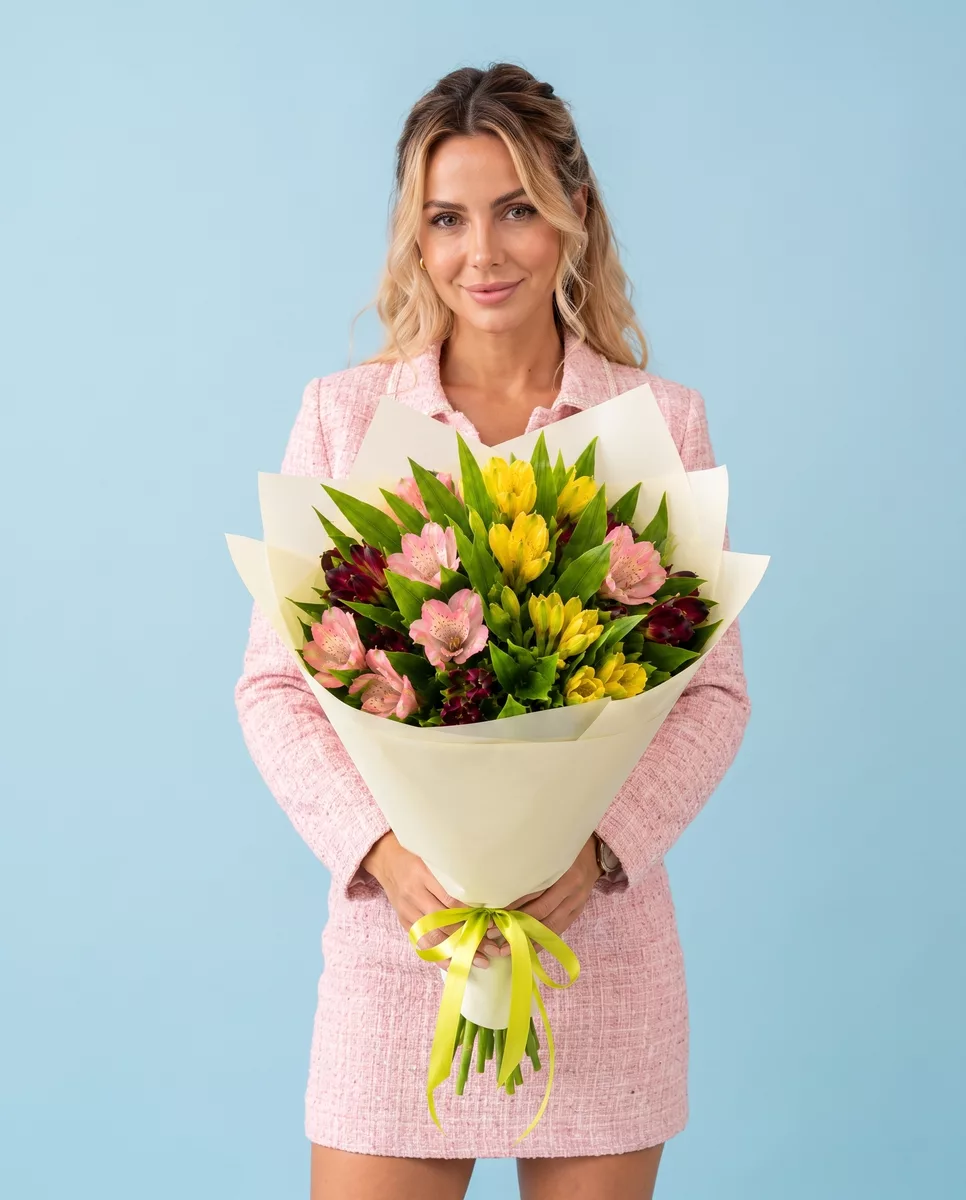
Certain flowers carry clear professional connotations in Russia and others carry romantic ones, and the line is drawn more firmly than in most Western countries. Roses in red or deep burgundy are the most romantic flower in Russian visual language and should be avoided entirely in a workplace context regardless of how tasteful the arrangement looks to you. Pale pink or cream roses in small quantities can work, but only if they are mixed with clearly non-romantic elements like eucalyptus, lisianthus, or alstroemeria. The varieties that work best for professional bouquets are spray chrysanthemums, which are long-lasting and carry no romantic weight at all; freesia, which is fragrant without being heavy and reads as cheerful rather than intimate; lisianthus in white or pale purple, which looks expensive and structured without any romantic association; and alstroemeria, which is practical, long-lived, and understood as a collegial flower. Orchid stems, particularly white phalaenopsis or cymbidium, work well for a senior or older boss because they read as genuinely prestigious without crossing into personal territory. Tulips are strongly associated with March 8 and work perfectly in that context but feel slightly casual at other times. Avoid lilies with heavy fragrance, particularly oriental lilies, in any office context — the scent is too strong for a shared workspace and will cause problems before the flowers even reach her desk. Hydrangea is a good structural filler that adds volume without adding romantic meaning, and it photographs well if the bouquet will appear in office social media.
Sizing and Stem Count: What Looks Right in an Office
Russians pay close attention to stem count, and odd numbers are the rule for live flowers given as gifts. Even numbers are reserved for mourning contexts, so a bouquet of ten or twelve stems is not just aesthetically unusual — it carries a negative association that your boss will notice even if she says nothing. Stick to seven, nine, eleven, or fifteen stems as your working numbers. For a professional context, seven to nine stems is the sweet spot for a single-person gift; it is substantial enough to look intentional but not so large that it dominates a desk or requires a separate vase to be sourced. A collective departmental bouquet can go to fifteen or even nineteen stems without looking excessive. The physical size of the arrangement matters as much as stem count. A bouquet that a person cannot carry in one hand while also holding a bag or opening a door is too large for a workplace gift — it creates a logistics problem for her and draws more attention than is comfortable. Ask the florist to wrap it so it can stand upright in a standard office vase, roughly thirty to forty centimetres of water depth. If you do not know whether she has a vase at the office, which is a reasonable thing not to know, choose a bouquet that comes in a box or a structured bag that can sit on a surface without support. This is not a small detail: a bouquet that immediately wilts sideways on her desk because there is nothing to put it in starts the gift on the wrong note entirely.
Colour Choices and What They Signal in Russian Context
Colour carries specific meaning in Russian flower culture and the professional register has its own palette. White is the safest single colour for a workplace bouquet — it reads as clean, respectful, and formal without any romantic or mourning association when used in living flowers. Cream and pale yellow work similarly well. Pale purple and lavender, particularly in lisianthus or freesia, are widely used in professional contexts and carry a sense of considered taste. Soft coral and peach tones are acceptable and slightly warmer in feeling, appropriate if you know your boss has a relaxed personal style. Bright yellow is cheerful and associated with energy rather than romance, but in a monochrome bouquet it can look slightly cheap unless the variety itself is prestigious — yellow freesia works, a bunch of yellow carnations does not. Avoid deep red entirely, as discussed. Avoid bright orange unless the occasion is specifically celebratory and the rest of the team is also bringing colourful gifts, because in isolation it can look accidental rather than chosen. Pink is the colour that requires the most care: pale blush pink reads as neutral and professional, hot pink or fuchsia reads as personal and youthful in a way that may not suit the register of a senior workplace relationship. If you are ordering without seeing the final arrangement, ask the florist specifically to avoid saturated pinks and to keep reds out of the mix entirely. A florist who understands the context will not be offended by this instruction — it is a professional request, not an unusual one.
Timing, Freshness and Delivery Logistics for Office Orders
Flowers delivered to an office have a harder life than flowers delivered to a home. Office temperatures in Russian buildings are often kept high in winter — twenty-two to twenty-four degrees Celsius is common — and there is rarely a cool spot to store a bouquet until it is given. This means freshness at the moment of delivery is more critical than usual, because the flowers will not have the recovery time they would get at home in a cool hallway. Order from a shop that cuts and assembles on the day of delivery, not one working from pre-made arrangements that have been sitting in a cold room for three days. For a morning presentation, which is the norm for birthdays and March 8, request delivery between eight and nine-thirty, before the working day fully begins and before the office heats up. Afternoon delivery works for a surprise, but if the flowers sit in a warm reception area for two hours waiting to be collected, the outer petals will show it. If you are ordering for March 8 specifically, place the order at least three days in advance — demand across the city is extreme and same-day assembly capacity fills quickly. For other occasions, forty-eight hours notice is sufficient for most arrangements. When giving the delivery address, specify whether the building has a reception desk, whether there is a security checkpoint that requires a visitor pass, and whether the recipient's name on the delivery matches the name she uses at the office — some people use a shortened version of their name professionally and a formal version on official documents, and a mismatch at the security desk causes delays.
The Card: What to Write and What to Leave Out
The card that accompanies the bouquet does more work than the flowers in a professional context, because it states the occasion and the sender explicitly and removes ambiguity that the flowers alone cannot resolve. Keep the text short and factual. A card that says 'Congratulations on your birthday, from the marketing team' needs nothing added to it. If you are giving as an individual, 'With respect and congratulations on March 8' is complete and appropriate. What to avoid: anything that references her appearance, anything that uses the word 'beautiful' in relation to her rather than the flowers, any phrase that could be read as commenting on the personal relationship between you. 'You inspire us' is borderline — it sounds like something from a motivational poster and lands awkwardly in a Russian professional context where directness is valued over sentiment. 'Thank you for your leadership this year' is better because it is specific and professional. If you genuinely do not know what to write, the most reliable formula is occasion plus professional role plus sender identity. 'Happy birthday. With respect from your colleagues in the sales department.' That is enough. In Russian workplace culture, restraint on the card is not coldness — it is appropriate formality, and a senior woman will read it correctly. If the shop offers printed cards, use them rather than handwriting unless your handwriting is confident, because a card that looks rushed or uncertain undermines an otherwise well-chosen bouquet.
Gifting flowers to a Russian female boss is straightforward once you understand the three things she is actually evaluating: whether the occasion justifies the gesture, whether the scale and variety are appropriate to a professional relationship, and whether the framing — collective versus individual, card text, timing — removes ambiguity rather than creating it. Choose varieties with no romantic weight, keep stem counts odd and sizes manageable, order fresh on the day, and write a card that names the occasion and the sender plainly. The rest takes care of itself. We deliver bouquets across Russia in 1–2 hours.
Frequently asked questions
Is it appropriate for a male employee to give flowers to a female boss in Russia?
Yes, on the three main occasions — March 8, her birthday, and a professional anniversary — it is entirely normal. The key is framing: a collective gift from the team is always safer than a solo one. If you are giving individually, choose modest sizing, non-romantic varieties like lisianthus or spray chrysanthemum, and a card that names the occasion explicitly.
What flowers should I absolutely avoid when gifting a boss in a Russian office?
Avoid red roses entirely — they carry a strong romantic signal in Russian culture regardless of arrangement style. Also avoid heavily fragrant oriental lilies, which are too intense for a shared workspace. Even numbers of stems should never be used for a living gift, as even counts are associated with mourning. Bright orange and hot pink are lower risk but can look unintentional rather than chosen.
How far in advance should I order flowers for March 8 delivery to an office?
At least three days before March 8. Demand across Saint Petersburg on that date is the highest of the year, and florists assembling fresh bouquets on the day reach capacity quickly. For other occasions such as birthdays or professional anniversaries, forty-eight hours notice is sufficient for most arrangements, including same-day delivery within the city.
Can I have flowers delivered directly to my boss at her office without her knowing in advance?
Yes, but give the florist precise logistics: the building address, whether there is a security checkpoint, the name she uses at work, and a delivery window when she will actually be present. A bouquet waiting at reception in a warm lobby for two hours loses quality quickly. Morning delivery before nine-thirty works best for freshness and for the social moment of presenting the gift.
What stem count is appropriate for a professional bouquet in Russia?
Always use an odd number — seven, nine, eleven, or fifteen stems are the most practical for workplace gifts. Even numbers carry a mourning association in Russian flower culture and will be noticed. For a single-person gift, seven to nine stems is the right scale. A collective departmental bouquet can go to fifteen or nineteen without looking excessive for a senior recipient.
Ready to send a bouquet?
Pick a city, choose the flowers, and we will hand them over with a photo confirmation.
Choose a city →