
Mother's Day Flowers for Mom in Russia: Dates, Varieties and How to Order
Every week someone calls or messages us from Berlin, Toronto or Dubai asking the same thing: when exactly is Mother's Day in Russia, and can we get flowers to my mum in Saint Petersburg by then? The answer is yes, but the date catches people off guard, and the wrong flower choice is the second most common mistake we see. This article gives you the dates, the varieties that actually work, and the exact steps to place an order from outside the country without stress.
When Is Mother's Day in Russia — and Why It Confuses Everyone
Russia celebrates Mother's Day on the last Sunday of November, not in May. This is the official federal holiday, established in 1998, and it applies across the entire country including Saint Petersburg. The date shifts each year — in 2024 it falls on 24 November, in 2025 on 30 November — so always check the calendar rather than assuming it matches the date you know from home. Many people ordering from abroad assume the holiday is in May like in the United States or the United Kingdom, and they miss the actual date entirely, sometimes by six months. There is also 8 March, International Women's Day, which in Russia carries enormous cultural weight and is treated very much like a second Mother's Day — flowers, gifts and family gatherings are standard. Most Russian mothers receive bouquets on both occasions. If you are planning ahead, mark both dates: 8 March and the last Sunday of November. Florists in Saint Petersburg see peak demand on both days, which means same-day availability of certain varieties can tighten quickly. Ordering 48 hours in advance on either date is a practical minimum, and for the most popular stems — garden roses, peonies when in season, and large-headed spray chrysanthemums — earlier is always safer. Knowing the correct date is the single most important step; everything else follows from there.
Bouquets we can deliver



What Russian Mothers Actually Receive — the Most Requested Varieties
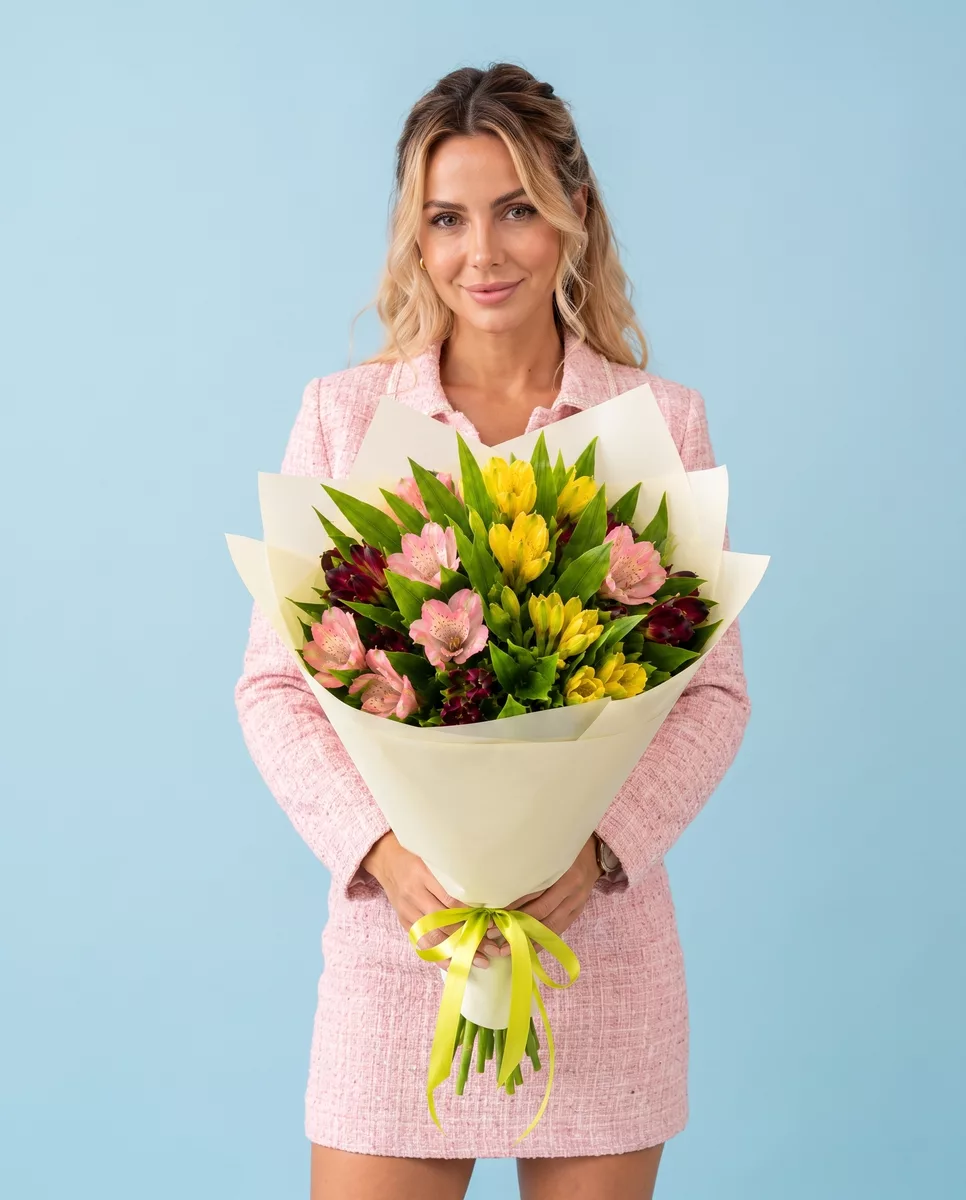
The flowers Russian mothers ask for and receive most often are roses, chrysanthemums, alstroemeria, carnations and, when the season allows, peonies and eustoma. Roses lead by a wide margin. The most commonly ordered varieties in our shop are garden-style roses with full, cupped heads — David Austin types like Juliet and Keira — as well as classic long-stemmed hybrid teas in cream, pale pink and soft coral. A bouquet of 25 or 51 stems is a typical size for a mother's gift; odd numbers are the Russian convention for living recipients. Chrysanthemums are the practical choice for November delivery because they are robust in cold weather, hold well in transit and last up to two weeks in a vase. Large single-headed varieties such as Zembla and Anastasia are particularly popular. Alstroemeria is requested for its longevity and the way it fills out mixed bouquets without overpowering other stems. Carnations, which fell out of fashion in Western Europe, remain genuinely loved in Russia — especially the large-headed Dianthus caryophyllus in white, red and bicolour. Eustoma, sold as lisianthus in some markets, is a favourite for its peony-like appearance and soft texture; it travels well and suits both minimalist and lush arrangements. For 8 March orders, tulips are the single most requested flower in Russia — millions are sold in the week before the holiday — and we stock them in single colours and mixed bunches throughout February and early March.
Flowers That Do Not Travel Well to Russia in Late November
November is cold in Saint Petersburg — daytime temperatures regularly sit between minus two and plus four degrees Celsius — and that affects which flowers survive delivery. Tropical varieties are the first casualty. Anthurium, bird of paradise and heliconia are sensitive to temperatures below ten degrees and can show cold damage within minutes of exposure to outdoor air during the handover at the door. We do not recommend them for November orders unless the recipient lives in a building with a warm lobby and can receive the bouquet immediately. Hydrangeas are another variety to approach carefully in late autumn. They wilt fast if the stems are out of water for more than an hour, and in cold weather the heads can bruise during transit. If you want the full, rounded look of a hydrangea arrangement, it is a better choice for an 8 March order when indoor temperatures are more stable and deliveries move faster. Delicate open garden flowers — anemones, ranunculus, sweet peas — are genuinely beautiful but fragile. They suit a recipient who is home and will place them in water within the hour. If your mother works long hours or lives alone and may not be home at a precise time, ask us to build the bouquet around hardier stems like chrysanthemums, roses and alstroemeria, which tolerate a couple of hours in a cool hallway without visible damage. Telling us the delivery situation — building type, whether someone will be home — helps us choose the right stems for the conditions.
Ordering From Outside Russia: What You Need to Prepare
Ordering flowers for delivery in Saint Petersburg from abroad is straightforward if you have the right information ready before you start. The most critical piece is the recipient's full address in Russian or in a clear Latin transliteration that includes the street, building number, apartment number and entrance number if the building has more than one. Many apartment buildings in Saint Petersburg have multiple entrances — podezdy — and without the correct entrance number the courier can spend twenty minutes finding the right door. The second thing you need is the recipient's mobile phone number with the Russian country code, which is plus seven. Our courier will call ahead to confirm the time, and without a working local number the delivery cannot be completed. If your mother does not have a Russian mobile number, provide the number of someone who can let the courier in. Payment from abroad is accepted by card through a secure link we send after the order is confirmed — no Russian bank account is required. When placing the order, specify the preferred delivery window: morning, afternoon or evening. For Mother's Day and 8 March we operate extended hours, but slots fill quickly. If you are ordering across time zones, be precise about whether your requested time refers to Saint Petersburg local time or your own. Saint Petersburg is UTC plus three year-round. A note in the order comments field about the occasion and any message for the card is helpful and costs nothing extra.
How Far in Advance to Order and Why Timing Matters
For standard dates we can handle same-day orders placed before noon Saint Petersburg time, and we deliver within one to two hours of confirmation. Mother's Day in late November and 8 March are not standard dates. On those two days demand is several times higher than normal, and the varieties that sell out first are the ones most associated with the occasion — tulips before 8 March, roses and large chrysanthemums before the November holiday. We recommend placing your order at least 48 hours before the desired delivery time on peak days, and 72 hours is more comfortable if you want a specific variety or a large bouquet of more than 51 stems. If you are ordering from a time zone that is significantly behind Saint Petersburg — the east coast of the United States is eight hours behind, the west coast eleven — place the order the day before you think you need to, because by the time your morning arrives it may already be the afternoon of the holiday in Saint Petersburg. For 8 March specifically, we see the highest volume of international orders in the 48-hour window before the holiday. Flower procurement for that period is done well in advance, but late orders risk substitutions on specific varieties. If a substitution is ever necessary, we contact you before making any change. The safest approach: decide on the bouquet, confirm the address and phone number, and place the order three days out.
Writing a Card Message From Abroad — What Works in Russian Context
A card with the flowers is standard practice in Russia, and most recipients expect one. If you are ordering from outside the country and want the message in Russian, you can write it in English and ask us to translate it — we handle this regularly and will not alter the meaning. Keep the message short: two or three sentences are more than enough, and a long paragraph on a small card looks cramped. The most common phrases people ask for are variations on happy holiday, I am thinking of you, and I love you and miss you. If you want to write the message yourself in Russian transliteration, the most reliable phrase for Mother's Day is S Dnyom Materi, which means Happy Mother's Day. For 8 March, S Vosymym Marta or S Prazdnikom are both correct and widely understood. Russian mothers appreciate directness in card messages — a sincere sentence is received better than an elaborate verse that sounds translated. If the bouquet is from children or grandchildren rather than one person, specify that in the order so the card can reflect it: From your children abroad reads very differently from From Anna. We print the card in the shop and attach it to the bouquet before dispatch, so there is no need to send anything physical from your end. If you want no card at all, simply note that in the comments — some customers prefer the bouquet to speak for itself.
What to Check Before You Confirm the Order
Before you click confirm or send us the final message, run through four things. First, verify the delivery address includes the apartment number and entrance number — missing either one is the leading cause of failed deliveries in Saint Petersburg. Second, confirm the recipient's Russian mobile number is correct and that the person will have their phone on them around the delivery window; if they are likely to be in a meeting or a medical appointment, choose a different time slot. Third, check that the date you have entered corresponds to Saint Petersburg local time, not your own time zone — an order for 10:00 AM that you placed thinking in New York time will arrive in the evening in Saint Petersburg. Fourth, read back the bouquet composition and stem count: if you ordered 25 roses in cream and the confirmation shows 15 in pink, raise it before the order goes to the workroom, not after. A note on building access: many apartment buildings in Saint Petersburg have an intercom system at the street door. If your mother's building requires a code or a call to a specific apartment number to open the street door, include that in the order comments. Our courier will have the information and will not need to call you at an inconvenient hour. These four checks take two minutes and prevent the majority of problems we see with international orders. Once the order is confirmed and the bouquet is assembled, we send a photo before dispatch on request — ask for this in the comments if you want it.
Russian Mother's Day falls in late November, and 8 March is equally important — knowing both dates puts you ahead of most people ordering from abroad. The flowers that work best for these occasions are roses, chrysanthemums, alstroemeria and, for 8 March, tulips. Order at least 48 hours before the holiday, have the full address and Russian mobile number ready, and double-check the time zone when you enter the delivery window. Those three steps cover the vast majority of what can go wrong with an international flower order, and they take less time than choosing the bouquet. We deliver bouquets across Russia in 1–2 hours.
Frequently asked questions
Can I order flowers for my mother in Saint Petersburg if I live outside Russia?
Yes. We accept international card payments through a secure link sent after order confirmation. You need the recipient's full Russian address including apartment and entrance number, and a working Russian mobile phone number for the courier. No Russian bank account or local contact is required on your end. We communicate with you in English throughout the process.
What is the difference between Russian Mother's Day and 8 March for flower orders?
Russian Mother's Day in late November is a quieter holiday than 8 March. On 8 March, demand for tulips and roses is at its annual peak and advance ordering is essential. For the November holiday, roses and chrysanthemums are the dominant requests. Both dates require ordering at least 48 hours ahead if you want specific varieties and guaranteed morning delivery slots.
How long do the flowers last after delivery in November?
Chrysanthemums last up to fourteen days in a vase with fresh water and a cool room. Roses typically last seven to ten days depending on the variety and room temperature. Alstroemeria holds well for ten days or more. We condition all stems before assembly, and we include care instructions with each bouquet so the recipient knows how to maximise vase life.
What happens if my mother is not home when the flowers arrive?
Our courier calls the recipient before arriving. If there is no answer, we attempt contact again and then reach you as the ordering party. We do not leave flowers unattended in a hallway or with a neighbour without your explicit instruction. If the delivery window needs to shift, we reschedule within the same day where possible. This is why a working Russian mobile number is essential.
Can I request a specific bouquet I have seen on your website or social media?
Yes. Reference the bouquet by name or send us a screenshot when placing the order. If a specific variety in that arrangement is unavailable on your chosen date, we will contact you before making any substitution. For peak dates like 8 March and the November holiday, confirming your chosen bouquet three days ahead gives us the best chance of sourcing exactly what you want.
Ready to send a bouquet?
Pick a city, choose the flowers, and we will hand them over with a photo confirmation.
Choose a city →