
New Year Flowers in Russia: Traditions, Varieties and Timing
Most customers outside Russia are surprised to learn that the biggest floral holiday here is not Christmas but New Year's Eve — January 1st is when families gather, champagne is poured, and flowers arrive at the door. Christmas is celebrated on January 7th in the Orthodox calendar and is quieter; New Year's is the national celebration with gifts, tables set for twelve, and bouquets expected before midnight. If you are ordering for someone in Saint Petersburg or anywhere else we deliver across Russia, understanding this calendar shift changes everything about your timing, your variety choices, and what the recipient will actually expect to find when the bell rings.
Why New Year, Not Christmas, Is the Flower Holiday in Russia
Soviet-era policy in the twentieth century moved the public celebration away from Christmas and attached all the gift-giving, tree-decorating, and family ritual to January 1st. That shift stuck. Today the decorated spruce or pine in the living room is called a New Year tree, not a Christmas tree, and the figure in the red coat who delivers presents on the night of December 31st is Ded Moroz — Grandfather Frost — not Father Christmas. Flowers follow the same logic: they are bought and delivered before midnight on December 31st, not on December 25th. Orthodox Christmas on January 7th does prompt some church flowers and small home arrangements, but the commercial and emotional peak for florists is the last evening of the year. This matters practically because the delivery window on December 31st is extremely compressed. Most recipients want flowers on the table before guests arrive, which means orders cluster between 14:00 and 22:00 Saint Petersburg time. Anyone ordering from abroad needs to account for time zones — Moscow and Saint Petersburg are UTC+3 year-round, so a customer in London placing an order at 18:00 local time is already at 21:00 in Russia. Booking a slot early in the afternoon Russian time is the safest move. The cultural weight of the occasion also means that a wilted or late bouquet lands harder here than a missed birthday delivery would in many other countries: New Year flowers are a statement, not an afterthought.
Bouquets we can deliver

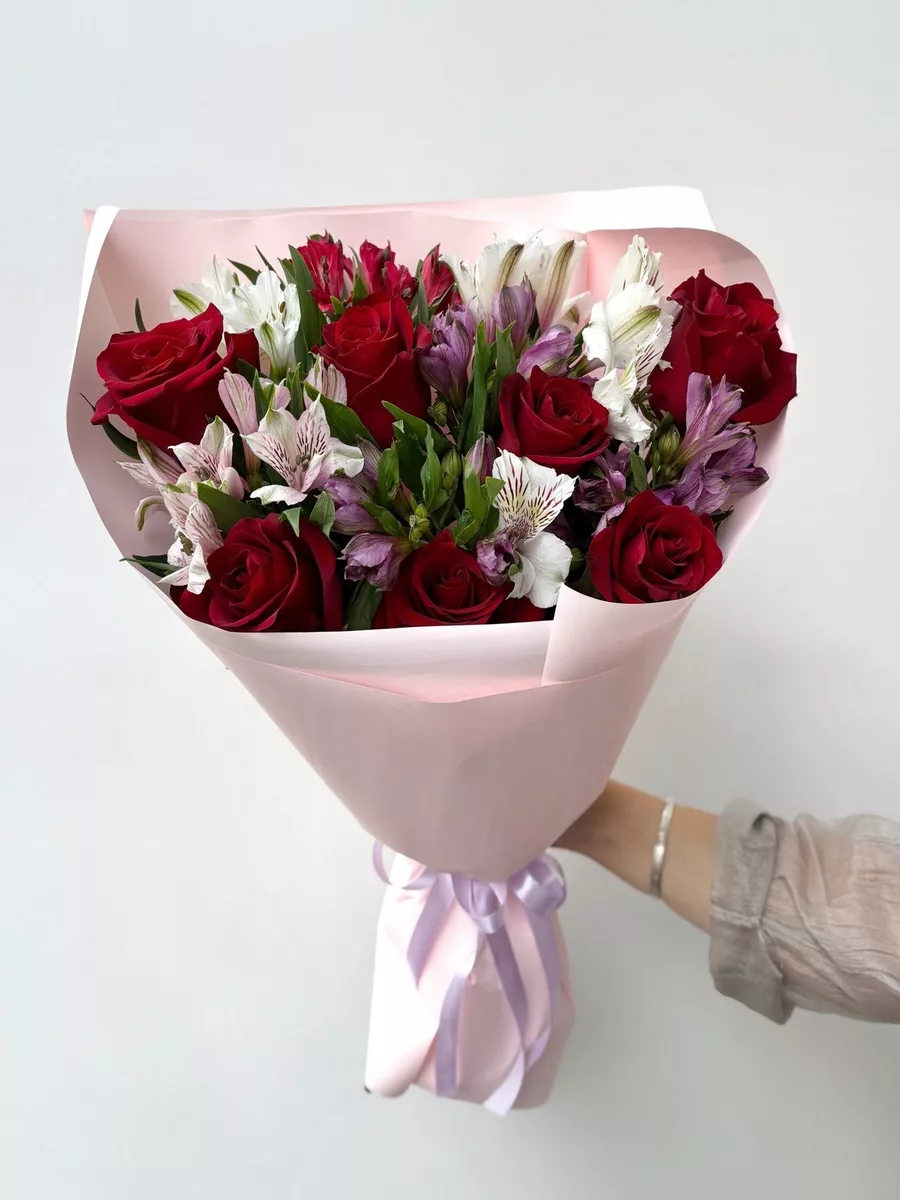

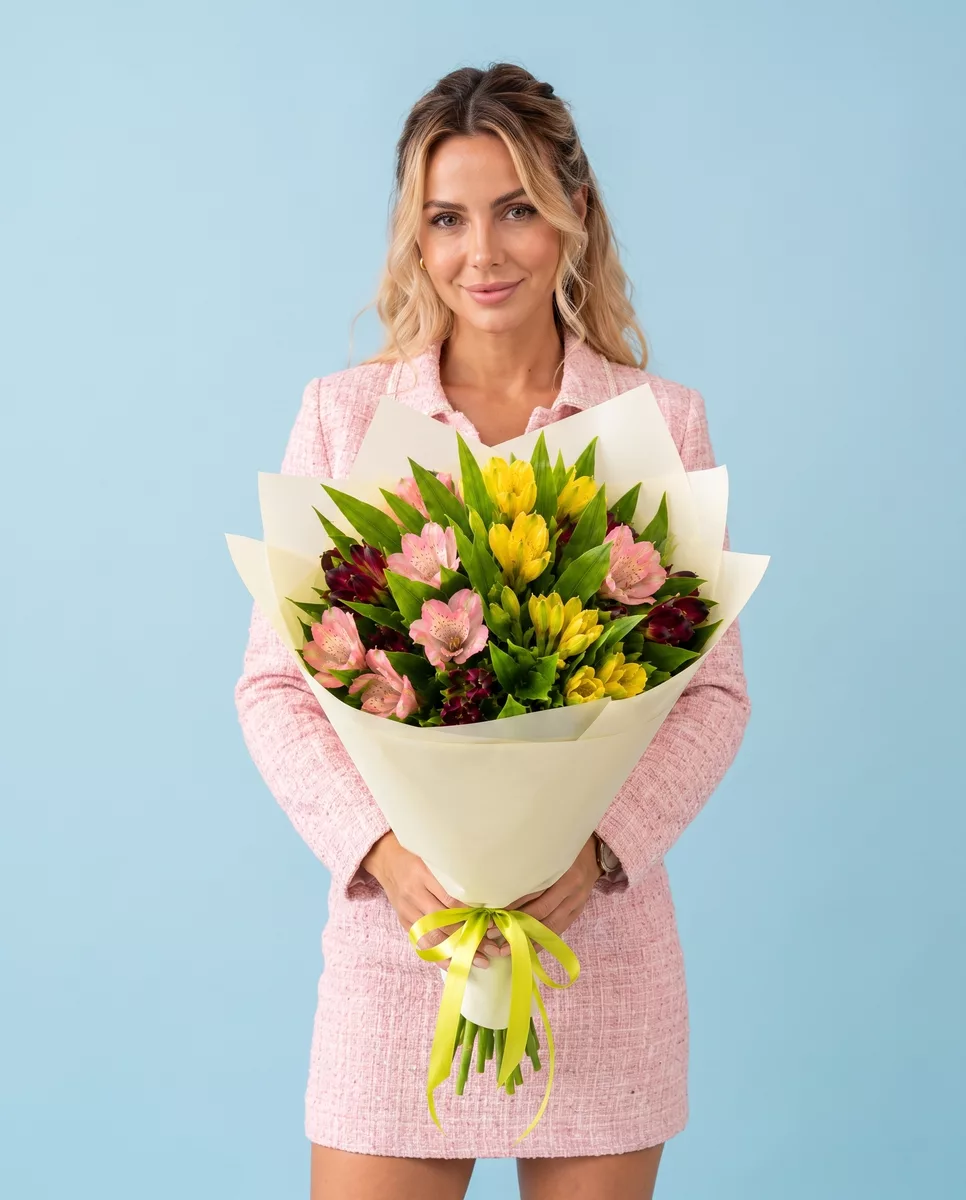
Which Flowers Russians Actually Put on the New Year Table
The most requested varieties for December 31st lean toward bold color and long vase life, because the bouquet needs to look good through the night and ideally into the first days of January. Red and white spray roses are consistently the top sellers, followed by standard large-headed roses in deep red or burgundy. Alstroemeria in red, orange, and white holds extremely well in heated apartments and costs less per stem than roses, making it a practical filler that also adds texture. Chrysanthemums — both the large single-headed santini type and the smaller spray varieties — are popular because they last ten to fourteen days in cool indoor conditions and come in seasonal gold, bronze, and white tones that suit the festive table. Gerberas in red and orange are common in mid-range bouquets but need to be cut fresh on the day because their stems are prone to bending in warm rooms. Tulips appear frequently despite being a spring flower: Dutch forced tulips are available through December and January, and Russians associate them with celebration rather than with any specific season. What customers often get wrong is ordering lilies for a New Year dinner table. Oriental lilies smell intensely as they open, which can overwhelm a dining room, and the pollen stains tablecloths and clothing. If lilies are specifically requested, we recommend Asiatic varieties, which are nearly scentless and open more predictably. Eucalyptus and ruscus are standard greenery choices that add volume without competing with the main flowers.
Arrangements That Work for the Festive Season
Round, dense bouquets in the Dutch style are the dominant format for New Year in Russia — a tight spiral of roses or mixed stems with minimal greenery showing, wrapped in kraft paper or matte film and tied with a wide satin ribbon. These photograph well, hold their shape during transport, and sit upright in a standard vase without rearranging. Sizes run from fifteen stems for a modest gift up to fifty-one or seventy-five stems for a significant gesture, and odd numbers are the Russian convention for living flowers — even numbers are reserved for mourning occasions, so always confirm the stem count before finalizing an order. Boxed arrangements in hat boxes have grown popular over the last five years. They use a foam base that keeps stems hydrated for eighteen to twenty-four hours without a vase, which suits recipients who are hosting and do not want to find a container immediately. Red roses packed in a black or white round box are the single most ordered New Year product in our shop. Festive additions that customers ask about include pine branches, fir tips, cotton stems, and dried orange slices. Pine and fir add a cold, resinous scent that reinforces the seasonal feeling, and they are genuinely hardy in cold transport conditions. Cotton stems and dried citrus are decorative rather than fragrant and hold indefinitely, so they work well in mixed arrangements where fresh flowers will eventually be swapped out. Avoid adding fresh mistletoe to Russian New Year bouquets — it is not part of the local tradition and most recipients will not recognize the reference.
Temperature, Transport and What Happens to Flowers on December 31st
Saint Petersburg in late December averages minus three to minus eight degrees Celsius, and temperatures can drop further overnight. This is the single biggest variable that determines whether an order arrives in good condition. Cold is not automatically the enemy of cut flowers — most varieties actually benefit from cool storage — but rapid temperature swings are damaging. A bouquet taken from a cold vehicle into a warm apartment and then left near a radiator will show petal browning and wilting within hours. We wrap orders in insulating sleeves and use sealed packaging for any delivery when outdoor temperatures are below minus five, and recipients should be told to let the flowers rest in a cool room for thirty minutes before moving them to a warm display spot. Roses are the most cold-sensitive of the common New Year varieties. Below minus ten, outer petals can freeze and then collapse as they thaw, which looks like bruising. Chrysanthemums and alstroemeria tolerate cold far better. If a customer is ordering roses for a late-evening delivery on December 31st and the forecast is severe, we will flag this and may recommend a chrysanthemum-based alternative or suggest an earlier delivery slot when temperatures are less extreme. Customers ordering from warm climates sometimes underestimate how seriously Russian florists treat the cold chain. It is not a formality — a bouquet left outside a locked door for twenty minutes at minus ten degrees will not recover. Delivery instructions should always include a phone number where the recipient can be reached, and someone should be home or available to receive the order.
Ordering for the Midnight Deadline: Slots, Lead Times and Mistakes
December 31st is the single highest-demand delivery day of the year, ahead of March 8th, Valentine's Day, and any other date. Orders placed on the day itself after noon carry a significant risk of missing the preferred time slot, and by 18:00 most same-day windows for evening delivery will be full. The reliable approach is to order on December 29th or 30th and specify a delivery window between 16:00 and 20:00 on December 31st — this gives the recipient time to put the bouquet in water before guests arrive and before the household becomes too busy to answer the door. Orders for December 31st placed before December 25th can usually guarantee any time slot requested. The most common mistake we see is customers assuming that because they are ordering online at midnight their time, the order is placed for the following morning. It is placed immediately, but if that midnight corresponds to 03:00 Saint Petersburg time, the order enters the queue for the next working slot, which on December 31st may already be constrained. Always check the Saint Petersburg time when placing the order and read the confirmation email for the assigned delivery window. A second common mistake is providing only a building address without an apartment number, entry code, or floor. In Russian cities, residential buildings often have coded entry doors and multiple staircases. A driver who cannot reach the recipient and cannot enter the building will wait a fixed period and then return the order. This is not a failed delivery in terms of our process, but it is a failed delivery in terms of the occasion. Fill in every address field completely.
New Year Corporate Flower Orders: What Offices and Restaurants Need
Corporate orders for New Year in Russia follow a different pattern from individual gifts. Companies typically want flowers delivered to the office on December 29th or 30th — the last working days before the long holiday break that runs from January 1st through January 8th. These orders are usually large: multiple bouquets for department heads, table centerpieces for reception areas, and occasionally full arrangements for conference rooms used for end-of-year celebrations. The most practical formats for offices are low, wide arrangements in ceramic or glass vessels that do not obstruct sightlines across meeting tables, and individual bouquets of fifteen to twenty-five stems for personal gifts. Restaurants ordering for New Year's Eve service typically want arrangements that look striking under warm lighting, hold their shape for a five to six hour service, and do not drop petals onto plates. Tall arrangements in narrow vases with roses and eucalyptus work well for this. Gerberas, as noted above, are risky for long evening service because of stem collapse; chrysanthemums and roses are more reliable. Corporate customers should submit orders with full delivery details — floor, contact name, and a phone number for the receiving person — no later than December 26th. Orders of more than ten bouquets to a single address benefit from a scheduled delivery window so that one person can sign for everything at once rather than managing multiple arrivals. We can split a corporate order into two delivery runs if the office has two separate floors or reception points, but this needs to be specified at the time of ordering, not on the day.
What to Check Before You Confirm a New Year Flower Order
Before submitting any order for December 31st delivery, run through five practical checks. First, confirm the recipient's full address including apartment number, staircase number if applicable, floor, and any entry code for the building door — without these, delivery to a Russian residential building is genuinely uncertain. Second, check that the phone number provided belongs to someone who will actually be at the delivery address during the requested window; if the recipient is at work until 19:00, do not book a 17:00 slot. Third, verify the stem count is an odd number for a traditional bouquet — even numbers are associated with mourning and will be noticed by Russian recipients. Fourth, if you are ordering lilies, confirm with us whether the variety is Asiatic or Oriental, and consider whether the setting is appropriate for a strongly scented flower. Fifth, check the delivery date in Saint Petersburg local time, not your local time, and read the order confirmation to verify the window assigned matches what you intended. Beyond these logistics, think about the vase situation. Hat box and foam-based arrangements need no vase and are ideal if you are unsure whether the recipient has one available. Standard bouquets need a tall vase of at least thirty centimeters for roses and forty centimeters for long-stemmed varieties — if this is a first-time gift to someone whose home you do not know well, the box format removes one variable. Finally, add a card message in Russian if possible — even a brief Novym Godom, meaning Happy New Year, means more than an English message to most Russian recipients.
New Year flowers in Russia are not a decorative extra — they are part of the core ritual of the evening, expected on the table alongside the champagne and the mandarin oranges that are themselves a New Year fixture. The varieties that work best are ones that tolerate heated apartments, hold color through a long night, and arrive in a format that requires no effort from a host who is already busy. Order early, fill in every address field, pick an odd stem count, and book a slot in the afternoon rather than the evening. The midnight deadline is real, and the flowers need to be there before it arrives. We deliver bouquets across Russia in 1–2 hours.
Frequently asked questions
Do Russians give flowers on Christmas or on New Year?
The main gift-giving celebration in Russia falls on January 1st, not December 25th. Orthodox Christmas is January 7th and is observed more quietly. Flowers are traditionally given and delivered on New Year's Eve, December 31st, which is why the delivery window that day is the busiest of the year for any Russian flower shop.
Why do Russian bouquets always have an odd number of stems?
Even-numbered bouquets are associated with funerals and mourning in Russian tradition, so living flowers are always arranged in odd numbers — fifteen, twenty-five, fifty-one, and so on. This is a firmly held convention and most Russian recipients will count the stems, so confirm the number before finalizing any order intended as a celebration gift.
Which flowers last longest in a warm Russian apartment over New Year?
Chrysanthemums — both large-headed and spray varieties — reliably last ten to fourteen days in a heated apartment. Alstroemeria and standard roses also hold well if cut stems are trimmed and water is changed every two days. Gerberas and open tulips are the shortest-lived options in warm indoor conditions and are better suited to same-day display than multi-day arrangements.
How early should I order flowers for December 31st delivery in Saint Petersburg?
Ordering by December 29th gives the best choice of delivery slots. Same-day orders placed on December 31st after noon face very limited afternoon windows, and evening slots are typically fully booked by mid-afternoon. If you are ordering from a different time zone, convert to Saint Petersburg time — UTC plus three — before checking availability.
What happens to flowers if the temperature outside is below minus ten degrees?
Rose petals can freeze and collapse on thawing if exposed to temperatures below minus ten for more than a few minutes. We use insulating packaging for cold-weather deliveries, but recipients should be available to take the order immediately. Chrysanthemums and alstroemeria tolerate cold significantly better than roses and are worth considering when severe frost is forecast on delivery day.
Ready to send a bouquet?
Pick a city, choose the flowers, and we will hand them over with a photo confirmation.
Choose a city →