
New Year's Eve vs Orthodox Christmas: When to Send Flowers in Russia
Customers ordering for the first time to a Russian address often assume the big flower moment is December 25. It is not. Russia runs on two separate festive peaks — New Year's Eve on December 31 and Orthodox Christmas on January 7 — and they behave very differently from a florist's point of view. Demand, variety availability, delivery windows and recipient expectations shift between the two dates in ways that catch people off guard. This article lays out both occasions plainly so you can decide what to send, when to order, and what to watch for.
Why Russia Has Two Winter Celebrations
The Russian festive calendar split into two distinct events after the Soviet period, when Christmas was suppressed and New Year's Eve absorbed most of the gift-giving and decoration traditions that elsewhere belong to December 25. When the Russian Orthodox Church calendar was no longer restricted, January 7 re-emerged as Christmas, but New Year's Eve had already become the dominant secular holiday with champagne, gifts under the fir tree and family gatherings. Today both dates are public holidays, and both carry genuine celebratory weight. New Year's Eve is louder, more universal and more commercial — roughly equivalent to Christmas and New Year combined in Western Europe. Orthodox Christmas on January 7 is quieter, more family-centred and more religious in character, though many non-churchgoing Russians mark it simply as an extension of the festive season. For the florist, the practical difference is this: December 31 sees a surge in large, showy bouquets ordered last-minute by people who want to make an impression, while January 7 brings a steadier, more considered wave of orders, often sent to older relatives or to mark a visit to someone's home. Understanding which occasion you are ordering for changes the bouquet, the timing and the message entirely.
Bouquets we can deliver



December 31: The Biggest Flower Day of the Russian Winter
New Year's Eve is the single highest-volume flower day of the Russian winter, comparable in demand to March 8, which is International Women's Day and the absolute peak of the Russian floral year. Orders for December 31 start arriving in meaningful numbers from December 27 onward, and the final 24 hours before midnight see a sharp spike in same-day requests. The varieties that move fastest on this date are red and white roses in long-stemmed formats — typically 60 to 80 centimetre stems — along with tulips, which arrive from Dutch and domestic growers in late December and are genuinely fresh at this time of year. Spray chrysanthemums, alstroemeria and hypericum berries are workhorses in New Year's compositions because they hold their shape and colour under the warm indoor temperatures of a Russian apartment on a party night, which can reach 24 to 26 degrees Celsius with guests present. Customers frequently underestimate how quickly flowers wilt in a heated flat when nobody is tending them during a celebration. The mistake we see most often is ordering delicate garden roses or ranunculus for a December 31 delivery without asking whether the recipient will have time to put them in water promptly. Standard roses and chrysanthemums are more forgiving. If you want something striking, a mono bouquet of 25 or 51 red roses in a kraft wrap remains the most recognised New Year's gesture in Russia and reads clearly to any recipient regardless of age.
What Orthodox Christmas on January 7 Actually Looks Like
January 7 is a public holiday in Russia, and for practising Orthodox Christians it follows a period of fasting that ends on the evening of January 6 with a church service. The celebration on January 7 itself is centred on family meals, home visits and the exchange of modest gifts. It is not a large commercial event in the way New Year's Eve is, and many Russians who are not religiously observant still treat it as a quieter continuation of the festive period rather than a standalone occasion. Flowers sent on January 7 therefore tend to be more intimate in scale — a bouquet of 7 or 11 stems rather than 51, and often in white, cream or pale pink rather than the bold reds of New Year's. White alstroemeria, cream spray roses, white lisianthus and waxflower are all well-suited to this occasion. Lisianthus in particular holds well in the cold temperatures of early January, when recipients may be moving between a chilly entrance hall and a warm living room. One thing worth knowing: many florists in Russia are themselves celebrating on January 7, so staffing can be lighter than on December 31. At Five Flowers we maintain full delivery operations on both dates, but it is worth placing your January 7 order by January 5 at the latest to guarantee your preferred bouquet is assembled from fresh stock rather than whatever remains after the New Year's Eve rush has cleared the coolers.
Varieties That Work Across Both Occasions
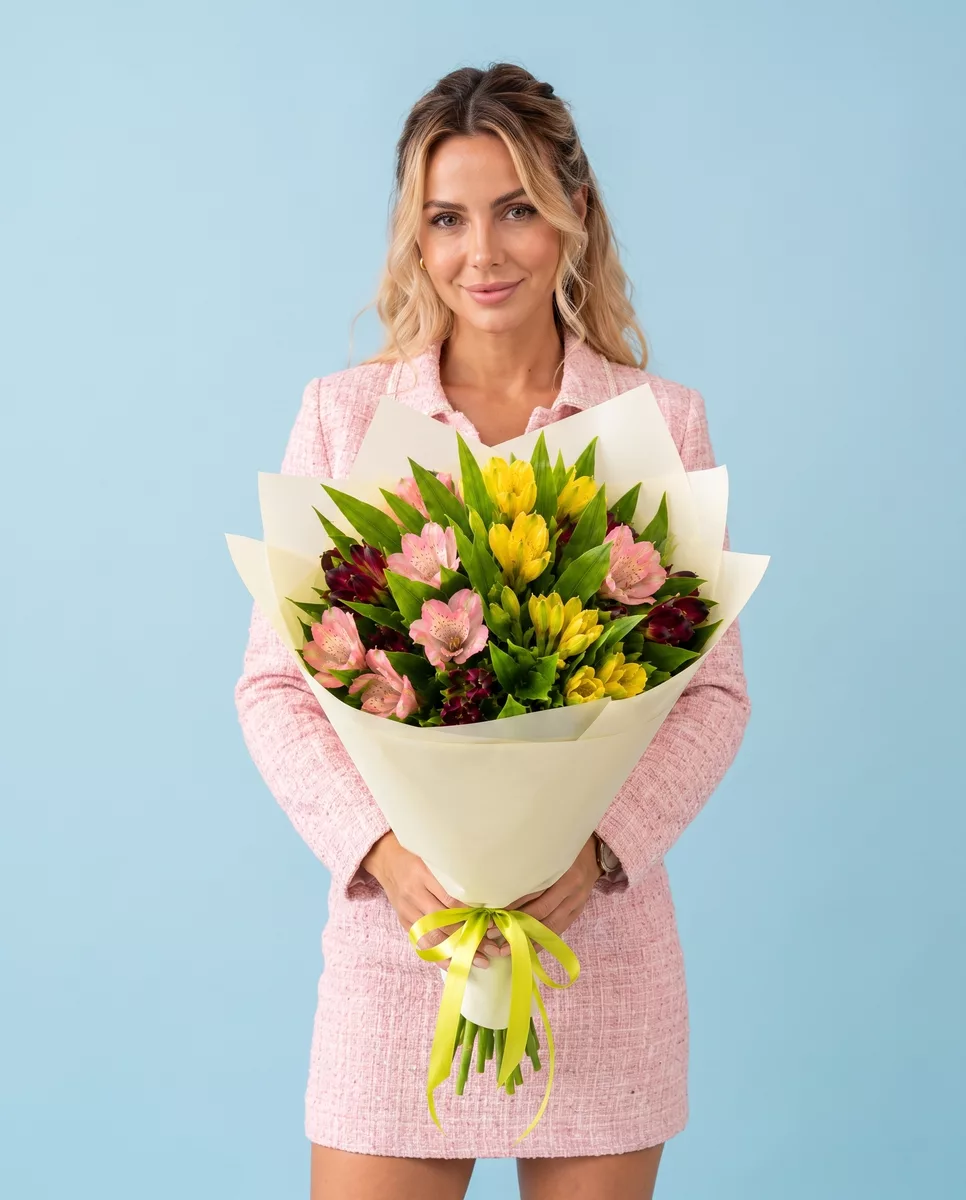
Some varieties perform reliably across both December 31 and January 7 without looking out of place at either. Standard roses are the obvious example — a well-conditioned rose with a tight bud will last seven to ten days in water, which means it bridges both celebrations if ordered for New Year's Eve. Tulips are seasonally appropriate in late December and early January, and their upright posture and clean lines suit both the festive energy of New Year's and the quieter tone of Christmas. Alstroemeria is a practical choice at both dates because it is robust, long-lasting and available in a wide colour range including the whites and creams that read well for January 7 and the yellows and oranges that complement New Year's arrangements. Hypericum berries — the small, round berries that appear in red, green and burgundy — are a useful structural element in winter bouquets because they add texture and hold their form even in warm rooms. Eucalyptus is worth mentioning separately: it is used heavily in winter compositions for its grey-green foliage and its ability to stay fresh for ten or more days, and it pairs well with almost any flower at either festive date. What does not work well across both occasions is anything with very delicate petals that bruise easily in transit during cold weather — garden anemones and sweet peas, for example, are better reserved for spring and summer deliveries rather than January in Saint Petersburg, where outdoor temperatures regularly fall below minus ten degrees Celsius.
Timing Your Order: The Windows That Matter
The delivery window on December 31 compresses significantly from around noon onward. Orders placed before 10 in the morning on New Year's Eve have the widest choice of bouquets and the most reliable delivery slots. Orders placed after 2 in the afternoon on December 31 will be fulfilled, but the choice of specific varieties narrows as stock moves quickly, and delivery may fall later in the evening than the customer expects. If you are sending to someone who hosts a New Year's gathering that starts at 8 or 9 in the evening, a bouquet arriving at 11 pm is not useful. The practical advice is to order by December 29 if you want a guaranteed morning delivery on December 31, or to order on the morning of December 31 itself if you are comfortable with an afternoon window. For January 7, the pressure is different. The rush is lower, but stock replenishment after the New Year's Eve surge takes a day or two. Flowers ordered for January 7 delivery that are placed on January 1 or 2 may draw from stock that was received before December 31 and has already spent several days in the cooler. Placing a January 7 order on January 4 or 5 gives the shop time to receive a fresh delivery from growers and ensures the bouquet has maximum vase life when it arrives. Delivery across Saint Petersburg on January 7 operates normally within our standard one-to-two-hour window.
Common Mistakes When Ordering for Both Dates
The most frequent mistake on New Year's Eve orders is leaving the delivery time unspecified and assuming the bouquet will arrive in the morning. Without a specified window, orders are dispatched in queue order, which on December 31 can mean a mid-afternoon or early-evening arrival. If the recipient needs flowers on the table before guests arrive at 7 pm, state that explicitly when ordering. The second common mistake is choosing a bouquet with a large proportion of tropical flowers — birds of paradise, anthuriums, heliconias — on the assumption that they look impressive. These varieties are sensitive to cold and can suffer cell damage if left outside a door in January temperatures while the recipient is out. For January 7, the most common error is ordering too late and receiving a bouquet assembled from post-New-Year's-Eve remnants that have been in water for five or six days. A bouquet that looks full in a photograph can arrive with soft stems and drooping heads if the stock is old. Ask when placing the order whether the flowers are from a fresh intake or from pre-holiday stock. Another mistake specific to January 7 is treating it as a minor occasion and under-ordering — sending three stems when the recipient is expecting a proper bouquet. Seven stems is a reasonable minimum for a Christmas visit, and eleven or fifteen is appropriate for a close relative or a host. Russian etiquette around even numbers of flowers in a bouquet is relevant here: even numbers are associated with mourning, so stick to odd numbers for any celebratory delivery.
What to Check Before You Confirm Your Order
Before confirming any order for December 31 or January 7, run through four practical checks. First, confirm the delivery address is within the delivery zone and that the recipient will be home or reachable by phone during the delivery window — on both festive dates, couriers cannot wait extended periods at an address because the schedule is dense. Second, check that the bouquet you are ordering is described as available from current stock, not as a pre-order item that depends on a future flower intake. Third, if you are ordering roses, confirm the stem length: 40-centimetre roses and 70-centimetre roses are priced differently and look different in the hand, and the longer stem is generally the right choice for a New Year's gift. Fourth, confirm the packaging. On New Year's Eve, a simple kraft wrap is standard and appropriate. On January 7, a white or ivory paper wrap or a light fabric ribbon reads better for the quieter, more personal tone of the occasion. If you are sending flowers from abroad to a Russian address and are unfamiliar with the building numbering system in Russian cities, double-check that the address includes the apartment number, the entrance number if the building has multiple entrances, and the floor — all of which are necessary for a courier to deliver to the correct door without calling the recipient and spoiling the surprise. Five Flowers delivers across Saint Petersburg and can reach most city districts within one to two hours of order confirmation on both festive dates.
The Russian winter gives you two genuine occasions to send flowers, and they reward different approaches. December 31 calls for bold, sturdy bouquets ordered early, with a confirmed delivery window that lands before the evening begins. January 7 calls for something quieter, fresher and placed in advance so the stock is genuinely new. In both cases the variety choice, stem count and timing matter more than the message card, and getting those three things right is what separates a bouquet that impresses from one that sits forgotten in a corner. We deliver bouquets across Russia in 1–2 hours.
Frequently asked questions
Is it appropriate to send flowers on Orthodox Christmas if I am not Orthodox myself?
Yes, entirely. January 7 is a public holiday in Russia and many people who are not religiously observant celebrate it as a family day. Sending flowers to a Russian friend or relative on January 7 is a straightforward gesture of goodwill and is received warmly regardless of the sender's own background or beliefs.
Can I order one bouquet to cover both New Year's Eve and Orthodox Christmas?
You can, if the bouquet is delivered on December 31 and contains long-lasting varieties. Standard roses, alstroemeria and eucalyptus will stay fresh for seven to ten days in water, which means a well-conditioned bouquet ordered for New Year's Eve will still look presentable on January 7. Ask the shop to condition the stems for maximum vase life.
What flower colours are most appropriate for January 7 in Russia?
White, cream and pale pink are the most fitting for Orthodox Christmas. They align with the quieter, more intimate character of the day. White lisianthus, cream spray roses and white alstroemeria are all good choices. Avoid deep reds and bold oranges, which read more naturally as New Year's colours.
Why do Russian bouquets always have an odd number of stems?
Even numbers of flowers are traditionally associated with mourning and funerals in Russian culture, so celebratory bouquets are always assembled with an odd number of stems — 7, 11, 15, 25, 51 and so on. This applies to both New Year's Eve and Orthodox Christmas orders. Reputable florists follow this automatically, but it is worth confirming when ordering.
How far in advance should I order for December 31 delivery?
Placing your order by December 29 gives you the widest choice of varieties and the most reliable morning delivery slot on New Year's Eve. Orders placed on the morning of December 31 are still fulfilled, but afternoon and evening slots fill quickly and specific varieties may sell out. For a guaranteed pre-party arrival, two days ahead is the safe margin.
Ready to send a bouquet?
Pick a city, choose the flowers, and we will hand them over with a photo confirmation.
Choose a city →