
Proposing With Flowers in Russia: Customs, Counts and Colours
Every week someone calls the shop and asks for 'something romantic for a proposal' without knowing that in Russia the bouquet itself carries a message before a single word is spoken. The number of stems, the colour, the flower variety — each one signals something specific to a Russian woman who grew up with these conventions. Get it wrong and the bouquet undercuts the moment; get it right and it does half the work for you.
Why Flower Count Is the First Thing Russians Notice
In Russia the rule about odd versus even numbers of flowers is not folklore — it is genuinely observed. Even numbers are for funerals and mourning; an even-numbered bouquet handed to a living person reads as an insult or at best carelessness. For a proposal this matters more than anywhere else, because the recipient and everyone around her will count the stems immediately. The minimum odd count considered appropriate for a serious romantic gesture is eleven, not the single-stem or three-stem arrangements common in Western proposals. Single flowers are given to children or as a casual thank-you; three stems are for a quick apology or a small birthday. A proposal sits at the top of the emotional register, so the count should reflect that weight. Nineteen, twenty-one, twenty-five and thirty-one are all numbers florists here prepare regularly for proposals. Some customers request fifty-one or one hundred and one roses, and both are legitimate — one hundred and one is an odd number and carries no negative association. What you must never do is round to a tidy even figure because it looks cleaner in the box. Ask the florist to confirm the count before the order is finalised; a reputable shop will always do this without being prompted. At Five Flowers we recount every proposal order at the packing stage precisely because this mistake is easy to make when assembling a large bouquet quickly.
Bouquets we can deliver



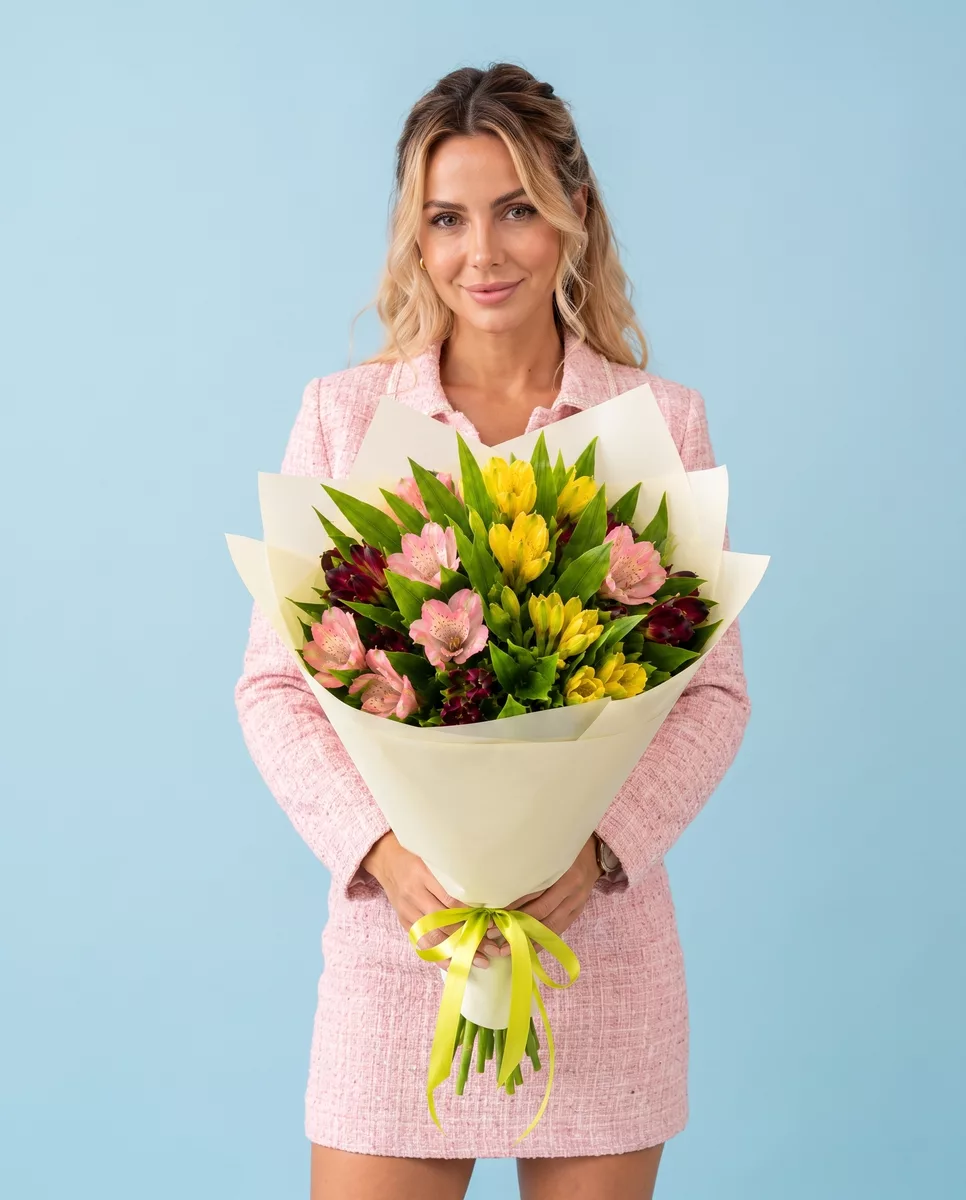
Red Roses: Why They Remain the Default and When to Deviate
Red roses dominate Russian proposal bouquets for a straightforward reason: the colour has meant romantic love in Russian culture for long enough that it needs no explanation. When a man arrives with red roses the intention is legible to everyone in the room, which is exactly what a proposal requires. The varieties that hold up best for a large ceremonial bouquet are Explorer, Red Naomi and Freedom — all long-stemmed, tight-budded at purchase and slow to open, which matters if the proposal happens in the evening and the flowers were ordered that morning. Avoid spray roses or garden varieties for a proposal; they open too fast and look deflated within hours. If you are ordering in summer, roses travelling across Russia face temperatures that can accelerate opening, so request buds that are no more than one-third open at the time of packing. In winter the risk reverses: roses chilled below four degrees Celsius during transit develop black petal edges within a day, so confirm that the delivery route is temperature-controlled. Deviating from red is entirely possible and some Russian women prefer it, but the deviation must be deliberate. White roses signal purity and are acceptable; pink signals affection and is slightly less formal. Burgundy is sometimes chosen by older customers as a more restrained alternative to bright red. What you should not do is mix colours in a proposal bouquet — mixed arrangements read as decorative rather than declaratory, and the proposal message gets lost in the variety.
Flowers Other Than Roses That Work for Russian Proposals
Roses are the default but they are not the only option, and a florist who knows the customer's partner well can suggest alternatives that carry equal weight. Peonies are the strongest substitute: in Russia they are associated with prosperity, femininity and celebration, and a bouquet of twenty-one or twenty-five white or blush peonies reads as lavish and intentional. The practical constraint is seasonality — peonies are available fresh and locally sourced only from late May through June; outside that window you are working with imported stems that vary significantly in quality and vase life. Tulips are popular in spring, particularly for younger couples, and a bouquet of thirty-one red or white tulips is a recognised proposal format in Saint Petersburg. Tulips are inexpensive relative to roses but they are not considered lesser — they are simply seasonal and honest about it. Orchids, specifically Phalaenopsis in a potted arrangement, are sometimes chosen as a proposal gift because they last weeks rather than days, but they read as a gift rather than a bouquet and the proposal symbolism is weaker. Eustoma, also sold as lisianthus, is increasingly used in high-end proposal bouquets as a filler that adds volume without cheapening the arrangement — it does not replace roses but supports them. Avoid sunflowers, chrysanthemums and carnations for a proposal context in Russia; all three carry associations that range from casual friendship to memorial, and none of them signal romantic intention clearly enough for the moment.
Colour Combinations and What They Signal in Russian Custom
Russian floral etiquette around colour is more specific than most Western customers expect, and the rules are worth knowing before you design the bouquet. White alone is clean and appropriate, particularly for a first serious relationship or a younger couple. Red alone is the clearest romantic signal. Pink sits between the two and is considered affectionate rather than passionately romantic — fine for a proposal if the relationship has that character. The combinations that cause problems are red and yellow together, which in Russia is strongly associated with separation and is genuinely avoided in romantic contexts. This is not a superstition that only older generations observe; younger Russians in their twenties and thirties still flag it. Red and white together is acceptable and is sometimes used in formal arrangements. Orange flowers — gerberas, ranunculus, certain roses — are cheerful but read as celebratory rather than romantic and are better suited to a birthday. Purple, including lavender and lilac, is associated with admiration and is sometimes included in proposal bouquets for women who are known to favour it, but it should not dominate. Green fillers such as eucalyptus, ruscus and pistacia are neutral and work with any colour palette. The practical rule when in doubt: keep the palette to one dominant colour with neutral green, confirm the stem count is odd and is at least eleven, and you have already avoided the most common mistakes. Colour is the second thing people notice after count, so these two elements together carry most of the cultural weight.
Timing the Delivery: When the Bouquet Should Arrive
A proposal bouquet has a tighter timing requirement than almost any other order because the moment is planned and the flowers must be present at exactly the right point. The most common mistake is ordering delivery to coincide with the proposal itself, which leaves no margin for the recipient to put the flowers in water before the evening continues. A better approach is to arrange delivery thirty to forty-five minutes before the proposal is scheduled, either to a restaurant table set up in advance, to a home address while the partner is still out, or to a hotel room. If the proposal is outdoors — on a bridge, in a park, at a specific location — the person proposing usually carries the bouquet themselves, which means ordering a pick-up from the shop rather than a delivery. In that case the pick-up time should be no more than two hours before the proposal, because roses out of water in a warm interior begin to show stress in the petals after ninety minutes. In winter this window extends slightly because cold air slows the process, but do not rely on outdoor temperatures to preserve the bouquet — the stems need water or at minimum a damp wrapping. Five Flowers delivers across Saint Petersburg within one to two hours and can arrange timed delivery to a specific window if the order is placed with enough lead time, typically the morning of the same day for evening proposals. For deliveries to other Russian cities the same timing principles apply but the order must be placed earlier to account for logistics.
Packaging and Presentation Conventions in Russia
The packaging of a proposal bouquet in Russia follows conventions that are different from the minimalist wrapping common in Scandinavian or British floristry. Russian customers and recipients expect the bouquet to look substantial and finished before it is even unwrapped — the outer presentation is part of the gift. Kraft paper is widely used and considered classic; it works for both red roses and white flowers and does not compete with the blooms. Fabric wrapping, particularly in velvet or organza, signals a higher price point and is appropriate for very large bouquets of fifty-one or more stems. Transparent cellophane alone is considered cheap for a proposal context and should be avoided. Ribbon is standard and should match or complement the flower colour rather than contrast sharply. A box arrangement — roses or peonies packed flat in a hat box or a round box — has become popular in Russia over the last decade and is a legitimate proposal format, but the count rule still applies inside the box. Some customers add a small card with a handwritten note; in Russian custom this is appreciated but not required, and the flowers themselves are understood to carry the message. What should never happen is the bouquet arriving in obvious transit packaging — bubble wrap, plain plastic bags or unfinished stems showing at the bottom. The florist should complete the presentation fully before dispatch. At Five Flowers the courier carries the bouquet upright and hands it directly to the recipient rather than leaving it at a door, which matters for both the condition of the flowers and the experience of receiving them.
What to Check Before You Confirm the Order
Before you finalise a proposal bouquet order there are five things worth confirming explicitly with the florist, because these are the points where mistakes happen. First, the stem count — ask for the exact number and confirm it is odd. Second, the colour — state it precisely and ask whether any filler or accent flowers deviate from that colour. Third, the opening stage of the buds — for same-day proposals you want buds that are closed or one-quarter open so they look their best in the evening rather than fully blown by afternoon. Fourth, the delivery address and timing window — if you are ordering to a restaurant, confirm that the restaurant accepts flower deliveries and knows to hold them in a cool spot. Fifth, the packaging — ask whether the presentation is complete or whether you need to do anything on your end when the bouquet arrives. If you are ordering from outside Russia, also confirm that the shop delivers to the specific city rather than assuming coverage. Five Flowers delivers across Russia from Saint Petersburg and handles proposal orders regularly, including for customers calling from abroad who are arranging a surprise. The most important thing is to place the order with enough lead time — same-day orders are possible but the earlier in the day you call, the more options are available for variety, stem count and delivery window. A proposal is not the moment to discover that a specific variety is out of stock or that the delivery slot you needed is already taken by another order.
Russian proposal customs around flowers are specific enough that knowing them in advance genuinely changes the outcome. The stem count must be odd and generous, the colour must be deliberate, the packaging must be complete, and the timing must give the flowers a chance to be seen at their best. None of this is difficult once you know what to look for, and a florist who handles proposals regularly will walk you through the details if you ask. The bouquet is not decoration for the moment — in Russian tradition it is the first statement of the proposal, and it should say exactly what you mean it to say. We deliver bouquets across Russia in 1–2 hours.
Frequently asked questions
Is it true that even numbers of flowers are bad luck in Russia?
Even numbers are associated with funerals and mourning in Russian custom, so giving an even-numbered bouquet to a living person is considered inappropriate. For a proposal this matters significantly — always confirm an odd number with your florist, with eleven being the practical minimum for a serious romantic gesture.
Can I propose with flowers other than red roses in Russia?
Yes. White roses, peonies in season and tulips in spring are all recognised proposal flowers in Russia. The key is that the colour choice should be intentional and the stem count must still be odd. Avoid mixing multiple colours in one bouquet, as mixed arrangements read as decorative rather than romantic.
Are yellow flowers really a problem for a proposal in Russia?
Red and yellow combined is strongly associated with separation in Russian culture and is genuinely avoided in romantic contexts across all age groups. Yellow flowers alone carry similar associations for many people. It is straightforward to avoid this — choose red, white, pink or blush, and the cultural risk disappears entirely.
How far in advance should I order a proposal bouquet for delivery?
For same-day delivery, placing the order in the morning gives the best choice of varieties, stem counts and delivery windows. For timed delivery to a specific thirty-minute window at a restaurant or hotel, earlier is always safer. Orders placed the day before allow the shop to source specific varieties that may not be in daily stock.
Does the packaging style matter for a Russian proposal bouquet?
Yes. Transparent cellophane alone is considered too casual for a proposal. Kraft paper wrapping is the classic standard; fabric wrapping signals a premium order. The bouquet should arrive fully finished with ribbon and a clean presentation — no visible transit materials and no unfinished stems showing at the base.
Ready to send a bouquet?
Pick a city, choose the flowers, and we will hand them over with a photo confirmation.
Choose a city →