
Corporate Flower Delivery to Remote Teams Across Russia: One Order, Many Cities
Every week someone calls the shop and asks the same thing: we have a team spread across six cities, can we send flowers to all of them today for the anniversary? The answer is yes, and the mechanics are less complicated than most HR managers expect. What trips people up is not the logistics but the details — which varieties survive a courier run in July heat, what address format actually works, and why ordering at noon for a 4 p.m. delivery in Novosibirsk is already cutting it close given the time-zone gap. This article covers all of that in the order you need it.
Why Flowers Work as a Corporate Reward in Russia
In Russian workplace culture, receiving flowers at your home or office from your employer is read as a personal gesture, not a generic perk. It carries weight because it requires someone to have thought about you specifically — your address, your city, the occasion. That is precisely why a voucher or a bank transfer does not produce the same reaction even when the monetary value is identical. Flowers signal that the company registered you as an individual, not a headcount. This matters especially for remote employees who rarely see the inside of a head office and can easily feel peripheral to company life.
The most common corporate occasions are work anniversaries, the birth of a child, International Women's Day on March 8th, and project completions. March 8th deserves particular attention: it is a public holiday, demand spikes enormously, and any order placed after February 28th without pre-booking risks stock shortages on key varieties. Roses, tulips and mimosa are the traditional choices for that date. For birthdays and anniversaries, the range is wider — spray chrysanthemums, alstroemeria and lisianthus all travel well and last longer than open roses, which matters when the recipient may not be home at the exact delivery moment and the bouquet sits in a hallway for an hour.
Companies that run quarterly reward programs tell us the same thing: employees remember the flowers longer than they remember the gift card. That is not sentiment — it is a practical argument for choosing a format that creates a visible, physical moment rather than a line in a banking app.
Bouquets we can deliver



How a Single Order Covers Multiple Cities at Once
The process starts with one consolidated brief sent to the shop: a spreadsheet or a simple message listing each recipient's name, city, delivery address, phone number and preferred delivery window. From that brief, the shop builds separate delivery tasks for each city simultaneously. There is no need for the corporate client to manage individual orders or chase separate confirmations — one order reference covers the whole batch, and status updates come back against that single reference.
Timing is where most first-time corporate clients make a mistake. Russia spans eleven time zones. If your head office is in Moscow and you want flowers delivered to a colleague in Vladivostok at 3 p.m. local time, that is 8 a.m. Moscow time — meaning the order needs to be confirmed and paid the evening before, not on the morning of the delivery day. Novosibirsk is four hours ahead of Moscow; Yekaterinburg is two. A noon Moscow confirmation for a same-day Novosibirsk delivery at 5 p.m. local time works, but only just, and it leaves no buffer if a street address turns out to be incomplete.
The shop handles the bouquet assembly in the destination city on the day of delivery, which means flowers are cut and arranged fresh that morning rather than shipped across the country in a box. This is the critical practical point: a bouquet delivered within the city where it was assembled will always be in better condition than one that traveled overnight. Varieties like garden roses and open peonies would not survive long-distance transit in acceptable condition, but they are perfectly fine for same-day city delivery.
Choosing Varieties That Survive the Delivery Run
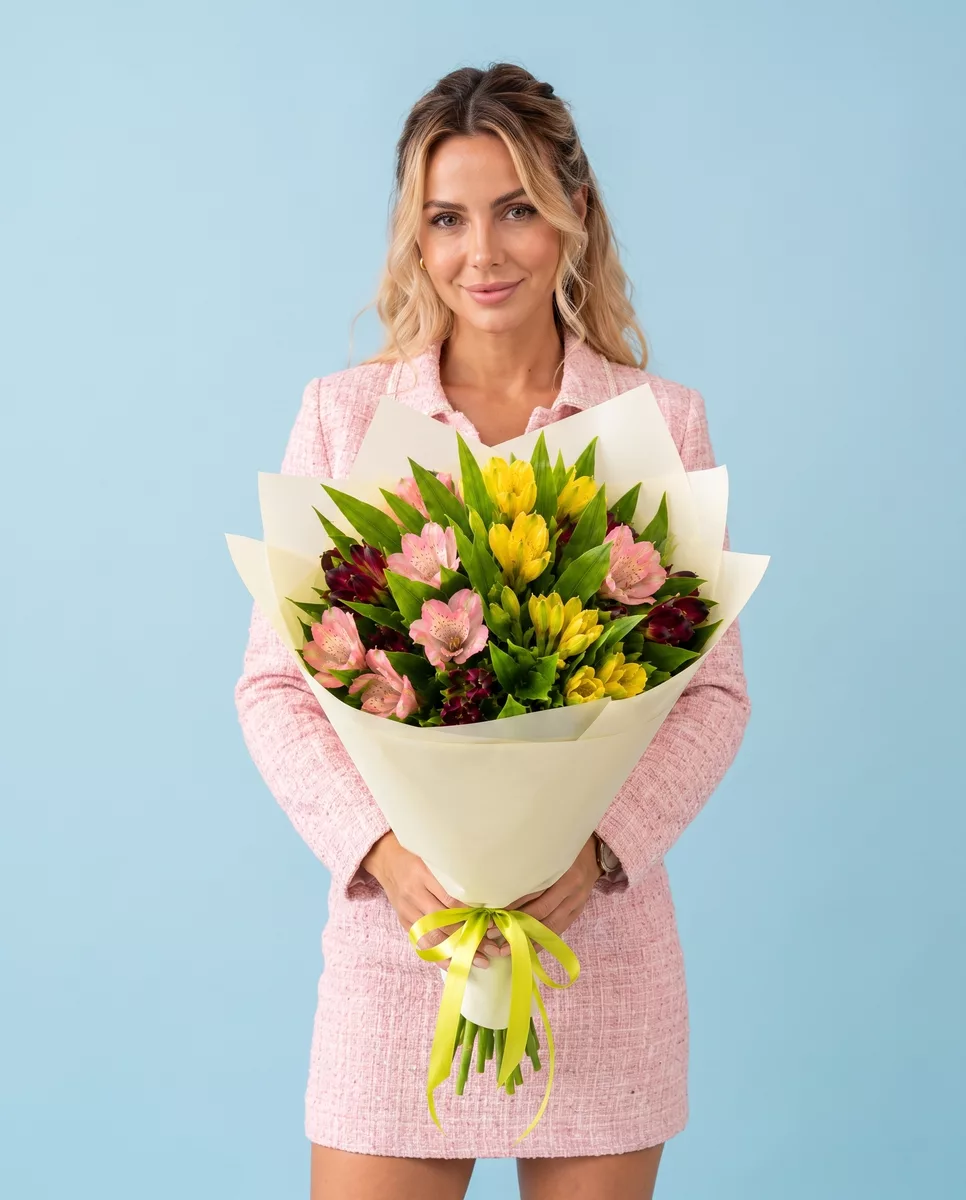
Not every flower that looks beautiful in a shop window is a good choice for a corporate delivery program. The bouquet may wait at a reception desk, sit in a warm office, or be left with a neighbor if the recipient is out. Variety selection should account for all of that. Alstroemeria is one of the most reliable choices: the buds open gradually over seven to ten days, the stems are sturdy, and the flowers handle temperature fluctuations between an air-conditioned courier bag and a warm apartment without immediate wilting. Spray chrysanthemums behave similarly and are available in white, yellow, bronze and burgundy, which makes them easy to adapt to company colors if that matters to your brand team.
Lisianthus, sometimes called eustoma, is another strong pick — it looks like a rose but lasts significantly longer and is far less sensitive to brief dry periods. Standard roses are fine when the delivery window is tight and confirmed, but they require water within two to three hours of arrangement and wilt visibly if left dry. For summer orders in cities where July and August temperatures regularly exceed 30 degrees Celsius — Krasnodar, Rostov-on-Don, Volgograd — avoid open garden roses entirely and lean toward closed buds of spray roses or carnations, which are more heat-tolerant than their reputation suggests.
Mimosa, popular in March, is extremely delicate and should only be ordered for same-day delivery with a confirmed two-hour window. Peonies are seasonal from May through June and travel well within the city on the day they are arranged, but they are not suitable for any delivery that might be delayed by more than an hour in warm weather. Knowing these constraints before you confirm the order saves a difficult conversation afterward.
What the Address Format Must Include
This is the section most corporate clients skip and then regret. Russian addresses have a specific structure that differs from Western formats, and an incomplete address is the single most common reason a delivery arrives late or fails entirely. The correct sequence is: city, district if relevant, street name, building number, corpus or stroenie number if the building is part of a complex, apartment or office number, floor, and any entry code for the door intercom. Missing the corpus number — which indicates a specific block within a multi-building address — sends the courier to the wrong building in a development that may have four or five identical-looking structures.
For office deliveries, add the company name and the recipient's full name. Many large office buildings in Moscow, Saint Petersburg and other major cities require the courier to call ahead from the lobby, so the recipient's mobile number must be current and reachable. If the person is in a meeting and has their phone on silent, the courier will wait a reasonable time and then leave the bouquet at reception — which is usually fine, but worth noting in the delivery instructions.
For residential addresses, intercom codes are essential in any building constructed after roughly 1995. Older Soviet-era buildings often have open entrances, but newer residential complexes almost universally have coded or app-controlled entry. Ask your employee for the code when you collect their address, and include it in the order notes. A courier standing outside a locked entrance with a bouquet of alstroemeria in July heat has about twenty minutes before the flowers start to show stress. Getting the address right the first time is not a bureaucratic detail — it is the difference between a successful delivery and an awkward follow-up call.
Timing the Order Around Russian Public Holidays
Russia has several extended public holiday periods that affect both flower availability and delivery logistics, and corporate clients who do not know the Russian calendar get caught out by them regularly. The main ones to plan around are the New Year and Christmas holidays, which run from January 1st through January 8th; International Women's Day on March 8th and the days immediately before it; Victory Day on May 9th; and the early May holiday cluster that often connects May 1st and May 9th into a week-long break. During these periods, demand for flowers is extremely high, staff schedules are compressed, and popular varieties sell out days in advance.
For March 8th specifically, any corporate order for more than ten bouquets should be confirmed by February 25th at the latest. The varieties most affected by stock pressure are tulips, mimosa and red roses — all of which are traditional for the occasion and which suppliers allocate quickly. If your company has a standing policy of sending flowers to all female employees on March 8th and you have staff in fifteen cities, that conversation with the shop needs to happen in February, not on March 6th.
The January holidays present a different problem: many recipients are traveling or at dachas outside the city, which makes residential delivery unreliable. Corporate deliveries during that window are better directed to offices, but many offices are also closed. The practical solution is to schedule January reward deliveries for the week of January 9th onward, when the country is back at work and addresses are reliably occupied. A little calendar awareness at the planning stage prevents a significant amount of logistical friction.
Packaging and Presentation for a Corporate Context
A bouquet delivered on behalf of a company should look intentional, not like something picked up at a petrol station. Presentation in a corporate context means a few specific things: a consistent wrapping style across all bouquets in the batch so that ten employees in ten cities receive something visually coherent, a card with a printed or handwritten message from the company, and packaging robust enough to survive a courier bag without the flowers shifting and breaking stems.
The standard approach is kraft paper wrapping with a ribbon in a neutral or brand-aligned color, secured tightly enough that the bouquet does not move in transit. Cellophane alone is not recommended for corporate orders because it shows every mark and crease from handling and looks cheap on arrival. A box format — where flowers are laid in a hatbox or a rectangular flower box — is more expensive but significantly more resilient for deliveries to office receptions, where the bouquet may be set down on a desk and left for an hour before the recipient sees it.
Cards matter more than most corporate clients expect. A printed card with the employee's name, the occasion and a sentence from the team or management turns a bouquet into a communication. Generic cards that say only 'congratulations' are read as low-effort. The shop can print individual cards for each recipient in a batch order — you supply the text per person, or a template with the name variable, and the cards are prepared alongside the bouquets. This adds a small amount of lead time to the order, so factor it in when you set your confirmation deadline. Flowers plus a personal card is the combination that employees actually mention to colleagues.
What to Check Before You Confirm a Large Batch Order
Before you send the final confirmation on a multi-city corporate order, run through a short checklist that experienced clients have learned the hard way. First, verify every address against the format described earlier — city, street, building, corpus, apartment, intercom code, recipient mobile number. Second, confirm the delivery time window in local time for each city, not Moscow time, and check that the window is realistic given when you are placing the order. Third, make sure the recipient will actually be available: a birthday delivery to someone who is traveling that day is a wasted bouquet.
Fourth, check the weather forecast for cities receiving delivery. This sounds unusual, but a heat wave in Krasnodar or a heavy frost in Novosibirsk in April affects which varieties are appropriate and how the courier should handle the packaging. The shop can advise on this if you flag the cities in your brief. Fifth, confirm the card text for each recipient before the order is locked — changes to card messages after bouquets are assembled create delays and sometimes errors.
Sixth, establish one contact person on your side who can receive delivery confirmations and handle any address issues in real time. Corporate orders that list three different email addresses for status updates invariably result in confusion when a courier cannot reach a recipient. One point of contact with a working mobile number, available during the delivery window, resolves almost every field problem within minutes. Finally, ask for a delivery confirmation format that works for your records — a timestamped message per delivery, or a summary report at the end of the day — so you can close the task in your HR system without chasing individual confirmations.
Sending flowers to a distributed team is a concrete, repeatable process once you know the variables: time zones, address formats, variety suitability, holiday calendars and packaging choices. The companies that do it well treat it like any other logistics task — they plan ahead, collect the right data from recipients, and confirm details before the day of delivery rather than on it. The result is that employees in Vladivostok, Yekaterinburg and Rostov-on-Don all receive a fresh, well-presented bouquet within the same working day, each with a card that uses their name and states the occasion. That consistency is what makes the gesture land as a company-wide standard rather than an ad hoc afterthought. We deliver bouquets across Russia in 1–2 hours.
Frequently asked questions
How far in advance do I need to place a corporate order for multiple cities?
For batches of up to five cities, the day before is usually sufficient. For ten or more cities, two to three days ahead is safer, especially if you need printed cards for each recipient. March 8th and New Year period orders should be confirmed at least one week in advance due to high demand and stock allocation on popular varieties like tulips and roses.
Can we send the same bouquet design to every employee in the batch?
Yes, and it is actually the recommended approach for corporate programs. A consistent design — same varieties, same wrapping, same ribbon color — reads as intentional across the whole team. The shop assembles each bouquet to the same specification in the destination city on the day of delivery, so quality is consistent even though the cities differ.
What happens if a recipient is not home when the courier arrives?
The courier calls the recipient's mobile number before arrival and again on arrival. If there is no answer, the bouquet is left with a neighbor, building concierge or office reception, depending on the address type. For residential deliveries, it helps to include a note in the order authorizing this. Flowers are never left outside an unsecured entrance in warm weather.
Which Russian cities can receive same-day flower delivery?
Five Flowers delivers same-day to all major Russian cities including Moscow, Saint Petersburg, Novosibirsk, Yekaterinburg, Kazan, Nizhny Novgorod, Chelyabinsk, Omsk, Samara, Rostov-on-Don and Krasnodar, among others. Confirm your city list with the shop when placing the order, and always specify the desired delivery time in local time for each location.
Can the card messages be different for each employee in the batch?
Yes. Supply a card text per recipient in your order brief — either individual messages or a template with the employee's name and occasion filled in for each person. The shop prints or handwrites the cards alongside bouquet assembly. Personalised cards significantly increase the impact of the delivery, so this step is worth the small additional coordination it requires.
Ready to send a bouquet?
Pick a city, choose the flowers, and we will hand them over with a photo confirmation.
Choose a city →