
Roses vs. Peonies: Which to Send a Russian Woman and When
The question comes in almost every week: someone ordering from abroad, or a colleague who has never bought flowers in Russia before, asks whether roses or peonies are the safer choice. The honest answer is that both are correct — but for different women, different relationships and different months of the year. Get the pairing wrong and you send a perfectly fresh bouquet that lands with the wrong signal. This article breaks down exactly what each flower means in Russian gifting culture, which varieties hold up in transit, and how to decide before you place the order.
What Roses Actually Signal in Russian Gifting Culture
In Russia, roses carry a weight that most other flowers do not. They are the default serious flower — the one people reach for at graduations, anniversaries, major birthdays and any occasion where the sender wants to communicate respect as much as affection. A bouquet of roses says that the sender thought about the gesture, spent money deliberately and considers the recipient worth the formality. That is not a small thing in a culture where understatement in gift-giving is sometimes read as indifference. The number of stems matters enormously here. An even number of flowers is associated with mourning in Russian tradition, so any bouquet should contain an odd count: 11, 15, 21, 25 or more. Florists at Five Flowers count every stem before the order goes out, but if you are specifying a number yourself, keep it odd without exception. Red roses remain the strongest romantic signal, read almost universally as a declaration. White roses are cleaner in meaning — they work for a colleague, a teacher or a relative without romantic implication. Pink roses, particularly varieties like Aqua or Sweetness, sit in the middle: warm but not intense, which makes them the most flexible choice when you are unsure of the relationship's register. For a woman you know well but whose preferences you cannot predict, a mixed pink-and-white arrangement of spray roses and garden roses reads as thoughtful rather than generic. Roses also travel well in cold-chain delivery, which matters when the recipient is not in the same city as the sender.
Bouquets we can deliver



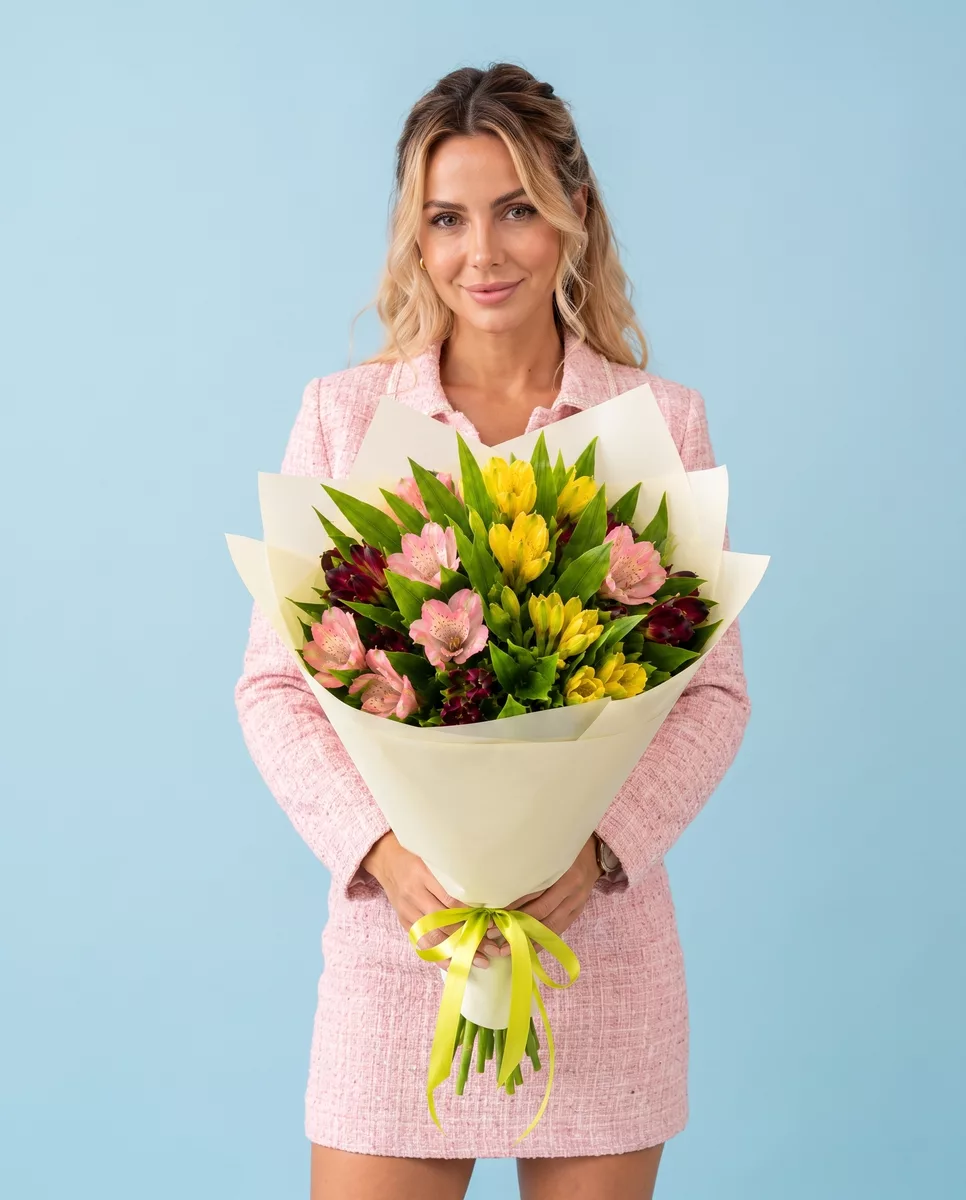
What Peonies Signal and Why Russians Treat Them Differently
Peonies occupy a different cultural space entirely. In Russia they are strongly associated with warmth, abundance and the particular pleasure of something seasonal and fleeting. Because peonies are only available fresh from roughly late May through July — and even then the window for domestic varieties is narrow — receiving them feels like a gift of timing as much as a gift of flowers. A woman who gets peonies in June knows that someone paid attention to the calendar. That specificity reads as intimate. Peonies are not the flower for a formal relationship. Sending them to a teacher, a senior colleague or a woman you have just met professionally can feel too casual, even careless. They work best between people who already have an established warmth: a close friend, a sister, a partner, a mother. The variety most commonly available in Russian florist supply is Coral Charm during early season and Sarah Bernhardt and Felix Crousse through peak June weeks. Coral Charm opens fast — within 24 to 36 hours at room temperature — so a recipient who is not home to receive the order should know the flowers need water and a cool spot immediately. Sarah Bernhardt is more forgiving, holding bud stage for two to three days if kept below 18 degrees Celsius. One common mistake senders make is ordering peonies in August or September expecting the same quality. By that point, the flowers are imported, often from Ecuador or Kenya, and while they are not bad, they do not have the same density of petals or scent that makes a Russian woman recognize them as the real seasonal thing.
Seasonal Availability and Why It Changes Your Decision
Seasonality is probably the single most practical factor that senders overlook. Roses are available year-round because the Russian market is supplied primarily by Ecuador, Kenya, Colombia and the Netherlands. A variety like Explorer or Red Naomi can be ordered in January with the same confidence as in June. That consistency is genuinely useful when the occasion does not allow flexibility — a birthday falls when it falls, and the sender cannot reschedule. Peonies are the opposite. In Saint Petersburg, fresh domestic peonies typically arrive in florist supply from the last week of May and are reliably available through the third week of July. Outside that window, what you get is imported stock that has spent time in refrigerated transport. The buds are sometimes smaller, the fragrance is reduced and the stems are shorter. These are not catastrophic problems, but they are noticeable to any Russian woman who has received peonies before. If you are ordering between August and April and you want something with the same loose, abundant quality as a peony, garden roses — particularly varieties like Keira or Juliet from the David Austin range — are the closest substitute and hold significantly better in transit. If the order date falls between late May and mid-July and the relationship is warm enough for peonies, there is almost no reason not to choose them. The seasonal rarity is part of the message. Outside that window, roses in the right variety and color will serve the occasion better than out-of-season imported peonies at a higher price.
Relationship Type: Matching the Flower to the Dynamic
The relationship between sender and recipient should drive the choice as much as any cultural rule. For a romantic partner — whether the relationship is new or established — red or deep-pink roses remain the clearest signal in Russian convention. A woman receiving red roses from a man she is dating understands exactly what is being communicated, and that clarity is often the point. Peonies in the same romantic context read as softer and more personal: they suggest the sender knows her well enough to choose something specific rather than something correct. Both are valid; the question is whether you want to be unambiguous or intimate. For a mother or grandmother, peonies are frequently the warmer choice, particularly if the occasion is a birthday or a family celebration rather than a formal holiday. Older Russian women often have a strong attachment to peonies as a garden flower — they grew up with them, and a bouquet carries that association. White or cream roses work well for the same relationship if peonies are out of season. For a female colleague or professional contact, the calculus shifts. Roses in white, pale pink or peach read as respectful and appropriate without crossing into personal territory. Peonies for a colleague can work if you know her well and the office culture is informal, but they are a riskier default. For a friend celebrating something significant — a promotion, a new apartment, the birth of a child — either flower works, but a large, generous arrangement of peonies in peak season is the kind of gift that gets photographed and remembered.
Varieties Worth Knowing Before You Order
Knowing a few variety names makes a real difference when you are ordering remotely and cannot see the stock in person. Among roses, Red Naomi is the standard for deep red long-stemmed arrangements — the stems reach 70 to 90 centimeters, the head is large and it holds for seven to ten days in a vase with proper care. For pink, Aqua is reliable and widely available; it has a soft lilac-pink tone that photographs well and suits a wide range of recipients. Mondial is the classic white rose for formal arrangements: clean, large-headed and long-lasting. If you want something closer to a garden rose without the price premium of David Austin varieties, Keira is worth requesting — it has a cupped, multi-petaled form that reads as less corporate than a standard hybrid tea. Among peonies, Sarah Bernhardt is the name most Russian women recognize: pale pink, very full, strong fragrance. It is the variety that defined what a peony looks like for a generation of Russian gardeners and their daughters. Coral Charm is more dramatic — deep coral-orange when it opens, fading to peach — and suits a recipient with a preference for color over pastels. Felix Crousse is deep fuchsia-pink and opens very fully; it is the showiest of the common varieties but also the quickest to drop petals in warm rooms. When placing an order, specifying a variety rather than just a color gives the florist a precise target and reduces the chance of substitution. If a specific variety is not in stock, a good florist will tell you and suggest the closest alternative rather than silently swap.
Temperature, Transit and What Happens to the Flowers in Transit
Delivery conditions matter more than most senders realize, and they matter differently for roses and peonies. Roses are relatively robust in transit if they are cut correctly and kept hydrated. A stem cut at a 45-degree angle, placed immediately in water with a floral preservative sachet, will survive two to three hours of transit in a temperature-controlled vehicle without visible stress. In summer, when Saint Petersburg temperatures exceed 25 degrees Celsius, roses need to be kept away from direct sunlight and should be delivered in insulated packaging. Heat accelerates water loss through the petals, and a bouquet left in a warm car for 40 minutes will show it. Peonies are more temperature-sensitive. A tight bud that has been held at 4 degrees Celsius in cold storage will open slowly over two to three days at room temperature — that is actually useful for a recipient who wants the flowers to develop gradually. But a peony that has already begun to open and is then exposed to warmth above 22 degrees during transit can go from bud to fully open in under six hours. If the recipient is not home, a fully open peony left in a warm entrance hall will drop petals within a day. The practical instruction for anyone sending peonies in summer is to confirm the recipient will be present, or to arrange delivery for a time when someone can receive the order and put it in water immediately. For roses, the margin for error is wider. Five Flowers delivers across Saint Petersburg and ships to other Russian cities with temperature-managed logistics, but the recipient's first 30 minutes with the flowers still determines a significant part of how long they last.
What to Check Before You Confirm the Order
Before finalizing any order, there are four things worth verifying regardless of which flower you choose. First, confirm the stem count is odd. This is not optional in Russian gifting culture — an even number is genuinely associated with mourning, and no matter how beautiful the arrangement, an even count will be noticed by the recipient and by anyone else who sees the bouquet. Second, confirm the delivery date falls within the availability window for peonies if that is your choice. If you are ordering more than a few days in advance, ask whether the variety you want will be in fresh stock on the delivery date rather than pulled from cold storage that has been held for two weeks. Third, specify the opening stage you want. For peonies, a tight bud is better for recipients who will not be home immediately; a half-open bud is better for a same-day occasion where you want impact on arrival. For roses, a bud that shows color but has not opened is standard and travels best. Fourth, include a care note with the order. Many Russian women know exactly how to care for cut flowers, but a recipient who is not accustomed to floristry will benefit from a simple instruction: recut the stems, use cool water, keep out of direct sun and away from fruit. Ethylene gas from ripening fruit shortens vase life significantly for both roses and peonies. Five Flowers includes a care card with orders, but a personal note from the sender repeating the basics adds a practical touch that is genuinely appreciated. These are small checks that take two minutes and prevent the most common complaints after delivery.
The choice between roses and peonies is not really about which flower is better — it is about reading the relationship, the season and the occasion correctly. Roses give you year-round availability, clear cultural signals and a wide range of varieties to match any register from formal to warm. Peonies give you a seasonal intensity and an intimacy that roses cannot replicate, but only when the timing is right and the relationship supports that kind of personal gesture. Most senders who ask this question already have an instinct about which direction fits — the details in this article are there to confirm that instinct with practical information rather than override it. When in doubt, a well-chosen rose arrangement in the right color and an odd stem count will never be the wrong answer. We deliver bouquets across Russia in 1–2 hours.
Frequently asked questions
Is it true that even numbers of flowers are bad luck in Russia?
Yes, and it is taken seriously. Even numbers of flowers are associated with mourning in Russian tradition and will be noticed by the recipient. Always order an odd count — 11, 15, 21 or 25 stems are the most common choices. This applies to roses, peonies and any other cut flower sent as a gift.
Can I order peonies in winter for delivery in Russia?
You can, but the flowers will be imported stock — typically from Ecuador or Kenya — held in cold storage and transit for longer than domestic peonies. The quality is acceptable but the fragrance and petal density are noticeably different from fresh June peonies. If you want the same loose, full effect in winter, garden roses like Keira or Juliet are a closer match.
What rose color is appropriate for a female colleague in Russia?
White, pale pink or peach roses are the safest choices for a professional relationship. Red roses carry a strong romantic signal in Russian convention and can create awkwardness in a work context. A mixed arrangement of white and soft pink spray roses reads as warm and respectful without implying anything personal.
How long do peonies last after delivery compared to roses?
A well-conditioned rose in a cool room with fresh water lasts seven to ten days. Peonies, once fully open, typically last four to six days. The key difference is that peonies open quickly in warm rooms — above 22 degrees Celsius they can go from bud to fully open in hours. Keeping them in a cooler space extends their life significantly.
Does the variety of rose I choose actually matter, or is color enough?
Variety matters practically, not just aesthetically. Different roses have different stem lengths, head sizes and vase life. Red Naomi holds longer than many red varieties; Mondial is more structured than softer white roses. Specifying a variety when you order reduces the chance of substitution and gives you more predictable results, especially for important occasions.
Ready to send a bouquet?
Pick a city, choose the flowers, and we will hand them over with a photo confirmation.
Choose a city →