
Russian Birthday Superstitions Around Flowers: What to Avoid
Every week someone calls us after the fact — the bouquet arrived, the recipient went quiet, and the sender wants to know what went wrong. Nine times out of ten it comes down to one of three things: the wrong number of stems, a colour associated with mourning, or a species that carries bad luck in Russian tradition. None of these rules are written on any official list, but they are followed seriously across Saint Petersburg, Moscow and most of Russia, especially by anyone over forty. This article goes through the main taboos plainly, variety by variety and number by number, so you can order with confidence.
Why Flower Etiquette Matters More in Russia Than You Might Expect
Russia has one of the highest rates of flower gifting in Europe — flowers are given at birthdays, graduations, school events and professional celebrations far more routinely than in most Western countries. Because flowers are so central to these moments, the rules around them are taken seriously. A sender who gets it wrong is not usually told directly; the recipient simply notices, feels uneasy, and the atmosphere shifts. That awkwardness is what our customers are trying to avoid when they call ahead to check. The superstitions are not uniform across every region or generation, but the core ones — even number of stems, yellow flowers, white chrysanthemums — are recognised almost everywhere in Russia. Younger recipients in their twenties may shrug them off, but their mothers and grandmothers in the room will not. When you are ordering for someone you do not know well, or for a professional contact, it is safer to follow the traditional rules than to gamble on how modern the recipient is. The other practical point is that these customs are deeply embedded in how Russian florists think about birthday orders. When a customer here asks for a birthday bouquet without specifying, we automatically build it around an odd number of stems and stay away from the problem colours. Understanding why we do that helps you give better instructions — and helps you catch any mistakes before the bouquet goes out the door.
Bouquets we can deliver



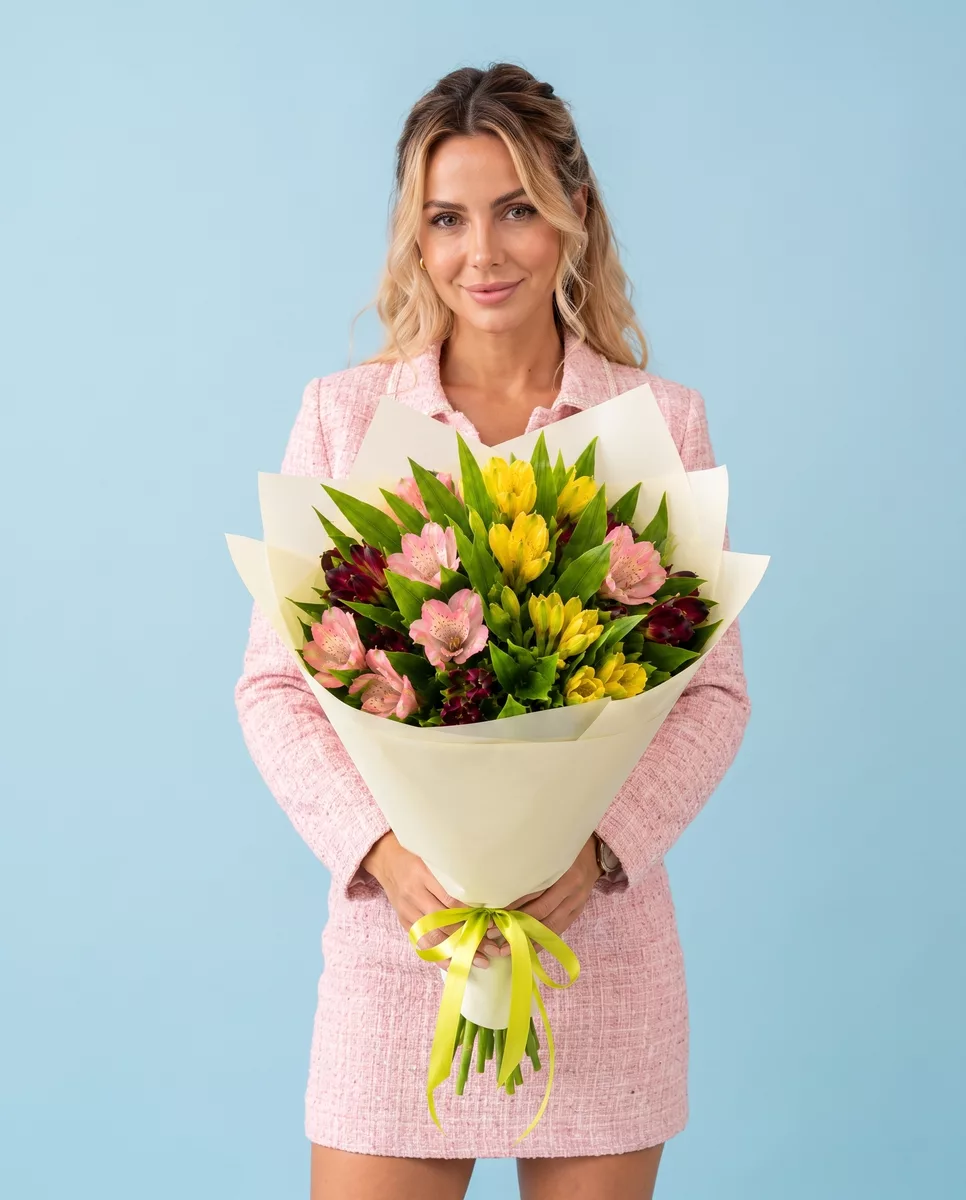
The Even Number Rule: Why Thirteen Beats Twelve Every Time
The most consistently observed rule in Russian flower culture is that even numbers of stems are for mourning, and odd numbers are for celebrations. This applies at every price point and with every species. A bouquet of ten roses, twelve tulips or twenty-four mixed stems will register immediately as wrong to most Russian recipients. The association is direct and old: even numbers appear at funerals, odd numbers appear at every other occasion. In practice this means that if you are ordering eleven roses, do not let anyone round it up to twelve for tidiness. If a bouquet is assembled as twenty stems, ask for one more to be added. The rule holds whether the bouquet contains three stems or fifty-one. Single-stem gifts are technically odd and are fine, though a single flower reads as very minimal for a birthday. The most common birthday counts we make are eleven, fifteen, nineteen, twenty-one, twenty-five and thirty-one — the last two work well for landmark birthdays because the numbers themselves feel significant. Odd numbers also give the florist more flexibility in building a balanced shape, so there is a practical benefit alongside the cultural one. When ordering online or by phone from outside Russia, double-check the stem count on your order confirmation. Some international ordering platforms default to round numbers for packaging reasons, and that is exactly the kind of detail that slips through. Ask specifically: how many stems are in this bouquet, and is that number odd?
Yellow Flowers: The Colour That Signals Separation
Yellow is the colour most commonly flagged by Russian recipients as problematic for birthdays, and it is the one that surprises foreign senders most. In Russian tradition, yellow flowers — particularly yellow roses — are associated with separation, infidelity and the end of a relationship. The saying most people know is roughly: yellow flowers mean your lover will leave you. This is not a fringe belief. It is repeated across generations and across regions, and it applies specifically to romantic and close personal relationships. For a birthday gift to a romantic partner, yellow roses or yellow tulips are a significant risk. For a gift to a colleague or a distant acquaintance, the stakes are lower, but many recipients will still notice and feel a flicker of unease. The safest approach is to avoid yellow as the dominant colour in any birthday bouquet sent to Russia. Yellow as a minor accent — a single spray of yellow mimosa tucked into a predominantly white or pink arrangement, for instance — is less loaded, but purists would still remove it. Varieties to be aware of include yellow spray roses, yellow Friesland tulips, yellow gerberas and yellow freesia. Sunflowers are a partial exception: they are so strongly associated with summer and warmth in Russian culture that they carry less of the separation connotation, and many Russians happily give and receive them. If you want warmth and brightness in a birthday bouquet, orange tones — orange spray roses, orange alstroemeria, peach ranunculus — achieve the same visual effect without the association.
White Flowers and the Chrysanthemum Problem
White flowers occupy complicated territory in Russian birthday culture. All-white bouquets are associated with funerals and are rarely given for birthdays by anyone who knows the custom. A pure white arrangement of white roses, white lilies or white chrysanthemums reads as a condolence gesture to most Russian recipients over thirty-five. The solution is not to avoid white entirely — white flowers are beautiful and many recipients love them — but to mix them with pink, red, coral or cream tones so the bouquet reads as celebratory. White roses mixed with pink spray roses and eucalyptus, for example, work perfectly well. White chrysanthemums are the single most flagged species for Russian birthdays. In Russia, chrysanthemums of any colour carry a stronger association with memorial occasions than they do in most other countries, and white chrysanthemums in particular are almost exclusively associated with mourning. If you are building a bouquet for a Russian birthday, replace white chrysanthemums with white lisianthus, white ranunculus or white spray roses — all of which give a similar full, rounded texture without the association. Cream or ivory tones, such as cream Mondial roses or ivory peonies, read as warm rather than mournful and are a safe substitute for stark white. The practical check when ordering: look at the species list, not just the colour description. A bouquet described as white may contain chrysanthemums even if the preview image does not make them obvious. Ask directly whether chrysanthemums are included if the birthday recipient is Russian and traditional.
Red Roses: When the Classic Choice Carries Expectations
Red roses are the most popular birthday flower in Russia by a wide margin, and they are entirely appropriate for birthdays. There is no taboo around red roses. However, there is a practical cultural point that senders from outside Russia sometimes miss: in Russia, red roses — especially long-stemmed red roses in a classic presentation — carry a strong romantic signal. A bouquet of twenty-one red roses sent to a female colleague or a female friend from a male sender will almost certainly be read as a romantic declaration, regardless of the sender's intention. This is not a superstition exactly, but it is a cultural norm that functions like one. If you are sending red roses to a friend or colleague rather than a romantic partner, it is worth either mixing the red with white or pink to soften the signal, or choosing a different species altogether — red tulips, red ranunculus or a mixed seasonal bouquet carry warmth without the romantic weight. For romantic birthday gifts, red roses remain the clearest and most universally understood choice in Russia. The variety matters less than the stem length and presentation: long-stemmed roses in a box or tied bouquet read as more formal and romantic; shorter spray roses in a mixed arrangement read as friendly and celebratory. Knowing which message you want to send helps you choose the format. If you are unsure, ask the florist to describe how the bouquet will read to a Russian eye — that is a question we answer several times a day.
Species and Colours That Work Safely for Russian Birthdays
Knowing what to avoid is half the task; knowing what works confidently is the other half. Pink is the safest colour across all species and all recipient ages. Pink roses — varieties like Pink Avalanche, Aqua or Sweetness — are universally read as celebratory and warm. Pink peonies, when in season from May through July, are among the most requested birthday flowers in Saint Petersburg and carry no negative associations. Coral and peach tones work similarly well. Purple and violet flowers — lavender lisianthus, violet alstroemeria, lilac — are popular for birthday bouquets and carry no taboos. Blue flowers are rare in cut form, but where they appear, such as blue delphiniums or blue hydrangeas, they are associated with calm and positivity rather than mourning. Red, as discussed, is strong and romantic but not taboo. Orange is cheerful and safe. Mixed bouquets combining several of these colours in one arrangement are the easiest way to avoid any single-colour misreading. Species that are reliably safe for Russian birthdays include roses of all colours except yellow, tulips of all colours except yellow, peonies, ranunculus, lisianthus, freesia in pink or white-pink mixes, alstroemeria, gerberas in non-yellow tones and seasonal garden flowers like anemones and sweet peas. Greenery and foliage — eucalyptus, ruscus, pistache — are neutral and add body without any cultural weight. If you are ordering a large celebratory bouquet and want to be certain, a mixed arrangement built around pink and coral tones with an odd stem count and no yellow or white chrysanthemums will land well with almost any Russian recipient.
Practical Checks Before You Confirm a Birthday Order to Russia
Once you know the rules, the final step is making sure the bouquet that arrives actually follows them. There are four things worth checking on any birthday order going to a Russian recipient. First, confirm the stem count is odd. Ask for the exact number and verify it yourself rather than trusting that the platform or the florist has applied the rule automatically. Second, look at the species list and check for chrysanthemums. If the bouquet contains them, ask for a substitution — lisianthus and ranunculus are the closest textural alternatives and are nearly always available. Third, check whether yellow is the dominant colour. A yellow-forward bouquet should be redirected toward coral, orange or pink. Fourth, if the bouquet is primarily white, ask whether any pink, coral or cream stems can be added to shift the overall tone. Timing is also relevant. Flowers ordered for same-day birthday delivery in Saint Petersburg and across Russia are typically cut and assembled the morning of delivery, which means they arrive fresh and open within a few hours. If you are ordering the day before, ask how the bouquet will be stored overnight — roses and tulips should be kept at four to six degrees Celsius in water, not at room temperature, or they will be visibly tired by the time they arrive. A birthday bouquet that follows every cultural rule but arrives wilted is still a poor gift. Freshness and correct cultural signals together are what make the delivery land the way you intend it to.
The rules around Russian birthday flowers are consistent enough that once you know them, ordering correctly takes less than a minute of extra attention. Odd numbers, no yellow, no white chrysanthemums, no all-white arrangements — those four points cover the vast majority of cases. The rest is choosing species and colours that suit the recipient, the season and the occasion. If you are ever unsure, describe the recipient to the florist — their age, your relationship to them, the formality of the occasion — and a good florist will build something appropriate without you needing to specify every stem. We deliver bouquets across Russia in 1–2 hours.
Frequently asked questions
Is it really a problem to send an even number of flowers to a Russian birthday?
Yes, for most recipients it is. Even numbers are firmly associated with funerals in Russian tradition, and many recipients will notice immediately. The fix is simple — just confirm the stem count is odd before finalising your order. If the platform shows an even number, ask for one stem to be added.
Can I send yellow sunflowers to a Russian birthday, or do they fall under the yellow flower taboo?
Sunflowers are a partial exception. They are so strongly associated with summer warmth and abundance in Russian culture that most recipients do not apply the separation superstition to them. That said, if the recipient is traditional or elderly, a mixed bouquet with sunflowers as one element rather than the sole flower is the safer approach.
Are white roses acceptable for a Russian birthday, or should I avoid all white flowers?
White roses are acceptable when mixed with other colours. The problem is an all-white bouquet, which reads as a condolence arrangement. Add pink, coral or cream stems to a white rose bouquet and it reads as celebratory. Avoid white chrysanthemums specifically — those carry the strongest memorial association regardless of what else is in the arrangement.
What is the safest all-round birthday bouquet for a Russian recipient I do not know well?
A mixed bouquet of pink and coral roses — varieties like Pink Avalanche or Aqua work well — combined with pink lisianthus and eucalyptus, assembled in an odd number of stems, is safe for almost any Russian recipient regardless of age, gender or relationship. It avoids every common taboo and reads as warm and celebratory.
Do younger Russians in their twenties still follow these flower superstitions?
Many do not hold them personally, but most still recognise them. The risk is not that the recipient themselves will be offended — it is that family members present at the celebration will notice and comment. For a birthday party with parents or grandparents in the room, following the traditional rules avoids any awkwardness, even if the recipient is relaxed about it.
Ready to send a bouquet?
Pick a city, choose the flowers, and we will hand them over with a photo confirmation.
Choose a city →