
Russian Wedding Flowers: Bridal Bouquets, Colors and Same-Day Delivery
Brides in Russia have very specific ideas about their wedding flowers, and the gap between what a guest assumes is fine and what the bride actually wanted is where most flower-related wedding stress lives. We hear it at the counter every week: someone ordered white chrysanthemums for the table because they look clean and classic, and the bride was quietly upset. Someone else sent a bouquet of yellow roses to congratulate the couple and could not understand the frosty reception. Russian wedding flower customs are not complicated once you know the logic behind them, but they are firm. This article covers the bouquet styles brides are actually choosing right now, the colour rules that still hold, the varieties that hold up through a six-hour ceremony, and exactly how to send congratulatory flowers so they arrive at the right moment.
What a Russian Bride Traditionally Carries
The classic Russian bridal bouquet is compact, round and held at waist height — a shape called a biedermeier in floristry, though most brides just say they want something neat and structured. Roses dominate, specifically spray roses or garden roses with dense petal counts such as David Austin varieties like Juliet or Keira, which give a full, layered look without requiring enormous blooms. Peonies are equally traditional when they are in season, roughly late May through June, and a bride who marries in that window will almost always ask for them. Outside peony season, ranunculus fills a similar visual role: layered, soft-edged and available year-round from Dutch growers. Stephanotis, a small white tubular flower with a waxy surface, appears in bouquets that follow older Soviet-era tradition — it was the prestige wedding flower for decades and still reads as formal and serious to older generations. Gypsophila, known in English as baby's breath, went through a period of being considered cheap, but it has come back strongly in the last three years as brides lean into airy, romantic aesthetics. The stems in a traditional Russian bridal bouquet are almost always wrapped tightly in satin ribbon, white or ivory, tied with a pin rather than left loose. Burlap, twine and other craft-style wrapping are modern choices and not universally accepted by family members who have opinions, which at a Russian wedding is most of them. The bouquet is typically ordered the morning of the wedding and kept in water until thirty minutes before the ceremony begins.
Bouquets we can deliver



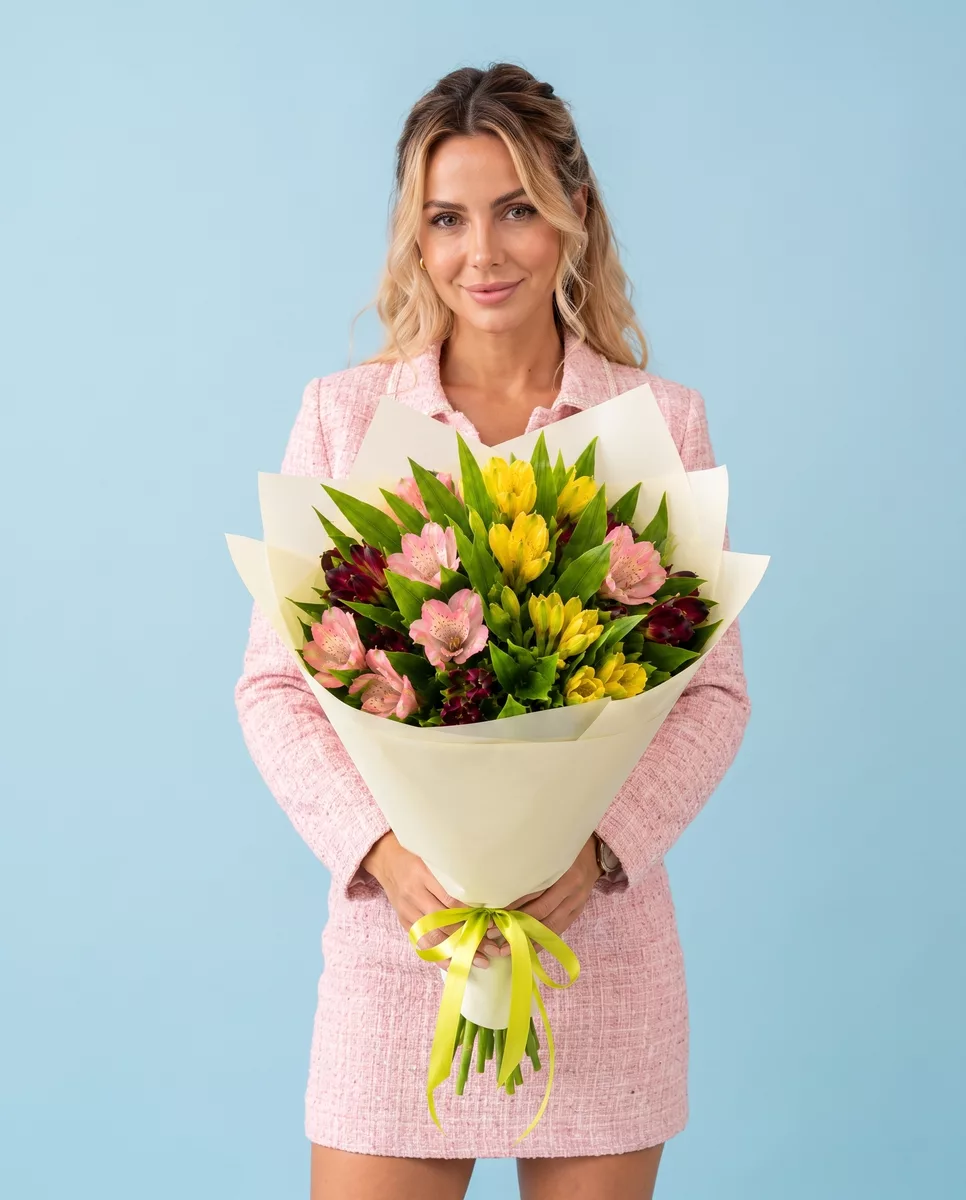
Modern Bridal Bouquet Styles Brides Are Choosing Now
Over the last four years, Russian brides have moved steadily toward what florists call a garden-style or English bouquet — an asymmetric, slightly loose arrangement that looks as though it was gathered from a cutting garden rather than constructed in a workshop. This style uses longer stems, visible foliage such as eucalyptus, dusty miller or ruscus, and a mix of bloom sizes rather than one dominant flower repeated uniformly. Garden roses remain central, but they are combined with lisianthus, sweet peas when available in spring and early summer, and clematis vine for trailing texture. Dried elements — pampas grass, lunaria seed pods, dried lagurus — appear in bohemian-leaning bouquets, particularly for outdoor or countryside ceremonies. A second strong trend is the single-variety bouquet: thirty to forty stems of one flower, usually tulips in late winter and spring, or calla lilies for a more architectural look. Calla lilies hold exceptionally well without water, which matters for a bride who will be photographed outdoors in cold weather. White and blush tones still lead overall, but terracotta, dusty rose, burgundy and deep plum have claimed a real share of the market, especially for autumn weddings. Brides ordering for September and October specifically ask for dahlias, which peak in that window and come in a colour range that suits warm autumn palettes. The practical question the bride is always thinking about, even if she does not say it, is how long the bouquet will stay presentable. A well-conditioned bouquet with stems re-cut and kept cool until the last moment will last the full day without visible wilting.
Colours That Work and Colours That Cause Problems
Yellow flowers at a Russian wedding are widely understood to signal separation or infidelity — the association is strong enough that most florists will flag it if a guest orders a yellow bouquet for the couple without asking. This is not a universal rule and younger couples in major cities sometimes ignore it entirely, but it is common enough that you should ask before sending anything predominantly yellow. The same caution applies to hollow-stemmed flowers such as daffodils when mixed with other varieties: daffodil stems release a sap that shortens the vase life of roses and tulips placed alongside them, so they are separated or used alone. Red roses carry a specific weight in Russia — they are romantic and serious, associated with deep feeling rather than celebration, and a large red rose bouquet sent to a bride can read as a personal declaration rather than a wedding congratulation. For congratulatory bouquets to the couple, white, cream, blush pink, lilac and soft coral are the safest palette choices and are unlikely to be misread by anyone at the table. Green flowers — bells of Ireland, green trick dianthus, green chrysanthemum varieties — work well as accent colours and read as fresh and modern rather than carrying any symbolic weight. Orange is cheerful and increasingly accepted, particularly in autumn arrangements. Deep purple and burgundy read as elegant rather than funereal in a floral context, unlike in some Western European traditions, so do not avoid them on that basis. The bride's own bouquet colour is usually decided weeks in advance and coordinated with the bridesmaids, so congratulatory flowers do not need to match it.
Varieties That Survive a Russian Wedding Day
A Russian wedding ceremony followed by a banquet typically runs six to eight hours, and the bridal bouquet is expected to look presentable in photographs taken at the beginning of the evening as well as at the start. This puts real pressure on variety choice. Roses with high petal counts hold better than open, single-layer varieties — a garden rose with sixty petals will stay closed and structured far longer than an open-faced anemone, which wilts within a few hours without access to water. Lisianthus is an underused choice for Russian brides but one that florists recommend strongly: the blooms last days without water, the petals do not bruise easily, and the flower comes in white, purple and blush tones that suit most palettes. Calla lilies, as noted above, are among the most resilient cut flowers available and are a sensible choice for winter or early spring weddings where the ceremony may involve time outdoors in temperatures below five degrees Celsius. Tulips are trickier — they continue to grow after cutting, which means a bouquet assembled the morning of the wedding will look slightly different by evening as the stems elongate and the heads open. This is manageable with careful conditioning but worth knowing. Orchids, particularly phalaenopsis and cymbidium, hold very well and look expensive, but they read as corporate or hotel-lobby to some Russian guests rather than romantic. Peonies are beloved but fragile in heat above twenty degrees — a June wedding in a warm hall can reduce a peony bouquet to loose petals within three hours. Florists compensate by using peonies at a tighter bud stage so they open gradually through the day rather than arriving fully blown.
Table Flowers and Venue Decoration Choices
The wedding table in Russia is expected to be generous — long tables loaded with food, and floral centrepieces that do not obstruct conversation across the table. Low arrangements are therefore preferred over tall ones, and the most practical format is a low, wide bowl or a cluster of bud vases grouped together so guests can see each other clearly. Hydrangeas are a workhouse of Russian wedding decoration because a single large head fills space efficiently, holds well in water, and comes in white, green, blush and deep blue-purple tones. They are also relatively affordable compared to roses at the same visual volume. Spray roses in clusters of five to seven stems per vase create a full look without the cost of large-headed garden roses. For long tables, florists often use a runner approach: a low line of mixed greenery — eucalyptus, ruscus, fern — punctuated by flower clusters every forty to fifty centimetres. Candles are placed within the greenery rather than in separate holders, which keeps the overall height low. Chrysanthemums appear frequently in budget wedding decorations, but many brides specifically exclude them because of their association with funerals in Russian culture — this is worth confirming before including them in any arrangement sent to or placed at a Russian wedding. Seasonal flowers reduce cost and improve quality simultaneously: tulips in March, peonies in June, dahlias in September, amaryllis in December. Asking what month the wedding falls in before designing table flowers is the single most useful question a florist can ask.
How to Send Congratulatory Flowers to the Couple
Guests who are not attending the wedding in person, or who want to send flowers in addition to a gift, face a specific timing problem: weddings in Russia typically begin at noon or one in the afternoon with a registry office ceremony and move to a banquet hall by three or four. Flowers sent to the banquet hall need to arrive before the guests do, which means delivery should be scheduled for noon to two in the afternoon at the latest. Flowers sent to the couple's home are usually better timed for the following morning, when the couple returns and can actually appreciate them rather than handing them off to a coordinator in the chaos of arrival. When ordering congratulatory flowers, specify clearly whether they are for the bride specifically or for the couple together — a bouquet addressed to both is usually a larger, more neutral arrangement, while one for the bride alone can follow her colour preferences if you know them. If you do not know her preferences, white and blush with green foliage is a reliable default that will not conflict with any table scheme or dress. Avoid very large arrangements that require a vase the couple may not have with them at the venue — bouquet format is more practical than a tall arrangement on a wedding day. Include a card with a legible name, because couples receive many flowers and will not always remember which arrangement came from whom. For delivery across Russia, order at least three hours before the required arrival time to allow for preparation and transit.
What to Check Before Placing Your Order
The most common mistake guests make when ordering wedding flowers is treating it like any other flower order — picking something that looks nice online and assuming it will be appropriate. Before confirming, check three things: the colour, the timing and the delivery address format. On colour, avoid yellow as a default, and if you want to send red roses, send them to the bride alone with a card that makes the sentiment clearly platonic or familial. On timing, confirm whether the flowers are going to a ceremony venue, a banquet hall or a home address, and whether the venue will accept deliveries before the event begins — some halls have strict delivery windows. On address, Russian venue addresses sometimes include a building number and a separate entrance number, written as korpus or stroenie, and omitting these will delay or prevent delivery. If you are ordering from outside Russia, have the address written in Russian characters as well as transliterated Latin, because drivers navigate using Russian-language maps. Check that the recipient's phone number is a current Russian mobile number starting with seven or eight — a foreign number cannot receive a Russian driver's call. For the bouquet itself, ask the florist what is in season on the wedding date rather than specifying an exact variety you saw in a photograph taken in a different month. A florist who knows the date and the colour palette will build something that actually looks the way the photograph did, using whatever is at peak quality that week.
Russian wedding flower customs are specific but not difficult to navigate once you understand the reasoning behind them. The bride has thought carefully about her bouquet, the venue decoration follows practical rules shaped by long table formats and long evenings, and congratulatory flowers land well when the timing and colour choices are deliberate rather than accidental. The details that matter most — variety selection for longevity, colour choices that carry no unintended message, delivery timed to the actual schedule of the day — are all things that a working florist can handle if the customer provides the date, the venue type and the colour preferences. Five Flowers delivers fresh flowers across Russia within one to two hours, and our team is available to advise on any of these choices before you place the order. We deliver bouquets across Russia in 1–2 hours.
Frequently asked questions
Are yellow flowers really a problem at a Russian wedding?
Yes, in most parts of Russia yellow flowers are associated with separation or unfaithfulness, and sending them to a couple on their wedding day is likely to be noticed and remembered. Younger couples in Moscow and Saint Petersburg may not care, but it is safer to choose white, blush, coral or lilac unless you know the couple's preferences well.
When is the best time to send congratulatory flowers to a Russian wedding?
Aim for delivery to the banquet hall between noon and two in the afternoon, before guests arrive. If you prefer to send flowers to the couple's home, the morning after the wedding is better — the couple will actually be present and able to put them in water, rather than handing them to a venue coordinator mid-event.
Which flowers hold up best through a full Russian wedding day?
Lisianthus, calla lilies and high-petal-count garden roses are the most reliable choices for a six-to-eight-hour event. Peonies are beautiful but wilt quickly above twenty degrees Celsius. Anemones and open-faced ranunculus are fragile without water. Ask your florist to condition the bouquet overnight and keep it cool until thirty minutes before the ceremony.
Can I order a bridal bouquet in a specific colour if I do not know the exact variety?
Yes, and this is often the better approach. Give the florist the wedding date, the primary colour and one or two secondary colours, and let them select what is at peak quality that week. A florist working with seasonal stock will produce a better result than one forced to source an out-of-season variety at short notice.
Do Russian brides ever use dried flowers in their bouquets?
Increasingly yes. Dried pampas grass, lunaria and lagurus appear in bohemian and countryside wedding styles, often mixed with fresh garden roses or lisianthus. The combination works well for outdoor autumn weddings. Traditional church or registry office ceremonies in cities tend to stay with fully fresh bouquets, as dried elements read as informal to older guests.
Ready to send a bouquet?
Pick a city, choose the flowers, and we will hand them over with a photo confirmation.
Choose a city →