
Scheduled vs. Immediate Delivery: Which Should You Choose
Every day customers call us with a version of the same question: should I order now for now, or lock in a specific hour later? The answer depends on the flower variety, the occasion's timing, and what the recipient's day actually looks like. Get it wrong and you either have roses sitting in a warm hallway or a courier arriving during a work meeting. This article breaks down both options so you can pick the one that fits your situation.
What Immediate Delivery Actually Means in Practice
Immediate delivery means the order enters assembly the moment you confirm it, and a courier leaves the shop within roughly thirty to forty minutes. In Saint Petersburg, where we operate our own delivery fleet, that translates to arrival within one to two hours depending on traffic and the district. This is not a vague promise — it is a hard operational window that we plan staffing around. The clock starts from order confirmation, not from when you first browsed the site.
The practical consequence is that the bouquet is cut and wrapped for same-day travel. Stems are cut at an angle, conditioning solution goes into the water source if the arrangement uses one, and the wrapping is chosen to handle a moving vehicle rather than a static display. Roses, spray carnations, and chrysanthemums handle this well because they are robust and do not bruise easily during transport. Ranunculus and anemones are more delicate and benefit from cooler conditions, so on days above twenty-two degrees Celsius we pack them with additional insulation.
Customers sometimes assume immediate means within fifteen minutes, as if flowers were a taxi. That is not how floristry works. Cutting, conditioning, arranging, wrapping, and handing to a courier all take time. If you genuinely need delivery in under an hour, call us directly rather than ordering online — we can tell you honestly whether it is possible for your district at that moment, rather than letting you find out at delivery time.
Bouquets we can deliver



What a Scheduled Slot Gives You That Instant Cannot
A scheduled delivery means you choose a specific date and a time window, typically a two-hour block, and we build the preparation timeline backward from that window. The bouquet is not assembled the night before and left in a bucket — it is cut and finished close to the departure time so it arrives at peak freshness. This matters most for varieties with short vase lives. Tulips, for instance, continue to open after cutting and can go from bud to fully open in four to six hours at room temperature. If you schedule delivery for the morning of a birthday and the recipient comes home in the evening, the timing can be planned so the flowers are at their best when seen.
Scheduling also solves the recipient availability problem, which is the single most common complaint we hear after a delivery goes sideways. The courier arrived, no one answered, the flowers sat with a neighbor for three hours. When you know the person will be home between noon and two in the afternoon, you book that window and the problem disappears. This is especially relevant for deliveries to residential addresses in large apartment complexes, where access without the recipient present is difficult.
For corporate deliveries — to an office address for a colleague's work anniversary or a client meeting — scheduled slots let you align with office hours, reception desk availability, and the moment when the recipient is actually at their desk. Spontaneous orders to offices regularly fail because the recipient left for a meeting or the building reception closes for lunch at an inconvenient time.
Occasions That Call for Immediate Dispatch
There are situations where scheduling is simply not possible because you did not know you needed flowers until right now. A friend called to say she passed her university entrance exams. A colleague announced a promotion at the morning meeting. A date moved from next week to tonight. These are real scenarios we handle daily, and immediate delivery exists precisely for them.
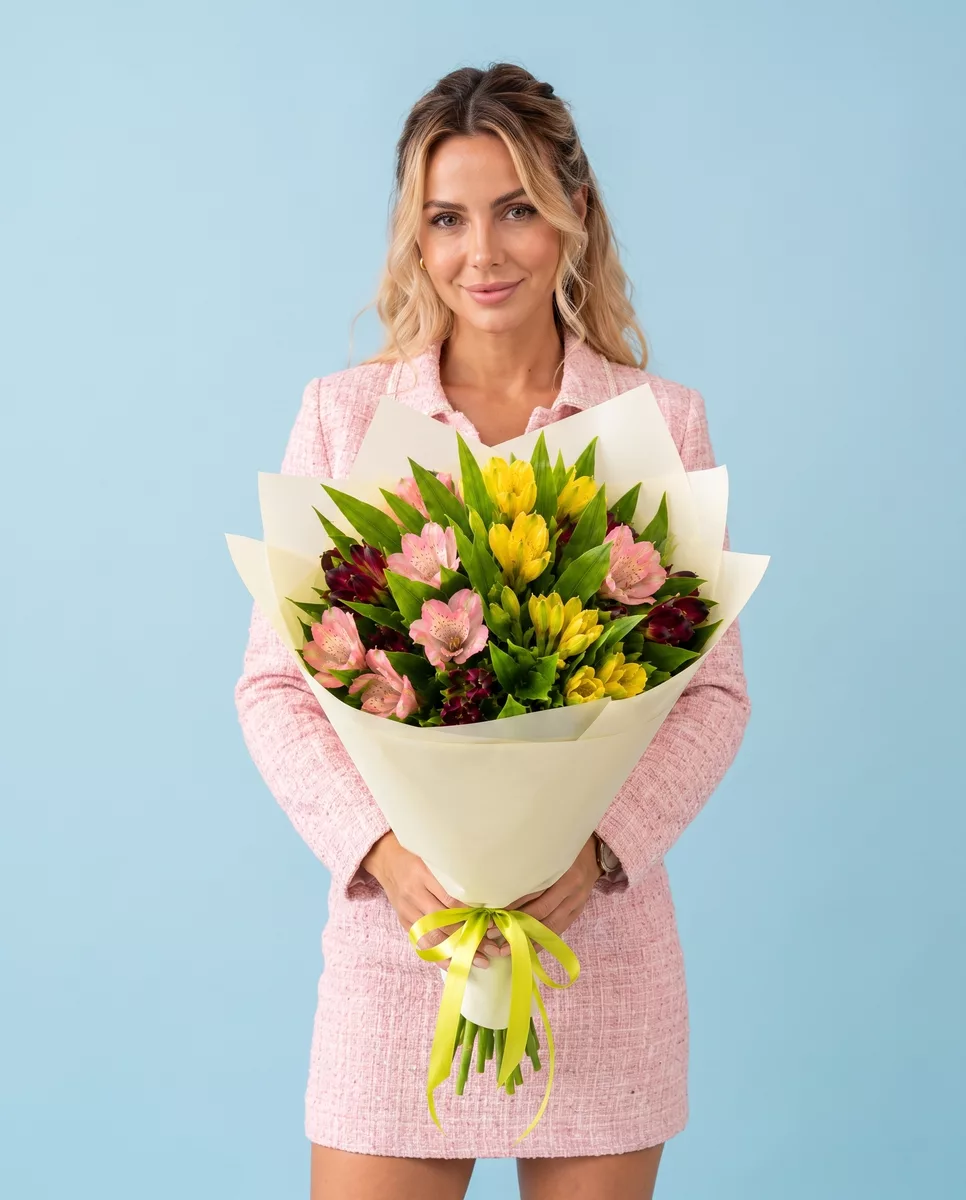
The variety selection for immediate orders is deliberately practical. We keep a standing supply of roses in multiple stem counts, alstroemeria, spray roses, and seasonal fillers like waxflower or eucalyptus that assemble quickly and travel well. If you have a very specific variety in mind — garden roses, sweet peas, or peonies outside their May to June season — an immediate order may not be able to fulfill that request, and we will tell you so. Substituting a variety without telling the customer is something we do not do.
Immediate delivery also suits situations where the gesture itself is the message. Sending flowers to someone who just received good news, or to a friend who mentioned feeling low, works best when the flowers arrive while the moment is still fresh. A bouquet that arrives six hours later, even a beautiful one, carries less of the original energy. For these emotional-timing situations, the two-hour window of immediate delivery is often the entire point, and the specific variety matters less than the speed.
Occasions That Demand a Scheduled Slot
Birthdays, anniversaries, and holidays are the clearest cases for scheduling, because the date and often the time are known well in advance. Valentine's Day on the fourteenth of February, International Women's Day on the eighth of March — these are Russian holidays with enormous flower demand, and immediate delivery on those dates cannot be guaranteed the same way it can on a quiet Tuesday. Booking a slot two or three days ahead locks in your delivery window before the queue fills.
The eighth of March deserves its own mention for anyone unfamiliar with Russian customs. It is the single largest flower-giving day of the year, larger than Valentine's Day by a significant margin. Almost every woman in a man's life — mother, partner, colleague, teacher — receives flowers. Demand peaks sharply in the morning hours between eight and noon, and then again in the early evening. If you want a specific time on that date, schedule it at least forty-eight hours ahead. Trying to place an immediate order at ten in the morning on the eighth is the most reliable way to be disappointed.
Weddings and corporate events are also scheduled-only territory. A bride's bouquet needs to arrive at a specific location within a narrow window that fits the ceremony timeline. The flowers need to be at exactly the right stage of opening — not so tight they look closed in photographs, not so open they drop petals by the reception. That level of precision requires a scheduled slot with a confirmed delivery address and a named contact person on site.
How Temperature and Season Affect Your Choice
Saint Petersburg's climate runs from minus fifteen in January to plus thirty in July, and that range directly affects which delivery type is safer for which flower. In winter, the main risk is cold shock. Tropical varieties — anthuriums, orchids, birds of paradise — can show cellular damage after even a few minutes of exposure below five degrees Celsius. For immediate winter deliveries of these flowers, we use insulated packaging, but a scheduled morning slot on a cold day is still safer than an immediate evening delivery when temperatures drop further.
In summer, heat is the enemy. Roses above twenty-five degrees Celsius begin to open rapidly and can be fully blown within hours of leaving the shop. Hydrangeas wilt faster than almost any other cut flower in heat and need to reach their destination and get into water quickly. For summer immediate deliveries, we prioritize these varieties only when the transit time is genuinely short — meaning the delivery address is within the closer districts. For summer deliveries to outer districts or during peak traffic hours, a scheduled morning slot when temperatures are lower is a measurably better choice.
Spring and autumn are the most forgiving seasons for both delivery types. Temperatures stay in a range that suits most varieties, and neither extreme cold nor extreme heat is a factor. If you are ordering tulips in March or dahlias in September, both immediate and scheduled delivery work well, and your choice can be based entirely on timing convenience rather than flower preservation.
What to Check Before You Confirm Either Order Type
Before you place an immediate order, confirm three things: the recipient's location is reachable within the delivery window, someone will be there to accept the delivery, and the variety you want is available today. The first two are the customer's responsibility; the third is ours to tell you. If you skip the second check and the recipient is at work until seven in the evening, your immediate order becomes a problem for both the courier and the flowers.
Before you confirm a scheduled order, verify the address in full detail. In Russian cities, addresses include the city, street, building number, corpus number if the building has multiple sections, apartment number, and often an entry code for the door intercom. Missing any one of these can delay the courier by fifteen to twenty minutes while they call for clarification, which can push the delivery outside your booked window. We ask for all of this at checkout, and filling it in completely is the single most effective thing a customer can do to ensure on-time delivery.
For both order types, confirm the recipient's phone number is current. Our courier calls ahead before arriving, both as a courtesy and as a practical step to ensure access. If the phone number is wrong or the recipient has it on silent, the delivery process stalls. We do not leave flowers unattended outside apartment doors as a default practice — the flowers can be stolen, damaged by weather, or simply go unnoticed. A correct phone number is not a formality; it is a functional part of the delivery.
Making the Final Decision: A Practical Framework
If you are ordering because something just happened and the timing of the gesture matters, choose immediate. If you are ordering because a date on the calendar is approaching and you know where the recipient will be, choose scheduled. These two sentences cover the majority of real decisions. The edge cases are worth thinking through, though.
If the recipient's schedule is unpredictable — they work shifts, travel frequently, or live alone with irregular hours — a scheduled slot is still better than immediate, because you can coordinate with them in advance without ruining the surprise. Telling someone to be home between two and four without explaining why is entirely possible, and most people accept it without pressing for details. Immediate delivery to an uncertain schedule is a gamble that the flowers will find a person rather than an empty hallway.
If you are ordering a large arrangement with specific varieties — say, a mixed bouquet of garden roses, lisianthus, and seasonal branches — a scheduled order gives us time to source exactly what you want rather than working from what is currently cut and ready. Immediate orders are assembled from available stock; scheduled orders can be prepared from a wider selection. For a significant occasion where the specific flowers matter, that difference is worth the planning. For a spontaneous gesture where the arrival matters more than the exact variety, immediate is the right call and we will make it beautiful regardless.
The choice between immediate and scheduled delivery is not about which option is better in the abstract — it is about matching the delivery type to the actual situation in front of you. Immediate dispatch handles the unplanned moments and the emotional timing that cannot wait. Scheduled slots handle the known dates, the demanding varieties, the high-traffic holidays, and the recipients whose location you can confirm in advance. Most ordering mistakes we see come from applying the wrong type to the situation: trying to use immediate delivery for a precise holiday morning, or scheduling a slot for a spontaneous gesture that loses its point if it arrives tomorrow. Know which one fits, check the address and phone number carefully, and the flowers will do the rest. We deliver bouquets across Russia in 1–2 hours.
Frequently asked questions
Can I switch from immediate to scheduled after placing an order?
Yes, if you contact us quickly — before assembly has started. Once the bouquet is being prepared, changing the delivery type is difficult because the cutting and conditioning timeline is already set. Call us directly rather than editing the order online; we can confirm in real time whether the change is still possible and what the new delivery window will be.
How far ahead can I book a scheduled delivery?
You can schedule up to two weeks in advance through our website. For major holidays like the eighth of March or Valentine's Day, we recommend booking at least forty-eight to seventy-two hours ahead, as time slots fill quickly. The earlier you book, the wider your choice of delivery windows and the more variety options are available for your arrangement.
What happens if no one is home during a scheduled delivery window?
The courier calls the recipient's number before arriving and again on arrival. If there is no answer, we contact the person who placed the order. We hold the flowers and attempt redelivery within the same day where possible, but this depends on the courier schedule and district. Redelivery may carry an additional charge. A correct phone number prevents almost all of these situations.
Are the flowers fresher with a scheduled order than an immediate one?
Not necessarily fresher, but the timing of peak freshness can be planned more precisely. With a scheduled order we cut and finish the bouquet close to departure, so it arrives at an optimal stage. Immediate orders are assembled from already-conditioned stock, which is also fresh but at a slightly different point in its opening. For most varieties the difference is minor; for fast-opening flowers like tulips, scheduling gives more control.
Can I request a specific variety for an immediate order?
You can request it, and we will confirm availability before you finalize. Immediate orders are built from what is cut and ready at that moment, so unusual or seasonal varieties may not be available. Common varieties — roses in multiple colors, spray roses, chrysanthemums, alstroemeria — are almost always in stock for immediate dispatch. For rare or specific varieties, a scheduled order gives us preparation time.
Ready to send a bouquet?
Pick a city, choose the flowers, and we will hand them over with a photo confirmation.
Choose a city →