
Sending Flowers to a Russian Woman: Etiquette Rules by Age
Every week someone calls us and says they want to send flowers to a woman in Russia but have no idea where to start. The question is almost never about the city or the delivery window — it is about what to actually put in the box. Age changes everything: the varieties that feel generous to a 65-year-old feel stiff and old-fashioned to a 17-year-old, and the card tone that works for a colleague in her 30s will read as cold to a grandmother who expected warmth. This article breaks the choices down by life stage so you can order with confidence rather than guessing.
Why Age Matters More Than Occasion in Russian Flower Culture
In Russia, flowers carry social weight that goes well beyond color preference. A bouquet signals not just affection but also how well the sender read the room, and Russian women — across generations — notice the difference immediately. The variety, the stem count, the wrapping style and the card wording are all read together as a single message. Getting one element wrong can undercut an otherwise generous gesture.
The clearest fault line is between generations. Younger women, roughly up to 25, have grown up with social media aesthetics and expect something that photographs well and feels current — loose garden-style arrangements, single-variety bunches, unconventional color palettes. Women in their 30s and 40s tend to prefer something that reads as considered and substantial, a bouquet that signals the sender spent real thought rather than clicking the first option. Women over 60 often have strong preferences rooted in Soviet-era flower culture, where certain varieties — carnations, gladioli, chrysanthemums — carry specific meaning tied to particular occasions.
One practical point that surprises many international senders: in Russia, odd numbers of stems are for living recipients and even numbers are traditionally reserved for mourning. This rule is observed seriously across all age groups, so always confirm your bouquet has an odd stem count — 7, 9, 11, 15, 21. Our team checks this automatically, but if you are specifying a custom stem count in the order notes, keep that number odd. A florist who does not flag this is not paying attention.
Bouquets we can deliver



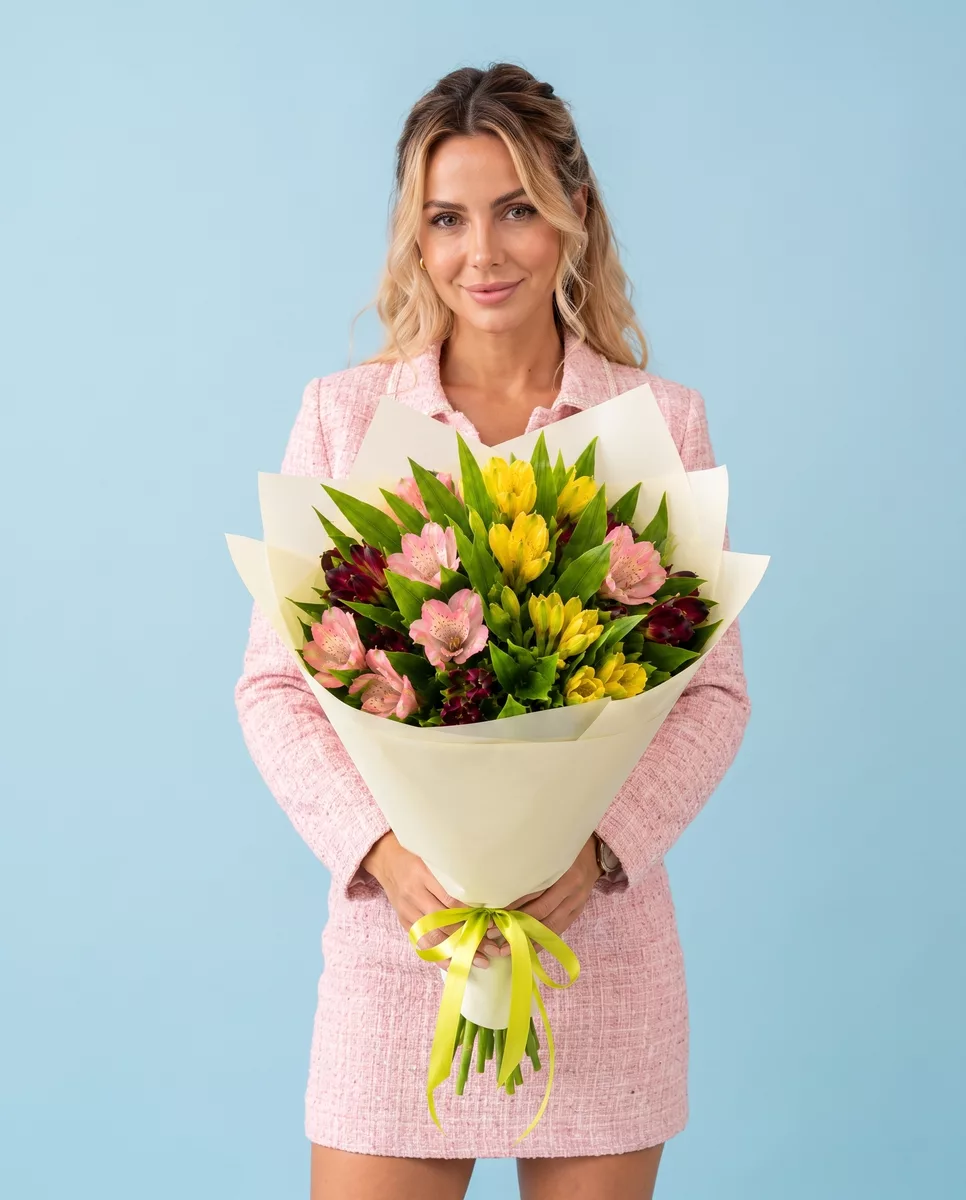
Flowers for Teenagers and Young Women Up to Age 25
The most common mistake with this age group is sending something that looks like it belongs in a hotel lobby — dense, symmetrical, heavy on red roses. Red roses read as a romantic declaration in Russian culture, and sending them to a teenage girl from a relative or family friend creates awkward social dynamics. Save red roses for a partner. For young women, the better direction is seasonal and light: ranunculus, anemones, sweet peas when available, spray roses in peach or lilac, or a single-variety bunch of garden tulips in spring.
Stem counts in the 7-to-11 range work well here. A 21-stem bouquet can feel overwhelming and overly formal for someone who is 18. The wrapping should be simple — kraft paper or a single-color matte wrap rather than elaborate cellophane and ribbon constructions. If you are ordering in winter, ask specifically about the freshness window for ranunculus: they are sensitive to temperature swings and should be delivered within the same day they are cut and arranged, especially if the recipient is in a city where the delivery involves outdoor transit in freezing temperatures.
For the card, keep the tone light and specific. Mention something real — a graduation, a performance, a birthday milestone. Generic phrases like "wishing you all the best" land flat with younger recipients who are accustomed to direct, personal communication. A short, honest sentence outperforms a long formal paragraph every time with this age group. If you are sending from abroad and writing in English, note that in the order and we will transliterate or translate as needed.
What Works for Women in Their Late 20s and 30s
Women in this bracket are often managing careers, households and social expectations simultaneously, and they respond to a bouquet that feels like it was chosen rather than assembled by default. This is the age group where presentation detail matters most. A well-constructed arrangement of garden roses — David Austin varieties if available, or other large-cupped roses with visible texture — in dusty rose, apricot or cream signals genuine effort. Peonies are enormously popular in this range when in season, roughly May through June in Russia, and a 9-stem or 15-stem peony bouquet in blush or white is almost impossible to get wrong.
Out of peony season, consider lisianthus, which holds well in transit and has a visual complexity that reads as sophisticated without being stiff. Eustoma, as it is often called in Russian flower shops, comes in white, purple, deep plum and pale pink, and it pairs well with eucalyptus or ruscus for a modern, structured look. Avoid carnations with this age group unless specifically requested — they carry associations with older-generation formality that most women in their 30s find dated.
Delivery timing is more important here than with any other age group. Women in their 30s are frequently out of the house — at work, at the gym, picking up children. Coordinate the delivery window when ordering and use the recipient's phone number so our courier can call ahead. A bouquet sitting in a warm entryway for three hours loses a full day of vase life. If the recipient has a desk job, a midday office delivery is often the most reliable option and has the added social dimension that colleagues will see it.
Flower Choices for Women in Their 40s and 50s
This is the age range where women are most likely to have strong personal preferences and least likely to be impressed by something generic. Many have received dozens of bouquets over the years and can tell immediately whether the sender made a considered choice. The varieties that consistently work: large-headed garden roses, hydrangea in blue or green tones, amaryllis in winter, and premium tulips — not standard single-color tulips but fringe or parrot varieties that have a more dramatic silhouette.
Stem counts at this stage can go higher — 15 to 25 stems is appropriate and feels proportionate to the life stage. A 25-stem bouquet of mixed garden roses in a tonal palette reads as genuinely generous without being excessive. Monochromatic arrangements, where all flowers are in the same color family with variation in tone and texture, are well-received by women in this bracket because they read as intentional and designed rather than grabbed off a shelf.
Card tone should be warm but not effusive. Women in their 40s and 50s tend to find over-the-top sentimentality slightly embarrassing, especially if the card will be read in front of others. A clear, warm statement — acknowledging a specific occasion or quality you genuinely appreciate — works better than superlatives. If you are sending for a birthday, name the year if the recipient is celebrating a round number: 45, 50, 55. Round-number birthdays in Russia are considered significant and are often celebrated with more formality than in Western contexts, so the bouquet and card should reflect that weight.
Sending Flowers to Women Over 60: Tradition and Respect
This age group is where Russian flower tradition is most strongly felt, and ignoring it will produce a result that feels foreign rather than thoughtful. Women over 60 in Russia grew up with a specific flower vocabulary: chrysanthemums for autumn occasions, gladioli for formal celebrations, carnations for national holidays and significant personal milestones. These varieties are not outdated choices here — they are culturally correct ones, and receiving them signals that the sender understood the occasion properly.
That said, roses remain universally appropriate at any age, and a well-made bouquet of classic red or deep pink roses in a 9-to-15 stem count is always safe and always welcome. If you want to go beyond roses, ask our team about what is seasonal and fresh on the specific delivery date. Chrysanthemums in particular come in a wide range of types — spray chrysanthemums, large-headed single blooms, pompom varieties — and the quality difference between a fresh stem and one that has been in cold storage too long is immediately visible. Request that the stems be cut that morning.
For the card, formality matters more here than with any other age group. Use the recipient's name and patronymic if you know it — for example, Tatyana Nikolaevna rather than just Tatyana. This form of address is standard in Russian for showing respect to someone older and will be noticed positively. Write in full sentences. Avoid abbreviations, casual phrasing or anything that reads as a text message. If you are writing in English and want the message transliterated into Russian for the card, specify this in the order notes and include a phonetic guide if the name is unusual.
Card Wording That Works Across Generations
The card is the part of a flower order that most international senders underestimate. In Russia, the written message accompanying a bouquet is read carefully and often kept. It is not a formality — it is part of the gift. A bouquet without a card, or with a card that says only "Happy Birthday," reads as incomplete, particularly to older recipients who expect a personal acknowledgment.
For younger recipients, the card can be brief and direct. Two or three sentences that reference something specific — a shared memory, a concrete achievement, a genuine observation — will outperform a longer generic message. For women in their 30s and 40s, a medium-length card of four to six sentences works well, balancing warmth with specificity. For women over 60, a slightly more formal and complete message is appropriate, ideally written as you would write a short letter rather than a note.
Practical points: if you are writing in English and the recipient reads Russian, ask us to translate or have a bilingual friend write the card. A message in a language the recipient does not read well defeats the purpose. Avoid humor unless you know the recipient extremely well — humor translates poorly across cultures and languages, and a joke that lands flat on a card is worse than no joke at all. Finally, always sign with your name in a form the recipient will recognize. If she knows you as a nickname, use it. If she knows you formally, use your full name. This sounds obvious but we see unsigned cards regularly, which creates genuine confusion on delivery.
Timing, Temperature and What to Check Before You Confirm the Order
Flowers are perishable and the Russian climate adds specific complications. In winter, temperatures in Saint Petersburg, Moscow, Novosibirsk and other major cities can drop to minus 20 Celsius or below. Cut flowers can freeze in transit in under ten minutes at those temperatures if not properly insulated. When ordering in winter, confirm that your delivery includes insulated packaging — we wrap bouquets in thermal material for cold-weather transit, but if you are ordering a particularly large or delicate arrangement, mention the outdoor temperature conditions in the notes so we can reinforce the insulation.
In summer, the opposite problem applies: heat above 25 Celsius accelerates wilting, particularly for peonies, sweet peas and ranunculus. Same-day delivery becomes more important, and early-morning delivery windows — before noon — help the bouquet arrive in the best possible condition. Ask specifically about the expected vase life of the varieties you are ordering relative to the season.
Before confirming any order, check four things: the delivery address is complete including apartment number and floor, the recipient's phone number is correct so the courier can call ahead, the stem count is odd, and the card message is written out in full rather than left as a note to "write something nice." That last instruction puts the florist in an impossible position — we do not know the relationship, the occasion or the tone you want. Write the card yourself, even if it is short. These four checks take two minutes and prevent the most common delivery problems we see every week.
Sending flowers across a generational and cultural gap is genuinely manageable once you understand the underlying logic. The variety signals the occasion, the stem count signals respect for tradition, the wrapping signals how much thought went into the order, and the card does the actual communicating. Get those four elements calibrated to the recipient's age and you will send something that lands properly rather than something that arrives and puzzles. When in doubt, call us before ordering — describing the recipient and the occasion takes three minutes and lets us suggest exactly the right arrangement rather than leaving you to navigate the catalog alone. We deliver bouquets across Russia in 1–2 hours.
Frequently asked questions
Is it appropriate to send red roses to a Russian woman who is not a romantic partner?
Red roses in Russia carry a strong romantic connotation and sending them to a colleague, family friend or acquaintance can create social awkwardness. For non-romantic occasions, choose a different variety or color — blush garden roses, tulips, peonies in season, or lisianthus are all appropriate and avoid any unintended signal about the nature of the relationship.
Why does the stem count need to be an odd number?
Even-numbered bouquets are traditionally associated with mourning in Russian culture and are brought to funerals or graves. For a living recipient, always use an odd number of stems — 7, 9, 11, 15, 21 are all common. This convention is observed across generations and regions throughout Russia, and an even-numbered bouquet will be noticed immediately by the recipient.
Can I write the card message in English if I do not speak Russian?
Yes, but consider the recipient's language ability first. If she reads English comfortably, an English card is fine. If she does not, request a translation when placing your order and write out exactly what you want to say — do not leave it open-ended. A translated card written in your own words is far more meaningful than a generic Russian phrase written by someone who does not know the recipient.
What flowers should I avoid sending to an older Russian woman?
Avoid arrangements that look purely decorative or trendy without substance — very small bouquets, heavily dried-flower arrangements, or varieties with no cultural familiarity can feel dismissive. Stick to classic varieties: roses, chrysanthemums, gladioli or carnations for formal occasions. These are not outdated choices for this generation — they are the correct ones and will be received as respectful and considered.
How far in advance should I order if I want delivery on a specific date?
For standard orders, placing the order by midday on the delivery date is usually sufficient for same-day delivery within our 1 to 2 hour window. For large arrangements, specific rare varieties, or delivery on major Russian holidays such as March 8th — International Women's Day — order at least two to three days ahead, as demand spikes sharply and specific varieties sell out quickly.
Ready to send a bouquet?
Pick a city, choose the flowers, and we will hand them over with a photo confirmation.
Choose a city →