
Flower Delivery to Kozelsk from Abroad: Zones, Timing and What to Order
Kozelsk is a small city in Kaluga Oblast, about 260 kilometres southwest of Moscow, and customers calling from Germany, Israel, the United States or Kazakhstan ask us the same cluster of questions every week: how long will it take, will the roses arrive open or tight, and what happens if nobody answers the door. The answers are concrete and worth knowing before you place the order, because Kozelsk is not Saint Petersburg — distances inside the region matter, the assortment that travels well differs from what works in a city with same-day replenishment, and the window for placing an order from a foreign time zone is narrower than most senders expect.
Why Kozelsk Is a Specific Destination and Not Just Any Russian City
Kozelsk sits in the western part of Kaluga Oblast and has a population of around eighteen thousand people. It is not a regional capital, which means it does not have the flower wholesale infrastructure that cities like Kaluga or Tula have. Every bouquet that arrives in Kozelsk has already travelled, and that travel time is built into the delivery window we quote. Senders who have previously sent flowers to Moscow or Saint Petersburg sometimes assume the same two-hour window applies everywhere in Russia, and that assumption causes frustration when it does not hold for a smaller city. The honest figure for Kozelsk is a same-day delivery when the order is placed before noon Moscow time, and next-day delivery when the order comes in during the afternoon or evening. Moscow time is UTC plus three hours year-round, since Russia abolished seasonal clock changes. A sender in Berlin is two hours behind Moscow in summer and three hours behind in winter, so the cutoff lands at ten in the morning Berlin time during summer months. A sender in New York is eight hours behind Moscow in winter, meaning the effective cutoff is four in the morning Eastern time, which in practice means placing the order the evening before. Understanding that gap is the single most useful thing a foreign sender can do before opening the order form.
Bouquets we can deliver

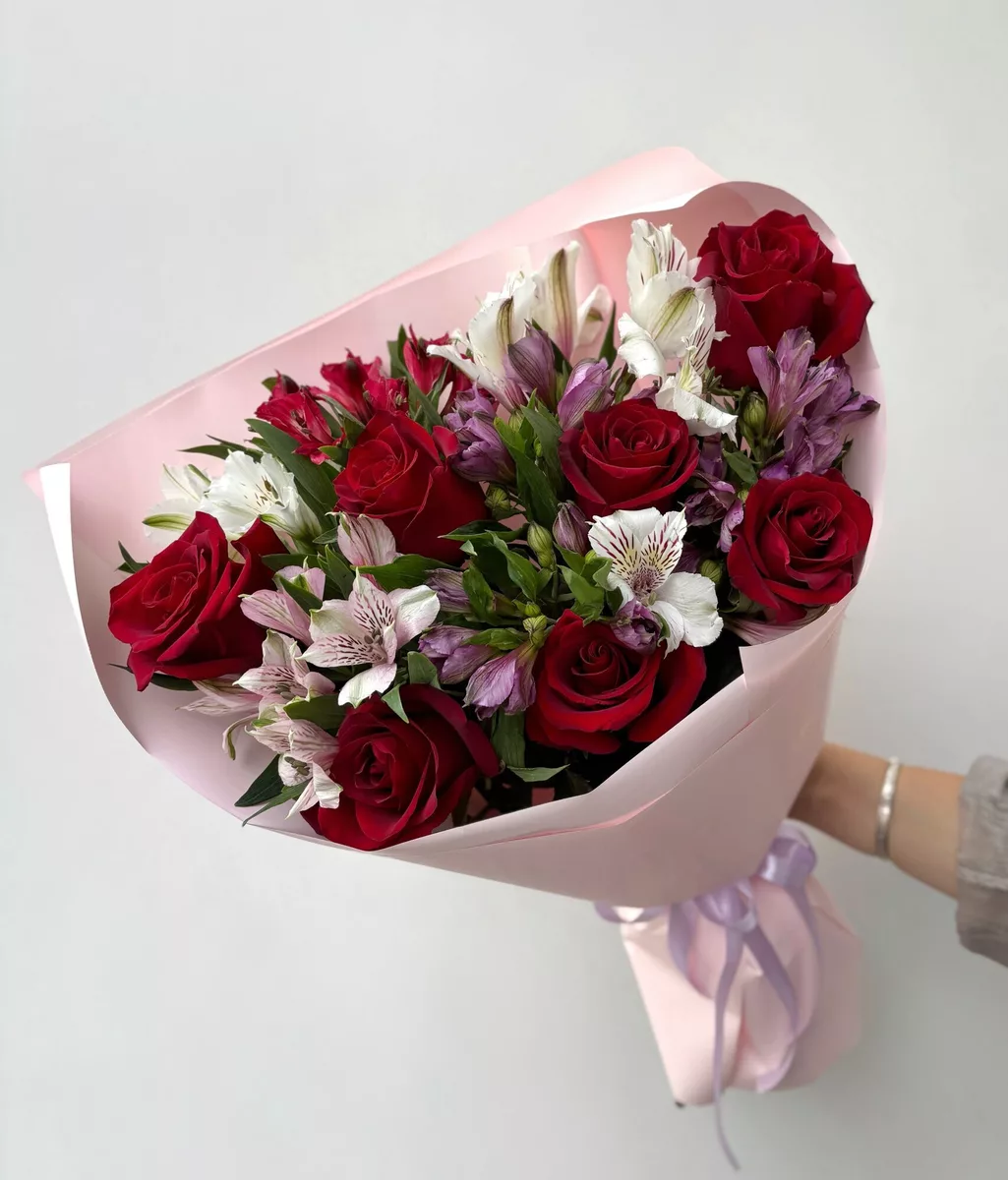


Which Flowers Actually Survive the Journey to Kozelsk in Good Condition
The varieties that hold up best over longer transit distances are not always the ones that photograph best in shop windows. Spray roses, also called cluster roses, have shorter individual stems and denser petals than large-headed garden roses, and they close back down during transport rather than continuing to open, which means they arrive in better condition and open properly once placed in water at room temperature. Standard roses in bud stage, particularly Dutch varieties in the 50-centimetre to 60-centimetre range, travel well when cut correctly and kept at four to six degrees Celsius during transit. Chrysanthemums, both the single-headed Santini types and the larger disbud varieties, are extremely robust and are underused by senders who default to roses out of habit. Alstroemeria holds water well and does not bruise the way tulips do. Tulips are worth discussing separately: they are popular, they look beautiful, but they continue growing after cutting, they bend toward light, and they are sensitive to temperature swings above twelve degrees Celsius. In summer, a tulip bouquet sent to Kozelsk without careful cold-chain management can arrive with bent, overextended stems. In November through March, when Kozelsk temperatures drop well below zero, tulips actually travel better because the ambient cold helps. Eustoma, sometimes listed under its commercial name lisianthus, is a good middle-ground choice: it looks delicate but is structurally tougher than it appears and holds its colour across a full week when conditioned properly.
Seasonal Timing and What That Means for the Bouquet You Choose
Russia has four distinct seasons and Kozelsk, being inland and at a higher latitude than most of Western Europe, experiences them sharply. January and February bring hard frosts, sometimes minus fifteen to minus twenty Celsius, which affects both the transit of flowers and what the recipient will actually want to put in a cold apartment entryway. Roses and chrysanthemums handle brief cold exposure better than tropical varieties like anthuriums or bird-of-paradise, which suffer cell damage below eight degrees Celsius even for short periods. March through May is the window when tulips, hyacinths and ranunculus are genuinely appropriate, because temperatures are moderate and these spring bulb varieties are at peak availability from Dutch growers. Summer, June through August, is the season when mixed bouquets with eustoma, spray roses and solidago work well because the variety mix reduces the risk that one element fails. September and October are excellent months for chrysanthemums, which are at their best in autumn and are deeply associated with the season in Russian floral tradition. November is transitional and often the month when senders from warmer countries underestimate how cold it already is in Kaluga Oblast. Choosing varieties that match the actual season is not sentimentality — it is a practical decision that determines whether the flowers look good for three days or ten days after delivery. When you are unsure, asking the florist to select seasonally appropriate varieties rather than specifying a fixed list usually produces a better result.
How to Write the Delivery Address and Recipient Details Correctly
This is the section most foreign senders skip, and it is the one that causes the most failed deliveries. A Russian address has a specific structure: city, street, building number, apartment number, and sometimes a corpus or stroenie number which indicates a secondary building on the same plot. Kozelsk addresses follow this format. If you write the address in the Western order — street first, then city — it can be misread. The safest approach is to get the full address from the recipient in advance, in Russian Cyrillic if possible, and paste it directly into the order form. If you only have a transliterated version, that is workable, but confirm with the recipient that the street name is spelled correctly, because transliteration from Russian to Latin has no single standard and the same street can appear as Ulitsa Mira or ul. Mira or simply Mira Street depending on who wrote it down. The apartment intercom code is a separate field and should not be omitted — many Russian apartment buildings have coded entry systems, and without the code the courier cannot reach the door. The recipient's phone number must be a Russian mobile number beginning with plus seven. If the recipient only has a landline, note that in the comments field so the courier knows not to expect a mobile callback. A card message in Russian is not required, but if you want to write one and are not a Russian speaker, a short message in English is perfectly acceptable — recipients in Kozelsk are accustomed to receiving cards in English from relatives abroad.
Payment from Outside Russia and What to Expect at Checkout
Paying for a flower delivery in Russia from a foreign bank card is a practical question that has changed significantly since 2022. Cards issued by Visa and Mastercard in most Western countries do not process directly through Russian payment terminals. This is not a shop policy — it is a consequence of international payment system restrictions. The practical solutions that work for most foreign senders are payment through international services that still process cross-border transactions, payment via a Russian bank card belonging to a family member or friend who is in Russia, or wire transfer in some cases for larger orders. When you open the order form on the site, the available payment methods are listed at checkout, and the options that are currently functional will be shown. It is worth checking this before you spend time building the order, particularly if you are ordering from a country with significant banking restrictions toward Russia. Senders from Kazakhstan, Belarus, Armenia and Azerbaijan generally have fewer payment complications because banking links with Russia remain more intact. Senders from Germany, France, the United States or the United Kingdom should plan for an extra step and possibly involve a Russian contact for the payment. The price itself is quoted in Russian rubles, and the ruble amount will be converted by your bank at whatever exchange rate applies at the time of the transaction, so the final charge in your home currency may differ slightly from any estimate you calculate in advance. There are no hidden service fees added for international orders.
What to Do If the Recipient Is Not Home at Delivery Time
This is the scenario that worries foreign senders most, and for good reason — you cannot be present to manage it, you may be in a different time zone, and the flowers are perishable. The standard procedure is that the courier calls the recipient before arriving. If there is no answer, the courier waits a short time and calls again. If the recipient remains unreachable, the order is held and a second delivery attempt is arranged. Fresh flowers cannot be left outside a door in Russian apartment buildings for several reasons: the building entrance is usually locked, leaving perishables unattended in a common hallway is not accepted practice, and in cold months the temperature in unheated stairwells can damage the bouquet. When you place the order, it helps to add a note in the comments field explaining that you are sending from abroad and asking the courier to send a text message to the recipient in addition to calling — many recipients are more likely to respond to a text if they do not recognise the calling number. You can also coordinate with the recipient yourself and let them know a delivery is coming on a specific day, even if you want the exact bouquet to be a surprise. Giving a time window rather than an exact hour is more realistic: morning deliveries are roughly between ten and one, afternoon between two and six. If the recipient works and will only be home after seven in the evening, note that in the order comments so the delivery is scheduled accordingly rather than defaulted to a midday slot.
Russian Flower Customs a Foreign Sender Should Know Before Ordering
Russian customs around flowers are specific enough that a sender from outside the country can accidentally make a choice that reads differently to the recipient than intended. The most important one is the odd-number rule: bouquets for living recipients are always given in odd numbers — one rose, three roses, five, seven, eleven, fifteen, twenty-five. Even numbers of flowers are associated with mourning and funerals in Russian tradition, and this is taken seriously across generations and across regions including Kozelsk. If you count the stems in the bouquet you are ordering and arrive at an even number, ask for one stem to be added. Most shops, including ours, automatically compose bouquets in odd quantities, but it is worth confirming if you are ordering a custom arrangement. Yellow flowers carry a cultural association with separation or bad luck in romantic contexts in Russia, though this is a belief that varies by generation — younger recipients in their twenties are often indifferent to it, while recipients over forty may notice. If you are sending to a romantic partner and want to be safe, avoid all-yellow compositions. White flowers are perfectly appropriate for birthdays, name days and professional occasions. Red roses are understood universally as romantic. Pink roses are a good neutral choice for a wide range of recipients and occasions. Name days, called imeniny in Russian, are celebrated similarly to birthdays and flowers are an entirely appropriate gift for them. If you know the recipient's name day date, it is a thoughtful occasion to send flowers even if you would not otherwise have a specific reason.
Sending flowers to Kozelsk from abroad is manageable when you have the right information before you start. The key variables are the time zone gap and the order cutoff, the variety choices that suit the season and the transit distance, a complete and correctly formatted address with the intercom code, and a payment method that actually works from your country. Getting those four things right means the bouquet arrives fresh, on time, and reads exactly as you intended it to — which is the whole point of sending flowers across that distance in the first place. We deliver bouquets across Russia in 1–2 hours.
Frequently asked questions
How far in advance should I place the order from a foreign time zone?
For same-day delivery to Kozelsk, the order must be placed before noon Moscow time, which is UTC plus three year-round. Senders in Western Europe should plan for a morning order, and senders in North America should place the order the evening before their local date. Next-day delivery gives you a comfortable buffer and is often the more reliable choice when ordering across multiple time zones.
Can I write the card message in English?
Yes, a card message in English is completely fine. Recipients in Kozelsk who have family or friends abroad are accustomed to English-language cards. If you want the message transliterated into Russian or translated, note that in the order comments and we will do our best, but English text printed clearly on the card is a perfectly acceptable and common choice.
What happens to the flowers if it is very cold in Kozelsk on the delivery day?
Bouquets are wrapped and insulated for cold-weather transit. Roses, chrysanthemums and spray roses handle brief cold exposure well. Tropical varieties like anthuriums are avoided in deep winter for this reason. If temperatures are forecast below minus fifteen Celsius, we may suggest a variety adjustment when you place the order, which you can accept or decline.
Is it possible to schedule delivery for a specific time, not just a date?
You can request a morning window, roughly ten to one, or an afternoon window, roughly two to six, and we will note a preferred hour in the order. Exact-minute delivery is not guaranteed because traffic and building access vary, but we work within the window you specify. If the recipient has a very narrow availability window, note it clearly in the comments field.
Do I need to tell the recipient a delivery is coming, or can it be a complete surprise?
It can be a surprise, but the recipient must be reachable by phone on the delivery day because the courier calls ahead. If the recipient does not answer unknown numbers, a failed delivery is likely. A practical middle ground is telling the recipient to expect a delivery on a specific day without revealing what it is — that preserves most of the surprise while ensuring someone is available to receive the bouquet.
Ready to send a bouquet?
Pick a city, choose the flowers, and we will hand them over with a photo confirmation.
Choose a city →