
Flower Delivery to Sredneuralsk from Abroad: Zones, Timing and What to Prepare
Every week we get messages from people in Germany, the UAE, the United States, Israel and a dozen other countries asking whether we can deliver flowers to Sredneuralsk. The answer is yes, and the process is more straightforward than most senders expect — but there are specific things about time zones, seasonal temperatures and Russian address formats that catch international customers off guard. This article covers all of it plainly, so your order arrives on time and the bouquet looks exactly as you intended.
Where Sredneuralsk Sits and Why It Matters for Delivery
Sredneuralsk is a small city in Sverdlovsk Oblast, roughly 30 kilometres north of Yekaterinburg. It sits in the Ural Federal District, which operates on Yekaterinburg time — that is UTC plus five hours, with no daylight saving adjustment, since Russia abolished seasonal clock changes in 2014. This is a critical detail for anyone placing an order from Western Europe, North America or the Gulf: when it is noon in London, it is already 5 p.m. in Sredneuralsk, and when it is noon in New York, it is 10 p.m. there. Many senders from abroad miscalculate this and place a same-day order that, by local time, is already an evening delivery or even next-day. The city itself is compact — a population of roughly 20,000 — and most residential addresses are in standard Soviet-era apartment blocks, which means deliveries go to a specific apartment number inside a building with a door code. That door code, called a domofon code in Russian, is not optional; without it, a courier cannot reach the floor. Always confirm the code with your recipient before ordering, or ask them to wait downstairs at the agreed time. The geography also means that weather in the Urals can shift dramatically between seasons, and that directly affects which flowers we can send without risking damage in transit.
Bouquets we can deliver



Time Zone Arithmetic: Placing Your Order at the Right Moment
The most common mistake international senders make is placing an order at what feels like a reasonable morning hour in their own country, not realising the recipient's day is nearly over. Sredneuralsk runs on UTC plus five, full stop. If you are in Berlin at UTC plus one, Sredneuralsk is four hours ahead of you. If you are in Dubai at UTC plus four, Sredneuralsk is one hour ahead. If you are in Toronto at UTC minus five, Sredneuralsk is ten hours ahead of you. Work out the local Sredneuralsk time first, then decide whether your delivery window is realistic. We offer delivery from early morning through evening, and same-day orders placed before a certain cut-off in local Sredneuralsk time are fulfilled the same day. Orders placed after that cut-off are scheduled for the following morning slot. When you are ordering from abroad, calculate the cut-off in your own time zone before you start filling out the form — this saves a frustrated message to our support team afterward. For milestone occasions — a birthday, an anniversary, a graduation — we strongly recommend scheduling the delivery for the morning of the date rather than the afternoon. Morning deliveries arrive when the recipient is most likely to be home, and they give the flowers the full day to be enjoyed. Afternoon slots work well for office addresses, but most Sredneuralsk residents we deliver to live in apartment buildings, not offices.
Seasonal Temperatures in the Urals and What They Mean for Flowers
The Ural region has a continental climate with genuine extremes. Winters in Sredneuralsk are cold — January averages well below minus fifteen degrees Celsius — and summers can push above thirty degrees in July. Both extremes affect flowers differently, and as a sender from abroad you should know which varieties hold up and which do not. In winter, roses and tulips travel well in insulated packaging, but tropical and thin-petalled flowers such as anemones and lisianthus can suffer petal damage if the packaging is opened in a cold entryway. We use thermal wrapping during cold months, but the recipient should bring the bouquet indoors immediately and not leave it in an unheated corridor. In summer, the risk flips: direct sun and heat accelerate wilting, especially for hydrangeas and garden roses. We recommend recipients place bouquets in water within twenty minutes of receipt and keep them away from south-facing windows. Spring — April through May — is the best season for tulip deliveries; the Urals receive Dutch tulip stock reliably during this period, and the moderate temperatures mean they travel without stress. Autumn is excellent for chrysanthemums, spray roses and alstroemeria, all of which are robust in cool conditions. Knowing the season when you order helps you choose a bouquet that will genuinely look good after delivery, not just in the photograph on the website.
Which Bouquets Work Best for Long-Distance Orders
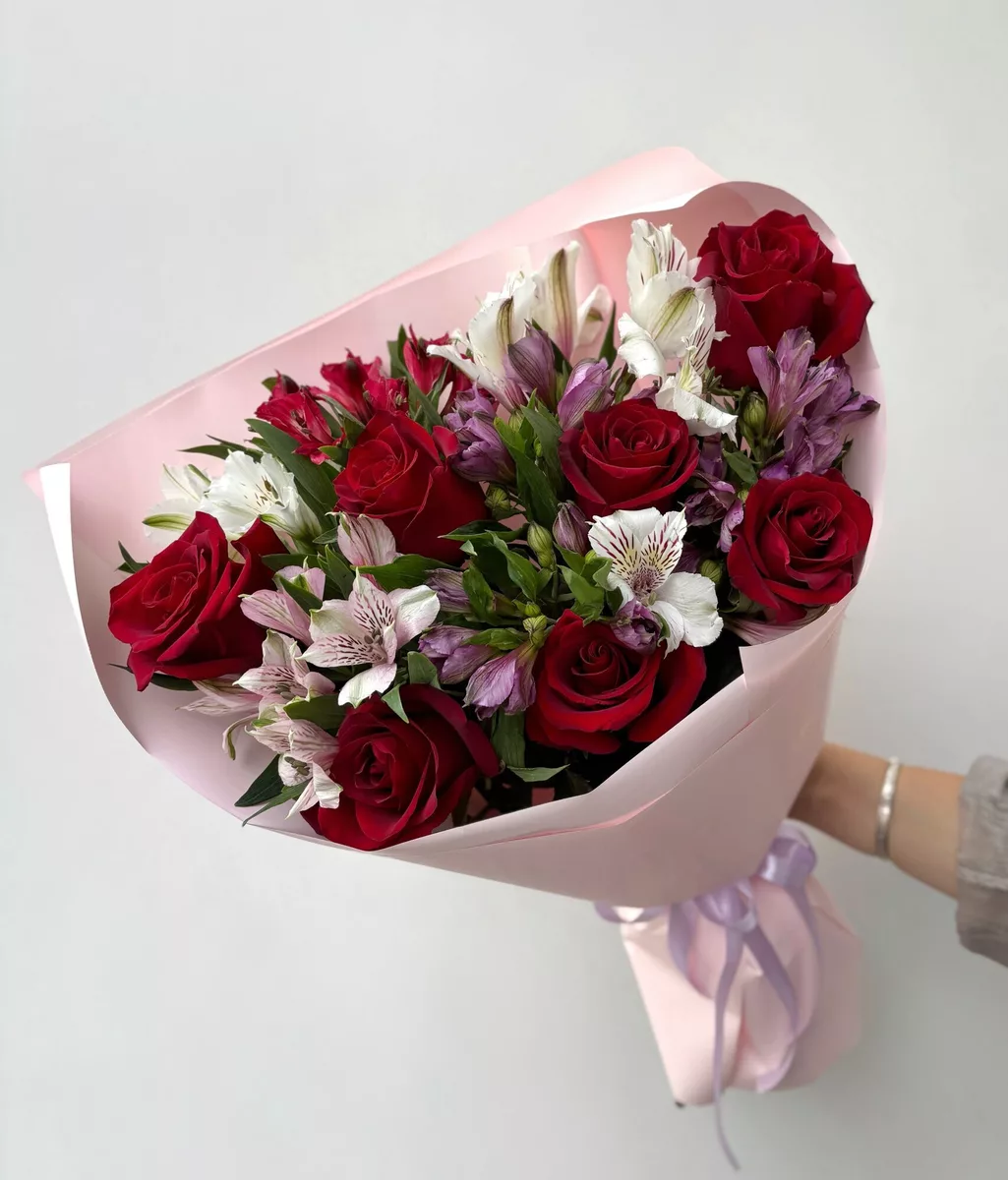
When you are ordering from another country, you cannot inspect the flowers yourself, so choosing varieties with strong post-delivery durability is practical rather than fussy. Roses are the reliable standard: a bouquet of 25 or 51 spray roses or large-headed roses such as Explorer or Red Naomi will hold its shape for five to seven days in water. Chrysanthemums — both standard single-stem and spray varieties — are exceptionally long-lasting and handle the temperature swings of Ural transit well. Eustoma, also called lisianthus, is a popular choice for women's birthdays and looks delicate but actually holds for up to ten days in fresh water. Alstroemeria is another strong performer; it continues to open buds after delivery, which means the recipient watches the bouquet evolve over several days. Orchid arrangements, particularly those built around Phalaenopsis branches, are excellent for significant occasions and last two to three weeks. What tends to disappoint in long-distance orders is anything built primarily around garden flowers with soft stems — sweet peas, for instance — or very open peonies in summer. Peonies ordered in tight bud, however, travel well and open beautifully indoors. If you are unsure, our team can advise on what is in peak condition on the day you are ordering, since stock quality shifts week by week depending on supplier deliveries. A quick message to us before placing the order prevents the most common mismatches between expectation and result.
Russian Address Format: What You Must Fill In Correctly
Russian postal addresses follow a structure that differs from most Western formats, and errors in the address field are the single most frequent cause of delivery delays for international orders. The standard format runs from largest geographic unit to smallest: city, then street name, then building number, then apartment number, then floor if needed. In Russian, the abbreviations are ulitsa for street, dom for building number and kvartira for apartment number. When filling out our order form in Latin characters, write it clearly — for example, Sredneuralsk, ulitsa Lenina 14, kvartira 37. Do not abbreviate in ways that could be misread. Building numbers in Russian cities often include a corpus or stroenie suffix, meaning a secondary block within the same plot — for instance, dom 5 korpus 2. If your recipient lives in such an address, both parts are essential. The domofon code — the intercom entry code for the building's front door — should be entered in the notes field. If you do not have it, write that the recipient will meet the courier at the entrance, and message your recipient to confirm this arrangement. Russian buildings rarely have a doorman, so the domofon is the only way in. Finally, include the recipient's mobile phone number in Russian format, starting with plus seven. Our courier will call ahead, and a reachable number is the difference between a delivered bouquet and a missed delivery.
Payment from Abroad and What to Expect After Ordering
Paying for a flower delivery to Russia from another country is straightforward with a card, and our checkout accepts major international Visa and Mastercard cards as well as a number of other payment methods depending on your country of issue. Some banks flag cross-border transactions to Russian merchants and apply an additional check — if your payment is declined on the first attempt, try again or contact your bank to pre-authorise the transaction. This is a bank-side issue, not a problem with our system. Once payment is confirmed, you receive an order confirmation with the scheduled delivery window. We will send you a delivery confirmation when the bouquet has been handed to the recipient. If you have not received confirmation within the expected window, check your spam folder first — confirmation emails from Russian domains occasionally land there for international recipients. You can also reach our support team by message to ask for a status update; include your order number, which appears in the confirmation email. One thing international senders often ask: can you include a card message in a language other than Russian? Yes, absolutely. We print the message as you write it, whether in English, German, Hebrew, Arabic or any other language you use. The recipient will see it exactly as written. If you want a Russian translation included alongside your message, note that in the comments field and we will arrange it. Keep card messages short — three to five sentences — so the printed card remains readable.
Customs, Etiquette and Numbers: What Russian Recipients Expect
If you are not familiar with Russian flower customs, a few points are worth knowing before you choose a bouquet. The most widely observed rule is that bouquets given as gifts should contain an odd number of stems — 1, 3, 5, 7, 11, 15, 25, 51, 101 and so on. Even numbers are associated with memorial occasions and are not appropriate for celebrations or everyday gifting. This is taken seriously across all age groups and regions, including Sredneuralsk. When in doubt, odd is always correct. Yellow flowers carry a nuance worth understanding: in Russian popular belief, yellow flowers can be associated with separation or bad luck in relationships, though this is more of a folk superstition than a universal rule and many younger recipients do not hold it at all. If you are sending to someone traditional or older, it is safer to mix yellow blooms with white or orange ones rather than sending a purely yellow bouquet. White flowers are considered neutral and appropriate for almost any occasion — birthdays, graduations, professional achievements, new homes. Red roses remain the standard for romantic occasions and are universally understood. Large bouquets — 51 or 101 roses — are considered genuinely impressive gestures and are common for significant birthdays such as a 50th or for a major professional milestone. If you want the delivery to feel special rather than routine, size matters more in Russian gifting culture than elaborate wrapping or packaging style.
Ordering flowers to Sredneuralsk from abroad is a reliable process when you handle three things correctly: calculate the time zone before placing the order, provide a complete address including the domofon code and a Russian mobile number, and choose varieties suited to the season. The city is well within our delivery reach, and the logistics from our side are consistent. What makes the difference on the sender's side is preparation — ten minutes spent confirming the recipient's full address and the delivery window in local time will do more for a successful order than any other single step. We deliver bouquets across Russia in 1–2 hours.
Frequently asked questions
Can I order flowers to Sredneuralsk from outside Russia without a Russian phone number?
Yes. You enter your own international number as the sender contact. The recipient's Russian mobile number goes in the recipient field — that is the number our courier calls before arrival. Without a reachable Russian number for the recipient, delivery to an apartment building becomes unreliable, so this detail is essential regardless of where you are placing the order from.
How far in advance should I place an order for a specific date?
For a guaranteed morning delivery on a specific date, placing the order the evening before in Sredneuralsk local time is ideal. Same-day orders are possible if placed before our local cut-off. For major dates — 8 March, 14 February, New Year — we recommend ordering two to three days ahead, as demand in the Ural region peaks sharply and popular varieties sell out early.
What happens if the recipient is not home at the delivery time?
Our courier calls the recipient's mobile before arriving. If there is no answer, the courier waits a short period and tries again. If the recipient remains unreachable, we contact you as the sender to rearrange. This is why a working Russian mobile number for the recipient is not optional — it is the primary tool for completing the delivery successfully.
Are there flowers I should avoid ordering in the Ural winter?
Tropical varieties with very thin petals — anthuriums in arrangements without protective packaging, open garden roses, and large open peonies — can show cold damage if exposed to minus temperatures even briefly. We use thermal packaging in winter, but very delicate compositions carry more risk than robust choices like roses in bud, chrysanthemums, or eustoma. Ask us what is performing well on the day you order.
Can the card message be written in English or another foreign language?
Completely. We print the card message exactly as you write it, in any language. If you want a Russian translation added alongside your original message so the recipient can read both versions, mention this in the order comments. There is no additional charge for this. Keep the message under five sentences so it fits neatly on the printed card without crowding.
Ready to send a bouquet?
Pick a city, choose the flowers, and we will hand them over with a photo confirmation.
Choose a city →