
September 1 Flowers: What Russian Students Receive on Knowledge Day
Every September 1 in Russia, schools fill with children carrying flowers — not for decoration, but as a direct gift to their class teacher. If you grew up outside Russia, this can look puzzling: hundreds of students arriving simultaneously with bouquets, the teacher's arms full before the first bell rings. The tradition is called Den Znaniy, Knowledge Day, and the flowers are as much a part of it as the white ribbons in girls' hair. This article explains which varieties actually show up, why certain flowers dominate, and what to do if you want to send a bouquet from abroad to a child or teacher you care about.
What Knowledge Day Actually Is and Why Flowers Matter
September 1 is the official start of the school year across Russia, and it is treated as a genuine holiday rather than a routine Monday morning. Every school holds a ceremony called the Linka — a formal outdoor assembly where teachers are introduced, speeches are made, and a first-grader is carried on a senior student's shoulders ringing a bell. The flower-giving is not optional or spontaneous; it is an expected part of the morning. Children arrive with bouquets prepared the evening before, and the gift goes directly to the homeroom teacher as a mark of respect for the new academic year. Teachers at Russian schools receive flowers from every student in their class, which means a single teacher can collect thirty or more bouquets in one morning. Most are taken home, but the gesture itself is what counts. Parents treat the flower budget seriously — it is one of the standard September expenses alongside new notebooks and a school bag. The custom dates to the Soviet era, when presenting flowers to educators was a formal sign of social esteem, and it has remained unchanged through every political and economic shift since. For families living abroad who have children studying in Russia, or for grandparents and relatives who want to participate from a distance, sending flowers on September 1 is a concrete way to mark the day. The deadline is always the morning of September 1, which means orders placed late on August 31 carry real risk if delivery windows are not confirmed in advance.
Bouquets we can deliver



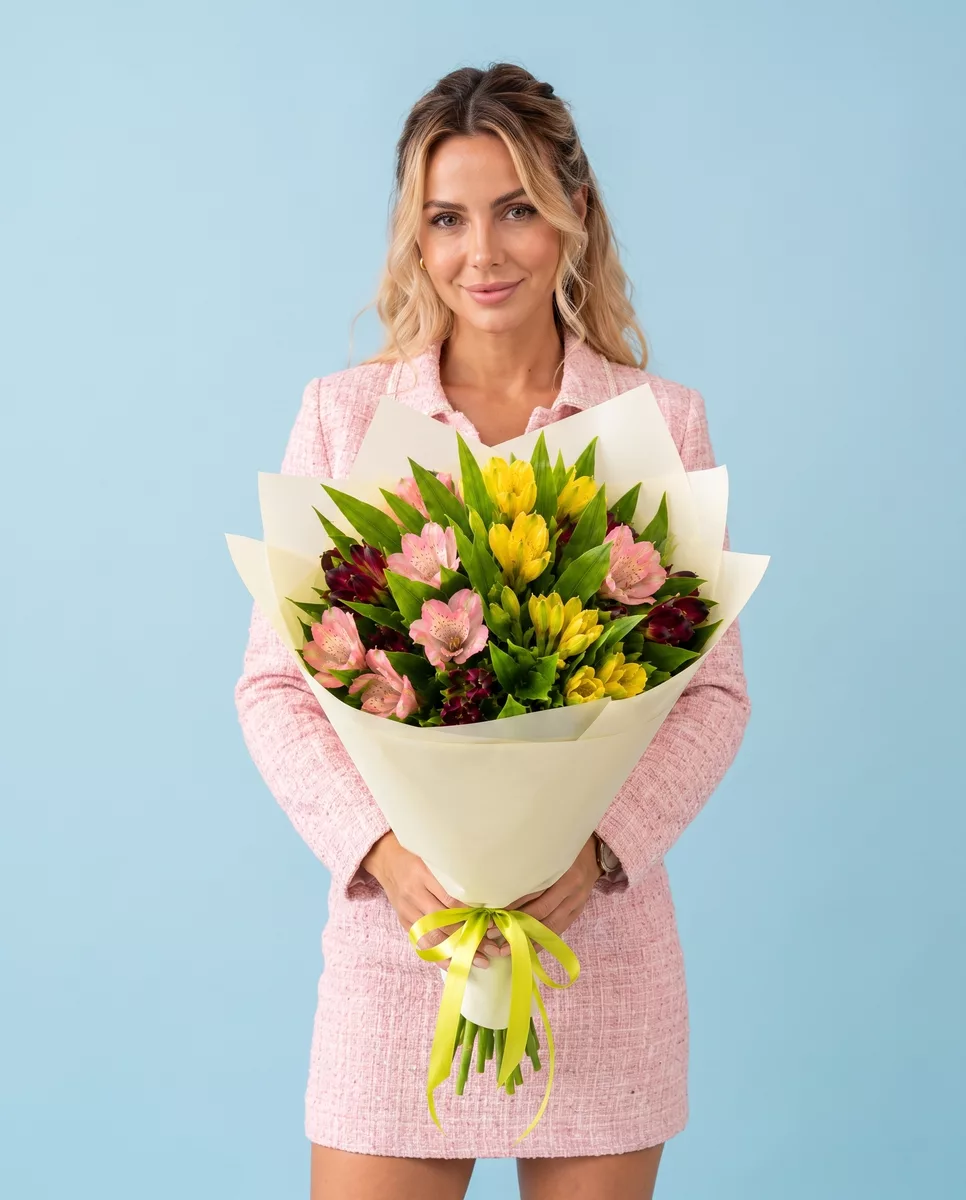
Gladioli: The Classic September 1 Flower and Why It Dominates
Ask any Russian florist which flower defines September 1 and the answer is immediate: gladioli. The tall, upright spike of the gladiolus has been the standard Knowledge Day flower for decades, and it remains the most commonly purchased variety on August 31 and the morning of September 1. Gladioli are in peak season during late August and early September across Russia, which keeps them relatively affordable and widely available compared to imported stems. The varieties most often seen are the large-flowered hybrids in white, cream, pale pink, and deep burgundy — colors that read as formal and respectful rather than casual. A single stem of a well-grown gladiolus can reach eighty to one hundred centimeters and carries twelve to sixteen florets along the spike, which means even a small bunch of three or five stems makes a visually substantial gift. The practical problem with gladioli is transport: the stems are tall and the florets bruise easily if pressed together or carried sideways. Children often hold them upright like a torch, which is exactly right. Florists wrapping gladioli for September 1 use firm kraft paper cones that protect the lower florets while leaving the top open. The flowers should be cut when the bottom two or three florets have opened and the rest are still in tight bud — this gives the longest vase life and means the teacher receives a bouquet that will continue opening for several days. Gladioli kept in a cool room with fresh water every day will last eight to twelve days, which is unusually long for a cut flower.
Asters, Chrysanthemums and Other Seasonal Alternatives
Not every family chooses gladioli, and the September 1 flower market is genuinely diverse. Asters are the second most common choice — the annual aster, Callistephus chinensis, blooms in late summer and produces dense, daisy-like heads in violet, white, pink, and deep purple. They are compact, easy for a child to carry, and their round shape contrasts nicely with the vertical gladiolus if both appear in a teacher's collection. Spray chrysanthemums are also widely used: the multiflora varieties produce clusters of small flowers on branching stems and hold up well at room temperature, which matters when a child is walking to school and the bouquet sits in a warm classroom for several hours before being taken home. Single-stem large chrysanthemums in white and yellow appear less often for Knowledge Day specifically, as they carry associations with other occasions in Russian culture. Roses are present but less dominant than you might expect — they are expensive relative to gladioli and asters in September, and a single rose feels insufficient while a dozen roses is a significant budget for a school gift. The varieties that work best for September 1 delivery are those with strong stems and tight buds that open slowly: Avalanche roses, white spray roses, and standard garden roses in peach or coral tones. Dahlias appear occasionally in September bouquets, particularly the ball and pompom varieties in orange and yellow, though they wilt faster than gladioli or chrysanthemums and require the recipient to put them in water quickly. A florist assembling a September 1 bouquet should always ask whether the flowers will sit in a warm school for several hours before going home.
What Teachers Actually Receive: Sizes, Wrapping and Expectations
The social norm for a Knowledge Day bouquet is clear to most Russian parents but opaque to anyone outside the tradition. A single stem is considered too small — it reads as an afterthought. A bouquet of five to seven stems is the standard for a class teacher; a larger arrangement of nine to eleven stems is appropriate if the child has had the same teacher for several years and the relationship is close. Very large bouquets of fifteen or more stems are given by families who want to make a stronger gesture, but they are not required and can feel excessive in the context of a school morning where every child is giving something. Wrapping follows a consistent aesthetic: kraft paper or matte floral paper in natural tones, tied with a ribbon rather than a bow, with the stems trimmed to a uniform length. Cellophane wrapping, which is common in some other countries, is used less often for formal Russian bouquets and reads as lower quality. The flower colors chosen for teachers tend toward the restrained — white, cream, pale pink, and soft lilac rather than saturated orange or red. Red flowers in particular are avoided for teachers because they carry a romantic association in Russian culture and would be considered inappropriate. Labels or cards are not typically attached to Knowledge Day bouquets; the gift is given in person with a verbal greeting at the ceremony. When ordering for delivery rather than pickup, the wrapping and color palette should be specified clearly because the florist cannot know the recipient's taste without guidance.
Sending September 1 Flowers from Abroad: Timing and Logistics
The challenge of sending flowers for September 1 from outside Russia is almost entirely a timing problem. Knowledge Day falls on a fixed date, the ceremony begins between eight and nine in the morning, and flowers need to be in the recipient's hands before the child leaves for school — which in most Russian cities means delivery must be completed before eight-thirty. Ordering through a Russian flower delivery service that operates its own courier network, rather than relying on international flower platforms, is the only way to guarantee that timing. The order should be placed no later than the evening of August 31, and ideally by midday on August 31, to allow the shop to prepare the bouquet and schedule an early morning delivery slot. Payment from abroad is straightforward with most Russian flower shops that accept international cards or payment links; the key information needed is the recipient's full address including apartment number, a working Russian mobile phone number for the courier to call, and the preferred delivery window. August 31 is itself a busy day for flower shops because many families buy the evening before and pick up in the morning — walk-in volume is high, and delivery capacity fills up. If you are sending to a school address rather than a home address, confirm with the recipient that someone will be there to accept the delivery, since school buildings are often locked before seven-thirty. Sending to a home address the evening of August 31 is generally more reliable than a same-morning school delivery.
Bouquets for Classmates: The First-Grader Tradition
September 1 flowers are not only for teachers. First-graders — children starting school for the first time, typically at age six or seven — often receive small bouquets from older students or from their own families as part of the day's celebration. The first-grader is the symbolic center of the Knowledge Day ceremony: one child is chosen to ring the school bell while being carried by a senior student, and all first-graders are treated as guests of honor at the Linka. Families sometimes send a small bouquet to a niece, nephew, or grandchild who is starting school for the first time, treating it as a milestone gift in the same way a birthday or graduation might be marked with flowers. These bouquets for children are smaller and lighter than teacher bouquets — three to five stems of asters or spray roses, compact enough for a small child to hold without difficulty. Bright colors are more acceptable here than for teacher bouquets: cheerful yellows, pinks, and mixed arrangements are all appropriate. Some families combine the flower delivery with a small gift, but the bouquet alone is a complete and recognized gesture. There is also a custom in some Russian schools of older students giving a single flower to a first-grader they are paired with as a mentor — a simple stem of a white rose or a single gladiolus. This is less universal than teacher gifting but is common enough that florists in late August regularly sell individual stems alongside full bouquets. If you are ordering for a first-grader from abroad, a delivery to the home address on the evening of August 31 means the child can carry the flowers to school themselves the next morning.
What to Check Before Placing a September 1 Order
Several things go wrong consistently with Knowledge Day orders, and most of them are avoidable with a few direct questions before confirming the purchase. First, confirm the delivery window in writing — not just that same-day delivery is available, but that a slot before eight-thirty on September 1 is specifically reserved for your order. Shops that cannot confirm a time window are unlikely to deliver before the ceremony. Second, check whether the shop delivers to the specific district of the city you need: Saint Petersburg and Moscow are large, and some outer districts require longer lead times or carry surcharges that affect whether an early slot is possible. Third, specify the flower colors explicitly and ask the florist to avoid red — this is a detail that matters for a teacher gift and is easy to overlook when ordering remotely. Fourth, provide a backup contact number for the recipient in case the primary number does not answer; couriers call ahead before arriving, and a missed call can mean a missed delivery. Fifth, if the recipient lives in an apartment building, include the entry code or intercom number — this is one of the most common reasons deliveries are delayed in Russian cities. Finally, ask about the flower condition at the time of wrapping: gladioli should have the lower florets open and the upper buds still closed, asters should be fully open but not showing pollen, and spray roses should be in tight bud. A florist who can answer these questions specifically is one who is actually preparing the flowers rather than relaying an order to an unknown third party.
September 1 in Russia is one of the few days when flowers are not a luxury or a surprise — they are expected, prepared the night before, and carried to school by children across the country as a straightforward expression of respect for their teachers. The varieties involved are seasonal and practical: gladioli because they are tall and in peak condition, asters because they are compact and bright, spray chrysanthemums because they last. If you are sending from abroad, the logistics are manageable as long as the order is placed on August 31 with a confirmed morning delivery slot, a correct address, and clear color instructions. Getting those three things right is the difference between a bouquet that arrives before the bell rings and one that arrives after the family has already left for school. We deliver bouquets across Russia in 1–2 hours.
Frequently asked questions
Which flowers are most traditional for September 1 in Russia?
Gladioli are the single most traditional choice — tall, in season, and long-lasting. Asters and spray chrysanthemums are the next most common. Roses appear but are less dominant because they are more expensive in September and a single rose feels insufficient as a teacher gift. White and pale pink tones are preferred over saturated colors.
Can I send flowers to a school address on September 1?
It is possible but riskier than a home delivery. School buildings are often locked before seven-thirty, and the recipient needs to be physically present to accept the order. Delivering to the home address on the evening of August 31 is more reliable — the child then carries the bouquet to school themselves, which is also the traditional way to arrive.
How many flowers should a Knowledge Day bouquet contain?
Five to seven stems is the standard for a class teacher. Three to five stems is appropriate for a first-grader or a smaller gesture. Bouquets of nine to eleven stems signal a closer relationship or longer acquaintance. Single stems are considered too small for a teacher gift in the context of Knowledge Day.
Why should I avoid red flowers for a teacher on September 1?
In Russian social custom, red flowers — particularly red roses — carry a romantic connotation. Giving red flowers to a teacher would be considered inappropriate and potentially embarrassing for the child. White, cream, pale pink, soft lilac, and yellow are all safe and well-received choices for teacher bouquets on Knowledge Day.
What is the latest I can order flowers for September 1 delivery?
Place your order no later than midday on August 31 to secure an early morning delivery slot on September 1. Evening orders on August 31 are accepted but early slots fill quickly as demand is high. Orders placed on the morning of September 1 cannot reliably be delivered before the school ceremony begins at eight to eight-thirty.
Ready to send a bouquet?
Pick a city, choose the flowers, and we will hand them over with a photo confirmation.
Choose a city →