
Yellow Flowers in Russia: The Separation Myth and What Florists See Now
At least once a week someone calls the shop and asks, in a slightly nervous voice, whether it is really true that yellow flowers mean a breakup. The short answer is: that belief exists, it is genuinely held by some people, and it is also genuinely ignored by a growing share of buyers who simply want a striking bouquet. Understanding where the superstition comes from, who still takes it seriously, and which yellow varieties are actually flying out of cold storage right now will help you order with confidence rather than anxiety.
Where the Yellow-Equals-Separation Belief Actually Comes From
The association between yellow flowers and bad luck or parting is not unique to Russia, but it took a particularly firm hold in Soviet-era popular culture. Folklore researchers trace part of it to older Slavic traditions around yellow as the color of autumn, fading and departure, though the connection was never uniform across regions. What cemented it for many people was Soviet cinema and literature from the mid-twentieth century, where a character receiving yellow blooms often preceded a scene of loss. That narrative shorthand repeated often enough became a cultural reflex. It is worth being precise about what the superstition actually says: it targets yellow flowers given romantically, specifically between partners. It does not apply to yellow in a mixed bouquet by most interpretations, and it does not apply to gifts between friends, colleagues or family members in the same way. Many customers who call us worried have already mixed yellow roses with white ones without realizing the traditional caveat is about mono-color romantic gifts. The belief is also generational in a measurable way. Customers over roughly fifty years old raise it consistently. Customers in their twenties and early thirties raise it occasionally, usually because a parent mentioned it. Teenagers and students almost never bring it up unprompted. That gradient tells you something useful about how fast the association is eroding in practice, even if it has not disappeared entirely from the culture.
Bouquets we can deliver



Which Generations Still Avoid Yellow and Which Order It Deliberately
When a customer calls asking for something bold and cheerful for a birthday, yellow comes up naturally in the conversation. The response divides almost cleanly by age. Customers born before 1975 frequently pause and ask whether yellow is appropriate, or they redirect to orange as a compromise that feels safer. Customers born between 1980 and 1995 are split: roughly half are comfortable with yellow in a mixed arrangement but hesitant about an all-yellow bouquet for a romantic occasion. Customers born after 1995 tend to request yellow by name, often citing specific varieties they have seen on social media. This is not guesswork from one florist's impression. It is what you hear across hundreds of orders when you pay attention to the conversation rather than just the final request. The shift has been accelerating since approximately 2018, when yellow tulips and yellow ranunculus started appearing heavily in lifestyle photography shared on Russian social platforms. Once people saw yellow bouquets framed as aspirational rather than ominous, the old association lost some of its grip. Corporate orders have driven a separate wave of acceptance. Offices ordering arrangements for lobbies or conference tables choose yellow frequently because it reads as energetic and professional rather than sentimental. A yellow spray chrysanthemum arrangement for a reception desk carries zero romantic subtext, and most buyers know that. The practical result is that yellow is now one of our stronger-selling color families for non-romantic gifting, which was not the case ten years ago.
Yellow Varieties That Are Actually Available and How Long They Last
Knowing the superstition is one thing; knowing what you can actually order is another. Yellow roses are the most requested yellow flower we handle, and the most common variety in the yellow range arriving from Ecuador and Kenya is a large-headed garden-style rose with a warm golden tone rather than a sharp lemon yellow. These hold well at four to six degrees Celsius and, properly conditioned, last eight to twelve days in a vase. Yellow tulips are a seasonal item, strongest from February through April when Dutch imports are at peak volume. They are a softer yellow, almost cream at the edges, and they open fully within two days of delivery, which some customers love and some find too fast. Yellow spray roses, sometimes called button roses, are available year-round and are frequently used as filler in mixed arrangements, though they work equally well as the lead flower in a compact bouquet. Yellow ranunculus arrives mainly from February through May and has become significantly more popular in the past three years. The petals are layered and the color ranges from pale butter to deep amber depending on the batch. They last five to seven days and are more temperature-sensitive than roses, so delivery timing matters more with ranunculus than with almost any other cut flower. Yellow freesia is available intermittently and brings a strong fragrance that some recipients find overwhelming indoors. Yellow gerbera is durable, inexpensive and cheerful, lasting up to two weeks with a clean water change every two days. Each of these varieties has a distinct character, and choosing between them should depend on the recipient's space, the season and how long the bouquet needs to last.
Mixed Bouquets: How Yellow Combines With Other Colors Without Triggering the Old Rule
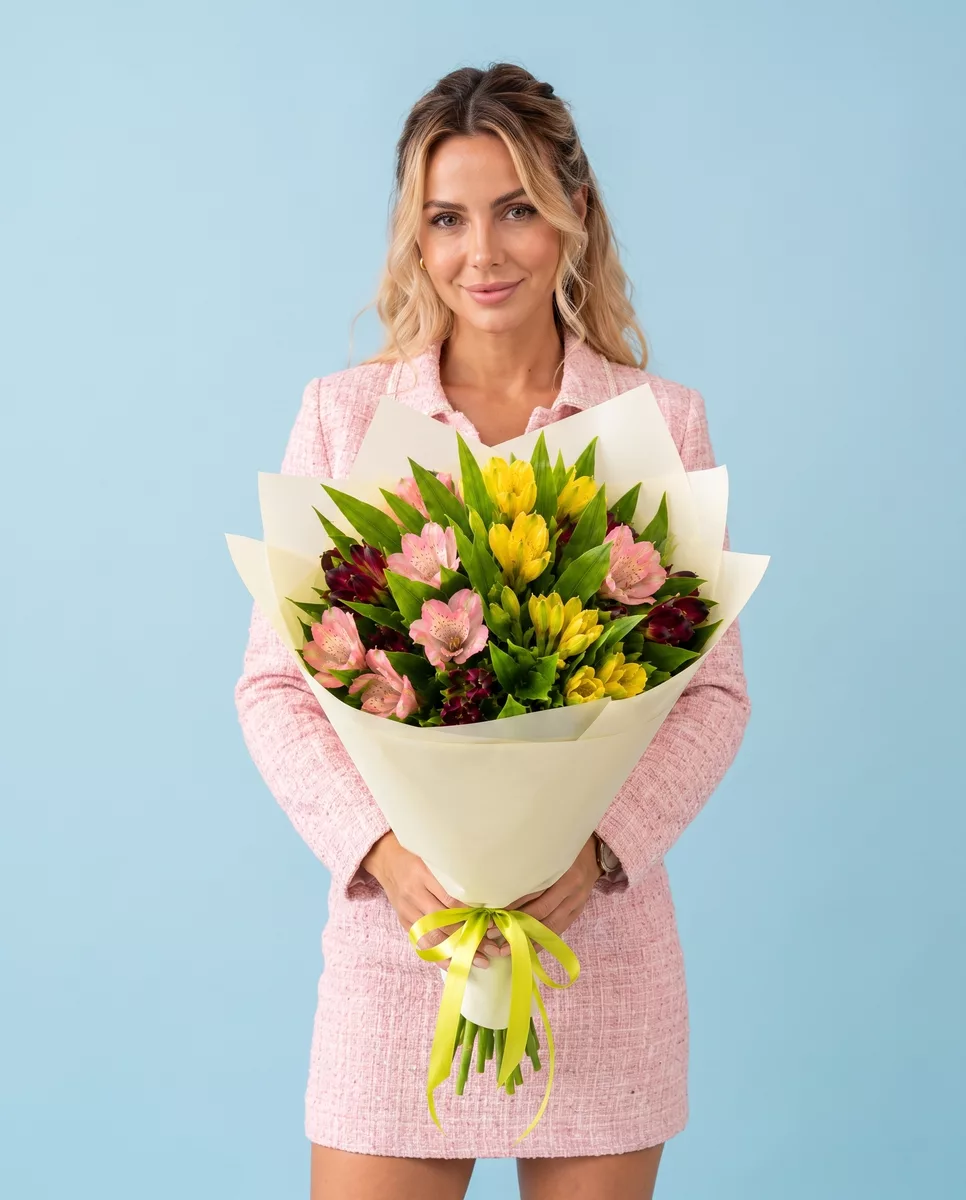
The traditional superstition, as most people who hold it understand it, concerns a bouquet that is entirely yellow. A mixed arrangement sidesteps the concern for the majority of customers who are cautious but not rigidly superstitious. The most commercially successful combinations we see involve yellow roses or ranunculus paired with white blooms, where the contrast is clean and the yellow reads as warmth rather than a statement. Yellow and burgundy is another pairing that works extremely well in autumn and winter, using yellow roses or yellow spray chrysanthemums alongside dark red or burgundy varieties. The yellow lifts what would otherwise be a heavy arrangement, and the dark tones prevent the yellow from feeling too light for a serious occasion. Yellow and deep purple, often achieved with yellow roses and purple lisianthus or purple statice as an accent, has become a popular choice for corporate gifting because the combination feels considered rather than accidental. What does not tend to work as well is yellow combined with pink, which can read as unfocused unless the specific shades are chosen carefully. Yellow with soft peach is better, and yellow with coral is better still, because those warm tones share the same undertone family. When a customer is uncertain about yellow but wants something bright, suggesting a dominant white arrangement with yellow accents, perhaps three or four yellow spray roses among fifteen white ones, usually resolves the hesitation. The yellow reads as an accent rather than a declaration, and the bouquet still has the energy the customer was originally looking for.
Occasions Where Yellow Is Genuinely the Right Choice
Yellow flowers are not a compromise or a workaround. For certain occasions they are simply the most appropriate choice, and customers who default away from yellow for every situation are limiting themselves unnecessarily. Graduations are the clearest example. A graduate receiving yellow sunflowers or a bold yellow rose bouquet gets something that photographs well, feels celebratory without being romantic, and stands out in a room full of red and pink arrangements. Yellow works for new job congratulations for similar reasons: it signals energy and optimism without the sentimental weight of red. Get-well bouquets benefit from yellow because the color is genuinely cheerful in a clinical or home-rest setting, and the varieties that work best here are durable ones like gerbera or spray chrysanthemum that will last through a recovery period without needing daily attention. For teachers receiving end-of-year gifts, yellow is traditional in many parts of Russia in a positive sense, associated with the academic calendar and autumn harvests rather than with parting. This is a case where the cultural context actually supports yellow rather than complicating it. Housewarming gifts are another strong use case. A yellow arrangement in a new apartment reads as welcoming and bright, and since there is no romantic relationship being navigated, the old superstition simply does not apply. Birthday bouquets for male recipients, where red roses can feel awkward and pink feels wrong, often land best in yellow or orange, and yellow roses in particular have become a popular choice for men's birthdays among younger buyers.
What to Check Before Ordering Yellow Flowers for Delivery
Ordering yellow flowers for delivery involves a few practical checks that are easy to overlook. The first is seasonality. Yellow tulips, ranunculus and some yellow roses have peak seasons, and ordering outside those windows means either a substitution or a flower that has been in cold storage longer than ideal. Ask when you order whether the specific variety you want is currently in fresh supply. The second check is delivery timing relative to the occasion. Yellow ranunculus and yellow freesia are among the more delicate options and do best when delivered within a few hours of being arranged. If you are ordering for an evening event, a morning delivery means the flowers will have been out of refrigeration for six to eight hours before the occasion begins. For those varieties, a tighter delivery window matters. The third consideration is the recipient's awareness of the superstition. If you know the person receiving the bouquet is older and holds the traditional view, either ask them directly whether they like yellow, or choose a mixed arrangement where yellow is a supporting color rather than the dominant one. This is not about the superstition being correct; it is about the recipient's experience of receiving the bouquet. A gift that causes momentary confusion or concern has not fully succeeded, regardless of your intentions. Finally, check the water and care instructions the shop provides. Yellow roses, like all roses, need a clean diagonal cut and fresh water every two days. Yellow gerbera needs the stems kept short in shallow water. Following the specific care note for the variety you ordered adds three to five days to the vase life in most cases.
How Attitudes Are Likely to Continue Shifting in the Next Few Years
The trajectory is clear from what we see in orders: yellow is becoming a mainstream choice rather than a cautious exception. The drivers of that shift are worth understanding because they suggest the change is structural rather than a passing trend. Visual culture has had the largest effect. When people spend time on image-heavy platforms and consistently see yellow bouquets presented as beautiful, aspirational objects, the emotional association updates faster than any deliberate cultural campaign could achieve. A twenty-two-year-old who has seen yellow ranunculus in hundreds of photographs over three years does not carry the same reflexive hesitation that someone who grew up without that visual context might carry. International influence matters too. As Russian buyers engage more with European and American floral aesthetics, where yellow has no negative connotation and is used freely in romantic contexts, the local superstition loses its self-evident quality. It starts to feel like a local peculiarity rather than a universal truth, which makes it easier to set aside. The corporate market is also normalizing yellow in a way that bleeds into personal gifting. When someone receives a yellow arrangement at their office opening or sees yellow flowers in a hotel lobby every week, the color stops feeling charged or significant in either direction. It becomes simply a color, which is probably where it should have been all along. None of this means the old belief will vanish entirely. Cultural associations of this kind tend to persist in some communities long after the mainstream has moved on. But the practical reality for anyone ordering flowers today is that yellow is a legitimate, widely accepted choice across most gifting contexts, and the florists arranging your order see it that way too.
Yellow flowers in Russia occupy an interesting position right now: the old superstition is real enough that you should be aware of it, particularly if the recipient is older or you know they hold traditional views, but it is no longer the dominant frame through which most buyers approach the color. Yellow roses, ranunculus, tulips and gerbera are moving through our cold storage at the same rate as any other strong color family, ordered for birthdays, graduations, get-well occasions and corporate events without hesitation. The practical advice is simple: know your recipient, choose the variety that suits the season and the vase life you need, and if you are uncertain about a mono-color yellow bouquet in a romantic context, mix it with white or add yellow as an accent. The flower itself is not the problem. It is one of the most structurally interesting and visually striking colors in the palette, and the florists who work with it every day have long since stopped seeing it as anything other than a beautiful material to work with. We deliver bouquets across Russia in 1–2 hours.
Frequently asked questions
Is it really bad luck to give yellow flowers in Russia?
The belief exists and is genuinely held, particularly among older generations, but it is not universal. It traditionally applies to all-yellow bouquets in romantic contexts. Mixed arrangements, gifts between friends or colleagues, and bouquets for non-romantic occasions are generally not affected by the superstition. Younger buyers in Russia largely do not observe it.
Which yellow flowers last the longest after delivery?
Yellow gerbera typically lasts ten to fourteen days with proper care, making it the most durable option. Yellow spray chrysanthemums are similarly long-lasting. Yellow roses average eight to twelve days. Yellow ranunculus and tulips are shorter-lived at five to seven days, so they work best when the occasion is within a day or two of delivery.
Can I order yellow tulips year-round?
Yellow tulips are a seasonal variety, most reliably available from February through April when Dutch imports are at their highest volume. Outside that window availability drops and quality can be inconsistent. If you want yellow tulips specifically, ordering within that seasonal window gives you the best result. Year-round alternatives include yellow roses and yellow spray chrysanthemums.
What color goes best with yellow in a mixed bouquet?
White is the most reliable pairing with yellow, giving a clean and versatile result. Burgundy and deep red work well in autumn and winter. Coral and peach complement yellow because they share warm undertones. Purple lisianthus alongside yellow roses is popular for corporate arrangements. Avoid combining yellow with cool pink unless the specific shades are carefully matched.
Are yellow flowers appropriate for a man's birthday bouquet?
Yes, and they are increasingly popular for exactly that occasion. Yellow roses in particular have become a go-to choice for male recipients among younger buyers, partly because red feels too romantic and pink feels wrong for many men's tastes. A bold all-yellow rose bouquet or a yellow and white mixed arrangement reads as celebratory and considered without any awkward romantic subtext.
Ready to send a bouquet?
Pick a city, choose the flowers, and we will hand them over with a photo confirmation.
Choose a city →