
Branded Corporate Bouquets: Adding Your Company Logo or Ribbon
Every week we take calls from office managers who ordered flowers for a client event and then realised, ten minutes before the courier arrived, that nothing on the bouquet said anything about their company. No ribbon, no card, no branded wrap — just flowers that could have come from anywhere. Corporate gifting is not the same as sending flowers to a friend, and the personalisation options available for B2B orders go well beyond writing a name on a card. This article walks through exactly what can be added, what lead time each option needs, and what details to confirm when you place the order.
What Branded Personalisation Actually Means for a Flower Order
When florists talk about branded personalisation, they mean any element of the bouquet or its packaging that carries your company's visual identity rather than the shop's. That covers printed satin ribbons with a logo, custom gift cards printed on your letterhead or with your corporate font, tissue paper in brand colours, and outer packaging — boxes or kraft wrapping — stamped or banded with your identity. It does not mean the flowers themselves change colour to match your Pantone, which is a question we get more often than you might expect. What it does mean is that when a client or employee receives the bouquet, the first thing they see is your brand, not ours. This matters most at product launches, partner appreciation events, annual general meetings, and large office milestones where dozens of bouquets go out at once and consistency across every single one is non-negotiable. A single bouquet with a handwritten card is a nice touch. Forty bouquets at a conference where twenty are wrapped differently because the ribbon ran out is a logistics failure. Understanding personalisation as a production and print question — not just a styling question — is the starting point for getting it right. The shop handles the floral side; you need to supply or approve the brand assets in advance, and that approval window is what most B2B clients underestimate when they first enquire.
Bouquets we can deliver



Branded Ribbons: Satin, Grosgrain and What Prints Cleanly
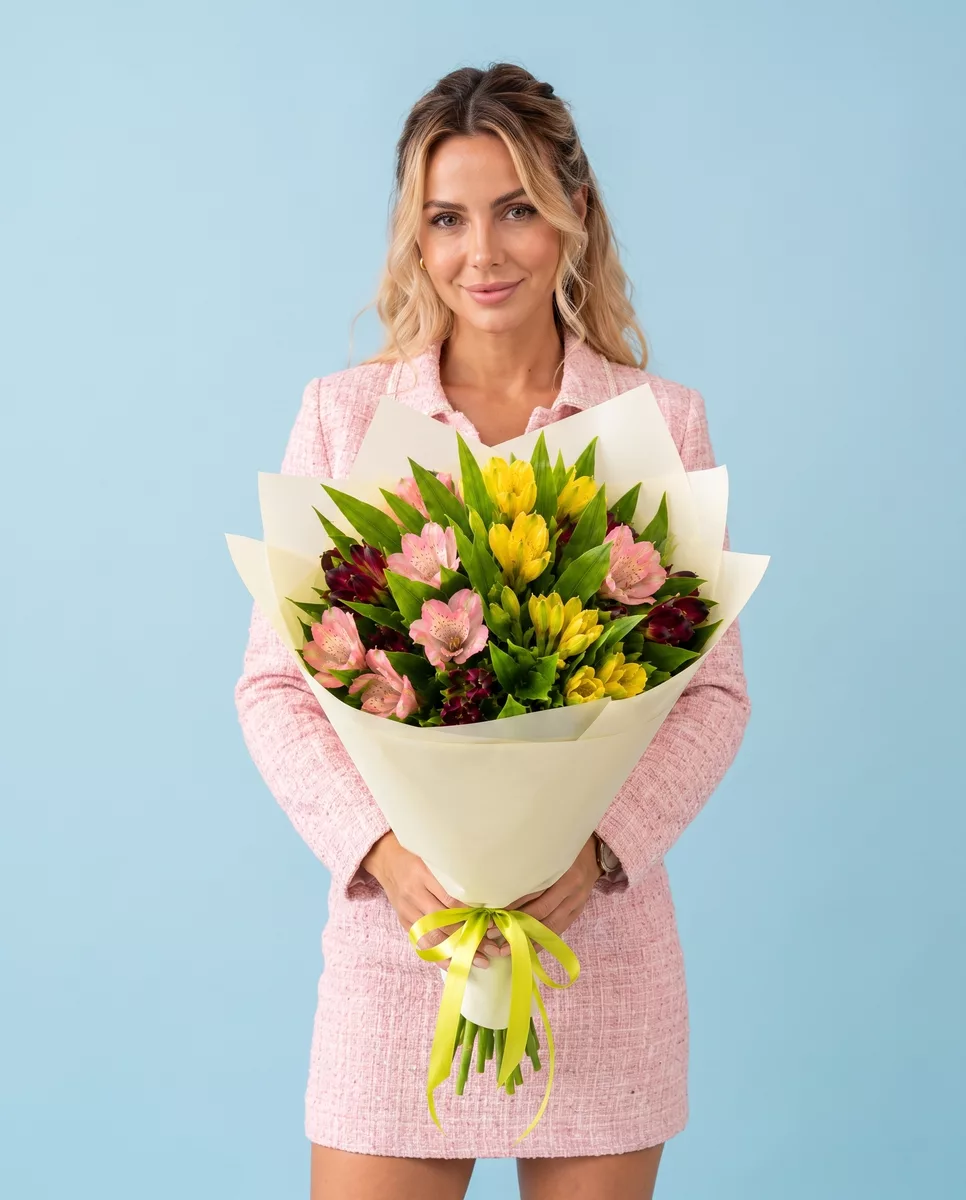
The ribbon is the most visible branded element on a bouquet because it sits at the stem wrap and faces outward in every direction. Satin ribbon takes single-colour logo printing very cleanly and holds the print through the humidity that fresh flowers generate. Grosgrain — the ribbed fabric ribbon — gives a slightly more textured, matte result that some corporate clients prefer because it reads as less festive and more formal. Both work well with roses, peonies, and ranunculus, which are the varieties most commonly requested for corporate gifting because they have strong, upright stems that hold a tied ribbon without the wrap slipping. Tulips and anemones have softer stems and the ribbon tends to migrate downward, so for large tulip orders we recommend a box presentation rather than a hand-tied bouquet, which solves the slippage problem entirely and gives a cleaner branded surface on the box itself. The practical limit for ribbon printing is a logo that works in one or two colours; full-colour photographic prints do not transfer well to fabric at bouquet-ribbon widths, which are typically between two and four centimetres. If your logo is a wordmark or a simple geometric mark, it will print sharply. If it is a detailed illustration or a gradient, discuss a simplified version with your account manager before the print file goes to production. Ribbon stock needs to be ordered and printed before the flowers are sourced, so the ribbon lead time, not the flower lead time, sets the earliest possible delivery date for a branded order.
Custom Cards and Inserts: Text, Format and Language
A branded card does two things: it identifies the sender and it carries a message. For corporate orders, those are often separate jobs — the company name and logo go on one face, the personal message or occasion text on the other. Cards can be printed on standard coated stock, on uncoated paper for a more tactile feel, or on card stock that matches your brand guidelines if you supply the specification. Size matters more than clients expect: a card that is too small gets lost inside the wrapping paper; a card that is too large looks like a label rather than a gift enclosure. The format we use most often for corporate orders is a folded A6 card, which gives four printable panels and fits cleanly into an envelope that can be sealed before the courier picks up the order. If you need the card to include a QR code linking to a digital message or a campaign page, that works on printed cards provided the code is at least two centimetres square and printed in solid black on a white or very light background — anything smaller or lower-contrast fails to scan reliably. Language is a practical point worth raising: most of our corporate clients sending flowers within Russia want the card text in Russian, but if the recipient is an international partner based in Saint Petersburg or another Russian city, an English card or a bilingual layout is straightforward to arrange. Supply the final text in writing; do not rely on a verbal briefing for card copy, because a single wrong word on forty printed cards is not fixable at short notice.
Packaging Options: Boxes, Wrapping and Brand Colours
Hand-tied bouquets wrapped in kraft or tissue paper are the standard format for individual deliveries, but for corporate orders — especially large volumes or high-value recipients — a box presentation is often the better choice for three reasons: structural protection during courier transit, a flat printable surface for branding, and a more formal unwrapping experience that suits a business context. Hat boxes and rectangular flower boxes in white or black are the most common base formats; both can be banded with a branded ribbon or have a branded belly-band sleeve fitted around the outside without any printing directly on the box, which keeps the cost down for shorter runs. If your brand colour is not white, black, or kraft brown, discuss this early — coloured boxes are available but require a minimum quantity that makes them unsuitable for orders of fewer than around twenty units. Tissue paper inside the box can be sourced in a wider range of colours, so the interior presentation can carry brand colour even when the outer box is standard. Wrapping paper with a repeated logo pattern is another option for hand-tied bouquets, though it requires a print run and is most cost-effective for companies that order flowers regularly throughout the year rather than for a single event. One thing to confirm regardless of format: the packaging needs to close securely enough that it does not open during a courier transit of up to two hours, which is the window we work within for deliveries across Russian cities. A beautiful open-top arrangement that arrives with flowers displaced is not the impression a corporate gift should make.
Flower Choices That Hold Up Through Branded Presentation
The flower varieties you choose affect how well the branded elements read on arrival. Roses — particularly large-headed garden varieties like David Austin types and standard high-stem roses — hold their shape reliably for the duration of courier delivery and photograph well against a branded ribbon or box, which matters if the recipient is likely to share the gift on social media. Chrysanthemums in spray form are extremely robust and are used heavily in Russian corporate gifting because they last ten to fourteen days in a vase with correct care, making them a practical choice for office environments where no one is going to be changing water daily. Peonies are the most requested premium flower for corporate orders from April through June when they are in season; out of season, the price rises significantly and the quality is less consistent, so we steer clients toward large-headed roses as a substitute that holds similar visual weight. Orchid stems — cymbidium and dendrobium — are used in high-value individual gifts rather than large-volume orders because of cost, but they pair exceptionally well with a box presentation and a minimal branded card because the flower itself is dramatic enough that the packaging does not need to work hard. Avoid including very delicate open flowers like sweet peas or garden anemones in a branded corporate order destined for courier delivery in summer; heat above twenty-two degrees Celsius causes rapid wilting, and a wilted flower arriving in an otherwise perfect branded box undermines the entire effect. Stick to varieties with strong cell walls and closed or semi-open buds at the time of dispatch.
Lead Times and Minimum Order Quantities for Branded Work
This is where most corporate enquiries run into difficulty, because the lead time for a branded order is driven by print production, not by flower sourcing. Standard flowers for a corporate order can be sourced and assembled within twenty-four hours. A printed satin ribbon with your logo needs a minimum of five to seven working days from the moment a confirmed, print-ready file is received — not from when the enquiry is made, not from when a draft logo is sent, but from when a file that meets the printer's specifications arrives and is approved. Custom-printed cards on branded stock follow a similar timeline. If you are planning an event and want branded bouquets, the conversation needs to start at least ten working days before the delivery date to allow for file preparation, approval, print production, and any corrections. Minimum quantities for branded ribbon printing are typically set at a length that corresponds to between fifteen and twenty-five bouquets, depending on ribbon width; ordering branded ribbon for three bouquets is not economical and most print suppliers will not run it. For cards, single-event print runs of twenty to fifty units are standard and cost-effective. If you need branded flowers for a recurring programme — monthly client gifts, quarterly partner recognition — it makes sense to print ribbon and cards in a larger batch and store them, which we can hold on your behalf between orders. Same-day branded orders are not possible for print elements; same-day orders using existing branded stock that has already been produced are possible, provided the stock is confirmed available before the order is placed.
What to Check Before You Confirm a Branded Corporate Order
Before you confirm the order, run through this list with whoever is handling the account on our side. First, confirm that your logo file is in a vector format — EPS or AI — or a high-resolution PNG at the size it will be printed; a logo pulled from a website at seventy-two DPI will not print sharply on satin. Second, confirm the ribbon colour and whether it is a standard colour from the printer's stock range or a custom-dyed colour, because custom dyeing adds time and cost. Third, confirm the exact text of any card copy in writing, including punctuation, because printed cards cannot be corrected after production. Fourth, confirm the delivery addresses: for large corporate orders going to multiple recipients, a spreadsheet with full addresses including apartment or office numbers and recipient phone numbers is required before the order is accepted — partial address lists cause delivery failures that cannot be resolved on the day. Fifth, confirm the delivery window: our standard delivery operates within a one-to-two-hour window from dispatch, but for events with a fixed start time, the order needs to be timed so that flowers arrive assembled and fresh, not two hours early sitting in a warm lobby. Flowers should be kept between eight and twelve degrees Celsius before arrangement and between fifteen and eighteen degrees after; ask whether the venue or office has a cool space to hold them if arrival is earlier than the event. Finally, confirm who receives the delivery at the destination — a named contact who is physically present, not a general reception that may not be staffed.
Branded corporate bouquets are a production project as much as a floral one, and the clients who get the best results are the ones who treat them that way: they send the logo file early, confirm the card text in writing, choose flower varieties suited to courier delivery, and build in the lead time that print work requires. The flowers themselves — the roses, chrysanthemums, peonies — are the part we handle without you needing to think about it. The brand assets are the part that have to come from your side, in good time and in the right format. Get those two things coordinated and the result is a bouquet that arrives looking exactly as it should: fresh, structurally intact, and carrying your company's identity clearly from the ribbon to the card. We deliver bouquets across Russia in 1–2 hours.
Frequently asked questions
Can I send a JPEG of our logo instead of a vector file for the ribbon?
A JPEG can be used only if it was exported at very high resolution — at least three hundred DPI at the actual print size. Most logos saved from websites are seventy-two DPI and will print blurred on satin ribbon. If you are unsure, send the file and we will check it before confirming the print order. A vector EPS or AI file is always the safest option.
Is there a minimum number of bouquets for a branded corporate order?
There is no minimum on the flower side — we can produce a single branded bouquet. The practical minimum is set by the ribbon print run, which is typically enough ribbon for fifteen to twenty-five bouquets depending on width. If you need fewer than fifteen, the most cost-effective approach is a branded printed card and standard ribbon rather than custom-printed ribbon.
How far in advance do I need to place a branded order for a conference or event?
Ten working days from the date you can supply a confirmed, print-ready logo file is the reliable minimum. This covers print production for ribbon and cards plus time for any corrections. If branded stock — ribbon and cards — has already been produced and is held with us, a same-day or next-day order on the flower side is possible.
What happens if flowers arrive wilted because the office was too warm?
Fresh flowers should be held between fifteen and eighteen degrees Celsius after arrangement. If a delivery arrives at a venue with no climate control in summer, quality will decline faster than expected. We recommend timing delivery as close to the event as possible and designating a cool holding space. Wilting caused by storage conditions at the destination is not a delivery failure we can correct after the fact.
Can the card text be in English for an international recipient based in Russia?
Yes. Cards can be printed in English, Russian, or a bilingual layout with both languages on the same card. Supply the final text in writing — do not send a verbal briefing or a rough draft — because printed cards go to production exactly as the text is received. Check spelling and punctuation carefully before confirming, as corrections after printing are not possible.
Ready to send a bouquet?
Pick a city, choose the flowers, and we will hand them over with a photo confirmation.
Choose a city →