
Children's Bouquets for September 1: Size, Price and Style
Every year in the last week of August we field the same questions at Five Flowers: how big should the bouquet be, will gladioli fit through a school door, and why did the roses arrive half-open. September 1 is Knowledge Day in Russia, a national first day of school where every child walks in carrying flowers for their teacher — it is one of the busiest single-day deliveries of the year, and the details matter more than people expect.
What Knowledge Day Actually Demands from a Bouquet
Knowledge Day falls on September 1 and is treated as a formal occasion across all Russian schools. Children line up in a courtyard ceremony, then carry their bouquets into the classroom and present them to the teacher at the end of the event. The bouquet therefore has to survive roughly two to three hours of being held by a child aged six to seventeen, often in warm late-summer weather, before it reaches the teacher's hands. That single fact shapes every decision you make about size, stem length and flower choice. A bouquet that looks magnificent in a shop photograph can become a wilting, stem-bent mess by the time the bell rings if the wrong varieties or wrapping are chosen. Teachers receive many bouquets on this day and genuinely appreciate ones that are fresh and well-conditioned rather than enormous. The social expectation in Russia is not to outspend other parents but to bring something neat, seasonal and clearly chosen with thought. Florists who work this holiday every year know that restraint in size combined with good flower quality is the right call. Understanding this context before you choose varieties and stem counts will save you from the most common ordering mistakes we see at Five Flowers every single September.
Bouquets we can deliver



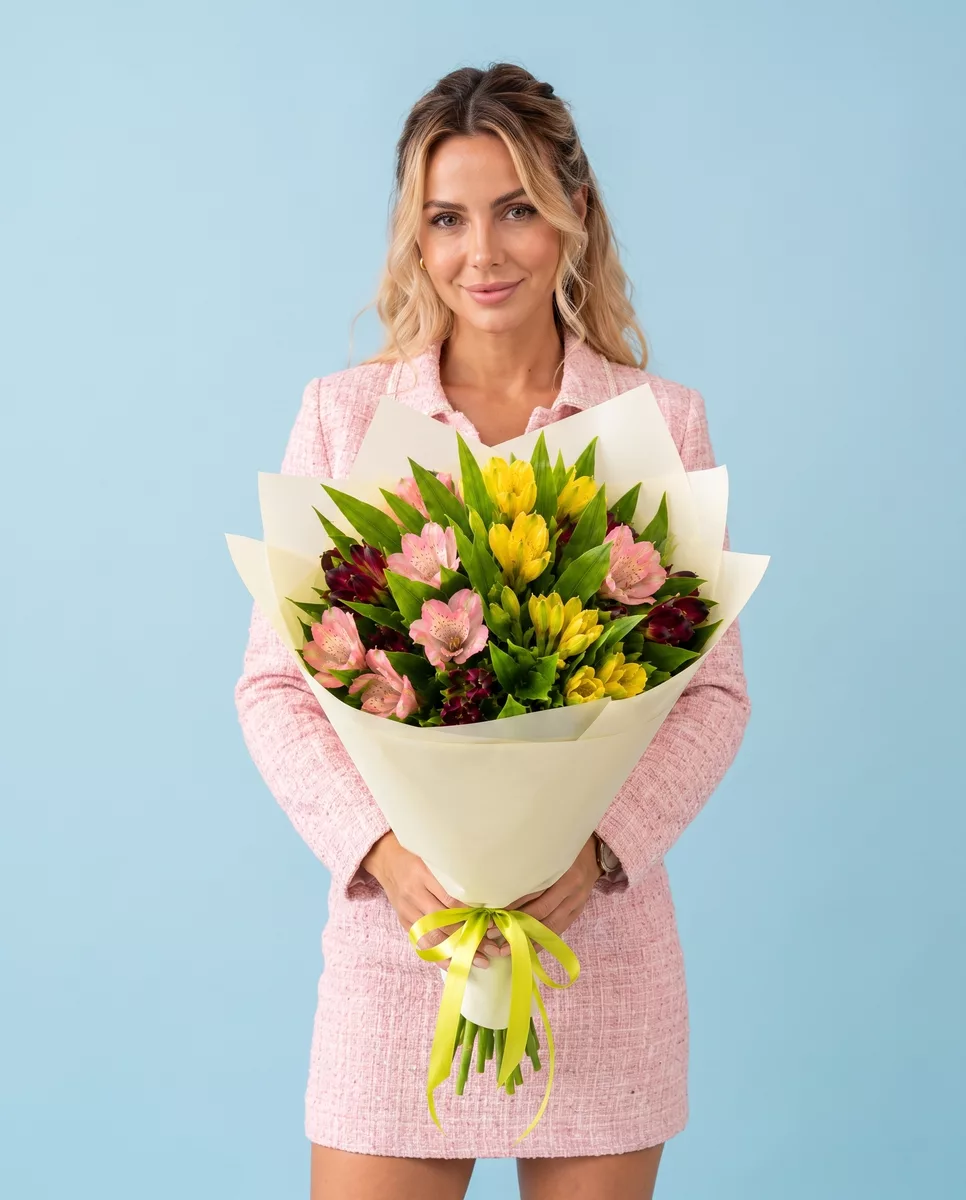
Size: What a Child Can Actually Carry
The single most consistent mistake parents make is ordering a bouquet sized for a reception desk rather than a child's arm. A seven-year-old first-grader has a reach of roughly forty to forty-five centimetres from elbow to fingertip, and a bouquet with stems cut to sixty or seventy centimetres will drag on the ground or force the child to hold it horizontally, which crushes the heads. For primary school children, stems should be trimmed to thirty-five to forty-five centimetres total length, and the bouquet diameter should sit between fifteen and twenty-two centimetres. For teenagers in upper grades, you can go to fifty centimetres on the stem and a slightly wider arrangement, but there is rarely a reason to go beyond that. Flower count matters less than proportion: seven stems of spray chrysanthemums arranged tightly read as generous and full, while fifteen limp stems of something loosely wrapped look sparse despite the higher number. A round, compact shape — sometimes called a pavé or dome arrangement — holds together better in a child's grip than a tall, loose gathering. When you order, always specify the age of the child who will be carrying it; a good florist adjusts stem length accordingly. We ask this question for every September 1 order because it changes the construction of the bouquet more than the flower choice does.
Which Flowers Hold Up Through a School Morning
September in Saint Petersburg and most of Russia still runs warm, with outdoor temperatures often between sixteen and twenty-four degrees Celsius during a morning ceremony. Flowers that are sensitive to heat and handling — garden roses with thin petals, sweet peas, open peonies, ranunculus in full bloom — will not last two hours in a child's warm hands without showing stress. The flowers that consistently perform well on September 1 are spray chrysanthemums, single-stem chrysanthemums, alstroemeria, lisianthus, statice, solidago and small-headed sunflowers. Gladioli are a traditional Soviet-era choice for this holiday and remain popular, but they are tall, heavy and awkward for younger children; if a parent insists on them, we suggest cutting the spike to a single lower third of the stem and pairing it with compact filler. Roses work well if they are ordered at bud stage — tight buds will open slowly over the day rather than dropping petals by the time the ceremony ends. Hypericum berries, waxflower and eucalyptus add texture without fragility. Avoid flowers with heavy pollen such as open lilies, since children in school clothes and teachers in formal dress do not want orange stains. Seasonal asters are excellent for this date: they are robust, inexpensive relative to their visual impact, and available in white, lilac and deep violet, all of which photograph well against a school uniform.
Colour and Style: What Teachers Actually Receive
Teachers on Knowledge Day receive somewhere between ten and thirty bouquets depending on the school size and grade. After the first hour, the colours they remember are the ones that were distinct rather than the ones that were loudest. All-white bouquets of lisianthus or spray chrysanthemums stand out precisely because most parents default to bright mixed colours. Pastel combinations — blush, ivory and soft yellow — read as considered and calm against the dark school uniforms children typically wear in Russia, which creates a better photograph and a more elegant presentation. Bright single-colour bouquets also work: all-yellow sunflowers, all-violet asters, all-coral alstroemeria. What tends to look chaotic is a mix of five or six unrelated colours in a small bouquet, because the arrangement has no visual anchor. Wrapping style affects the impression as much as the flowers. Kraft paper with a single colour ribbon is currently the most common choice and suits a school setting better than cellophane, which crinkles loudly during a quiet ceremony. Fabric wrapping — burlap or cotton — holds moisture better and protects stems during carrying, which matters on a warm day. Avoid foam-filled boxes for a child to carry; they are heavy and awkward. The style should be tidy enough to look intentional but not so elaborate that the child cannot see over it while walking.
Timing Your Order and Delivery for September 1
September 1 ceremonies in Russian schools typically begin between eight and nine in the morning and last thirty to sixty minutes. Children need their bouquets in hand before they leave home, which means delivery must arrive by seven-thirty at the latest for most families. Five Flowers delivers across Saint Petersburg within one to two hours of order confirmation, but on September 1 the order volume between five and eight in the morning is the highest of the year for this holiday. Placing your order on August 30 or the morning of August 31 is the practical standard for anyone who wants a specific variety, a specific colour palette or a specific stem length. Orders placed after nine in the evening on August 31 can still be fulfilled, but the selection of pre-conditioned stock narrows and you are more likely to receive a substitution on a detail like filler variety or ribbon colour. If you are ordering for delivery to a school address rather than a home address, note that school gates open at different times and a florist cannot wait; delivery to the home the evening before is the more reliable option. Flowers delivered the evening of August 31 should be placed in water immediately, kept away from direct sunlight and away from fruit — ethylene gas from apples and pears accelerates petal drop in roses and lisianthus overnight.
Budgeting Honestly: What Different Price Points Get You
Parents often ask whether a smaller budget means a worse bouquet for the teacher, and the honest answer is no — it means a different bouquet, and the difference is not always visible to the teacher. A modest budget handled well by a florist produces a tight, well-proportioned arrangement of seasonal spray chrysanthemums, asters or alstroemeria with appropriate greenery and clean wrapping. A higher budget allows for roses at bud stage, lisianthus, garden-style mixed arrangements or the addition of decorative elements like dried cotton stems or preserved eucalyptus. The mistake at the lower end is trying to stretch a small budget into a large bouquet: a florist who adds stems to hit a visual size target without the budget to support it will use filler that wilts quickly or leave stems too long for the child to carry. It is always better to ask for a compact, well-made arrangement within your actual budget than to request something larger and accept compromises on flower quality. At the higher end, the mistake is paying for complexity that the teacher cannot appreciate in a busy morning ceremony — an elaborate hand-tied garden arrangement with twelve varieties is genuinely beautiful, but a teacher holding thirty bouquets will remember the freshness and neatness of yours more than its intricacy. Tell your florist your budget directly and ask what they would build with it for a primary school child; that conversation produces better results than browsing by price tier alone.
What to Check Before You Confirm the Order
Before you confirm any September 1 bouquet order, run through four specific checks. First, confirm the stem length matches the child's age — state the age explicitly, not just the school grade, since ages vary. Second, confirm that no open lilies are included if the delivery is going to a school setting; ask about pollen-bearing flowers specifically. Third, confirm the delivery window and whether the driver will call ahead: on a busy holiday morning, a missed call means a missed delivery, and you want to know the shop's policy on re-delivery attempts. Fourth, confirm the wrapping material and whether it includes a water source for the stems — a small water tube on each stem or a damp cotton base inside the wrap keeps flowers fresh for two to three additional hours in warm weather, which is exactly the margin you need between delivery and ceremony end. If you are sending a bouquet to someone else's child as a gift, include a small note with the child's name on the outer wrap so it does not get confused with another family's order during a busy morning. Check whether the shop sends a photo of the completed bouquet before dispatch — at Five Flowers we do this as standard on high-volume days so you can confirm the size looks right before it leaves us. These four checks take three minutes and prevent the most common complaints we hear after September 1 every year.
September 1 bouquets are not complicated once you understand what the occasion actually asks of them: a flower arrangement that a child can carry, that holds up in warm weather for two to three hours, and that a teacher can receive with genuine pleasure among many others. Compact size, robust varieties, clean wrapping and an early order placed by August 31 cover ninety percent of what makes this delivery successful. Five Flowers handles September 1 orders across Saint Petersburg with same-day delivery and pre-ceremony timing built into every booking — order by the evening of August 31 to secure your preferred varieties and get a photo confirmation before the bouquet leaves us. We deliver bouquets across Russia in 1–2 hours.
Frequently asked questions
Can I order a September 1 bouquet on the morning of September 1 itself?
Yes, Five Flowers delivers within one to two hours across Saint Petersburg, so a morning order is possible. However, stock of specific varieties narrows significantly before eight in the morning on this date. If you need a particular colour, flower type or stem length, ordering on August 30 or 31 guarantees better results and avoids substitutions.
Are gladioli appropriate for a first-grader to carry?
Gladioli are a traditional Knowledge Day flower in Russia but they are tall and heavy, which makes them awkward for young children. If you want them included, ask the florist to use only the lower section of the spike at a shortened stem length and pair it with compact filler. For children under ten, a round arrangement of chrysanthemums or asters is a more practical and comfortable choice.
How do I keep the bouquet fresh if it arrives the evening before?
Place the stems in clean water immediately after delivery. Keep the bouquet away from direct sunlight, heating vents and fruit — apples and pears release ethylene gas that accelerates petal drop in roses and lisianthus. A cool room overnight is ideal. Remove the outer decorative wrap before placing in water, then rewrap loosely in the morning before the child carries it.
What flower colours work best against a Russian school uniform?
Russian school uniforms are typically dark — navy, black or dark grey — which means white, cream, yellow and soft violet flowers photograph and present well in contrast. All-white lisianthus or spray chrysanthemums are particularly striking. Avoid dark burgundy or deep red against dark fabric, as the contrast disappears and the arrangement loses its visual impact in ceremony photographs.
Is it acceptable to send a bouquet directly to the school address?
It is possible but carries timing risk. School gates open at specific times and a driver cannot wait if no one is available to receive the order. Delivery to the family home the evening of August 31 is more reliable. If you do choose school delivery, confirm the gate opening time precisely and provide a contact phone number for the parent or child who will be at the entrance.
Ready to send a bouquet?
Pick a city, choose the flowers, and we will hand them over with a photo confirmation.
Choose a city →