
How to send flowers to Russia from another country
6 min read
Sending flowers into Russia from abroad sounds complicated and mostly is not. The one thing worth understanding before you order is that nothing is shipped across a border. No bouquet flies from London to Kazan. A florist inside the recipient's own city makes it on the day of delivery, and a local courier carries it across town. Your money crosses the border; the flowers never do.
What actually happens after you press order
- You choose the recipient's city and a bouquet. Prices are shown in roubles with a dollar and euro equivalent at the central bank rate.
- The order goes to a florist working in that city. For Saint Petersburg that is our own shop; in other cities we assemble and deliver the bouquet ourselves.
- The florist assembles the bouquet the same day — this is why seasonal availability matters more than the photo on the site.
- A courier delivers it, usually within one to two hours of confirmation in larger cities.
- We send you a photo before or at handover, so you see what was actually given.
What you need to know about the recipient
A name and a mobile phone number are enough to start. A full address is better, but Russian couriers routinely work from a phone number alone: they call, agree a time, and meet the person at a convenient point. If you want a surprise and do not want the recipient called in advance, say so in the order comment — we will keep the call to the last minute instead.
Flats in Russian buildings often sit behind an intercom and a code. If you know the entrance number or the code, add it. If you do not, it is not fatal; it just costs the courier a few minutes.
Timing across eleven time zones
Russia spans eleven time zones. When it is 9 in the morning in London it is midday in Moscow and evening in Vladivostok. An order placed in the American evening lands in the Russian night, and the florist starts on it the next morning. If the date matters — a birthday, an anniversary — order a day ahead and name the date. Same-day is normal, but only inside the recipient's working day, not yours.
How much to spend without looking odd
A bouquet that reads as generous in Russia is usually smaller and cheaper than its equivalent in Western Europe or the United States. Flowers are an ordinary, frequent gift there, not a special-occasion extravagance, and a well-made mixed bouquet of seasonal flowers is respected more than a large uniform bunch. Spending very heavily is not rude, but it can read as formal or business-like rather than warm.
Popular right now



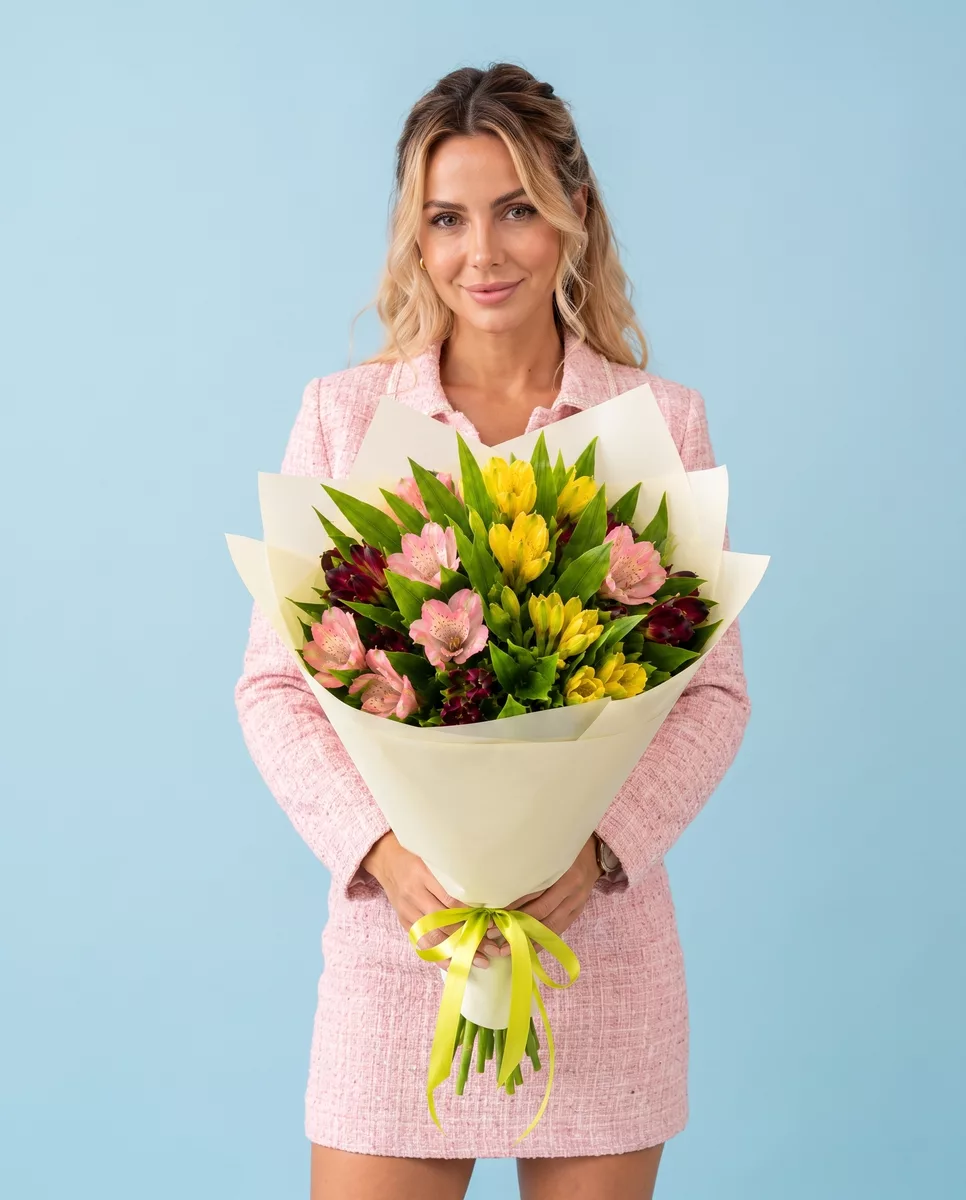
The one mistake foreigners make most
Sending an even number of flowers. In Russia an even count belongs at a funeral; a gift to a living person is always odd — three, five, seven, nine. Above roughly eleven stems people stop counting and it no longer matters, but below that the rule is absolute and everyone notices. We cover it properly in Russian flower etiquette.
Paying from abroad
Which flowers actually arrive looking right
Russian florists work with what the wholesale market in their city carries that week, not with a fixed menu. This matters when you order because a bouquet described as roses and eucalyptus in the catalogue may arrive as roses and ruscus if eucalyptus ran short — the florist substitutes to keep the arrangement coherent rather than delay delivery. If a specific flower genuinely matters, name it in the comments field and ask for confirmation before the order is placed; most shops will tell you honestly whether they have it. Roses are the safest choice year-round because they move through Russian wholesale quickly and the cold chain is reliable even in summer. Chrysanthemums, carnations, and alstroemeria are also consistently available and hold up well in heated Russian apartments, which tend to run warm. Peonies are strong in late spring, ranunculus appears in early spring and disappears fast, and tulips flood the market around the eighth of March then thin out sharply afterward. Orchid arrangements exist in most cities but the quality varies more than with cut flowers, and they are harder to courier without bruising in cold weather. If the recipient lives outside a regional capital, the variety range narrows further — a florist in a smaller city may carry five or six reliable stems rather than twenty. Exotic tropical flowers are a gamble outside Moscow and Saint Petersburg regardless of season. Asking the florist what is strong that week, which you can do through the order comments, usually produces a better result than insisting on a specific stem that arrived in the catalogue photograph from a shoot done in a different month.
What goes wrong and how to catch it before delivery
The most common failure is a wrong or incomplete address that looks complete. Russian addresses follow a specific sequence — city, street, building number, block or korpus if the building is part of a complex, flat number — and missing the korpus detail is enough to send a courier to the wrong entrance of a large residential cluster. If the recipient lives in a new development on the edge of a city, the street may not yet appear in mapping software the courier uses, which means a phone call is unavoidable regardless of whether you requested a surprise. Giving the florist a landmark or the name of the nearest metro station alongside the address removes most of that friction. Timing failures almost always trace back to time zone arithmetic done in the wrong direction. Write the desired delivery time in Moscow time and then convert it yourself rather than leaving the conversion to the order form — different platforms handle this differently and an ambiguous entry defaults to whatever the system assumes. If the occasion is time-sensitive, same-day orders placed before noon local city time are generally safe; orders placed in the afternoon for the same evening are a risk worth flagging explicitly with the florist. A third category of problem is the recipient not being reachable. If the person works in a building with a strict entry policy, is in a hospital, or is travelling that day, the courier cannot complete delivery and the bouquet returns. Checking with the recipient's family or a colleague about their schedule — without revealing the gift — takes two minutes and prevents the most frustrating outcome, which is a bouquet delivered to a neighbour or rescheduled by a day.
Regional differences that change what you should order
Moscow and Saint Petersburg operate on a different supply level than the rest of the country, and an order that works smoothly in either city may need adjustment for Novosibirsk, Yekaterinburg, Kazan, or anywhere further east. The gap is not about quality of florists but about what arrives at the wholesale terminal. Premium Dutch roses in forty-centimetre stems are standard stock in Moscow; in a mid-sized Siberian city the florist may offer the same variety but in a shorter stem length, which changes the proportions of the arrangement. Specifying a minimum stem length in the comments is worth doing if the recipient will display the bouquet in a tall vase. Cities east of the Urals also sit in time zones where same-day delivery windows are narrower relative to when a foreign customer is awake and able to place an order. Vladivostok is seven hours ahead of Moscow, which means a customer in Western Europe placing an order at 8 in the morning is already looking at mid-afternoon Vladivostok time, and a same-day order may already be late. For eastern cities, ordering the day before is the lower-risk default. Cultural specifics shift slightly by region too. In Tatarstan and other republics with a significant Muslim population, alcohol-paired gift sets that some florists bundle with bouquets may be inappropriate, and it is worth unticking those additions if the order form includes them. In southern cities like Krasnodar or Sochi, flowers with short vase life — open garden roses, sweet peas — handle the warmer climate less well in summer, and a florist there will often steer toward tighter buds or more robust stems without being asked.
This is the part that changed after 2022 and the part worth asking about rather than assuming. Cards issued outside Russia do not work with Russian payment providers the way they used to. If your card is refused, write to us on WhatsApp or Telegram before trying again — we will tell you which payment routes are currently working, and we will not take an order we cannot actually deliver.
Frequently asked questions
Do the flowers cross the border?
No. A florist in the recipient's own city makes the bouquet on the day of delivery and a local courier brings it. Only the order and the payment cross the border.
How fast can it be delivered?
In cities of any size, usually one to two hours after the order is confirmed, within the recipient's working day. In small towns it can be the same day or the next morning, depending on the courier's route.
Do I need the exact address?
It helps, but a name and a working mobile number are enough. The courier calls and agrees a place and time with the recipient.
Can I keep it a surprise?
Yes. Say so in the order comment and the courier will call only when already nearby, rather than in advance.
What if nobody answers the phone?
The courier tries again and we contact you. The bouquet is kept in cool conditions and delivered later the same day or the next morning; it is not simply left at a door.
Ready to send a bouquet?
Pick a city, choose the flowers, and we will hand them over with a photo confirmation.
Choose a city →