
Mixed Bouquets vs Single-Species Bouquets: Russian Preferences by Occasion
Every week customers call and ask some version of the same question: should I send one type of flower or mix several together? The answer depends almost entirely on who is receiving it, what the occasion is, and — more than most people expect — on deeply rooted Russian ideas about what a bouquet is supposed to communicate. Getting it wrong does not ruin the gesture, but getting it right makes a noticeable difference.
Why Mono-Bouquets Still Dominate Russian Gifting Culture
Russia has a long tradition of giving single-species bouquets, and that tradition is not fading. Walk into any large celebration in Saint Petersburg — a graduation, a teacher appreciation day, a birthday for a woman over fifty — and you will see armfuls of roses, or chrysanthemums, or gerberas, rarely a mixture. The logic behind this is cultural rather than aesthetic: a mono-bouquet reads as deliberate. It says the giver chose this flower specifically, not just grabbed whatever was available. That signal matters to Russian recipients in a way that can surprise buyers from Western Europe or North America. Roses are the clearest example. A bunch of thirty red roses carries a specific weight in Russian social life that thirty mixed stems simply do not replicate, regardless of how artfully those stems are arranged. Spray roses, garden roses and standard hybrid tea roses are treated as distinct enough that florists often clarify which type the customer means, because the recipient will notice. Tulips in March, around International Women's Day on March 8th, follow the same logic: a mono-bouquet of tulips is the expected form, and mixing them with ranunculus or anemones — however beautiful — can feel like a deviation from the norm to an older recipient. Younger buyers in their twenties and thirties are more flexible, but even they tend to default to mono-bouquets when the stakes feel high.
Bouquets we can deliver



Where Mixed Arrangements Have Gained Real Ground
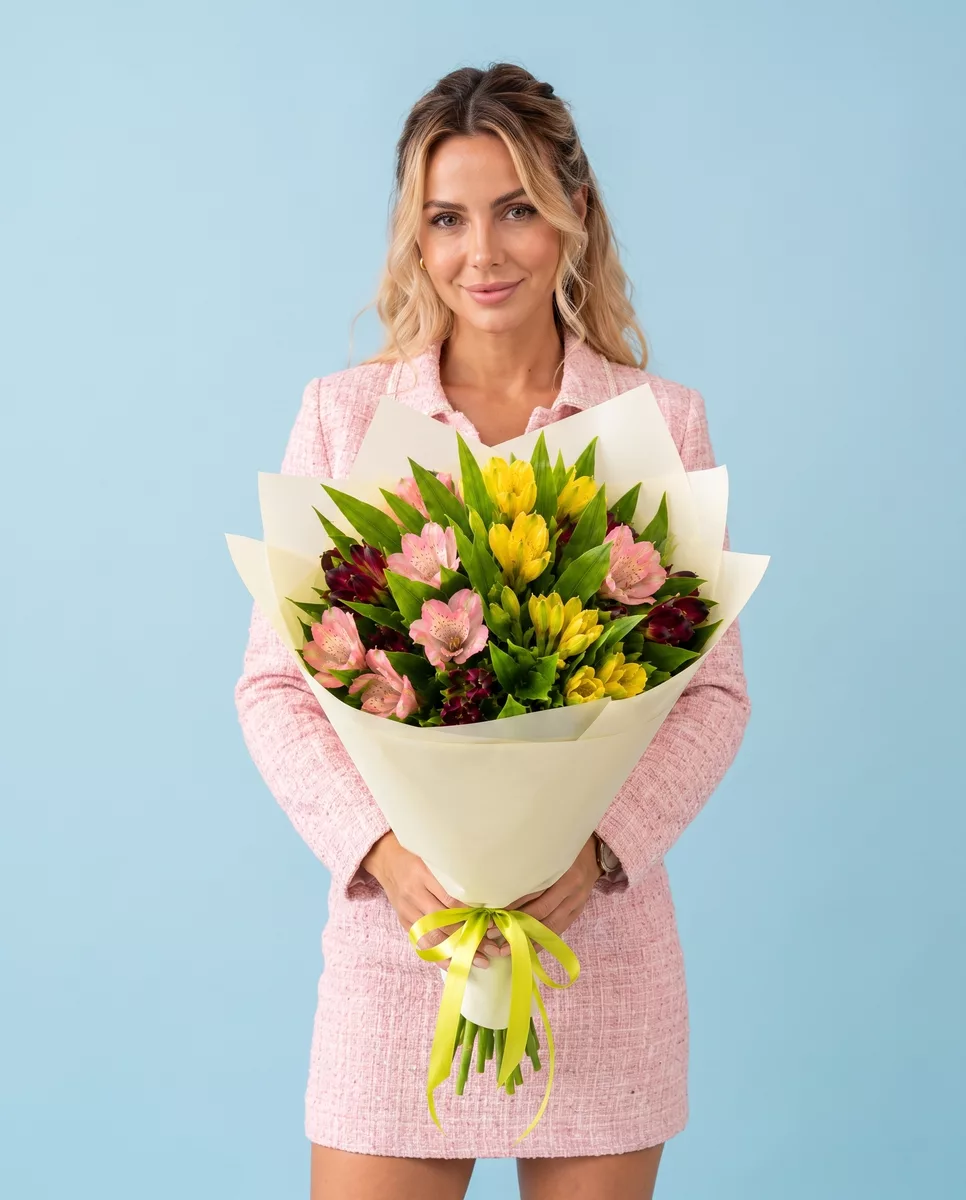
Mixed bouquets have grown significantly in popularity over the past decade, driven by social media, by the influence of European and South Korean floral aesthetics, and by a younger generation of buyers who shop online and care about visual texture. The segment where mixed arrangements now genuinely compete with mono-bouquets is the birthday gift for women aged twenty-five to forty-five, particularly in larger cities like Saint Petersburg and Moscow. A typical arrangement in this category might combine garden roses such as David Austin varieties with eucalyptus, lisianthus, and a few stems of scabiosa or astrantia — flowers that would have been nearly invisible in Russian shops ten years ago but are now stocked regularly. The key shift is that mixed bouquets are no longer seen as a budget compromise, which was their reputation for a long time. For decades, mixing species was what florists did when they needed to bulk out an order cheaply, combining carnations with filler greens to make a thin selection look fuller. Customers remember that, and some older buyers still associate mixed bouquets with exactly that kind of padding. Overcoming that association requires visible quality: the stems need to be premium, the palette needs to be controlled, and the proportions need to feel intentional rather than accidental. When those conditions are met, mixed bouquets sell extremely well for birthdays, for housewarming gifts, and for congratulations on professional achievements.
The March 8th Question: Tulips or a Spring Mix
International Women's Day on March 8th is the single largest flower-buying event in Russia, and it creates a reliable annual debate between mono-bouquets and mixed spring arrangements. The short answer is that tulips dominate, and they dominate by a wide margin. Buyers order tulips in quantities that strain supply chains across the country every late February and early March, and the preference is almost always for single-variety bunches: all white, all pink, all red, or a deliberate gradient of one color family. Mixing tulips with daffodils or hyacinths is something florists can do, and the result is often lovely, but it is not what most Russian buyers reach for on March 8th. There are practical reasons for this alongside the cultural ones. Tulips and daffodils have different water requirements and different stem-conditioning needs; daffodils release a sap that shortens the vase life of tulips placed alongside them unless the stems are pre-conditioned separately for several hours before being combined. Hyacinths are heavy-headed and need support. A mixed spring bouquet requires more preparation time and more careful handling at delivery. For a holiday when a shop might process hundreds of orders in a single day, the logistics of mixed spring arrangements become genuinely complicated. Buyers who want something beyond the standard tulip bunch for March 8th tend to choose ranunculus, which combines well with almost everything and holds up better in the temperature swings of a Russian late-winter delivery.
Roses: When One Variety Is Enough and When It Is Not
Roses occupy a category of their own in Russian flower culture, and the mono-versus-mixed question plays out differently here than with any other flower. A bouquet of a single rose variety — say, all Explorer roses in deep red, or all Mondial in cream — is considered complete and appropriate for almost any occasion. Adding a second rose variety creates what florists call a mixed rose bouquet, which is distinct from mixing roses with other species entirely. Russian buyers are generally comfortable with multi-variety rose bouquets as long as the palette stays coherent: two shades of pink, or a blend of cream and peach, reads as intentional. Mixing red roses with yellow roses in the same bouquet is something florists in Russia approach carefully, because the combination of red and yellow carries associations that vary by region and by the age of the recipient, and some older customers find it jarring. Mixing roses with other species — peonies, lisianthus, ranunculus — works well commercially and is popular for romantic occasions and anniversaries. The proportions matter: roses should remain the clear lead flower, with supporting species adding texture rather than competing for visual dominance. A bouquet where roses are buried under eucalyptus and cotton stems confuses Russian buyers who expect the primary flower to be visible and identifiable at a glance. Florists who work with this market learn quickly that transparency of structure — being able to see what is in the bouquet — is valued more here than in some other markets.
Corporate Orders and Professional Occasions: What Businesses Actually Request
Corporate flower orders in Russia follow their own logic, and it leans heavily toward mono-bouquets or very restrained mixed arrangements. When a company orders flowers for a partner's anniversary, for a presentation to a client, or for a business opening, the default request is almost always roses — usually in red or white — or a clean arrangement of white flowers such as eustoma, white chrysanthemums, or white roses combined. The reasoning given by corporate buyers, when they explain their thinking, is usually about legibility: a mono-bouquet or a white arrangement reads as formal and considered, while a colorful mixed bouquet can seem too casual or personal for a professional context. There are exceptions. Technology companies, creative agencies, and younger businesses in Saint Petersburg have started ordering more adventurous mixed arrangements, including flowers like protea, anthurium, and tropical foliage that would never appear in a traditional Russian corporate order. These orders are growing but still represent a minority. The practical issue with corporate flower delivery is timing: corporate recipients are often in meetings, and the bouquet may sit at a reception desk for an hour or two before it is collected. This makes stem durability a real consideration. Chrysanthemums and roses hold up well at room temperature for several hours. Ranunculus and sweet peas are more fragile and better suited to orders where someone will be home to receive them promptly. When placing a corporate order, specifying a delivery window matters more than most buyers realize.
What Younger Buyers in Russia Are Ordering Now
The purchasing patterns of buyers under thirty-five have shifted noticeably in the past five years, and the shift runs toward mixed bouquets with a specific aesthetic: loose, garden-style arrangements with a natural silhouette rather than a tight, structured form. This style, sometimes called a freestyle or botanical bouquet in Russian florist terminology, typically combines three to five species in a palette of two or three related colors. Popular combinations include peach garden roses with white lisianthus and dusty miller, or lavender spray roses with blue eryngium and soft green eucalyptus. These arrangements photograph well, which matters for a generation that shares gifts on social media, and they read as thoughtful and current rather than conventional. Younger buyers also tend to be more comfortable asking for specific flowers by name, which changes the conversation at the order stage. A customer who asks for a bouquet with ranunculus and anemones knows what they want and is less likely to default to whatever the florist suggests. This specificity is useful for florists because it reduces the chance of a mismatch, but it also means that availability matters more: ranunculus has a relatively short season, anemones are sensitive to heat, and a buyer who has their heart set on a particular flower needs to be told early if it is not available that day. For same-day delivery orders placed in summer, some spring flowers simply will not be in stock, and having a florist who can suggest a genuine equivalent — not just a substitute — makes a significant difference to the outcome.
Checking Your Order: What to Confirm Before You Confirm
Whether you are ordering a mono-bouquet or a mixed arrangement, there are several things worth confirming before the order is placed, and most customers skip them. The first is the stem count. A bouquet described as large can mean eleven stems or thirty-one stems depending on the shop and the flower, and in Russian gifting culture odd numbers are the convention for live flowers — even numbers are traditionally associated with mourning occasions and should be avoided for celebrations. The second thing to confirm is the color palette, especially for mixed bouquets. Asking the florist to describe the colors verbally, not just the species, prevents surprises: a bouquet described as containing roses, lisianthus, and eucalyptus could be deep burgundy and forest green or pale blush and silver-grey, and those are very different gifts. Third, confirm the delivery temperature window. Flowers delivered in summer in Saint Petersburg, when outdoor temperatures can reach twenty-five to thirty degrees Celsius, need to be transported in a cooled vehicle and handed over promptly. If the recipient is not home, the bouquet should not be left in direct sunlight. Asking whether the delivery includes a note about care instructions is a reasonable request and good florists will include one. Finally, if the recipient has any known preferences — a dislike of strong scents, for example, which rules out hyacinths and some lilies — mention it at the order stage rather than hoping the florist guesses correctly. These details are not excessive; they are the difference between a bouquet that lands well and one that misses.
The honest summary is that Russians prefer mono-bouquets for formal and high-stakes occasions, and are increasingly open to mixed arrangements for personal celebrations, especially among younger recipients in larger cities. Neither format is universally better. What matters is matching the bouquet to the occasion, the recipient's age and taste, and the practical realities of delivery timing and flower durability. A florist who knows the stock, knows the season, and asks the right questions at the order stage will steer you toward the right choice — and the right choice is the one that arrives in good condition and means something to the person who receives it. We deliver bouquets across Russia in 1–2 hours.
Frequently asked questions
Is it rude to give a mixed bouquet in Russia instead of a single-flower bunch?
Not rude, but context matters. For formal occasions, professional settings, or recipients over sixty, a mono-bouquet is safer and more conventional. For a birthday or a personal celebration for someone younger, a well-composed mixed arrangement is entirely appropriate and increasingly common. The key is that it should look intentional, not assembled from leftovers.
Why do Russian florists insist on odd numbers of flowers?
Odd numbers — eleven, fifteen, twenty-five, thirty-one — are the convention for gifts to living people in Russian culture. Even numbers are traditionally reserved for mourning occasions. Most buyers outside Russia are not aware of this, and it genuinely matters to many Russian recipients, so it is worth following the convention when ordering for delivery in Russia.
Which flowers hold up best if the recipient is not home when the bouquet arrives?
Roses, standard chrysanthemums, and alstroemeria tolerate a wait better than most flowers. Ranunculus, sweet peas, and anemones are more fragile and should only be ordered when someone will receive them promptly. In summer, any bouquet left in direct sunlight for more than thirty minutes will deteriorate quickly regardless of variety.
Can I request a specific color palette for a mixed bouquet when ordering online?
Yes, and you should. Specifying a palette — for example, white and soft green only, or shades of peach and coral — gives the florist the information needed to make a coherent arrangement. Without that instruction, the result depends entirely on what the florist judges to be appropriate, which may not match what you had in mind.
What is the most common mistake buyers make when ordering flowers for March 8th in Russia?
Ordering too late. Demand for tulips and roses in the days around International Women's Day is extremely high, and same-day delivery slots fill up fast. Placing your order two to three days in advance secures both the flowers and the delivery time. Buyers who order on March 7th in the evening frequently find that preferred varieties are already sold out.
Ready to send a bouquet?
Pick a city, choose the flowers, and we will hand them over with a photo confirmation.
Choose a city →